Broomstick vs Arm-Lock Putters: Setup and Equipment Rules to Check
Compare the way you hold it, the way it is built and the way you are allowed to use it.
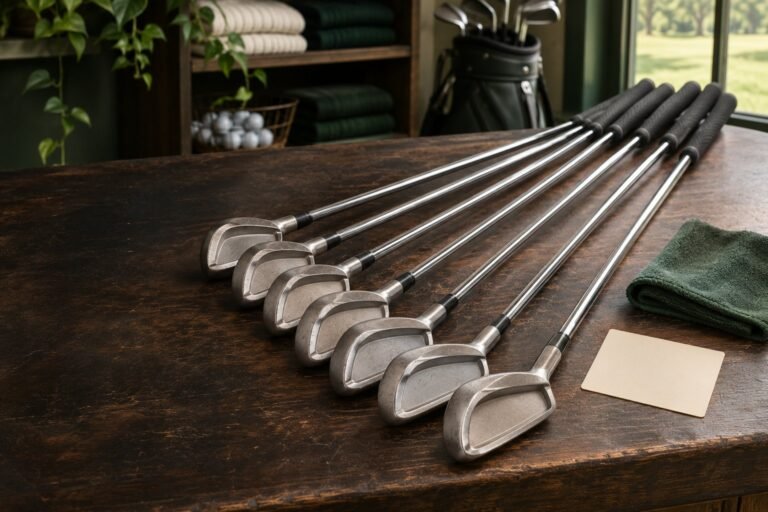
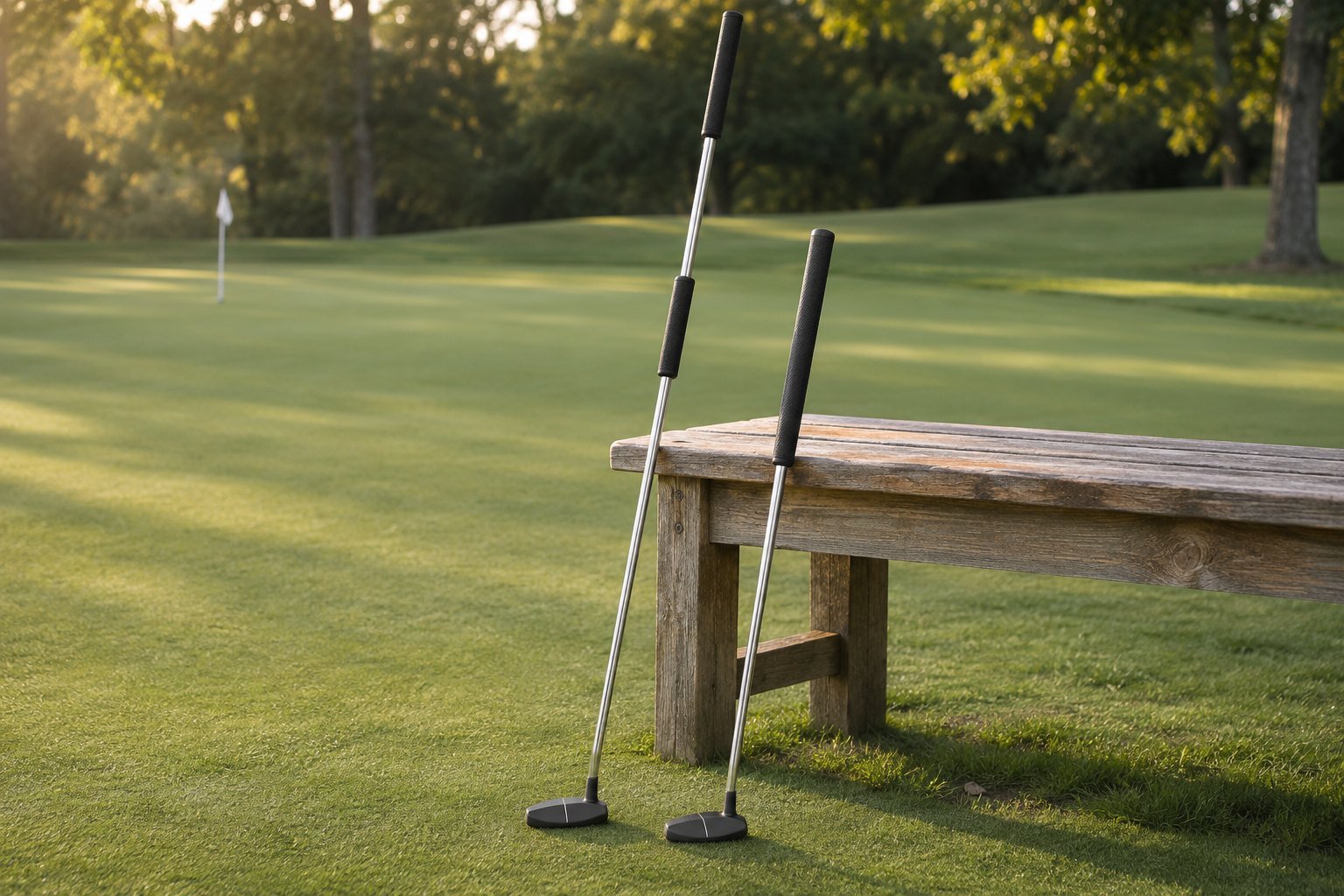
AI illustration of alternative putter types, not exact models or proof of equipment conformity.
Broomstick vs arm-lock putters involves two checks: the club’s construction and the stroke. Rule 10.1b addresses anchoring while making a stroke; it does not ban every long putter. [1]
Once that is clear, the choice becomes more practical: which arrangement can you set up comfortably, aim reliably and use for both short and long putts? This research-led comparison explains what to try and what to ask. It does not promise that either style will solve a putting problem or replace an individual fitting.
This guide contains affiliate links. If you buy through them, Taylor’s Trailblazing Golf may receive a commission at no extra cost to you.
The club’s construction and the way you make the stroke both matter.
Separated hands and forearm contact create different setup questions.
Record the grip, length, lie, loft and weighting of the trial club.
Compare both styles with the putter you already use.
Broomstick vs arm-lock putters: what changes?
The names describe putting systems, not just a head shape. L.A.B. Golf describes arm-lock with the grip resting along the lead forearm and a forward-leaning shaft arrangement. Its separate sweeper guidance deals with long-putter builds and a different hand arrangement. The details still depend on the golfer and model. [4] [5]
Scroll within the table to see every column.
| Question | Broomstick | Arm-lock |
|---|---|---|
| Where do the hands go? | Typically separated along the longer shaft. | The hold supports an extended grip against the forearm. |
| What should feel repeatable? | Upper-hand height, lower-hand position and your relationship to the ball. | Forearm contact, hand position and the intended shaft lean. |
| What needs particular attention? | Whether the whole setup is comfortable without bracing the upper hold against the body. | Whether the grip rests naturally below the elbow without forcing the wrist or posture. |
| What should you compare on the green? | Start direction, pace, setup repetition and room for the stroke. | The same tasks, including whether the contact arrangement remains comfortable. |
| What is the trade-off? | A substantially different hold and a longer club to manage. | A different forearm and shaft relationship to learn. |
The practical questions in the table are prompts for your own trial. They are not claims that one style is inherently more accurate. Do not choose from your height, handicap or a professional golfer’s preferred length alone.

Read the anchoring rule before changing your stroke
Direct contact and incidental contact are different
Holding the club or a gripping hand against the chest, stomach or chin during the stroke is prohibited direct anchoring. The hand-and-forearm exception does not extend to the upper arm: the rule defines the forearm as below the elbow, including the wrist. Mere touching without holding against the body is treated differently. [1]
A forearm can create an indirect anchor point
The R&A’s clarification explains the combination: a forearm is held against the body while separated hands work independently, allowing one hand to provide the stable point for the other to swing around. It also makes clear that forearm contact with the body is not automatically an anchor point in every arrangement. [2]
A jacket does not provide a way around the rule. Deliberately holding the club or gripping hand against clothing pressed to the body counts as body contact. [2] If you are uncertain, show the committee or a referee your actual stroke rather than asking for a ruling based only on the word “broomstick”.
Keep the ruling and the fitting separate
A comfortable setup still needs to satisfy the rules. An allowed arrangement still needs to suit you. Ask for help with each question from the appropriate person; a retailer’s description of a club does not settle every way it might be used.
Check the club’s construction as well as the stroke
These selected Equipment Rules checks matter particularly for long and modified putters. They are not a complete conformance assessment. [3]
Scroll within the table to see every column.
| Feature | Requirement to verify |
|---|---|
| Length | Putters are exempt from the 48-inch maximum applying to other clubs. |
| Shaft alignment | At least 10° from vertical in the toe-to-heel plane; certain designs require more. |
| Two separate grips | Both circular and aligned with the shaft, with at least 1.5 inches (38.1 mm) between them; upper grip at least 5 inches (127 mm) long. |
| Single non-circular grip | Must satisfy symmetry, no-concavity and generally similar cross-section requirements. |
Ask the manufacturer or a qualified builder about the exact club, especially if it has been altered. Photographs and a ruler cannot settle every construction question. Keep any confirmation with the build specification rather than relying on “the previous owner used it in competitions”.
Do not extend, bend or reconfigure an ordinary putter merely to imitate a photograph. Have any proposed conversion assessed before buying parts. A purpose-built option may be more sensible once compatibility, workmanship and the complete cost have been considered.

Fit the whole system, not a length label
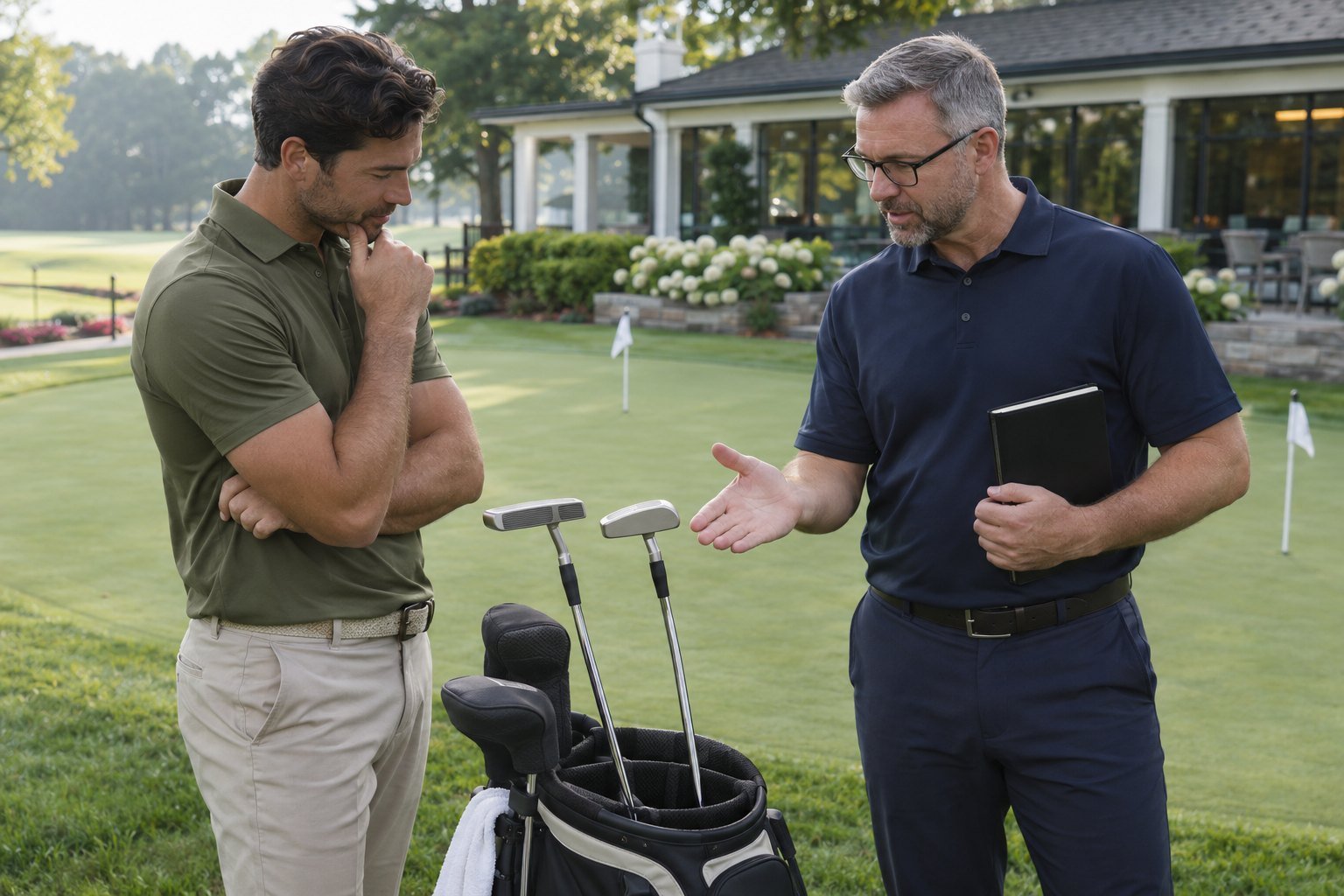
Before booking, confirm that the fitter offers both broomstick and arm-lock trial clubs in your handedness, with enough options to make the comparison useful. Bring your present putter and normal golf shoes to the appointment. Explain whether your goal is a more comfortable setup, easier aim, a different way to control the stroke, or simply an informed trial. Ask the fitter to demonstrate each arrangement before you judge it.
For arm-lock
Discuss the contact area on the forearm and the shaft position that goes with it. L.A.B.’s own explanation treats shaft lean and build geometry as part of the design, and notes that head weighting changes with its arm-lock lengths. This is why copying one length or adding a long grip is an incomplete specification. The manufacturer’s claims of improved consistency remain claims; they do not establish your result. [4]
For broomstick
Check that you can return to the chosen upper-hand position without reaching or hunching to accommodate the club. L.A.B.’s sweeper range uses dedicated builds, with some heads differing from their standard-length relatives. That is a useful reminder to ask which exact head, shaft, grip and weighting you are trying. [5]
For both, request the measured length, lie and loft, complete grip description and any planned alterations. Do not adopt a fixed loft simply because it is popular online. Ask the fitter to assess the club’s delivery and the ball’s launch in your actual arrangement.
If your original concern is the posture of a conventional putter, our putter-length setup guide can help you describe it. That home check does not supply a broomstick or arm-lock specification.
Back to the top ↑Compare the systems without rushing the result
Allow a sensible familiarisation period with each unfamiliar hold. A few awkward first strokes do not prove a style unsuitable, while a run of holed putts does not prove a lasting improvement. The aim is to learn enough to decide whether a longer trial is worthwhile.
Use this suggested comparison with a fitter or on a permitted practice green. Keep the balls and tasks consistent, record every attempt and take breaks. The sequence is our practical framework, not a validated fitting test.
- Begin with the current putter to establish what your normal setup and pace look like that day.
- Try the first alternative after the fitter has checked its setup. Use a short, nearly straight putt, then several longer putts to different stopping distances.
- Repeat the tasks with the second alternative. Reset your stance between attempts rather than rolling a pile of balls from one position.
- Return to the current putter. If time allows, change the order in another session so that one style does not always benefit from being last.
- Review start direction, stopping distances and comfort separately. Do not combine them into an unexplained “winner” score.
Scroll within the table to see every column.
| Observation | Current putter | Broomstick | Arm-lock |
|---|---|---|---|
| Exact trial build | Record it | Record it | Record it |
| Comfort and repeatable setup | Your notes | Your notes | Your notes |
| Start-direction pattern | All attempts | All attempts | All attempts |
| Long-putt stopping distances | Short / long notes | Short / long notes | Short / long notes |
| Question still unanswered | Write it down | Write it down | Write it down |
Use a plain note such as “comfortable but unfamiliar on longer putts” when that is what you observed. Leave uncertain results unresolved. If a position causes discomfort, stop; an equipment comparison is not a reason to tolerate it.
Check the exact configuration before shopping
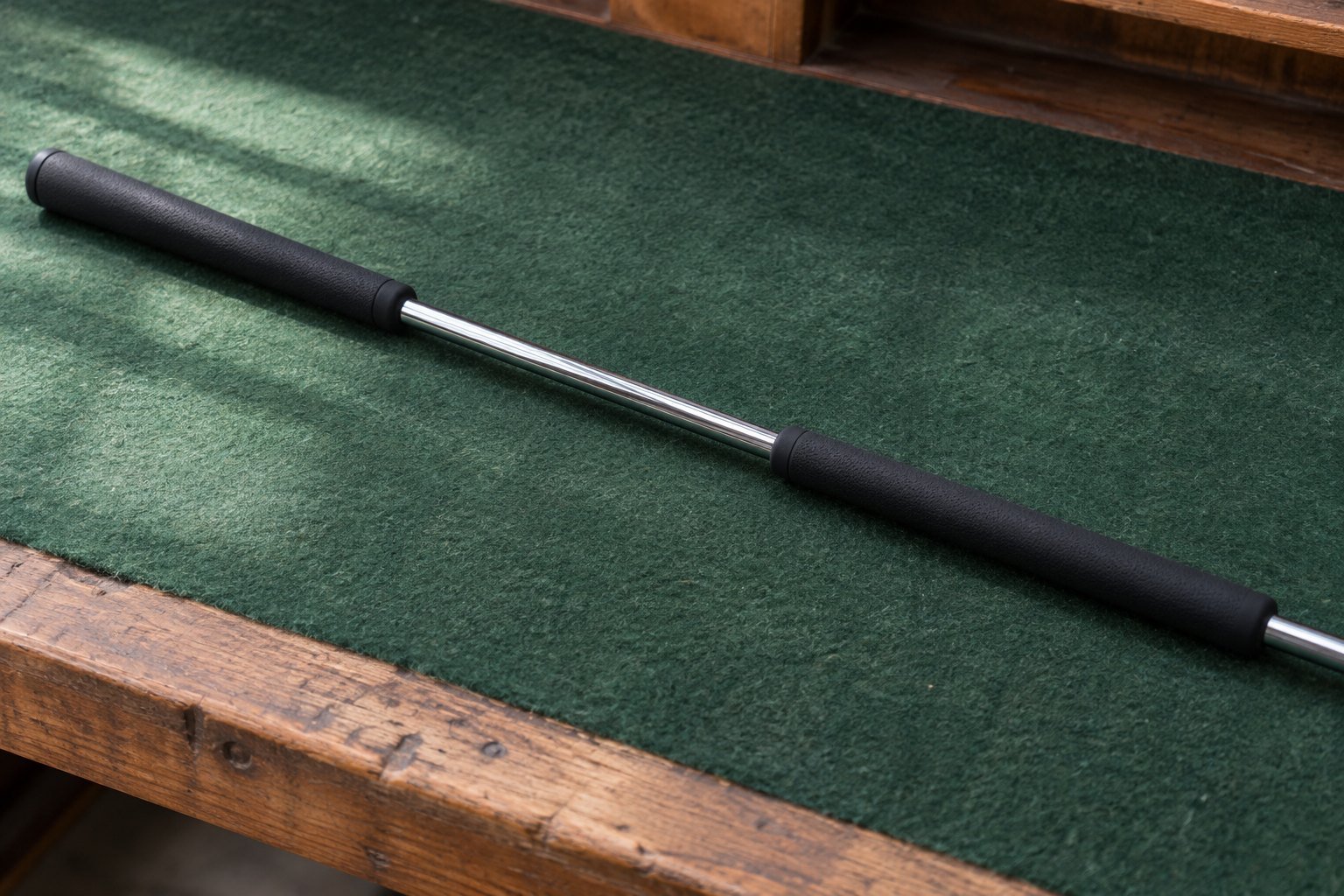
Similar names can conceal different builds. Odyssey’s UK page identifies the Ai-DUAL Square 2 Square MAX ½ Ball Cruiser Broomstick Center Shaft Putter as its broomstick configuration, with a two-piece broomstick grip and an SL 180 shaft. Those details help distinguish it from another putter sharing the same head-family name. They do not make it the right fit for every golfer. [6]
If that exact configuration is on your fitting shortlist, view the Odyssey broomstick model at Callaway UK. Confirm the selected handedness, dimensions, grip and order terms with the seller before paying. The page’s existence does not establish that your required option is available.
For a broader search across manufacturers, browse equipment at Clubhouse Golf. Treat retailer categories as a starting point: labels such as “long”, “Cruiser” and “counterbalanced” do not automatically describe an arm-lock or broomstick build. Ask to see the actual specification of the club you intend to order.
Compare the complete cost, including fitting, approved changes, delivery and any required grip. Use our guide to fitting fees to clarify what the session price includes. If an existing putter can be professionally adapted, obtain the full quote and compatibility assessment first. Do not assume a cheap extension produces the same outcome as the club that worked in the fitting.
Back to the top ↑Make a final check before competition
Use a short record while the details are fresh. It is easier to resolve a question before the event than while a playing partner is waiting for a ruling.
- Record the exact putter model, configuration and any subsequent modifications.
- Keep the manufacturer or builder’s response to any construction question.
- Ask the committee about an uncertain stroke arrangement, demonstrating the whole motion rather than a still photograph.
- Practise the arrangement in clothing you expect to wear, including a waterproof if relevant, so you know whether it changes the available space.
- Check the event’s requirements and obtain any individual ruling or applicable disability modification through the proper process.
Rule 10 points to specific Rule 25 modifications for certain players with disabilities. Check the relevant provision before assuming an exception applies. [1]
Do not use a between-putt adjustment as a competition experiment. The Rules limit deliberate changes to a club’s playing characteristics during a round. Settle your intended build and practice method in advance, and ask the committee about any uncertainty. [7]
Choose the system you can repeat comfortably
Give broomstick a serious trial if you want to explore a separated-hand arrangement and are prepared to learn a different way of controlling the club. Explore arm-lock if forearm contact feels promising and a fitter can create a comfortable complete build around it. In either case, judge what you can actually reproduce.
Keep the conventional putter if the alternatives offer no useful advantage or introduce compromises you do not want. A longer club does not remove the need to read the green, choose pace and practise. Nor does it need to be a last resort: curiosity is a reasonable reason to arrange a trial.
The strongest next step is a fitting appointment that offers the styles you want to compare, followed by a clear written specification and enough practice to judge it fairly. Buy the exact configuration that earns your confidence, with any rules question resolved before competition.
Back to the top ↑Sources and research
Research reviewed on 23 November 2026. Manufacturer descriptions, official guidance and retailer information are distinguished from the suggested comparisons and editorial recommendations in this guide.
- The R&A — Rule 10.1b: Anchoring the ClubCurrent rule and links to relevant Rule 25 modifications; checked 23 November 2026.
- The R&A — Rule 10 Clarifications, 10.1b/1 and 10.1b/2Official clarification text on forearm anchor points and clothing; checked 23 November 2026.
- The R&A — Equipment Rules, Part 2: Conformance of ClubsSections on length, alignment and grips; checked 23 November 2026.
- L.A.B. Golf — ArmLock Putters and Lie Angle BalanceManufacturer explanation of arm-lock setup and its own builds; checked 23 November 2026.
- L.A.B. Golf — Sweepers and Lie Angle BalanceManufacturer description of dedicated long-putter builds; checked 23 November 2026.
- Odyssey UK — Ai-DUAL Square 2 Square MAX ½ Ball Cruiser Broomstick Center Shaft PutterExact model description, grip and shaft checked 23 November 2026; confirm the selected order configuration.
- The R&A — Rule 4.1a: Clubs Allowed in Making a StrokeDeliberate changes to playing characteristics during a round; checked 23 November 2026.
Find more equipment guidance in Irons, Wedges & Putters.
Illustrations in this article were created for Taylor’s Trailblazing Golf. Third-party photographs, where used, are credited beside the image or in the source list.