
Putter Alignment Aids: Which Markings Are Useful to Compare?
Find the markings that make sense from your stance, then check what happens to the ball.
AI-generated illustration of a generic putter at address.
Putter alignment aids give your eyes something to work with: a small dot, a long line, a pair of rails or a contrasting block behind the ball. The useful marking is the one that helps you settle the face towards your chosen starting direction without repeatedly changing your mind.
That is a more useful buying question than asking which pattern looks most technical. A confident address position, the direction the ball starts and its finishing position are different observations. This research-led guide explains how to compare them, with a simple practice record you can take to a fitting. It does not report personal product testing.
Ad – includes affiliate links. Taylor’s Trailblazing Golf may earn a commission from qualifying purchases. Our recommendations follow the reader’s needs and the available evidence. Read our disclosure.
Start with the view
Compare markings from your own comfortable stance.
Separate the checks
A clear view, measured aim and ball start answer different questions.
Keep a fair comparison
Record the complete club and repeat the trial order.
Keep what works
A more elaborate sight line is not a compulsory upgrade.
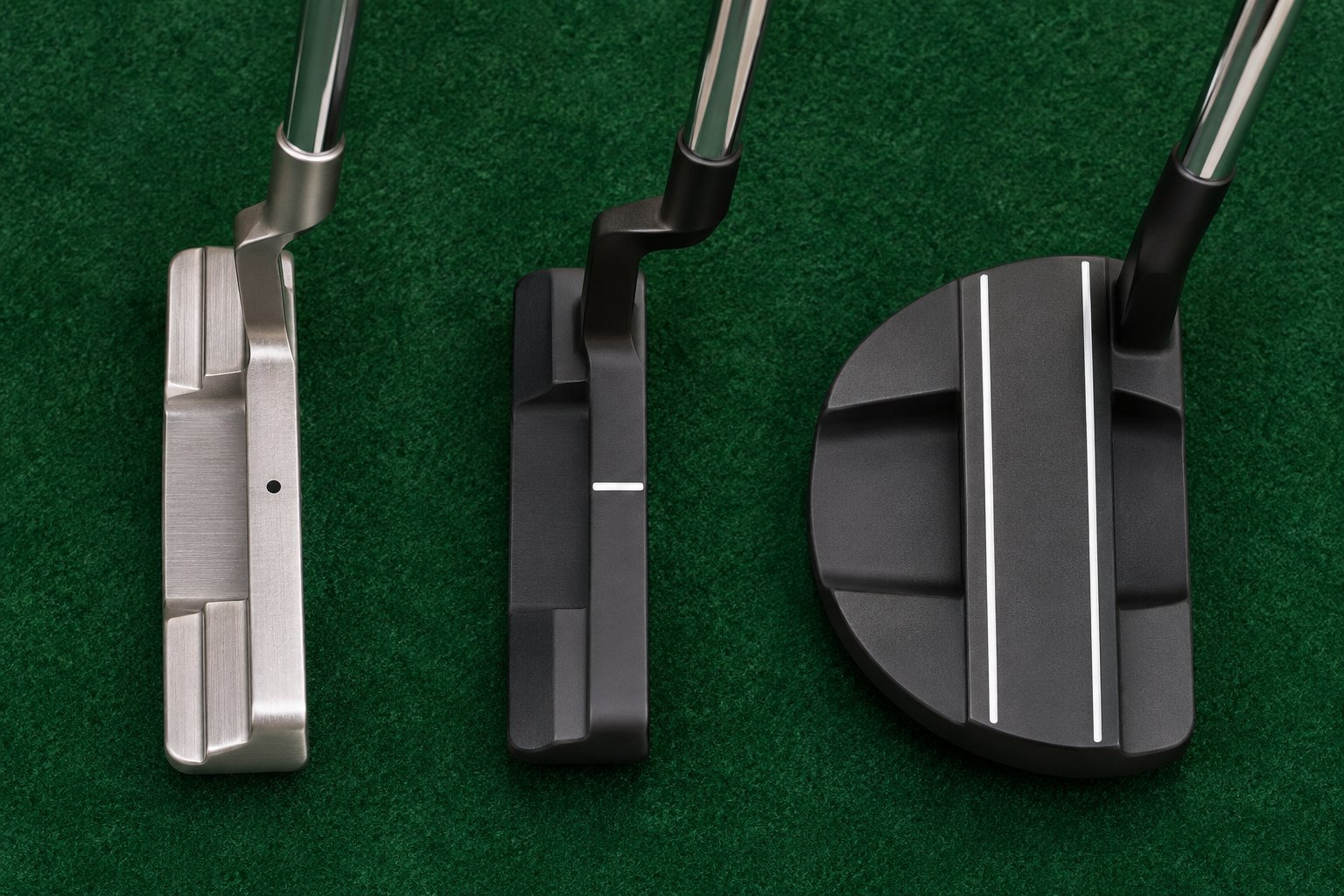
Putter alignment aids: what each marking helps you compare
Start by looking at the direction of the cue. A line running from the face towards the back of the head offers a reference along the intended starting line. The straight top edge of the face offers a reference across it. Some golfers find one view easier to use than the other; the purpose of a trial is to discover your own preference.
Swipe or scroll the table to see all columns.
| Marking | What to look at | Useful comparison question | Possible drawback |
|---|---|---|---|
| Dot or short line | A small reference near the middle of the face | Can I centre the ball and judge the face edge without extra detail? | Offers little visual extension towards the target |
| Long single line | A direction cue extending behind the face | Does the line appear to continue towards my chosen start point? | May compete with a ball line or other edges |
| Parallel rails or ball-width marks | A channel or frame around the ball | Do I place the ball centrally without searching for the middle? | A crowded design may draw attention away from the face |
| Ball-shaped circles or discs | A sequence of round shapes behind the ball | Is the apparent continuation of the ball easier to organise than thin lines? | Usually comes with a larger head shape, changing more than the markings |
| Contrasting bands or face edge | A broad boundary across the head | Can I judge the face’s orientation more easily from this edge? | Lighting, finish and the surrounding head shape can affect the view |
These are comparison prompts, not player categories. There is no need to decide that you are a “line person” for life. A different putter length, head shape or setup can change what you see.
Separate the view, the aim and the result
A putter can look square to you while its face points away from the chosen starting direction. Science & Motion explains that perceived direction can be affected by setup, including distance from the ball and head position. Its guidance treats visual perception as something to check, rather than assuming that a convincing view proves accurate aim.[1]
There are three useful questions. Does the marking look clear? Where is the face actually aimed before the stroke? What happens when you strike the ball? A fitting system can examine address aim, face angle at impact and stroke path separately; the SAM PuttLab reporting manual describes those as distinct measurements.[2]
A holed putt is useful feedback, but an incomplete diagnosis
When a ball goes in, you have observed a successful combination of read, starting direction and pace. You have not isolated the effect of the sight line. Likewise, a miss is not enough to blame the marking. Keep the first few centimetres of ball travel separate from the final result in your notes.
A home video can help you describe your routine, but an oblique camera angle cannot reliably certify a face angle to a fraction of a degree. If you want that measurement, ask how a fitter establishes and calibrates the target line.
Recognise the idea behind named alignment systems
Manufacturer examples are useful for understanding the visual choices. They do not establish which putter will work best for you.
- PING describes the Scottsdale TEC Hayden as combining a long alignment line with a small dot on the top rail. That gives you a focal point near the face as well as a longer reference behind it.[3]
- The Scottsdale TEC Ketsch 4 combines a long line with two shorter ball-width lines. It is a useful example of direction and framing cues in the same head.[4]
- Callaway’s Triple Track explanation describes the use of three lines on Odyssey putters and attributes the design to Vernier hyperacuity. That is the maker’s explanation of its alignment concept, not proof that three lines suit every golfer.[5]
- Odyssey’s White Hot Versa information describes black-and-white contrast as a way of highlighting face orientation. Its visual emphasis differs from simply extending a thin line behind the ball.[6]
Read those names as clues about what to compare. Avoid importing a brand’s performance promise into your own expectations. Also check the complete model: a different neck, offset, length or head can change the address view even when the alignment branding is the same.
To explore the maker’s available equipment, you can Browse golf clubs at Callaway UK. This opens the wider club range; check the specific putter and its address markings before choosing.
If the Ketsch 4’s combination of line and ball-width frame interests you, View the Ketsch 4 at Clubhouse Golf. The checked listing is labelled right-handed; confirm the exact length and build before ordering.[7] Its markings alone are not a reason to buy.
Make the comparison from your normal setup
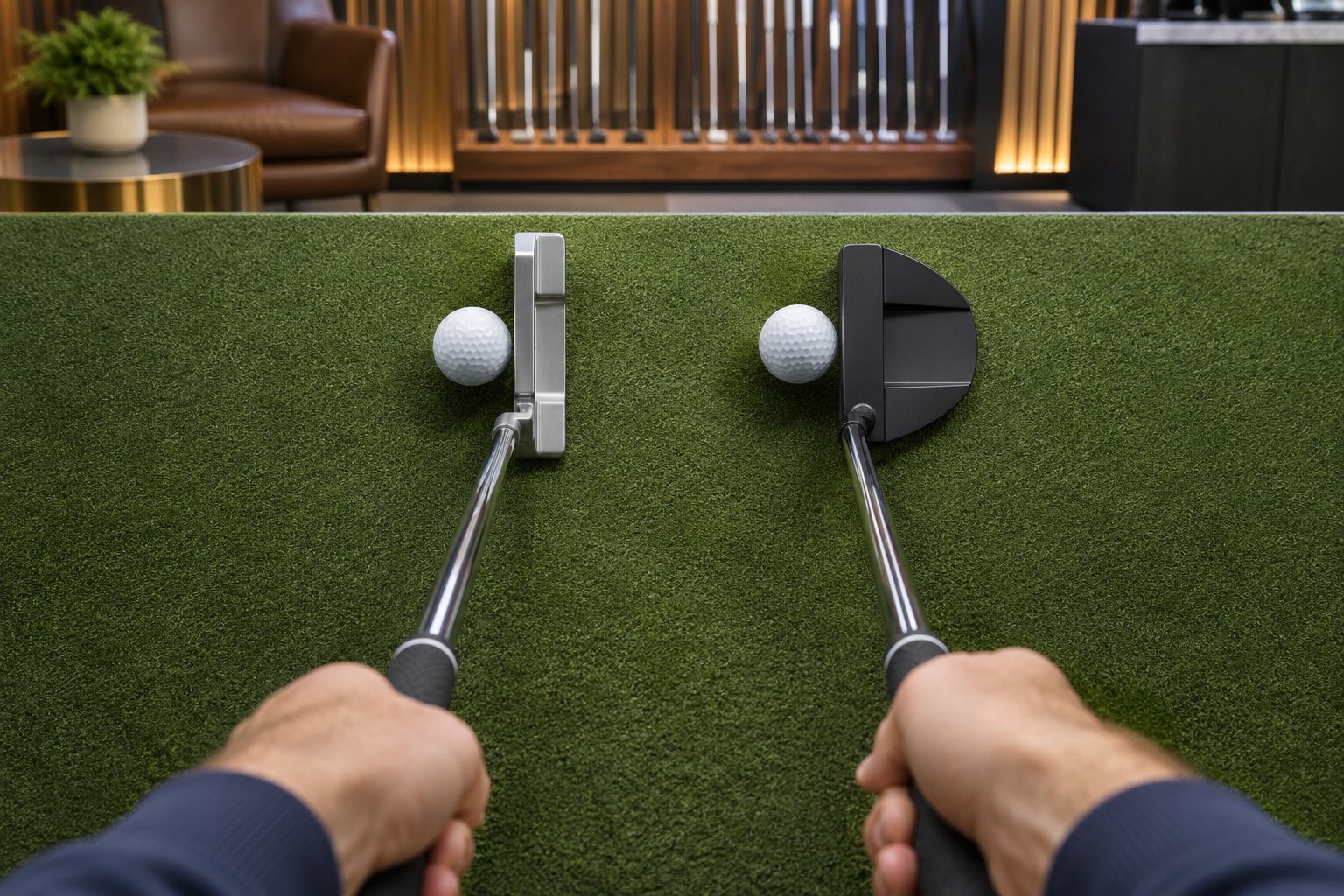
A product photograph shows the club from the photographer’s position. Your eyes are beside and above the ball, with a shaft, hands and some of the head in view. Try the markings from the stance you can comfortably repeat, in your usual golf shoes.
Begin with your current putter. Set it down normally, step away, and repeat. Notice whether you repeatedly move closer, raise the handle or change your head position to make the line look right. Those observations are useful fitting questions; they are not an instruction to force your eyes directly over the ball.
Our putter-length home setup check can help you describe an awkward reach before you compare new alignment patterns. If the trial putter is a different length, record that difference instead of attributing every change to its markings.
Look in more than one light
Check a light head against both shaded and sunlit grass when practical. On a shop mat, notice whether overhead lighting produces a reflection across the cue you want to use. Do not assume that bright white, polished steel or a dark finish will be easiest for everyone. The relevant question is whether you can still see the intended reference clearly.

A short comparison session you can repeat
This is a suggested way to organise a trial, not a validated fitting test. Choose your current putter and one candidate. Use the same balls, the same short putt and the same routine. If the clubs differ in length, grip or head construction, write that down: you are comparing complete putters, not conducting an isolated experiment on paintwork.
- Choose a quiet, nearly level practice area where putting is permitted. Establish a clear start direction with a fitter or a straight practice reference. Keep markers outside the stroke and ball path.
- Make five separate setups with each putter, stepping away between attempts. Record whether the view is clear immediately or whether you repeatedly re-aim. Do this before scoring any holed putts.
- Roll five putts with your current club, then five with the candidate. Note obvious initial left or right starts and any repeated pace problem. Avoid “correcting” the next stroke just to rescue the score.
- Repeat in the opposite order after a short break. This gives the familiar and unfamiliar clubs a fairer share of your fresh attention.
- Try several longer putts. A visually reassuring head still needs to feel manageable when pace matters more.
A small practice gate can make early starting direction easier to observe. Science & Motion describes using a gate on a straight putt to check perception.[1] For this comparison, have its alignment checked and use a generous opening initially. A gate hit can reflect aim, delivery or the gate setup; it does not diagnose the cause on its own. These are practice checks, to be removed when the session is finished.
Swipe or scroll the table to see all columns.
| Observation | Record | Why it matters |
|---|---|---|
| Exact build | Model, neck, length, grip and ball used | Prevents a fitting change being mistaken for a marking change |
| Five fresh setups | How many felt clear immediately; any repeated re-aiming | Captures visual usability separately from the stroke |
| Short-putt starts | Left, right or through the intended start area | Shows a pattern worth discussing, without claiming a precise face angle |
| Long-putt pace | Short/long tendency and unusually wide finishing spread | Checks that the preferred look has not distracted you from distance |
| Repeat visit | Whether the same preference returns on another day | Reduces the influence of a lucky run or first impressions |
Do not turn ten or twenty putts into a percentage claim that one marking is better. A small sample is useful for narrowing choices and preparing questions. Repeatability across sessions matters more than a single winning streak.

Decide how the putter works with a line on the ball
If you already use a line on the ball, compare the complete view with that line in place. Ask whether the ball and putter references appear to agree from your normal address position. If they seem to point in different directions, do not assume that either one is automatically wrong. Recheck the selected start direction and your viewing position.
Try the ball’s plain side as a separate comparison if that is comfortable. Change only this part of the routine, using the same putter and practice position. You may find that two strong sets of lines feel reassuring, or that they encourage unnecessary adjustment. Record the effect instead of copying someone else’s preference.
There is no need to buy specially marked balls before establishing whether you like a ball line at all. First find out whether the extra reference helps your routine.
Keep, compare again or book a fitting?
Swipe or scroll the table to see all columns.
| What you notice | Useful next step | Avoid jumping to |
|---|---|---|
| Current marking is clear and repeatable | Keep it while you investigate any separate pace or green-reading issue | Buying a more complex pattern because it is newer |
| Candidate is easier to settle, with no obvious drawback | Repeat the trial outdoors and check the full specification | Promising yourself fewer putts from one session |
| Face looks square but starts repeatedly disagree | Ask for separate address-aim and impact measurements | Bending the putter or repainting its lines to hide the pattern |
| Preference changes when stance or length changes | Resolve the complete setup with a fitter first | Labelling the sight line as the sole cause |
At a fitting, ask which view helps you aim consistently and whether that address aim carries through to impact. Ask to see several putts, including the spread of results, rather than one best stroke. Take your current putter along: a recommendation to keep it is a useful outcome.
My recommendation
Begin with three visibly different approaches: a quiet dot or short line, a longer direction cue and a broader frame or contrasting edge. Narrow them down from your own stance, then compare the complete clubs. Buy only when the easier view survives a repeat trial and the rest of the putter suits you. If the evidence is mixed, keep the current club and spend the next session understanding the uncertainty.
Sources and research notes
Research checked on 23 November 2026. Manufacturer pages establish the described features, not personal performance. Older documents below are used for the stated design or measurement principles. No hands-on tests or player results are claimed.
- Science & Motion: The Importance of Aim in Putting & Putter Fitting (22 November 2023). Setup, perception and practice-gate guidance.
- SAM PuttLab Reports Manual, version 5 (October 2013), pages 11–15. Definitions of address aim, impact face angle and path; not a current software specification.
- PING: Scottsdale TEC Hayden. Official description of its dot and long alignment line.
- PING: Scottsdale TEC Ketsch 4. Long and ball-width alignment lines.
- Callaway: We Took Triple Track Technology To The Next Level (13 May 2020). Manufacturer explanation of its putter alignment concept.
- Odyssey: White Hot Versa. Manufacturer description of black-and-white contrast. European design information; no UK price or availability claim.
- Clubhouse Golf: PING Scottsdale TEC Ketsch 4. UK retailer listing, labelled right-handed. Recheck the chosen build and current terms before purchase.
Illustrations in this article were created for Taylor’s Trailblazing Golf. Third-party photographs, where used, are credited beside the image or in the source list.