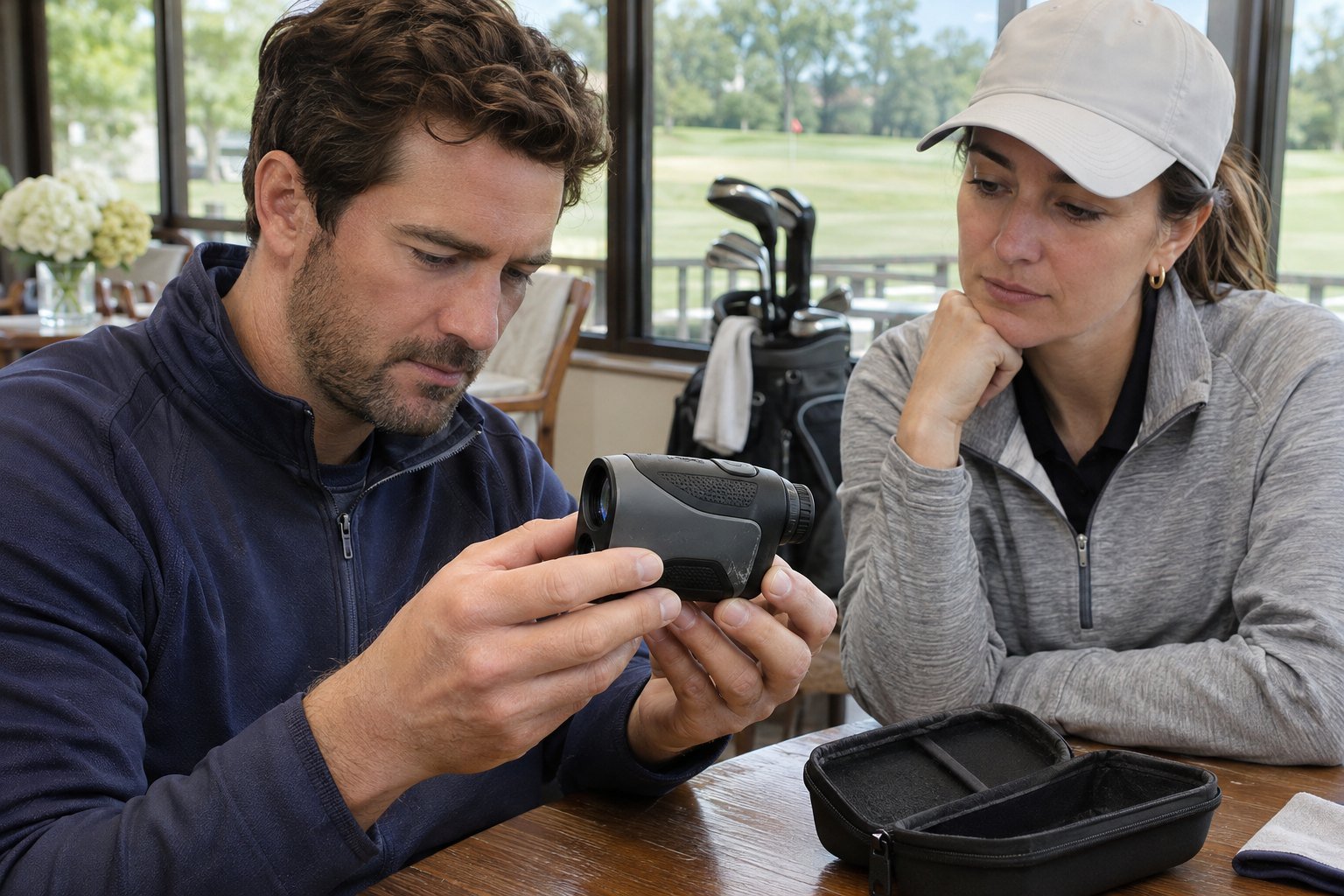
Buying a Used Golf Laser Rangefinder: Optics and Buttons
Read the display, check the controls and leave unresolved faults out of your bargain calculation.
Inspect the actual instrument and its response, not only the listing photographs. Generic AI illustration, not a tested product.
Buying a used golf laser rangefinder is easier when you separate a worn outer case from a device that cannot give you a dependable, readable result. Start with the exact model, then check its optics, buttons, distance units and battery compartment. Finally, decide what the seller has actually demonstrated and what remains uncertain.
This researched guide uses the Bushnell Tour V6 family as a specific manual example, not as a claim that every laser works the same way. The images illustrate generic equipment; they do not document tests of the named model.
Ad – includes affiliate links. If you buy through these links, Taylor’s Trailblazing Golf may earn a commission. Recommendations are based on the equipment decision and the available evidence.
Clear identity, usable optics, responsive controls and written terms justify a price comparison, not a claim of laboratory accuracy.
An unknown mode, missing part or claimed flat battery needs a demonstration or an exact replacement quotation.
An unresolved internal fault or refusal to demonstrate the device leaves too much of the purchase dependent on guesswork.
Buying a used golf laser rangefinder starts with its identity
Request fresh photographs of the model label, both optical ends, the controls and the battery door. Ask for the original receipt if available, what is included, and whether the unit has been dropped, wet inside, repaired or opened. A familiar case or a copied product description does not identify the instrument inside it.
Match the actual label and button layout to the maker’s manual. For example, Bushnell’s shared Tour V6 manual distinguishes the standard model from the Tour V6 Shift: slope-adjusted information belongs to the Shift version. A seller’s short description saying “V6” leaves that distinction unresolved. [1]
Keep the advertisement and the seller’s answers together. Record seller status, model, serial details supplied privately, asking price, delivery, included accessories and any stated faults. This becomes the reference if the parcel contains a different version or an omitted part.
A useful remote demonstration shows the actual instrument, its controls and its response in one continuous clip. It can reduce uncertainty about identity and operation, but it cannot reproduce the view you will get through the eyepiece.
Check the view as well as the outside glass
Use ordinary indirect light to inspect the outer optical surfaces and casing. Look for chips, obvious scratches, loose surrounds, separation at seams and signs of impact. Ask whether a visible mark is on the outside or appears within the view. Do not accept a confident diagnosis from a photograph alone.
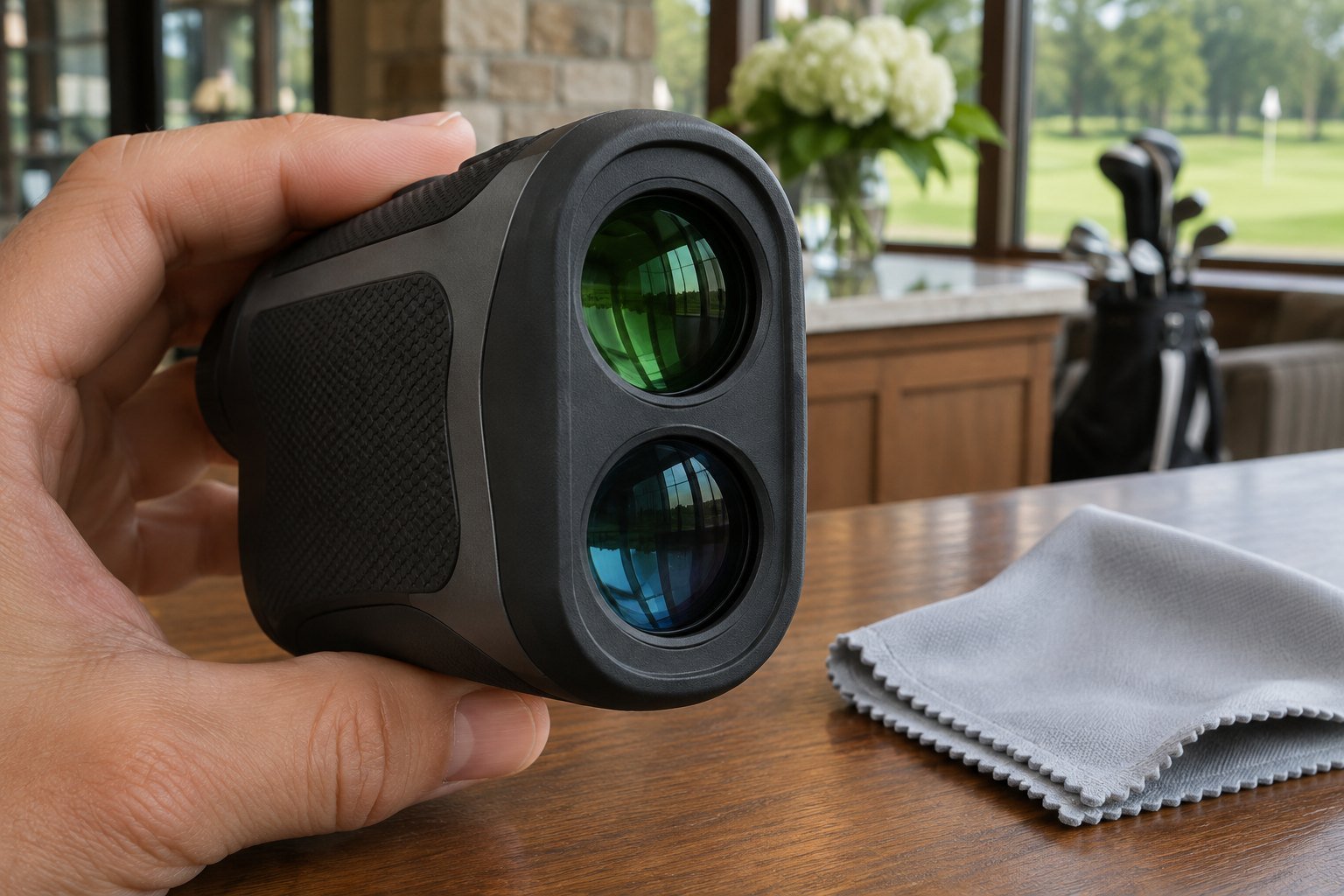
Look through the instrument yourself where possible, using the glasses you normally wear for golf. Adjust the eyepiece as the exact manual directs. Check whether the target and the displayed numbers are usable for you. A seller being able to focus it does not settle your own ability to read it comfortably.
Compare several displayed distances so different digits appear. Missing segments, a persistent dark patch or internal haze should remain an unresolved fault until the maker or a qualified service provider assesses it. Do not assume every mark is harmless dust or that cleaning the outside will solve it.
If dust is preventing inspection, let the seller follow the maker’s lens-care instructions. Avoid an improvised polishing experiment during a purchase inspection. You are deciding whether to buy an instrument, not trying to restore its optics at the viewing.
Back to top ↑Make each advertised control do its job
Wake the display several times, make ordinary measurements and operate the accessible controls without force. Notice sticking, delayed responses or a button that only works at an awkward angle. Check the eyepiece adjustment and any advertised vibration or visible target feedback.
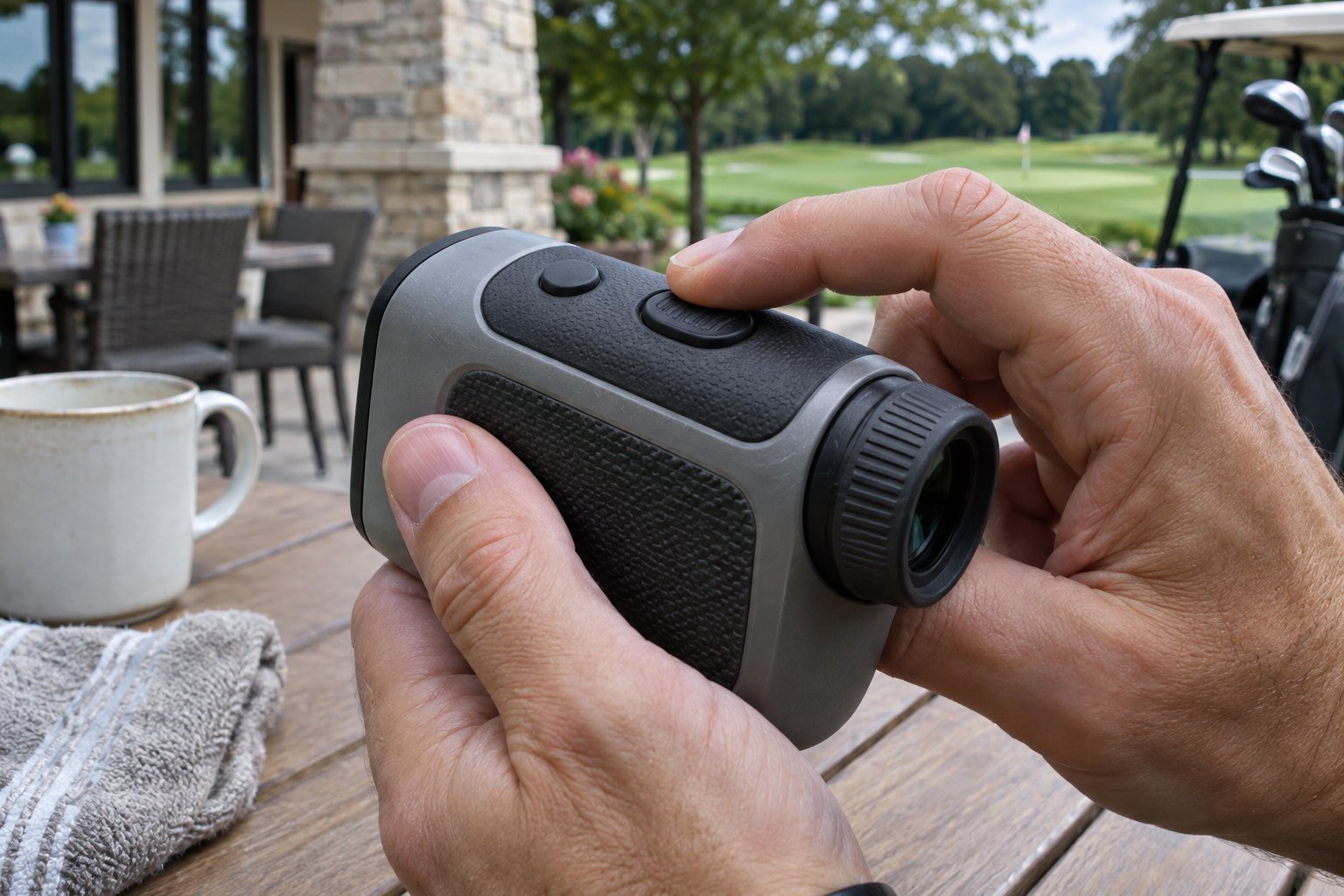
Have the seller show the yard or metre indicator, then return the unit to your preferred setting. Follow the manual for that button layout rather than a remembered shortcut from another model. On the Tour V6 family, the manual identifies distance units and a line-of-sight distance separately from the Shift model’s extra slope information. [1]
A different unit or display mode can explain apparently conflicting numbers. Resolve that before judging the device. If slope matters to your choice, the slope versus non-slope rangefinder guide explains what that feature is intended to add.
Do not treat a vibration alone as proof that you measured the intended flag. Bushnell’s manual includes a JOLT demonstration during unit selection, without ranging a target. Feedback and a successful distance measurement are therefore separate things to check. [1]
Back to top ↑Check repeatability without calling it calibration
With permission and a clear, empty target area, choose one distinct stationary object. Stay in the same place, use the same units and mode, and take three separate readings of the same part of that object. Record all three, including a failed attempt. Keep the instrument away from direct sun and never use people as targets.

Then try a second obvious object at a different distance. This checks that the display changes and the device responds to a new target. Remain within the exact model’s operating limits: the Tour V6 instructions specify a target at least five yards away. [1]
Large unexplained jumps deserve another controlled attempt after checking aim, units and the battery. A nearby branch or background object may mean you have changed the thing being measured. If you cannot obtain a convincing demonstration, leave the fault unresolved rather than negotiating as though it has been diagnosed.
Closely grouped readings establish only repeatability in that check. They do not prove the true distance, performance in rain or the maker’s accuracy specification. Another consumer rangefinder is a comparison device, not a calibration certificate.
The standard Tour V6 does not need a phone app for ranging, according to Bushnell’s support page. A seller’s phone or account is therefore not a substitute for demonstrating the unit itself. Other models need their own check. [2]
Back to top ↑Inspect user-accessible parts and confirm support
Only open a compartment the manual identifies as user-accessible. Look without probing for residue, leakage, damaged threads, a missing cover or a seal that does not sit as intended. Do not scrape contacts, force a cap or open the main housing to investigate a fault.
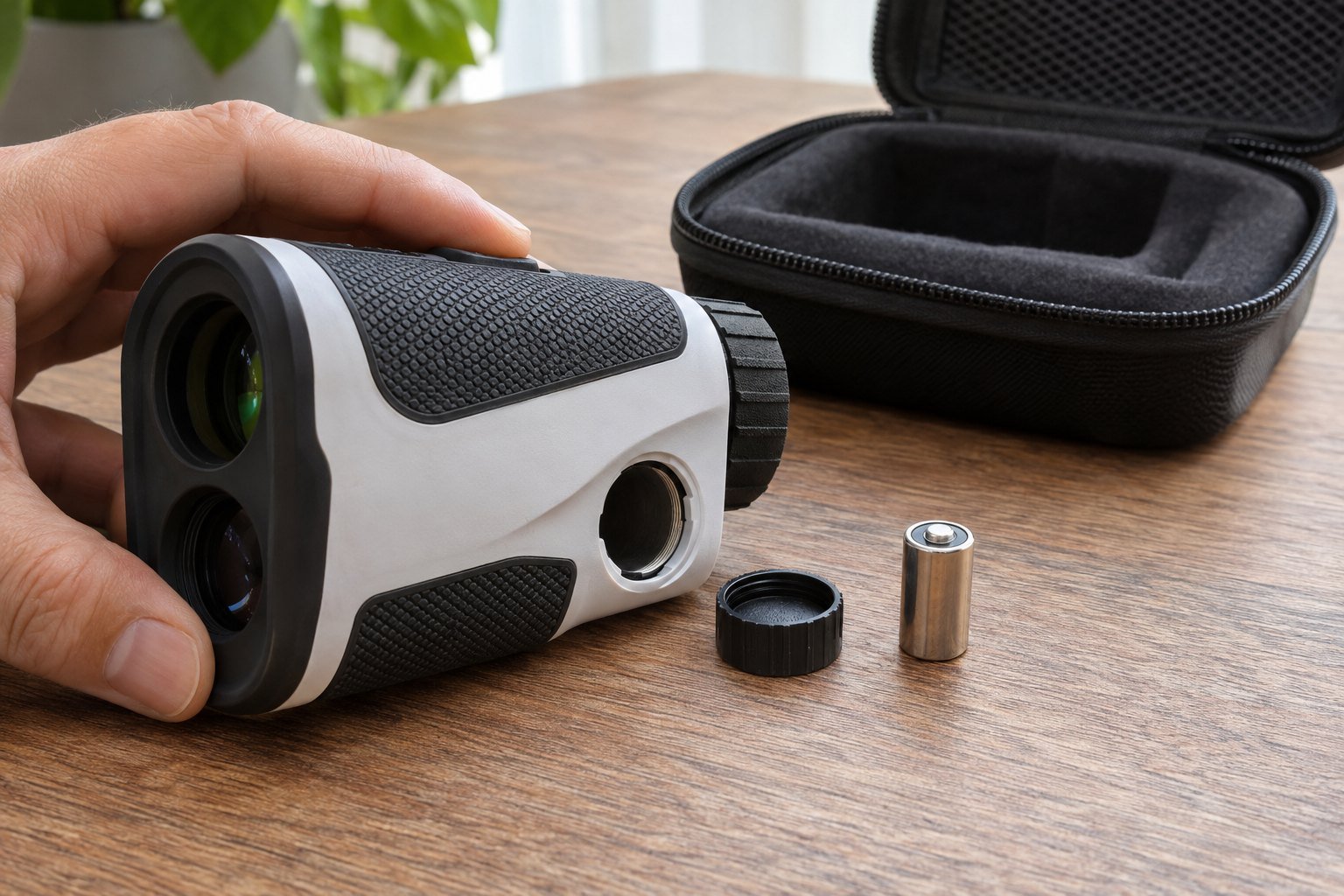
The Tour V6 manual specifies a CR2 three-volt lithium battery and warns against using damaged cells or disassembling the rangefinder. That is a model-specific requirement, not permission to put a similar-looking cell into another device. Follow the exact battery type and polarity instructions. [1]
If the seller blames a flat battery, ask them to demonstrate the unit with the correct replacement. Do not pay on the assumption that a cheap cell must cure a blank display. Stop the inspection if a battery is damaged, leaking or unusually hot; do not improvise a repair.
For a missing cover or eyecup, obtain the exact compatible part, availability and delivered price before buying. Ask the UK service contact whether the serial number and original receipt establish any remaining cover for a second owner. Bushnell’s published warranty has exclusions, including unauthorised repair and water damage; it is not evidence that this particular UK used purchase is covered. [3]
Back to top ↑A completed accept, ask or walk-away record
The following entries are fictional examples of how to record a decision. They are not listings, test results or assessments of real devices.
On a phone, swipe within the table to see all columns.
| Example | Evidence recorded | Decision and next action |
|---|---|---|
| A: complete demonstration | Model confirmed; display readable; controls respond; repeated readings stay close on the chosen target; written sale and fault-return terms supplied. | Accept as a candidate for purchase. Compare the total cost; do not describe it as calibrated or assume a transferable warranty. |
| B: “just needs a battery” | Exterior appears tidy, but display intermittently goes blank. No demonstration with the specified replacement battery. | Ask for that demonstration before paying. If the seller cannot resolve it, pass rather than price it as a battery-only fault. |
| C: unexplained internal condition | Persistent internal haze and an admission that the casing was opened. No service diagnosis or repair quotation. | Walk away. A low asking price does not make speculative internal repair an ordinary maintenance task. |
Use the same three columns for your own viewing. Write observations such as “display stayed blank twice”, rather than conclusions such as “battery fault”. The distinction stops an optimistic explanation becoming the basis of your offer.
Back to top ↑Compare the saving with the terms you actually have
Establish whether the seller is a business or a private individual. MoneyHelper explains that second-hand rights depend on this distinction; do not assume a private sale has the cancellation rights of a trader sale. Save the description and any specific return promise. [5]
For most online consumer purchases from a UK trader, GOV.UK describes a 14-day period after receipt to notify cancellation, followed by another 14 days to return the goods. Excessive handling can affect the refund. That is not permission to play several rounds and then treat a used device as unchanged. In-person change-of-mind returns depend on the seller’s policy; faulty-goods rights are a separate issue. [4]
Calculate asking price plus delivery, a necessary battery and confirmed parts or service. Keep an unquoted repair as “unknown”, not £0. Compare that figure with a suitable new alternative and its own terms, rather than with the used seller’s claimed original retail price.
On 24 November 2026, Clubhouse Golf listed the standard black Bushnell Tour V6, product code RFBUS065, at £249. This is a new-device comparison point, not a used offer or a promise of a future price. [6] Check the standard Tour V6 at Clubhouse Golf.
Illustrative budget: £155 asking price + £8 delivery + a £6 battery allowance = £169 before any service or missing parts. Against the dated £249 new example, that leaves £80. All three used-purchase inputs are hypothetical. If a repair remains unquoted, the saving is still incomplete.
Buy only when the evidence, usable display and agreed terms make the total acceptable to you. If the condition cannot be explained, another listing is a more useful next step than a larger discount on an unknown fault.
Back to top ↑Sources and checks
Research and specifications checked on 24 November 2026. Manufacturer descriptions are identified in the text; practical checklists and worked examples are editorial guidance, not product testing.
Illustrations in this article were created for Taylor’s Trailblazing Golf. Third-party photographs, where used, are credited beside the image or in the source list.