Cart Bag Compatibility: Trolley Strap Channels and Base Fit
A bag can look right on a trolley and still sit on the wrong part of its base. Check the contact points first, then see whether the strap leaves your pockets usable.
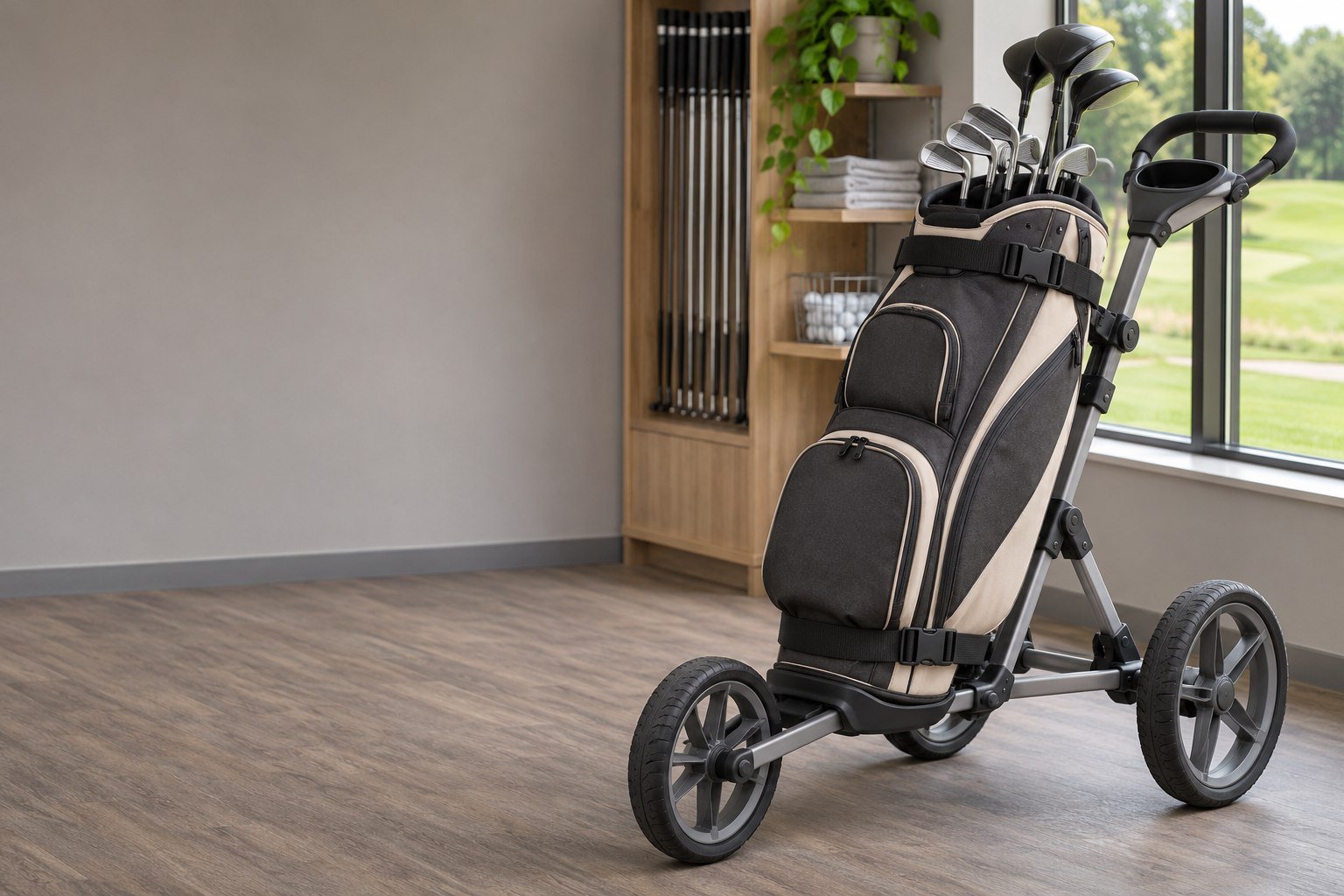
AI illustration of generic equipment. Check the complete bag-and-trolley combination before buying. No named product or physical test is pictured.
A cart bag can look ideal on its own and become awkward once it meets your trolley. Start with the two items together: the base needs support, the upper restraint needs a clear route, and your pockets still need to open.
Research-led guidance for UK golfers. Read how we assess golf equipment for the distinction between documented features and hands-on testing.
This guide contains affiliate links. If you buy through them, Taylor’s Trailblazing Golf may receive a commission at no extra cost to you.
A strap cannot correct a bag perched on an incompatible lower support.
The channel must align with the trolley strap at the fitted height.
A normal strapped fit and a proprietary locking fit are different claims.
Replacement is worthwhile when it fixes a real fit or access problem.
Cart bag compatibility starts at three contact points
Ignore the pocket count for the first few minutes. Place the trolley in its normal fully assembled position on level ground and compare the bag with the lower platform, upper cradle and intended strap path. Those three relationships decide whether the combination is worth considering.
The 2026 Motocaddy SE instructions illustrate the distinction clearly: a non-EASILOCK bag rests on the lower platform and in the upper cradle, with the lower strap retained. An EASILOCK bag uses its specified pins and matching holes instead; the upper support still has a separate job. These are instructions for that system, not a universal attachment method.[1]
On a small screen, swipe inside the table to read every column.
| Contact point | What you want to see | Reason to pause |
|---|---|---|
| Lower support | The intended part of the base is supported in its correct orientation. | The bag sits on a ridge, a small projection or a folded stand mechanism. |
| Upper cradle | The cradle supports the bag where its maker intends, without bearing on an opening or fragile fitting. | It presses on a zip, forces a pocket shut or meets only soft unsupported fabric. |
| Strap path | The prescribed strap route closes with useful adjustment remaining. | The buckle barely catches, the strap crosses a pocket opening or the bag deforms when secured. |
This is an editorial screening method, not a load certification. A combination that looks satisfactory must still comply with both manufacturers’ instructions. If a seller cannot confirm an unusual pairing, a direct fitting demonstration is more useful than a promise that a bag is “trolley friendly”.
Back to the start ↑Read the underside before measuring the top
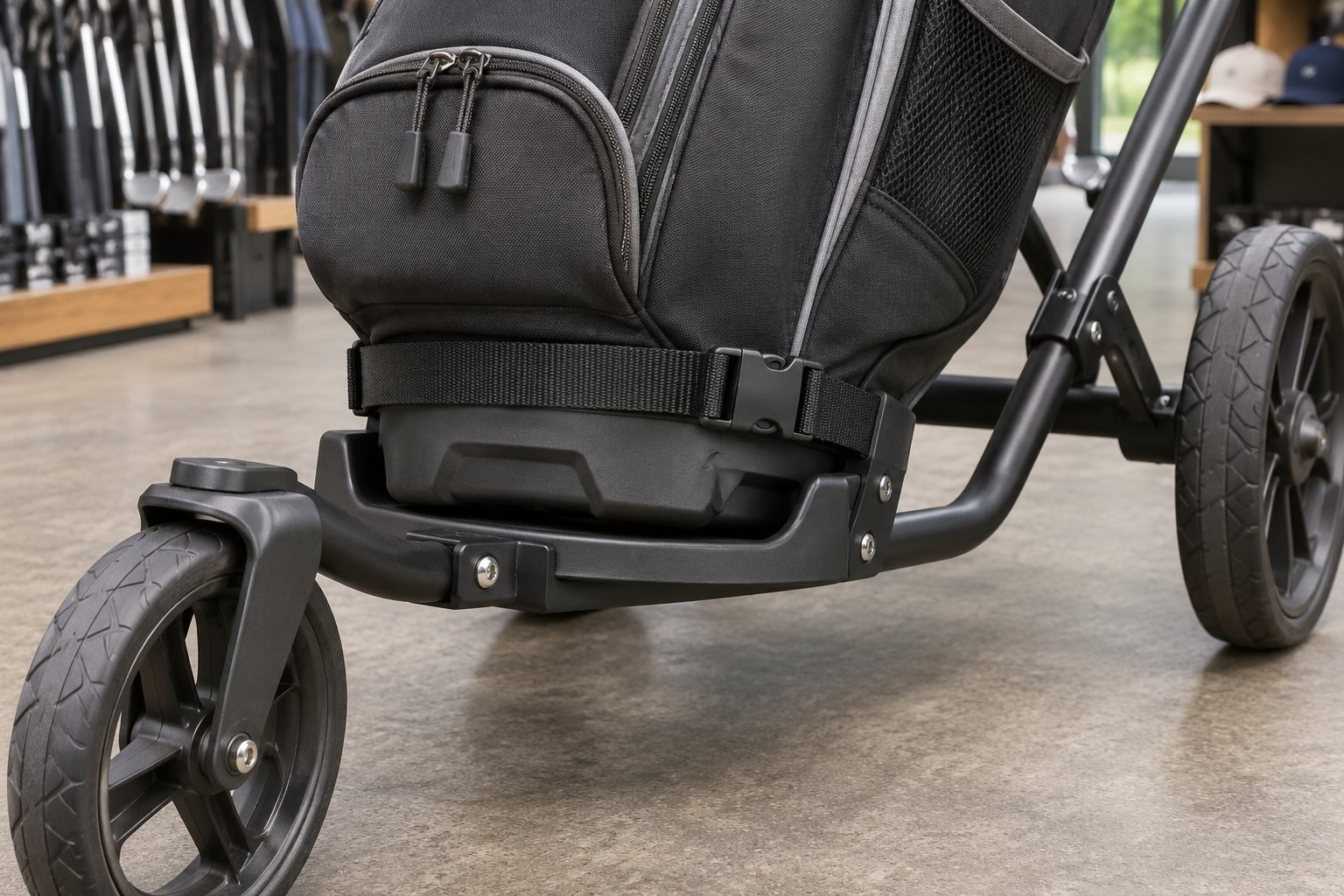
A top diameter describes the club opening. It tells you little about the underside that meets the trolley. Turn an empty bag carefully to inspect its base, then compare its shape with photographs or, preferably, the actual lower support. Look for a moulded notch, flat seating area, locking fittings and projections that may interfere.
Note which way the manufacturer intends the bag to face. Do not rotate it simply to make the underside sit better if the result puts essential pockets against the trolley frame. Fit involves the whole bag, not a single successful contact point.
Make a useful comparison record
Record the bag’s complete model name and year or product code, the trolley model, and a photograph of both contact areas. If measurements are needed, note the usable lower-support width, the bag’s actual contact footprint and the height at which the upper cradle meets it. These are comparison observations, not standard dimensions that certify a fit.
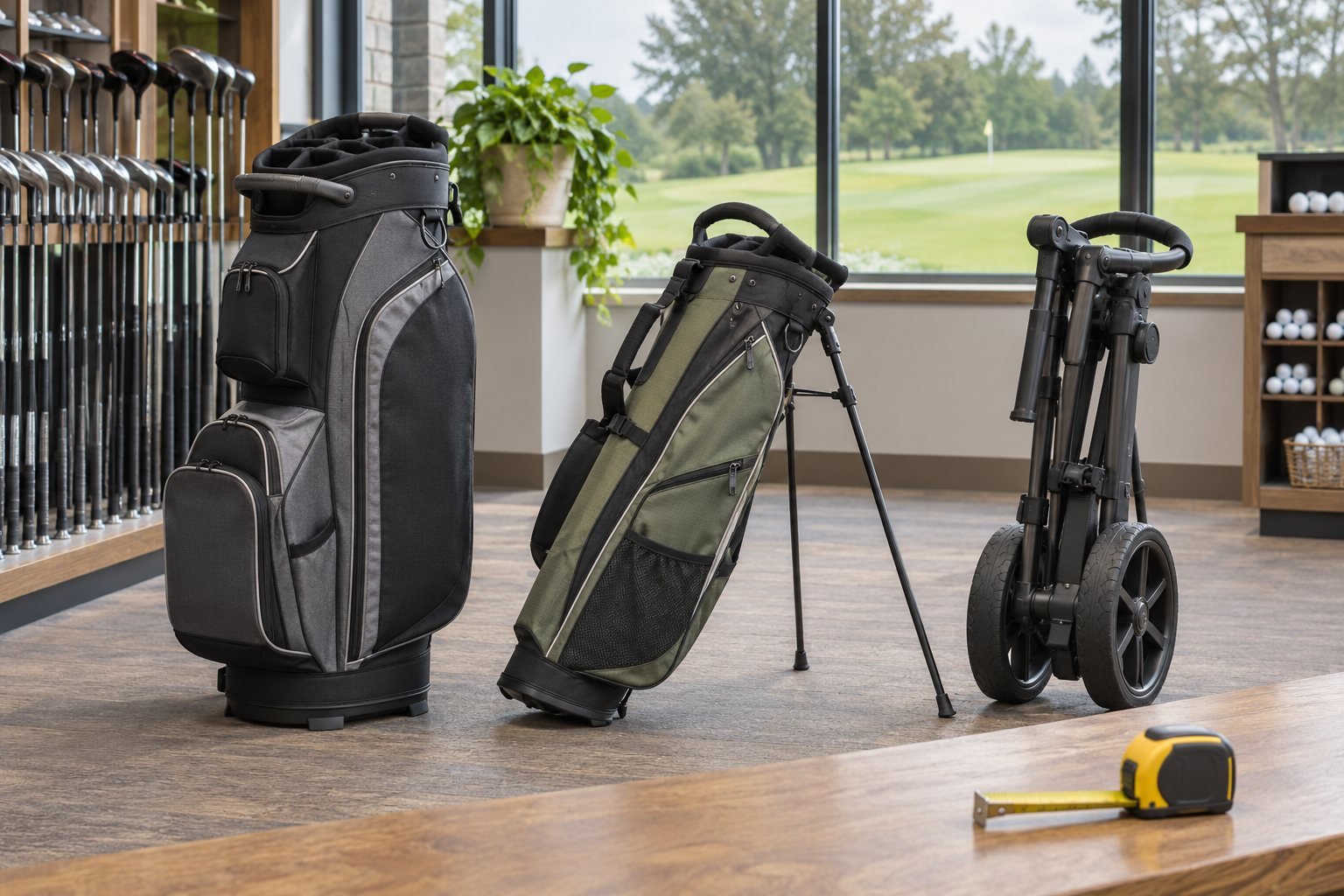
An overall width can include bulging pockets; a base width can include feet that are not meant to carry the load on the trolley. Ask what the published measurement refers to before using it to rule a bag in or out. A tape measure can narrow a shortlist, but it cannot show whether a curved base and shaped support mate correctly.
For a used bag, inspect the actual base rather than relying on the original product photographs. Damage or a missing fitting changes the decision even when the model itself is suitable.
Back to the start ↑What a trolley strap channel does—and what to check
A strap channel gives the retaining strap a route through or behind part of the bag so that it need not sit across the outside of a pocket. PING, for example, lists a cart-strap channel on its current Traverse. That confirms a feature; it does not identify every compatible trolley.[3]
On your trolley, check where the strap actually arrives. A channel that is useful with one support height may be awkward with another. The strap should follow the intended route without being twisted, dragged diagonally across a zip or forced around a handle. Make sure its buckle or hook remains accessible once the pocket is filled.
Fasten and adjust only as the trolley instructions describe. For the SE, Motocaddy specifies elasticated supports adjusted to hold the bag reasonably tightly and correctly clipped back into their housings. That is different from tightening until the bag body is visibly crushed.[1]
Open the pocket with something inside
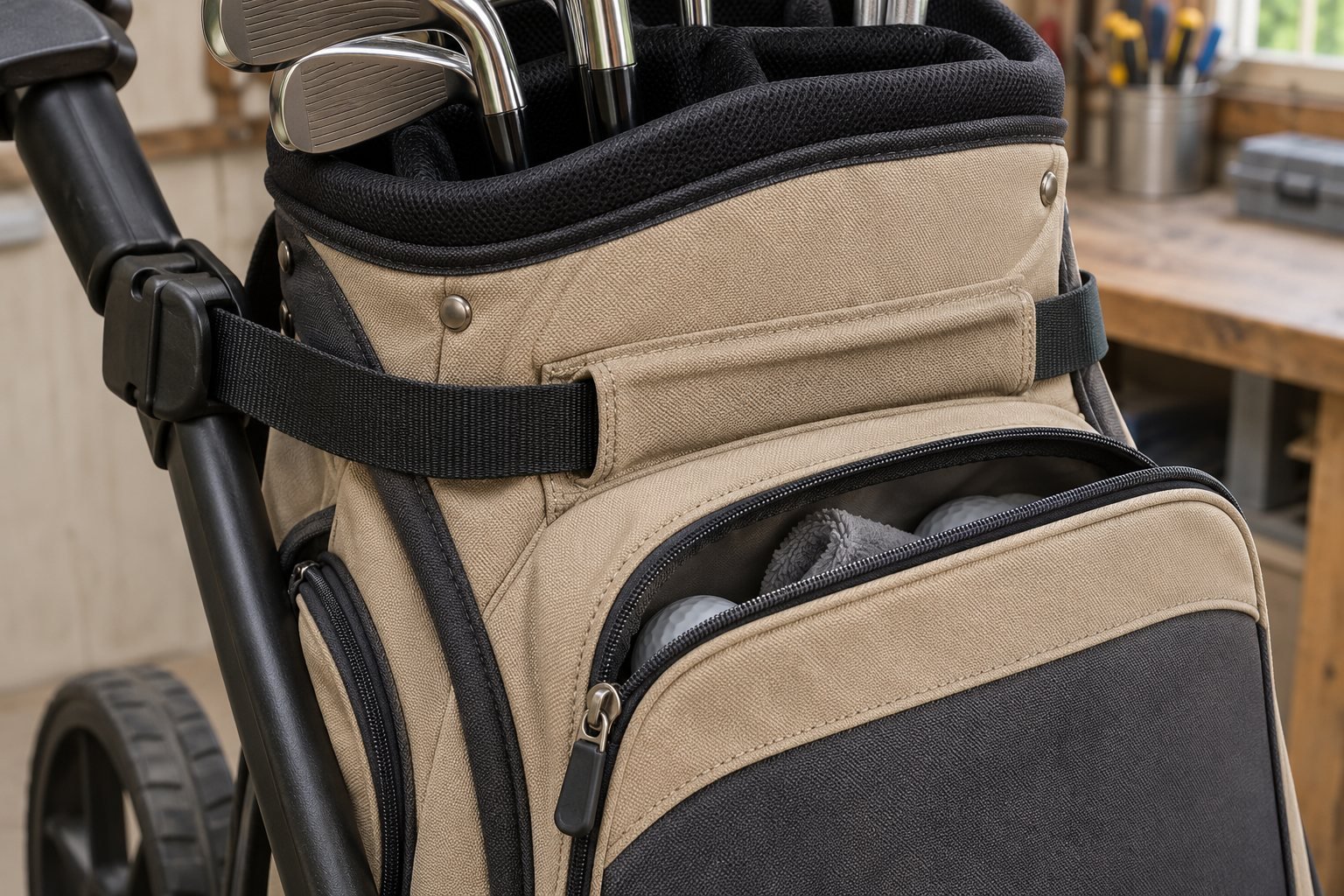
A flat empty pocket can conceal an access problem. Put a jacket or other normal contents inside, close the retaining strap, then open and close the pocket fully. Try removing the object rather than merely checking that the zip moves. If every visit requires unfastening the bag, the channel has not solved the practical problem for that pairing.
Do not use a carry handle, towel loop or decorative loop as an alternative attachment point unless the maker explicitly approves it. If a correctly fitted strap does not reach, ask about the exact approved replacement or extension. An improvised bungee changes the attachment without proving it is suitable.
Back to the start ↑Separate a strapped fit from a locking-system fit
Matching brand names are a starting point, not the whole check. Identify the precise attachment system, the parts required on both sides and any model-year restriction. “Can be strapped to this trolley” and “engages this trolley’s lower lock” are different answers.
On a small screen, swipe inside the table to read every column.
| Description | What it establishes | What remains to check |
|---|---|---|
| Ordinary strap attachment | A retaining method is available. | Base seating, upper support, strap adjustment and pocket access on the actual pair. |
| Motocaddy EASILOCK | A defined bag-to-trolley connection using compatible fittings. | Correct bag pins and trolley support, plus the required upper restraint. |
| PowaKaddy MAG-LOK | A magnetic lower connection for compatible equipment. | The particular trolley and bag support it, and the correct fitting is installed. |
| Anti-twist base | The maker describes a feature intended to resist rotation. | Whether the shape actually engages your trolley; it is not a cross-brand standard. |
For example, the 2026 PowaKaddy FX1 manual permits MAG-LOK with a compatible PowaKaddy cart bag and describes a front strap arrangement for most other cart bags. “Most” leaves room for exceptions; it is not a guarantee for every base shape.[2]
Do not remove lower restraints merely because another bag on the course does without them. Follow the instructions for your particular connection. Missing pins, a mismatched magnetic fitting or an incorrectly seated base should be resolved before using the combination, rather than compensated for by extra strap tension.
A proprietary system can simplify repeat loading. Its value is the convenience it adds to a bag that already suits your needs. It is not a reason to accept blocked pockets or buy a new trolley when a safe ordinary strapped fit works well.
Back to the start ↑Use this loaded-fit worksheet in the shop
Ask the retailer whether you can bring your trolley and normal clubs for a fitting check. Start with the power off where applicable and follow the trolley manual. Choose a clear, level area; this is not a hill or tipping test.
On a small screen, swipe inside the table to read every column.
| Check | Record | Decision |
|---|---|---|
| Seat the base | Which part touches the support? Are all required fittings properly engaged? | Stop if the correct seating is uncertain. |
| Secure the upper bag | Where does the cradle touch, and how much strap adjustment remains? | Reject a fit that depends on crushing the bag or straining the closure. |
| Reach everyday kit | Can you remove a ball, drink, rangefinder and jacket without releasing the restraints? | Decide whether any awkward pocket is a realistic compromise. |
| Remove clubs | Can your own grips and headcovers pass without fighting the support or neighbouring clubs? | Check the loaded arrangement, not the top-divider count alone. |
| Check the full setup | Do the rain hood, towel and usual accessories remain clear of moving parts? | Resolve interference before a normal, controlled movement check. |
Use three outcomes: acceptable as instructed; uncertain and awaiting manufacturer confirmation; unsuitable in the current configuration. Do not average them into a score. A pleasing pocket layout cannot cancel out an unsupported base.
If access to clubs is the sticking point, the published guide to full-length golf bag dividers explains why the top count alone does not settle that question. Keep the trolley fit and the internal club arrangement as separate checks.
Back to the start ↑Buy the feature that fixes your actual mismatch
Before replacing a bag, write down the failure in one sentence: “The upper strap covers the jacket pocket,” “The base will not seat,” or “The cradle pushes against the rangefinder pocket.” That makes it harder to be distracted by extra storage that does not solve the original problem.
If you want a documented trolley-oriented design to inspect, Callaway lists LOWRIDER trolley compatibility on its 2026 ORG 14 HD. It is a candidate for a physical fitting check, not proof of a universal fit. View the ORG 14 HD at Callaway UK.[5]
For an EASILOCK-equipped setup, the 2026 Motocaddy Club-Series is another specific example: Motocaddy documents an anti-twist base and EASILOCK compatibility. The matching Black/Lime listing can be found at Clubhouse Golf. View the Club-Series Black/Lime at Clubhouse Golf.[6][7]
These examples illustrate different buying questions, rather than an overall ranking. Compare the exact version supplied, try your loaded setup and check current availability and return conditions with the seller. No price or stock claim is assumed here.

Keep your present bag if it seats correctly, secures as instructed and gives reasonable access. Replace an approved worn restraint if that is the actual problem. Consider a different bag when correct attachment still leaves a structural mismatch or repeated obstruction. Do not modify a moulded base, drill new holes or alter the trolley frame to rescue an unsuitable pairing.
Back to the start ↑Watch for the riding-cart meaning of “cart bag”
Product language can conceal a use-case difference. Sun Mountain describes its C Series as designed for riding golfers, with a forward-facing top and a cart strap pass-through. A useful arrangement on the rear of a ride-on cart may face you differently when the bag is inclined on a walking trolley.[4]
That does not make riding-cart bags unsuitable for walking trolleys. It means the label cannot answer your specific question. Look at the fitted orientation: which pockets face out, where the short clubs sit, how far the bag leans and whether the handle or frame blocks access.
For online purchases, send the seller the trolley model and a clear photograph of its supports. Ask whether the proposed bag has been confirmed with that model, what fittings are included and which attachment route is intended. A specific answer is more helpful than an assurance that it works with “all standard trolleys”.
The sensible final choice is the bag that passes the fit worksheet with your equipment and needs the fewest daily workarounds. You can explore other layouts in the Golf Bags guides, but treat a successful physical pairing as more valuable than an extra row of features.
Back to the start ↑Questions before you decide
Can a small bag be as awkward to fit as a large one?
Yes. Smaller overall dimensions do not show where its rigid support areas meet the trolley. A narrow bag may also leave the strap near the end of its adjustment range. Check contact and closure rather than assuming that smaller means more compatible.
Should I choose the bag or trolley first?
If one already works well, use it as the fixed part of your comparison. If buying both, ask to fit the exact pair together before choosing. There is little benefit in selecting each independently and hoping the contact points line up.
Does a strap channel make a bag waterproof?
No. Strap routing and weather protection are separate features. Check the exact bag’s fabric, seams, zip construction and stated limits; a channel or rain hood is not evidence of complete waterproof protection.
Sources and editorial checks
Manufacturer specifications and instructions inform this guide. The comparison and checklists are editorial decision aids, not results of hands-on product testing.
- Motocaddy — 2026 SE instruction manualPages 14–15: EASILOCK and non-EASILOCK lower support, upper restraints and adjustment. Checked 23 November 2026.
- PowaKaddy — 2026 FX1 owners manual, REV2Page 6: MAG-LOK installation context and front-strap option for most other cart bags. Checked 23 November 2026.
- PING Europe — TraverseOfficial feature listing includes a cart-strap channel; no universal trolley fit inferred. Checked 23 November 2026.
- Sun Mountain — C SeriesManufacturer identifies the riding-golfer use case and cart strap pass-through. Checked 23 November 2026.
- Callaway UK — 2026 ORG 14 HD Cart BagLOWRIDER trolley compatibility feature; no physical fit test or current stock claim. Checked 23 November 2026.
- Motocaddy UK — 2026 Club-Series bagOfficial anti-twist base and EASILOCK feature description. Checked 23 November 2026.
- Clubhouse Golf — Club-Series Black/LimeVerified relevant UK listing; linked version should still be checked when buying. Checked 23 November 2026.
Illustrations in this article were created for Taylor’s Trailblazing Golf. Third-party photographs, where used, are credited beside the image or in the source list.