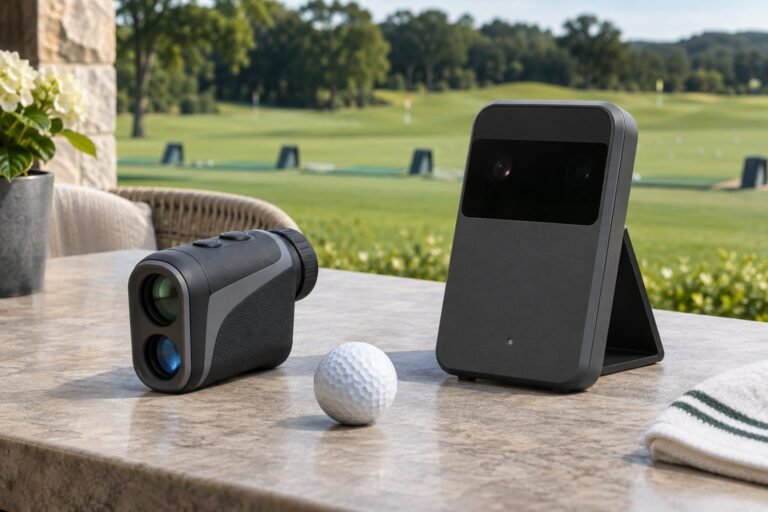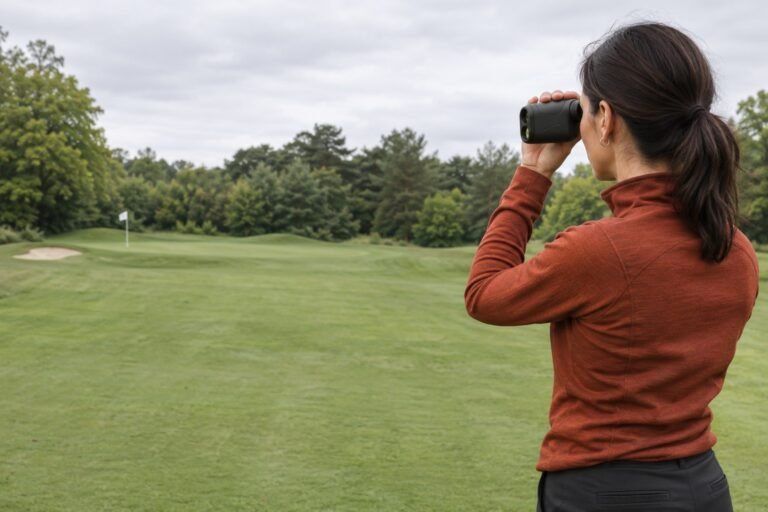
Clip-On Golf GPS Devices: Who Benefits Over a Wrist Display?
A clip-on GPS makes sense when you want distance information without a watch on your wrist. Its value depends on where it stays, how you read it and whether it comes with you when you leave the bag.
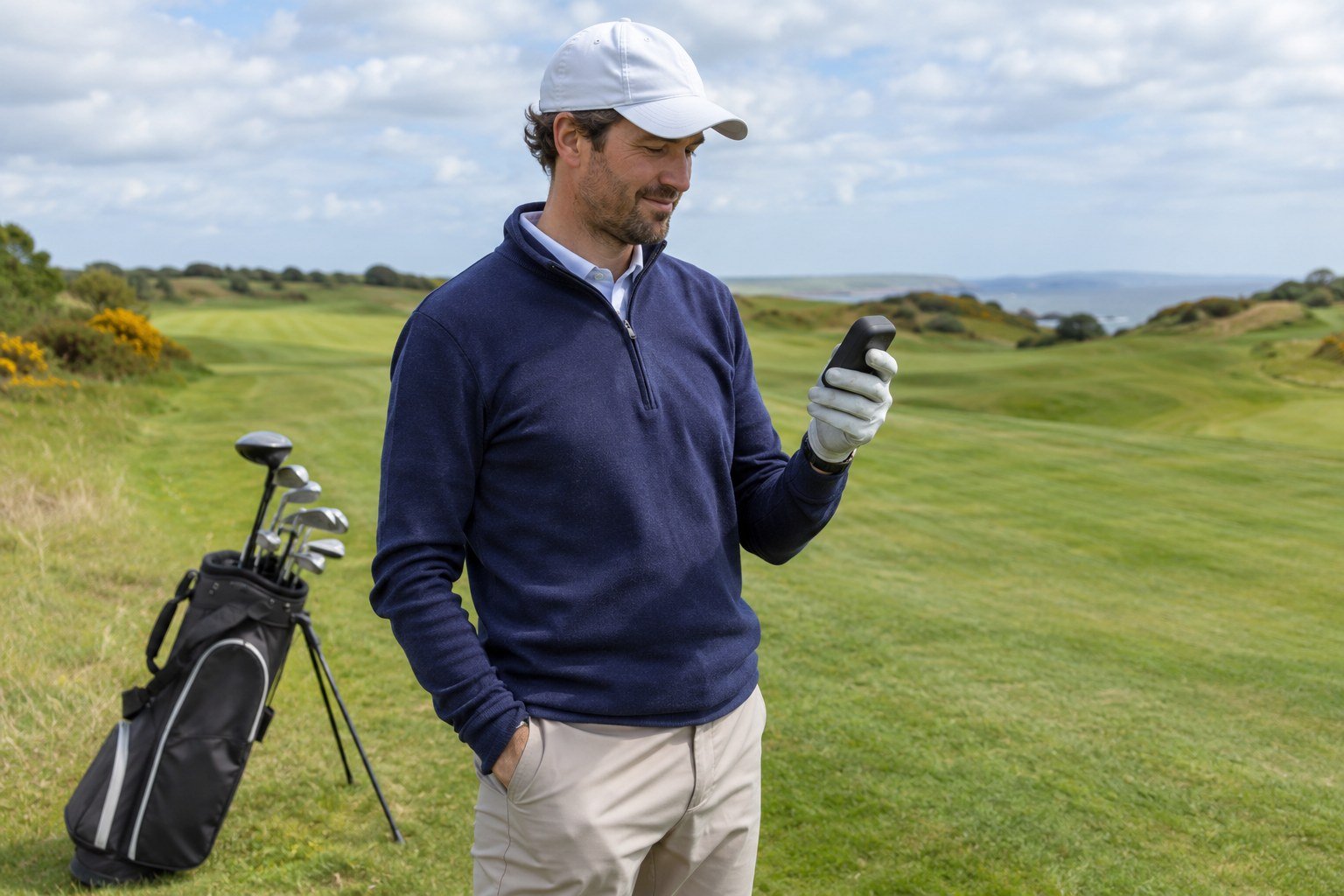
AI illustration. Choose a carrying position that keeps the receiver secure and its screen easy to reach when you need a distance.
This guide contains affiliate links. If you buy through them, Taylor’s Trailblazing Golf may receive a commission at no extra cost to you.
Clip-on golf GPS devices put the display somewhere other than your wrist. The practical question is whether you can keep the receiver secure, carry it to the reading position and reach the screen comfortably throughout a round.
Research-led guidance for UK golfers. Read how we assess golf equipment for the distinction between documented features and hands-on testing.
A separate receiver may suit you if its carrying and reading routine is comfortable.
Decide how the receiver will come with you before relying on a bag attachment.
Try the exact display and controls; the clip alone does not change them.
Who is likely to benefit from a clip-on GPS?
A clip-on unit can suit a golfer who dislikes wearing a watch during play, already wears a preferred everyday watch, or wants to hold the distance display at a convenient angle. Those are practical preferences. They do not need a claim that removing a watch will improve the swing.
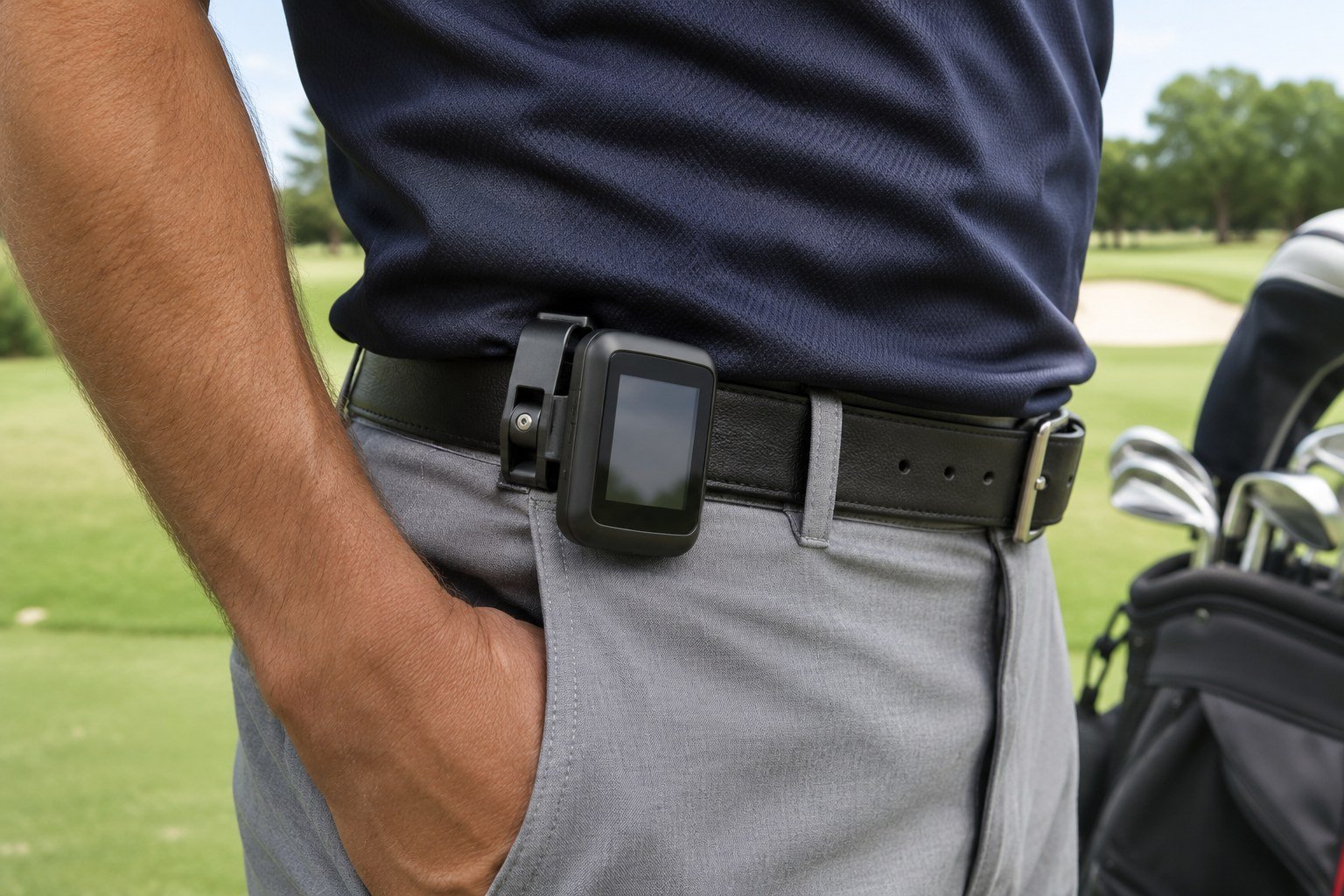
The arrangement is strongest when the device has an obvious home and an easy route from that home to a useful reading position. That might be an approved clothing attachment or a suitable place on the bag. The right answer depends on the attachment supplied with the exact model and how you move around the course.
A wrist display keeps the reading surface on your arm. A separate device adds a decision about carrying, access and replacement after use. Some golfers will welcome that freedom; others will find the extra handling irritating. Judge the complete routine rather than the idea of keeping the wrist clear.
Start with one sentence: “I want the receiver to stay on my ___, and I expect to read it by ___.” If the second blank requires an awkward twist, removing several items or walking back to the bag, you have identified something to investigate before shopping.
Back to the start ↑Compare where the device will stay during a round
“Clip-on” describes an attachment possibility, not one universal way to carry every device. Check the model’s approved accessories and safety instructions before choosing a position. The table sets out practical questions; it does not certify that a particular clip fits a particular item of clothing or bag.
On a small screen, swipe inside the table to read every column.
| Arrangement | Potential advantage | Question that could change the choice |
|---|---|---|
| Wrist display | The receiver remains with you when you leave the bag. | Are the case, sleeve and reading position comfortable for your normal routine? |
| Approved clothing clip | Keeps the wrist free while the receiver travels with you. | Can you see or remove it easily, and does the attachment remain comfortable when sitting and walking? |
| Approved bag attachment | Gives the device a consistent home beside the equipment you carry. | Will you take it with you when the bag stays elsewhere? |
| Handheld reading, then secure storage | Lets you choose a viewing distance and angle. | Is returning it straightforward when you are also managing a club, glove or umbrella? |
Try the intended outer layer as well as ordinary golf clothing. A convenient belt position may be hidden beneath a jacket. A bag attachment may sit under a rain hood or alongside a pocket zip. The arrangement must still let you use those items normally.
Think about the whole outing, including arrival, pauses and packing up. A consistent place for the receiver makes it easier to include it in your own departure check. It does not make a loose or unsuitable attachment secure.
The distance starts at the receiver’s position
The G12 manual explains that the device acquires satellites and calculates its location.[2] The practical consequence is straightforward: a receiver left on the bag is at the bag, even when you are standing somewhere else. Choose a carrying routine that brings it to the place from which you want the reading.
Do not turn that into a fixed correction such as subtracting the number of paces to the bag. The bag, ball and target may lie in different directions. The useful habit is to have the receiver with you when you check the intended target and to allow the device to establish its position as its instructions require.
Hypothetical example: a golfer parks a trolley beside the path and walks across the fairway to the ball. A bag-mounted unit is convenient beside the trolley, but the golfer needs a plan for carrying it across too. A clothing clip or wrist display might make that sequence easier. If the receiver is already carried in the hand, the bag attachment may remain a perfectly useful storage position.
Also identify what the number represents. The G12’s normal hole view gives front, middle and back distances; its manual distinguishes those from the actual pin location.[2] Seeing a flag symbol or moving a pin marker is not proof that the device has independently located today’s flag.
If your decision is really about a GPS yardage versus a laser reading, use the existing GPS watch versus laser rangefinder comparison first. A change in attachment does not change the underlying question about the target you need.
Look at the actual controls and attachment design
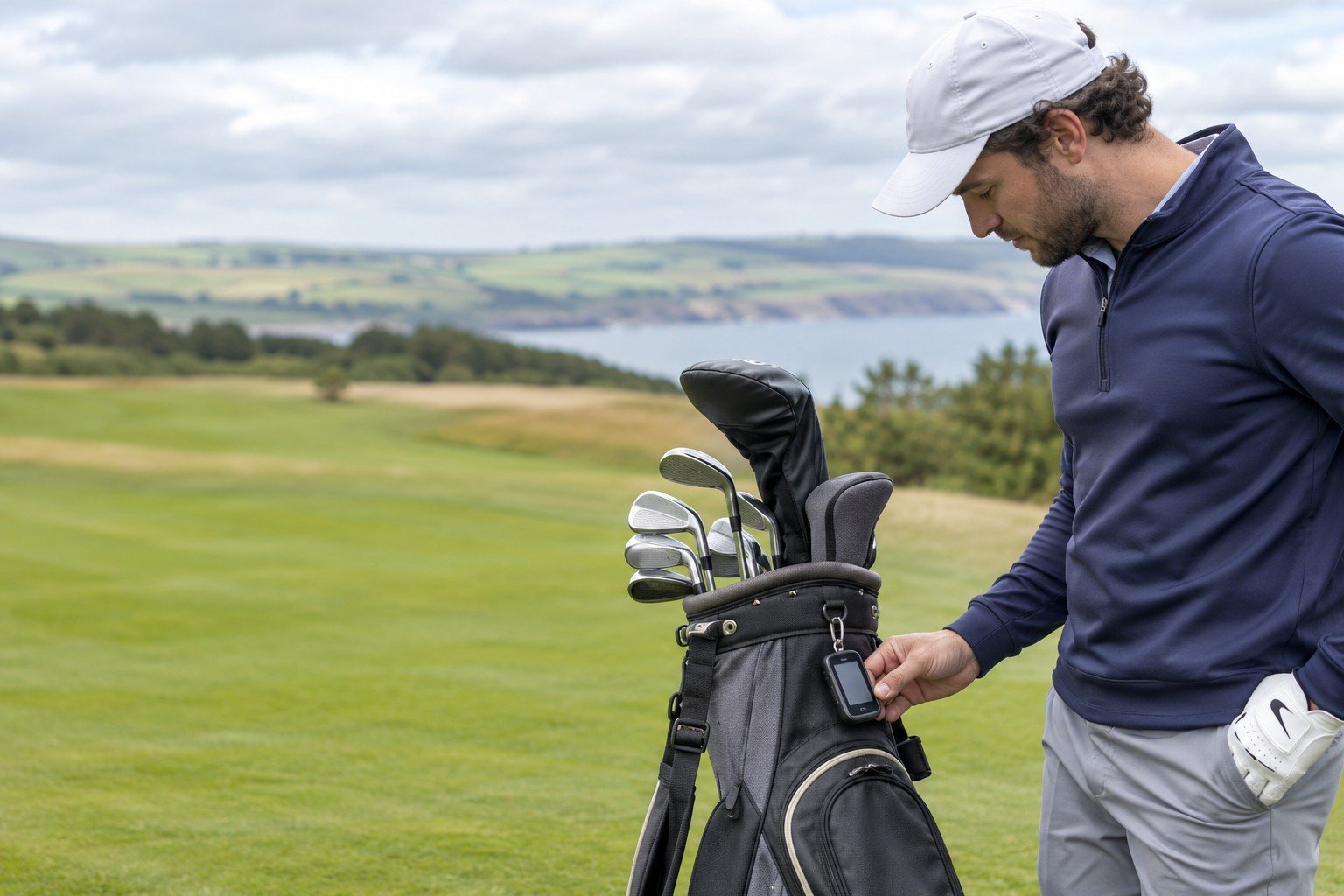
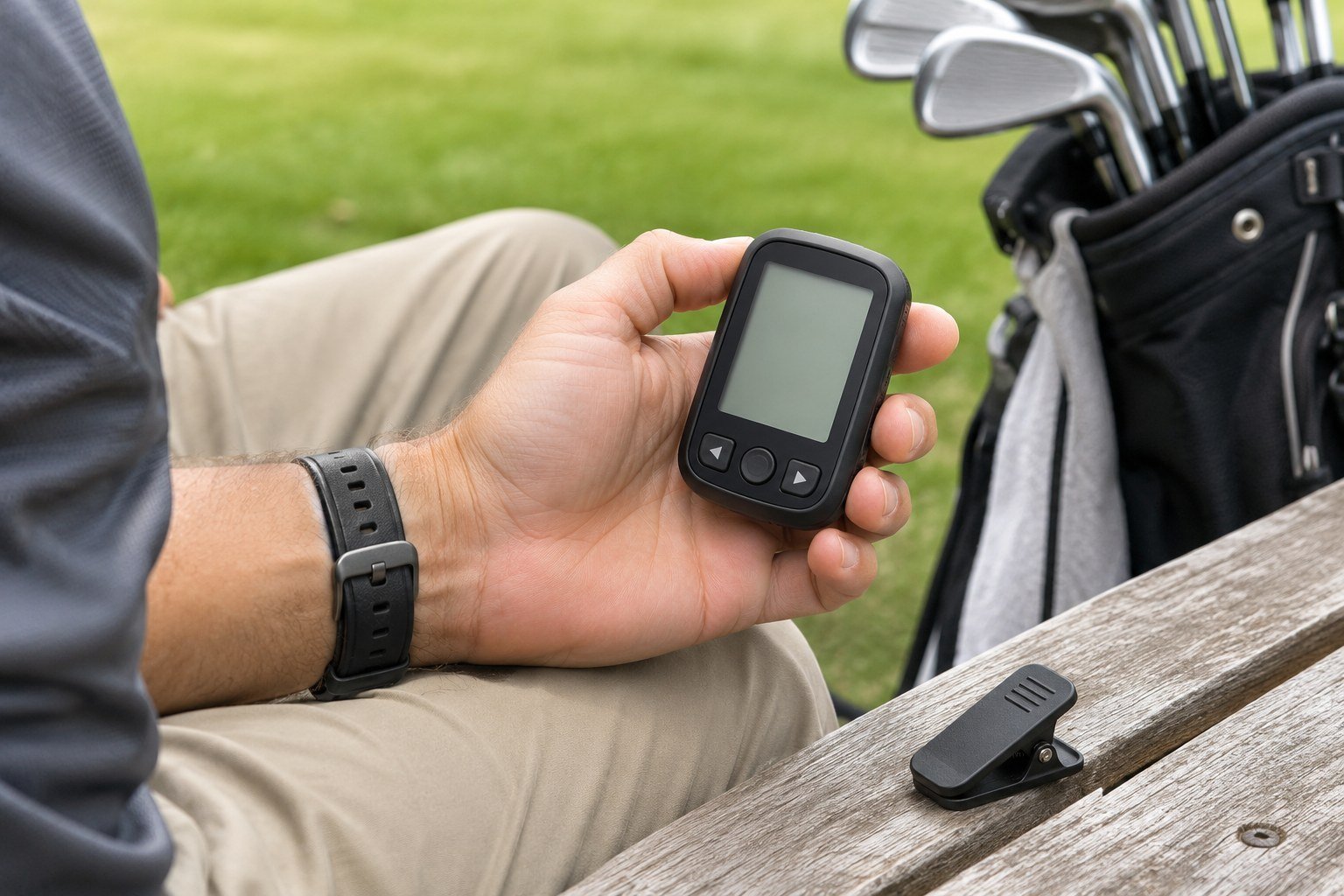
Garmin describes the Approach G12 with a built-in clip and a lanyard loop for carrying on clothing or a golf bag.[1]
Its manual documents buttons, Big Numbers and reversible screen orientation.[2] Try the display in its intended carrying position.
Bushnell’s Phantom 3 Slope has a touchscreen and is supplied with a belt clip and carabiner.[3]
Its manual also identifies a side control and a screen-lock function.[4] A clip-capable device therefore need not be button-only, and a touchscreen device need not be operated entirely through touch.
On a small screen, swipe inside the table to read every column.
| Example | Relevant documented design | Check before choosing |
|---|---|---|
| Garmin Approach G12 | Built-in clip; button navigation; invertible screen.[1][2] | Can you read and control it in the intended position, or is removal more convenient? |
| Bushnell Phantom 3 Slope | Touchscreen; supplied clip and carabiner; screen lock.[3][4] | Does the complete retrieve, unlock, read and return sequence suit you? |
These are construction examples, not a ranking of accuracy, retention or visibility. Rehearse the essential task on a working unit when possible. Notice whether the fingers holding it obscure the display or operate a control unintentionally. Ask which actions remain available in a locked state.
A bigger housing is not enough evidence that a screen will solve your reading problem. Read the yardage and its label at the distance you prefer, then check a secondary view and the route back.
Rehearse access with the equipment you actually use
Begin indoors over a stable surface, using only the intended attachment and following its instructions. A retailer may need to demonstrate the arrangement if its display unit cannot be attached to your own clothing or bag. Treat an untried fit as an open question.
- Put on the ordinary outfit. Include the jacket or other layer likely to cover the device.
- Set up the intended position. Check that the clip closes normally and the device is seated as specified, with no damaged or missing part.
- Read the essential information. Decide whether you can do this in place or need to remove the unit.
- Change one useful view. Try a hazard or other information screen, then return to the main distances.
- Complete the return step. Put the device back in its intended position and check that you can still use nearby pockets and fastenings.
- Repeat ordinary movements. Walk a few steps and sit comfortably, then repeat the reading task. Note rubbing, covering or awkward access.
Consider what happens when your hands are already occupied. It is reasonable to choose a watch because you dislike handling another object. It is equally reasonable to prefer a separate receiver that you can hold where you want. Neither choice needs an invented claim about saving strokes.
For a shared device, agree who carries it and when it changes hands. The relevant distance is taken at its location, and the person holding it must know which view and target are selected. One device does not become a simultaneous personal reading for golfers standing in different places.
Back to the start ↑Include weather and attachment condition in the choice
An exposed bag position, a covered clothing position and handheld use create different access questions. Check whether the place you chose stays usable with a rain hood, wet outerwear or an umbrella. Then apply the exact device’s weather instructions.
For example, Bushnell’s Phantom 3 manual warns against heavy rain, direct streams of water and submersion.[4] Do not use a broad “waterproof” listing label as permission to leave that model exposed in every condition. If those restrictions conflict with your expected use, ask the manufacturer or compare a different device before buying.
Before relying on a clip, inspect the parts that actually hold the unit. Look for a crack, missing component, distorted shape or a fastening that no longer closes normally. That is an ordinary condition check, not a retention test or a guarantee that the unit cannot be lost.
Ask the manufacturer for the correct replacement part when something is damaged. A clip that looks similar is not evidence of compatibility. Avoid buying an unknown attachment merely to make an unsuitable carrying position work.
At the end of the round, include the GPS in your normal equipment check and follow its cleaning and storage instructions. Keep the carrying accessory with the unit so the next round starts with the complete arrangement.
Back to the start ↑Record whether the clip-on actually improves your routine
Use this record for a current watch, a borrowed demonstration and any proposed replacement. Fill it with observations from the actual arrangement. It is not a points system: one unresolved attachment or access problem can outweigh several attractive features.
On a small screen, swipe inside the table to read every column.
| Prompt | Write a specific answer |
|---|---|
| Why leave the wrist? | The particular preference or interference you want to resolve. |
| Where does the receiver stay? | The exact permitted attachment and the clothing or bag used. |
| What happens away from the bag? | Who takes the device and where the reading is made. |
| Can you read and return it? | Whether removal, unlocking or an awkward hand change is needed. |
| What changes in rain? | Coverage, access and any model-specific restriction. |
| What remains unanswered? | The fit, missing part, setting or condition that needs a demonstration or manufacturer reply. |
Hypothetical decision: a golfer wants a free wrist and can comfortably read a permitted clothing-mounted receiver. It remains accessible with the usual jacket, and the ordinary movement check reveals no interference. That is a reason to shortlist the clip-on format, without claiming it will be more accurate.
Change one fact: the only convenient attachment is on the bag, and the golfer regularly leaves it while taking several clubs to the ball. The choice now depends on whether they welcome carrying the GPS too. The wrist display may remain the easier arrangement even if the separate screen is pleasant to read.
Buy for a clear carrying benefit, or keep the wrist display
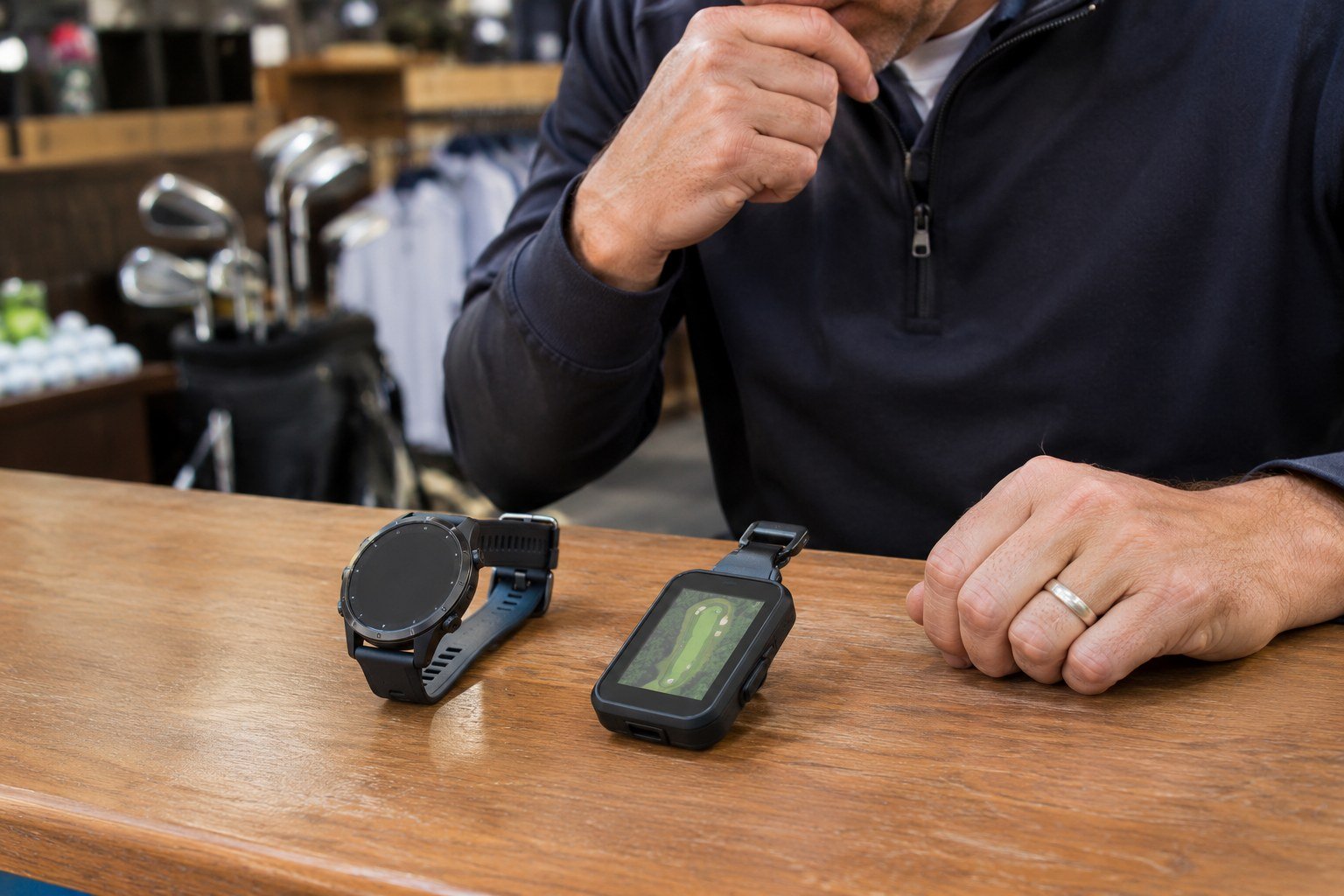
If the button-based example fits your routine, view the Garmin Approach G12 Black at Clubhouse Golf.[5]
If you want to try the touchscreen and supplied-clip arrangement, view the Bushnell Phantom 3 Black at Clubhouse Golf.[6] Check the exact model, included accessories, current return conditions and the manufacturer’s instructions before ordering.
Keep a wrist device that already works unless the separate receiver solves a problem you can name. Choose a clip-on when its location, access and handling make it a better fit for your own round. A different form is not automatically an upgrade.
For broader equipment choices, the GPS & Rangefinders guides provide the surrounding context. Your final plan here should say where the receiver lives, how it reaches the reading position and how it returns safely to its place.
Back to the start ↑Questions before you decide
Can I leave a clip-on GPS on the trolley when I walk to the ball?
It may be a convenient storage position, but take the receiver with you when you need a reading from your own position. A unit left elsewhere is not located where you are. Include that carrying step in the comparison with a wrist display.
Does clip-on mean the screen is larger than a watch screen?
No. Inspect the exact display and the size of its golf information. The benefit may be freedom to choose a viewing position rather than extra screen area. Try both the main distance and smaller labels.
Can I use any clip or carabiner that fits the gap?
Use the attachment and arrangement specified for the device. A similar appearance or physical fit does not establish secure compatibility. Ask for the correct part if the supplied attachment is missing or damaged.
Sources and editorial checks
Manufacturer documentation and published technical evidence inform this guide. The comparisons and checklists are editorial decision aids, not results of hands-on product testing.
- Garmin — Approach G12 introductionManufacturer announcement dated 16 March 2021; attachment design only. Checked 24 November 2026.
- Garmin Approach G12 — Owner’s ManualControls, location, hole view, larger numbers and orientation; printed pages1–4. Checked 24 November 2026.
- Bushnell Golf — Phantom 3 SlopeManufacturer product and included-attachment descriptions. Checked 24 November 2026.
- Bushnell Phantom 3 Slope — Owner’s ManualOfficial manufacturer-linked manual; controls, screen lock and care. English printed pages3–9. Checked 24 November 2026.
- Clubhouse Golf — Garmin Approach G12 BlackExact UK model/colour listing; retailer reference RFGAR034. Checked 24 November 2026.
- Clubhouse Golf — Bushnell Phantom 3 BlackExact UK model/colour listing; retailer reference RFBUS071. Checked 24 November 2026.
Illustrations in this article were created for Taylor’s Trailblazing Golf. Third-party photographs, where used, are credited beside the image or in the source list.