Driver Shaft Flex Labels: Why 'Stiff' Isn't Consistent Between Brands
Compare the exact shaft and finished club, then use the label to order the option you preferred.
- Cross-brand comparison
- Exact-model checklist
- Fitting questions
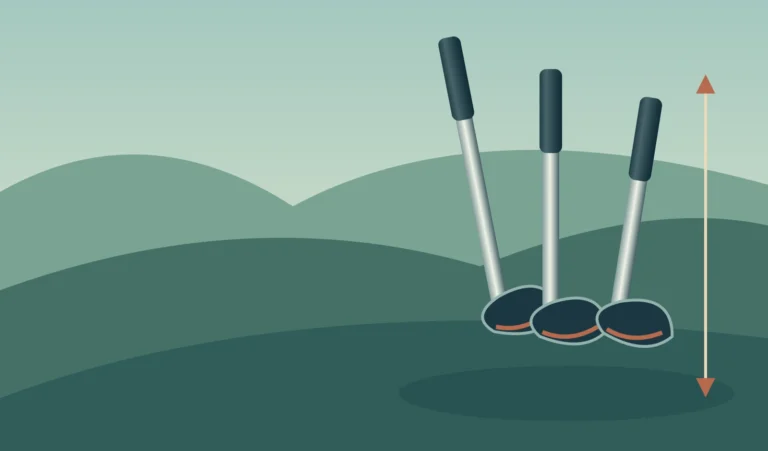
AI-generated illustrations show generic golf equipment and settings. They are not photographs of the named products or records of product testing.
You have played a shaft marked Stiff for years. A new driver offers another Stiff option, so it is tempting to regard the shaft decision as settled. The missing detail is what that letter describes in each particular model.
Driver shaft flex labels help identify an option within a range. They do not replace the full product name, its published profile or the details of the club you try. The useful aim is to find a repeatable build and document it accurately enough to buy the same thing.
Keep the full name
Brand, model, generation, weight class and flex belong together.
Read beyond one letter
Regional profile, torque and flight descriptions answer different questions.
Treat charts as a start
A swing-speed band can suggest a trial; it cannot settle the fit.
Verify the order
The shaft version and complete build should match the club you chose.
What driver shaft flex labels actually tell you
Titleist explicitly notes that shaft flex is not standardised across the industry: a shaft labelled Stiff in one model can play closer to an Extra Stiff in another. Its guide also treats swing speed as a starting point, with tempo, transition and release affecting the result. [1]
The label still matters. If you preferred a particular model in S, ordering its R option changes the specification. What you cannot do is carry that S across every brand and assume you have preserved the same bending behaviour.
Use the letter as part of the name of the candidate. Ask “Which exact Stiff shaft?” before asking whether Stiff suits you. The same discipline applies to numeric flex codes: copy the maker’s designation rather than treating it as a universal measurement or translating it into another brand’s letter.
This also removes an unnecessary status question. You are selecting equipment for useful tee shots. A label should not become something you feel obliged to retain when another documented option works better for you.
Read real specifications without inventing a flex conversion
These manufacturer entries show the level of detail worth recording. They are examples of product identification, not a ranking of stiffness or a recommendation that the three shafts are interchangeable.
| Exact manufacturer entry | Flex label | Published shaft weight | Listed shaft length |
|---|---|---|---|
| Mitsubishi Diamana WB 63 [2] | S | 62 g | 46 in |
| Fujikura VENTUS Blue 6 with VeloCore+ [3] | S | 65.5 g | 46 in |
| Project X HZRDUS G4 Black, 60 g category [4] | 6.0 | 61 g | 46 in |
Scroll within the table to see all columns.
The table deliberately preserves the manufacturers’ labels. A listed length of 46 inches describes the shaft specification, not the finished playing length of a driver. The weight figures do not establish which shaft is stiffer, and the two S labels do not prove matching bend profiles.
For a cross-brand shortlist, save the relevant maker’s specification page and copy the complete row for the option under discussion. Where a name includes a generation or technology term, keep it: VENTUS Blue with VeloCore+ is a more precise identification than “a blue Fujikura”.
If a shop lists only “Stiff graphite”, ask for the model before treating its club as comparable with your fitting recommendation. An unavailable detail is a reason to ask a specific question, rather than fill the gap with an assumed equivalent.
Separate bend profile, torque and intended flight
A profile describes more than a single overall flex category. Fujikura’s profile guide separates the tip, middle and handle regions. For example, it describes VENTUS Blue with VeloCore+ using different stiffness categories for those three regions. This is the maker’s description of that model, rather than an industry-wide grading scale. [5]
That gives you a better fitting question: which part of the profile is the fitter trying to change, and why? You do not need to interpret every engineering measurement yourself. You do need an explanation that connects the proposed model to the comparison you are making.
Torque is a separate characteristic
Mitsubishi defines torque in terms of shaft twisting. It also cautions that higher torque does not automatically mean instability and lower torque does not automatically mean a harsh feel. Do not use a torque number as a substitute for the flex label or as a stand-alone quality score. [6]
Launch and spin descriptions express design intent
Mitsubishi says its launch and spin descriptions are approximations of the expected response: golfers load and deliver shafts differently, so an individual result can differ. A “low launch” description is a candidate-selection clue, not a promise about your ball flight. [6]
If a comparison chart offers extra measurements, ask whether they were taken under a common method before comparing brands. More decimal places do not solve an undefined comparison.

Take this cross-brand documentation checklist to the fitting
Complete one copy for your existing driver and one for each serious candidate. A photograph of the shaft’s identifying markings can support the written record, but ask the fitter to confirm anything ambiguous.
| Document before comparing brands | Question to ask | Why the answer matters |
|---|---|---|
| Full shaft name | What are the brand, family, colour or profile, generation and technology designation? | A shortened name can describe several different products. |
| Weight and flex options | Which exact weight class and printed flex are fitted? | “Stiff” alone cannot identify the component. |
| Product version | Is it the manufacturer’s aftermarket model or a specified club-maker partner version? | The version should be confirmed from documentation, not guessed from cosmetics. |
| Profile information | What does the maker say about the handle, middle and tip, and which differences are relevant to this trial? | A whole-shaft label leaves regional behaviour undescribed. |
| Published measurements | What was measured, at what length, and under which method? | A number needs a defined comparison before it becomes useful evidence. |
| Build history | Has the shaft been tip trimmed, and what finished length, adapter and head are used? | The trial must be identified as a finished assembly. |
| Other build details | What grip, head setting and weight configuration accompany it? | These must be recorded if the order is to reproduce the trial. |
| Reason for selection | Which observation would make us keep, reject or retest this candidate? | A recommendation should connect to a useful golf outcome. |
Scroll within the table to see all columns.
Not every published page provides a detailed bend-profile graph or measurement method. Record what is available and what is unknown. Do not let an attractive chart create false certainty when its scale, test conditions or exact shaft version are missing.
Five questions that make a recommendation more useful
- What in my present shots or delivery made you choose this candidate?
- Are we comparing flexes within one model, or changing model and weight as well?
- Which parts of the complete club will stay the same for the comparison?
- What result would make you recommend keeping my current shaft?
- Can you supply the exact tested specification in writing, including any build changes?
These questions make room for the fitter’s judgement while keeping the recommendation reviewable. A useful answer can be provisional: a candidate may be worth trying without anyone claiming its label predicts the result.

Check the version and assembly before blaming the letter
Stock and aftermarket names need an exact check
Mitsubishi explains that shafts produced for its club-maker partners may use different materials or technology from its aftermarket products. It also says those partner models should not be dismissed. The practical response is to confirm the version, then compare it on its merits. [7]
Do not assume that a stock shaft is an inferior stand-in, or that a costly aftermarket option is necessary. Equally, do not substitute a similarly named version without confirming what you are buying. A helpful order description identifies the component, rather than merely calling it “premium”.
Keep trimming and finished length in the record
Fujikura explains that tip trimming can alter the shaft profile, while generally advising against it for driver shafts and recommending individual guidance from a fitter or builder. That is a reason to document the build, not a reason to experiment with a saw. [8]
Ask whether the trial shaft has been tip trimmed and which manufacturer instructions apply to the exact model. Keep the finished playing length with that answer. Do not apply a generic “cut this much to gain one flex” rule across brands, models or installations.
For a replacement assembly, use our driver head and shaft adapter compatibility guide to check the physical fit. An appropriate flex choice still needs the correct component combination and competent installation.
Use labels to organise a fitting, then compare the shots
Bring your current driver and describe what you want to improve in ordinary golf terms: a more manageable miss, useful flight, comfortable effort or a feel you trust. Keep the wider head and loft decision in view; our complete driver selection guide explains how those choices fit together.
If you want an initial shortlist, Fujikura’s Fuji Fit recommender is one manufacturer tool. It asks seven questions about your swing and current shaft, and explicitly presents its result as a starting point to confirm with a dealer. It does not compare every shaft brand. [9]
During the fitting, distinguish a flex comparison within a model from a switch to another family. Where practical, keep the head, setting, playing length and grip consistent while assessing shaft candidates. If the fitter changes those as part of an improved complete build, record the changes and judge the resulting club.
Use a consistent target and ball type, retain ordinary misses and return to the current driver between candidates. Ask to see the shot pattern and useful flight, not only the best carry number. Keep a separate note of feel: a preferred sensation is worth knowing, but it does not prove a distance or accuracy gain.
When possible, describe that sensation before being reminded of the label or price. “I can feel the transition more clearly” is useful feedback; “this must be too soft because it says R” builds a conclusion into the observation.
Do not diagnose the correct shaft from one slice or one high shot. If the comparison is inconsistent, arrange another look or keep the present club. Before booking, our guide to a useful fitting session and its fee helps clarify what records and follow-up you should receive.
Resolve the comparison without defending a label
Use these decision prompts to interpret what you actually observe. They are a practical worksheet, not results from a test.
| Situation | What it supports | What to do next |
|---|---|---|
| The current S build and a candidate R build both produce useful shots. | Both deserve consideration on their own merits. | Compare repeatability, preferred feel and complete cost; do not eliminate R because of its letter. |
| Two shafts marked S feel quite different. | The same label has not made the builds interchangeable. | Check exact model, profile and assembly before attributing the difference to stiffness. |
| A candidate feels appealing but produces no clear practical advantage. | You have a preference, not yet a performance case. | Decide whether that preference alone justifies the price, or keep the current build. |
| The result changes when the fitter returns to the original club. | The comparison is not settled. | Pause, repeat or arrange a further trial rather than invent a flex rule. |
Scroll within the table to see all columns.
Example: the preferred option carries a different letter
Suppose your current driver uses an S shaft and you prefer a candidate marked R. Document its full identity and the complete build, then confirm the comparison. If it remains the useful choice, order that specification. There is no need to relabel it mentally as “really a Stiff” to justify the decision.
Example: the cheaper listing looks almost identical
Suppose a fitting sheet specifies a particular generation and technology designation, while a sale listing omits both. Ask the seller for confirmation. If it is another version, it may still be worth trying, but the successful fitting has not established it as a direct substitute.
Use the retailer’s selectors to reproduce the chosen build
Once a head and shaft combination has earned a place on your shortlist, check the ordering details against the written fitting sheet. These two routes illustrate the information to compare; neither head is recommended simply because a particular flex appears in its menu.
If your fitting points to Quantum Max, check the Quantum Max configuration at Callaway UK. Its configurator separates shaft, flex, length and grip selections. Confirm the exact shaft name alongside the flex, rather than stopping at “Stiff”. [10]
If you are buying a right-handed Titleist GTS2, review the GTS2 shaft and custom-fit options at Clubhouse Golf. The listing has separate shaft and flex selectors, with further length, grip and weight choices under its custom-fit options. Match those to the trial specification. [11]
Before paying, confirm the full price and any substitutions, assembly requirements or custom-order conditions with the seller. If a requested option cannot be supplied, return to the fitter rather than accepting another shaft solely because the flex label matches. Keep a copy of the agreed specification with your order.
Let the specification preserve the result
Start with the full shaft name, understand which details remain unknown and compare complete clubs in a useful fitting. Then copy the chosen model, version, weight class, flex and build onto the order. The label matters because it helps reproduce your choice; it cannot make that choice on its own.
Sources
Sources checked on 22 November 2026. Product names refer to the exact models described.
- Titleist — The Complete Guide to Golf DriversNon-standardised flex labels and the limits of selecting by swing speed alone.
- Mitsubishi Golf — Diamana WBExact WB 63 S shaft specification.
- Fujikura — Shaft SpecsVENTUS Blue 6 S with VeloCore+ specification; distinct from VENTUS TR and earlier generations.
- True Temper — Project X HZRDUS G4 BlackNumeric flex designation and 60 g category specification.
- Fujikura — Shaft Profile GuideSeparate handle, middle and tip descriptions.
- Mitsubishi Golf — Golf Shaft BasicsTorque definition and limitations of intended launch and spin descriptions.
- Mitsubishi Golf — Frequently Asked QuestionsDistinction between club-maker partner shafts and aftermarket products.
- Fujikura — Tip TrimmingMaker-specific guidance and the need for fitter or builder advice.
- Fujikura — Fuji Fit Driver Shaft RecommenderQuestionnaire scope and explicit qualification that results require fitting confirmation.
- Callaway UK — Quantum Max DriverSeparate configuration fields for shaft, flex, length and grip.
- Clubhouse Golf — Titleist GTS2 Golf DriverRight-handed retailer listing and standard/custom specification selectors.
Illustrations in this article were created for Taylor’s Trailblazing Golf. Third-party photographs, where used, are credited beside the image or in the source list.