Electric Trolley Chargers: Matching the Exact Battery
The charger has gone missing, the battery has changed, or a replacement listing looks almost right. Start with the complete battery identity before choosing what to plug in.
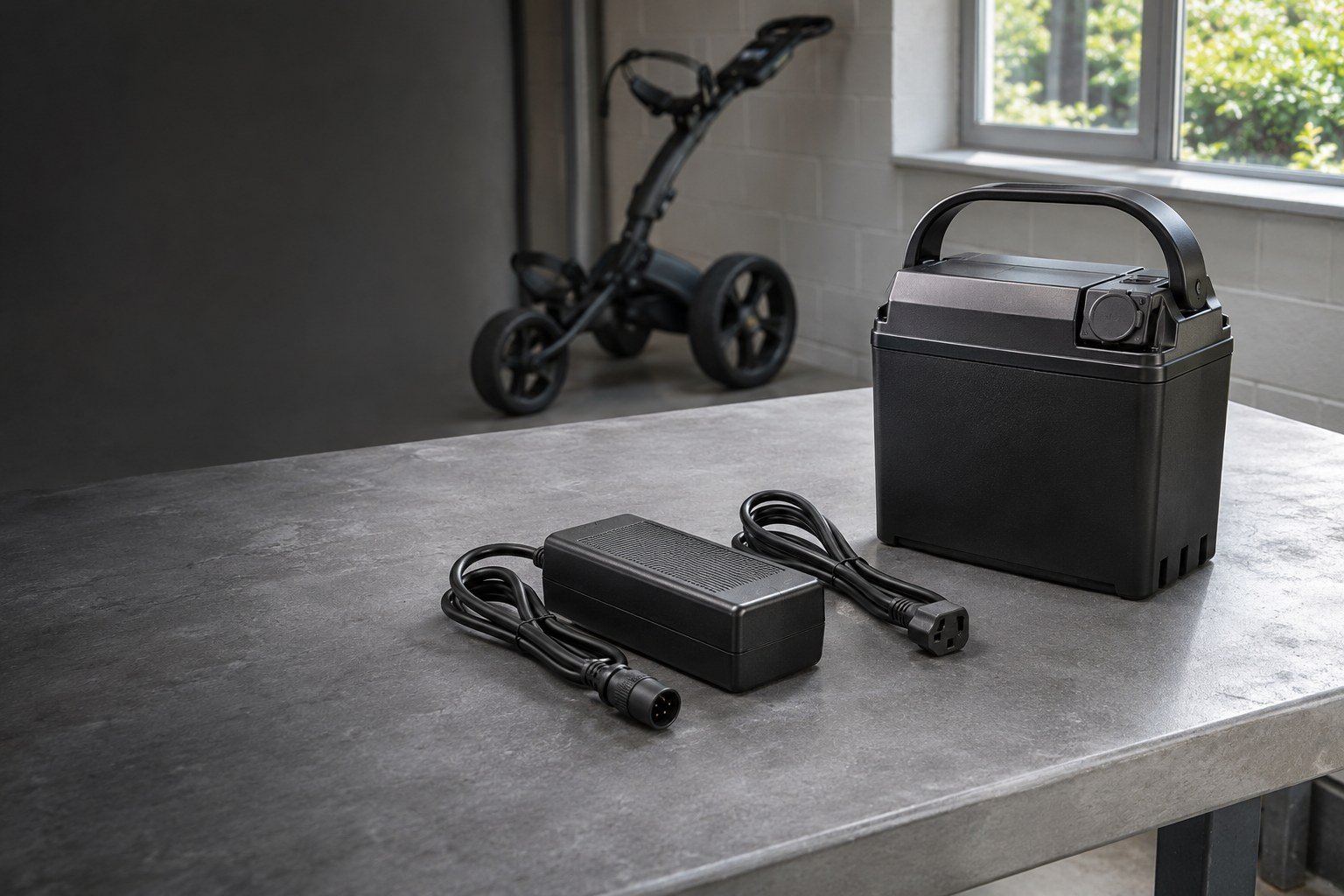
Identify the complete battery and charger before connecting them. Generic AI illustration; no specific product compatibility is shown.
A lost charger creates a deceptively simple shopping problem: find the right-looking lead and get ready for Saturday. The better starting point is a record of the battery actually fitted to your trolley. That record makes it easier to distinguish a genuine replacement from something merely described as compatible.
This guide combines manufacturer instructions with an original matching worksheet. It is research-led guidance, not a charging test or approval of an unlisted combination.
This is a research-led guide. How we assess golf equipment explains the evidence behind our recommendations.
Read the installed pack’s model and chemistry, including any replacement fitted since purchase.
Use the matching manual or manufacturer confirmation to identify the charger.
Match the listing and delivered label to the approved part number.
Save the correct connection sequence, indicators and storage routine with the equipment.
Identify the system you own today
Bring together three identities: the trolley, the installed battery and the charger, if you still have it. Photograph their exterior labels while the equipment is disconnected. Keep serial numbers in your own records or send them directly to support; there is no need to publish them in a forum.
Buying year alone can be misleading when old stock remains on sale. Record the model year or version shown in the documentation, the serial number and the battery’s own part number. If a previous owner replaced the battery, start the charger enquiry from that replacement pack and establish that it is approved for the trolley too.
The Motocaddy SE illustrates why generation matters. Its 2024 manual identifies a 12.8V lithium charging system and names S-ULTRA 274Wh lithium or 12V 21Ah lead-acid battery options. The 2026 SE manual describes a 28V system. “Charger for an SE” therefore leaves an important question unanswered.[2][3]
If a label is missing or unreadable: send a clear overall photograph and every remaining identifier to the manufacturer. A previous seller’s description can help the enquiry, but it should not become the approval on which you charge the pack.
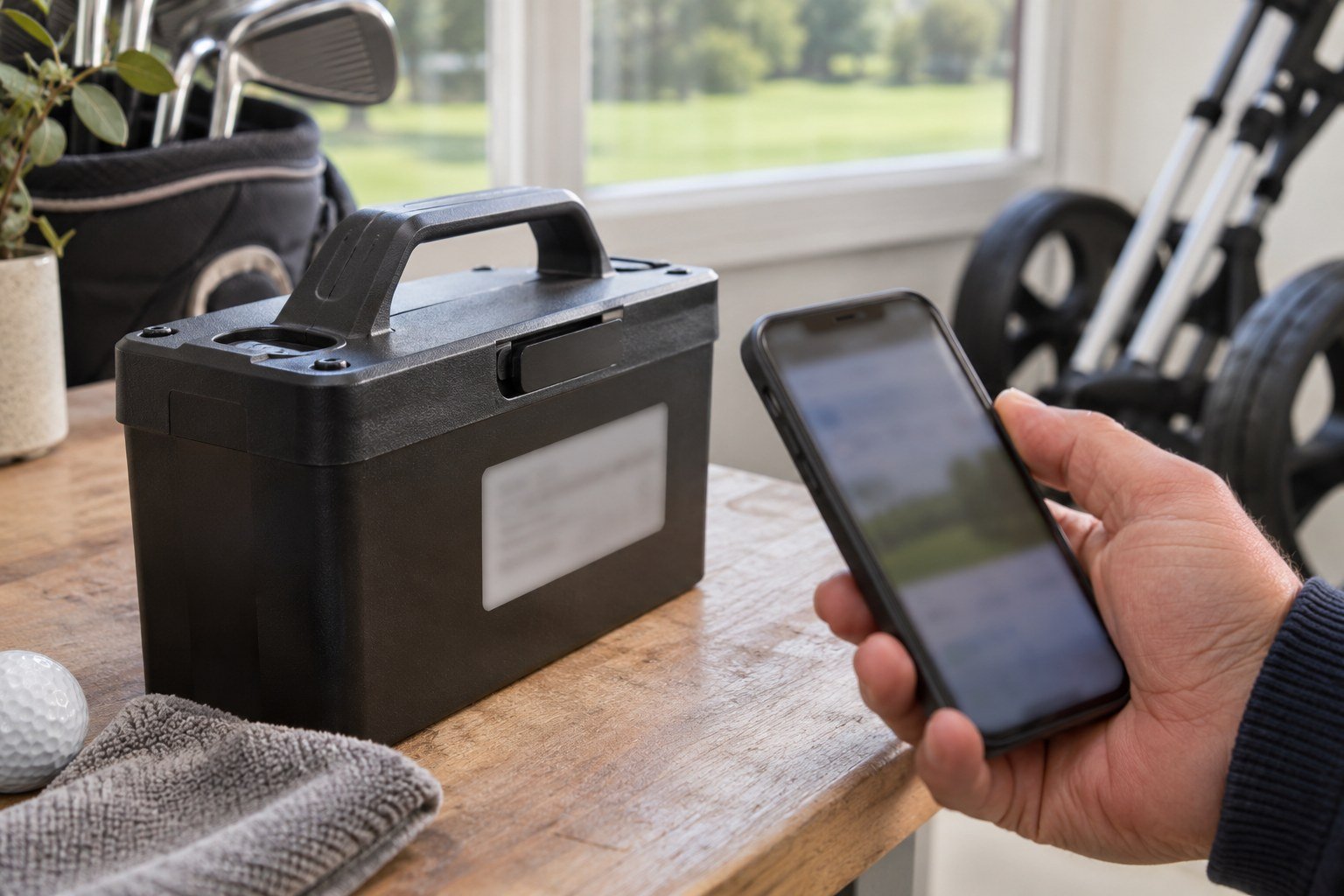
The battery-to-charger matching worksheet
Copy this table into a note before you shop. The final column is a decision gate: an empty field means the match remains unresolved. This is a proposed buying check, not an electrical test.
| Record | Evidence to keep | Ready to proceed when… |
|---|---|---|
| Trolley identity | Exact model, version and serial number. | The manufacturer has identified the correct generation. |
| Installed battery | Maker, model/part number, chemistry, marked voltage and capacity. | The details describe the pack you own, including any replacement. |
| Approved charger | Charger model or part number in the battery instructions or written manufacturer reply. | The approval names this battery or its explicitly defined battery family. |
| Connections and lead | Photographs of the specified charging connection and supplied mains lead. | The documented arrangement matches without alteration or an improvised adaptor. |
| Retail listing | Full product code, included lead, seller identity and relevant exclusions. | The seller confirms the approved item is what will be supplied. |
| Instructions | Manual title, revision/date and relevant page. | You have the connection order, completion indication and charging conditions. |
Keep a photograph of the old charger as supporting evidence, but do not assume it was correct merely because it came with a used trolley. Ask the manufacturer to confirm the proposed replacement against the battery identity.
For a shared household or club store, make a separate record for each battery and charger. A removable storage tag can identify a confirmed pair, provided it does not cover safety labels or ventilation. Avoid a communal box of interchangeable-looking leads.
Back to top ↑Electric trolley chargers: exact matches in the manuals
These examples show the level of detail to seek. They are not a universal compatibility chart and do not approve a battery for a different trolley.
| Documented example | Published distinction | Buying implication |
|---|---|---|
| 2026 Motocaddy SE manual | 28V blue/black battery connections: white LC-2326 charger. The supported grey/black 28V alternative uses black LC-2323.[3] | “28V Motocaddy” alone does not identify the required charger. |
| Motocaddy/LitePower 12V lithium charger | The product page identifies part LICH128BLKBL and specified 12V lithium applications.[4] | Retain the part code; do not extend that description to every lithium battery. |
| Motocaddy lead-acid charger | The manufacturer lists its supplied lead-acid batteries and explicitly excludes Explorer.[5] | Read exclusions even when the chemistry and brand appear to match. |
Colour is useful within the manufacturer’s documented system. It is not an independent electrical standard. Photograph the housing without opening it or touching contacts, and use that photograph alongside the model code.
When a broad shop description conflicts with a specific manual, ask for confirmation that identifies both the battery and the charger. Do not choose whichever wording permits the purchase. The same applies when a newer part is said to supersede an older one: obtain the replacement mapping from the maker.
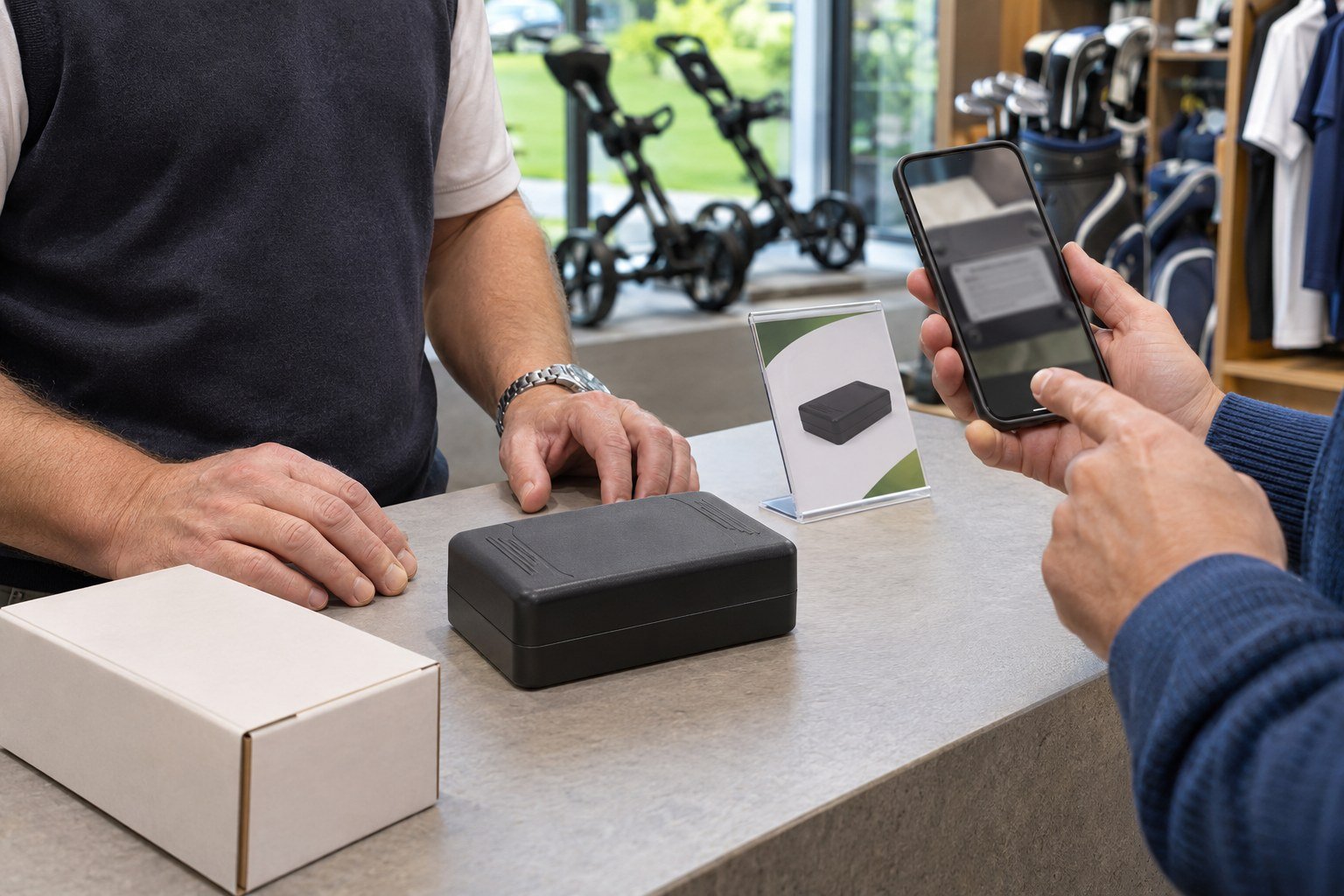
Read the whole label, then the charging instructions
Copy the label exactly. Keep the battery’s voltage and capacity fields separate from the charger’s input and output fields; they describe different parts of the system. Do not reduce the matching exercise to finding two similar numbers. Approval of the complete combination is the useful evidence.
Ask the supplier to identify the exact UK mains lead supplied as well as the charger body. A photograph of a connector on its own leaves unanswered questions about the rest of the product and its provenance. A generic “golf trolley charger” title is a reason to request the full code, not a reason to experiment.
Indicator instructions also vary. The 2024 SE lithium instructions describe four green LEDs reaching a steady fully charged display. Motocaddy’s lead-acid instructions distinguish a 90% stage from full charge.[2][7]
Write down the completion signal for your charger, including whether a light is steady or flashing. Record which connection comes first and whether the battery has an on/off control that must be set for charging. Follow the applicable sequence rather than copying the routine from another trolley.
A faster-looking charger is not an upgrade by default. Unless the battery manufacturer approves that exact charger, a higher output figure or “rapid” description does not establish suitability. Treat the supplied charger’s instructions as part of the purchase.
Back to top ↑Set up a repeatable charging routine
The PowaKaddy CT10 GPS manual specifies its supplied matched charger, a hard flat surface, uncovered equipment and protection from weather. It also prohibits probing terminals with conductive objects.[6]
For lithium equipment, the National Fire Chiefs Council advises against charging while asleep or away from home, or where equipment could obstruct an escape route. Inspect the battery, charger and cable before use; damaged equipment should not be charged.[1]
- Choose the time. Allow for the full charging procedure in your manual while you can supervise it.
- Prepare the place. Use the required dry, clear surface and temperature conditions. Keep the manual accessible.
- Follow the sequence. Use only the confirmed charger, specified lead and prescribed battery-switch setting.
- Check completion. Read the correct indicator sequence and disconnect as instructed.
Do not borrow a universal “leave it on overnight” or winter top-up rule. Motocaddy’s 2019 lead-acid instructions, for example, require disconnection after charging and a six-week interval during prolonged storage. That instruction belongs to the system covered by that manual.[7]
If your equipment will spend winter somewhere colder than its permitted charging conditions, decide in advance where you can follow its instructions. A tidy shelf is not automatically an appropriate charging location.
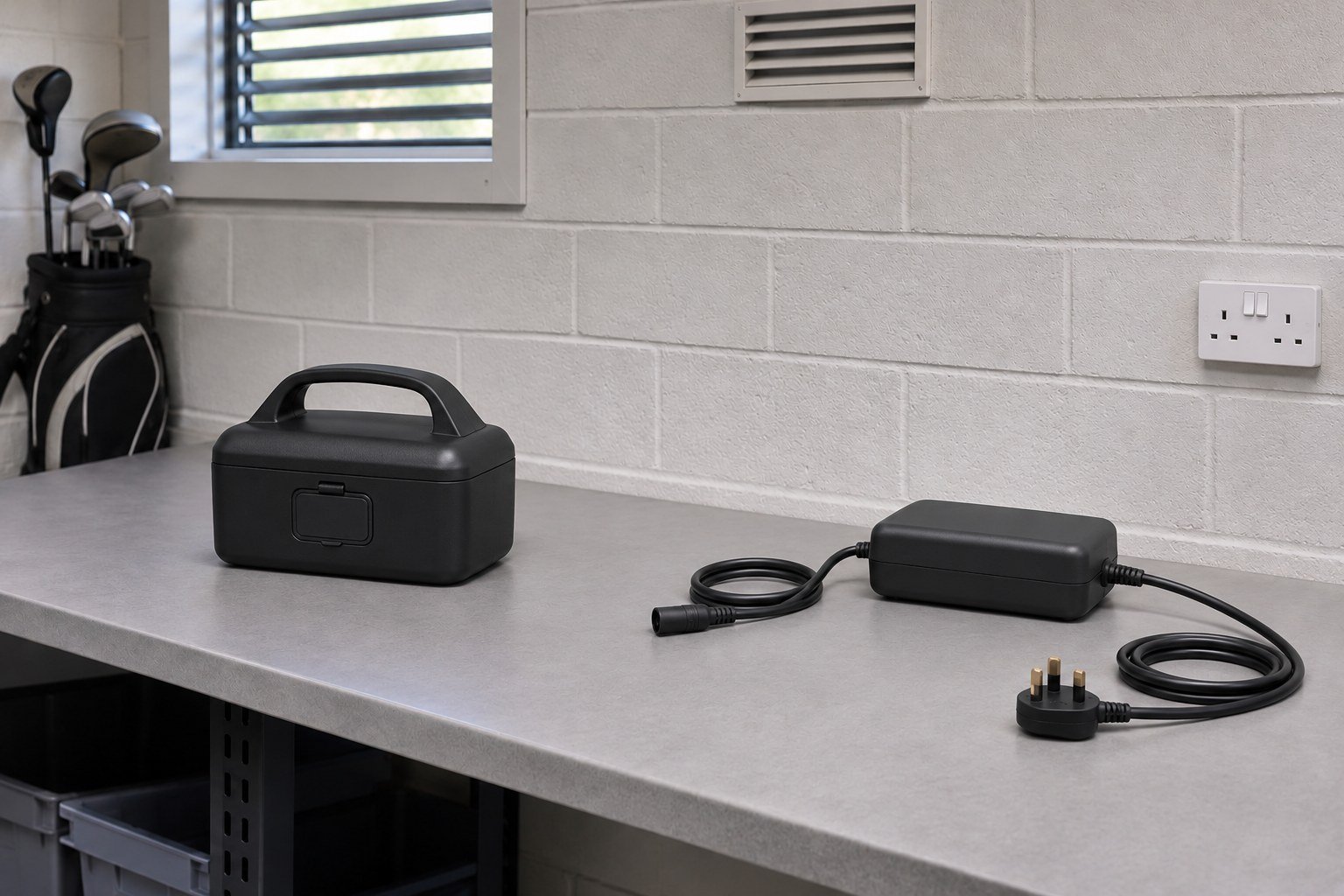
Separate a missing charger from a charging fault
Replacing a lost, identified charger is a purchasing task. Investigating a pack that no longer charges is a diagnosis task. A failed round does not, by itself, tell you which component needs replacing.
PowaKaddy recommends checking the charger when a battery is failing prematurely and having the charger checked when replacing a battery. Its service guidance suggests arranging the visit first so the agent can say which equipment to bring.[8]
Send the agent a short history: when it last worked, whether the battery or charger changed, the observed lights, and any drop, water exposure or visible damage. Describe what happened without repeating an uncertain charging attempt simply to recreate it.
Stop using or charging a damaged, swollen, leaking or unusually hot lithium pack and seek disposal or service advice. If it is smoking or burning, do not move it: get out, stay out and call 999.[1]
The owner’s role here is exterior observation and accurate reporting. Do not open the casing, alter wiring, probe contacts or bypass protection electronics. The CT10 manual states that its battery has no user-serviceable parts.[6]

Buy the approved replacement, with its identity intact
Once the match is confirmed, compare sellers offering that exact product. Check the actual seller, included lead, condition, instructions and returns process. The National Fire Chiefs Council recommends manufacturer-approved replacements and reputable retailers, and cautions that the history of second-hand chargers may be unknown.[1]
The manufacturer’s 12V lithium charger listing and lead-acid charger listing are useful identification starting points for the applications they name. Neither is a recommendation for an unidentified battery.[4][5]
Before connecting the delivery, compare its label and contents with the approval you saved. If the code differs, ask whether it is an authorised supersession. Keep the item disconnected while the discrepancy is resolved.
Here is a concise message you can adapt:
My trolley is [model/version/serial]. The installed battery is [maker/model/chemistry/voltage], shown in the attached label photographs. Please confirm the approved replacement charger part number, the required mains lead and the current charging instructions. The proposed listing is [link]. Is this exact supplied item approved for this battery?
If your real problem is insufficient playing range, investigate that separately before buying a charger. Our guide to trolley battery capacity and 36-hole claims explains the route, load and system questions that a charger purchase will not answer.
Back to top ↑Keep one useful record for next time
Store the confirmed part numbers, manual and purchase receipt together. Add the manufacturer’s reply if the match required clarification. If the battery changes later, review the record before reusing the charger.
The successful outcome is simple: you can explain exactly which battery the charger is approved for, show the evidence and follow the correct routine. If any of those steps remains uncertain, manufacturer identification is the next purchase-saving action.
Back to top ↑Frequently asked questions
Can I use a charger because its plug fits?
No. The physical connection is only one part of an approved combination. The 2026 Motocaddy SE instructions distinguish two 28V battery/charger pairings, illustrating why a broad voltage or brand description is insufficient.[3]
Can a lead-acid charger charge a lithium trolley battery?
Do not use it unless the battery manufacturer explicitly approves that exact charger for the pack. Motocaddy publishes separate lithium and lead-acid chargers with defined applications.[4][5]
Does a green light always mean charging has finished?
Use the indicator sequence for the actual charger. Motocaddy’s lead-acid manual distinguishes 90% charge from full charge; the 2024 SE lithium instructions use a four-LED display.[7][2]
Can I buy a charger before identifying the battery?
Identify the installed battery first, then obtain the approved charger code. A product family name is incomplete information: Motocaddy publishes separate lithium and lead-acid charger applications, including exclusions.[4][5]
Where can I find the correct Motocaddy manual?
The manufacturer’s instruction library groups manuals by model and year and includes separate battery instructions. Match your equipment’s identity, then ask support about any conflict or replacement battery.[9]
Sources and checks
Sources consulted on 23 November 2026. Manufacturer and retailer descriptions are attributed claims; illustrations do not show tested products. Recheck current model-specific instructions and compatibility before use or purchase.
- National Fire Chiefs Council — Lithium-ion batteries
- Motocaddy — 2024 SE Instruction Manual, pages 6–8
- Motocaddy — 2026 SE Instruction Manual, pages 6–9 and 18
- Motocaddy — Motocaddy/LitePower 12V Lithium Charger
- Motocaddy — Lead-Acid Battery Charger
- PowaKaddy — CT10 GPS Owners Manual, REV2, battery care
- Motocaddy — Lead-Acid Battery Instructions, 2019
- PowaKaddy — FAQs and Technical
- Motocaddy — Instruction Manuals
Illustrations in this article were created for Taylor’s Trailblazing Golf. Third-party photographs, where used, are credited beside the image or in the source list.