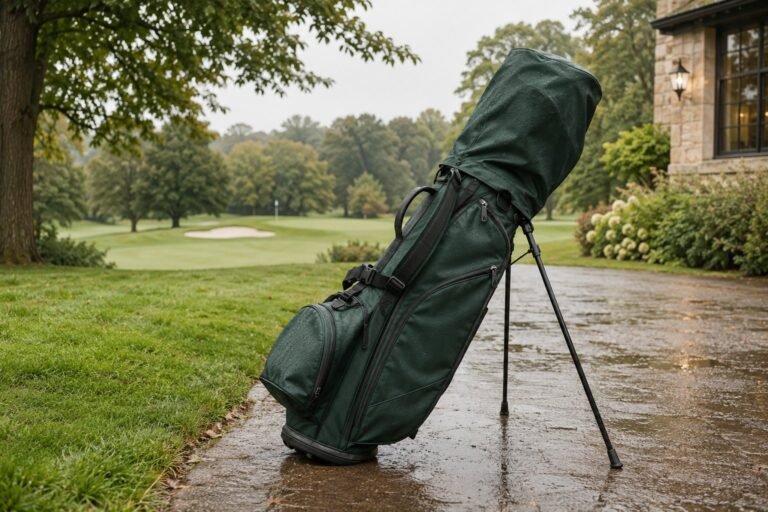
Golf Bag Pocket Layout: Pack for a Walking Round
Give each pocket a job, then check retrieval with the bag packed for the round you intend to play.
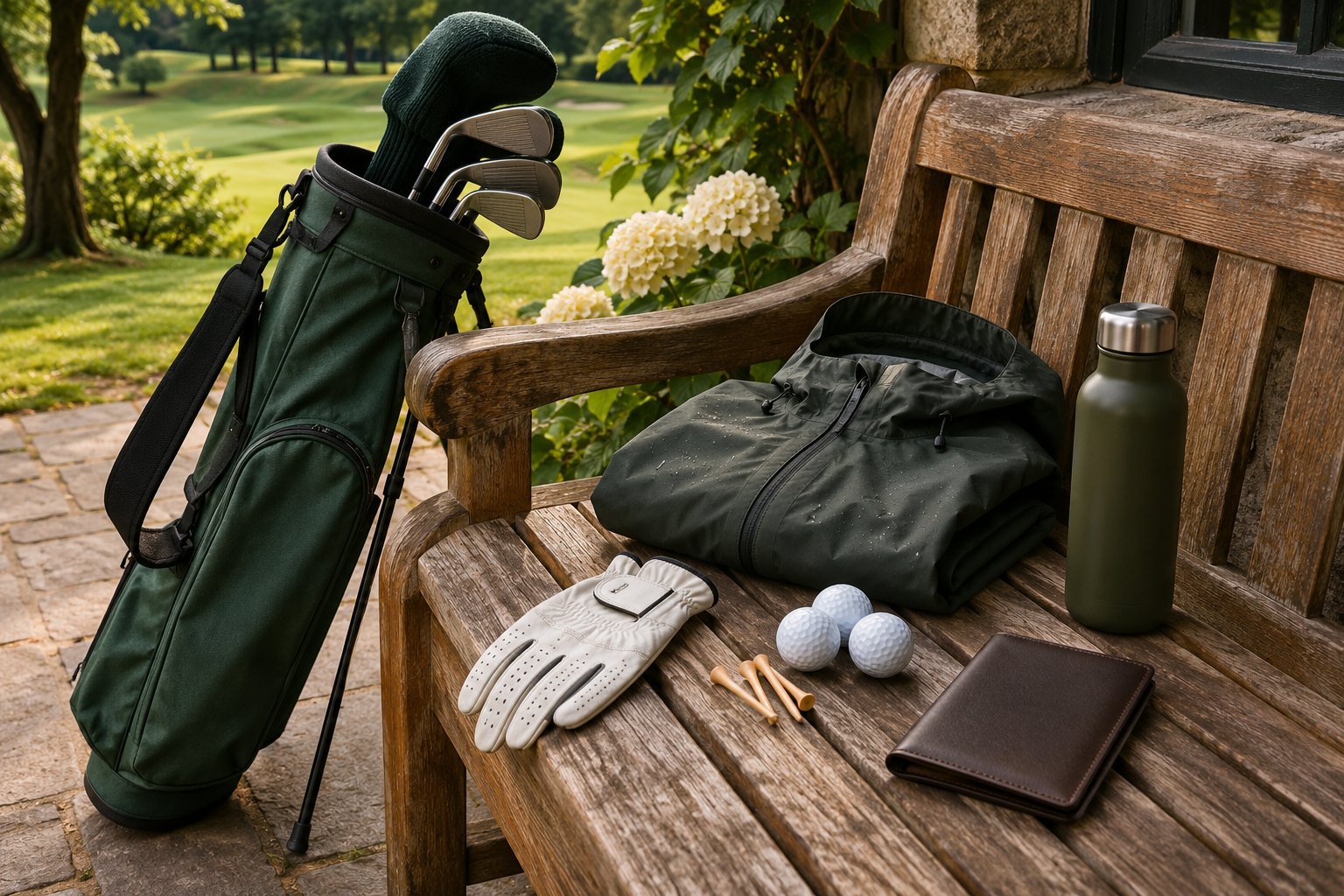
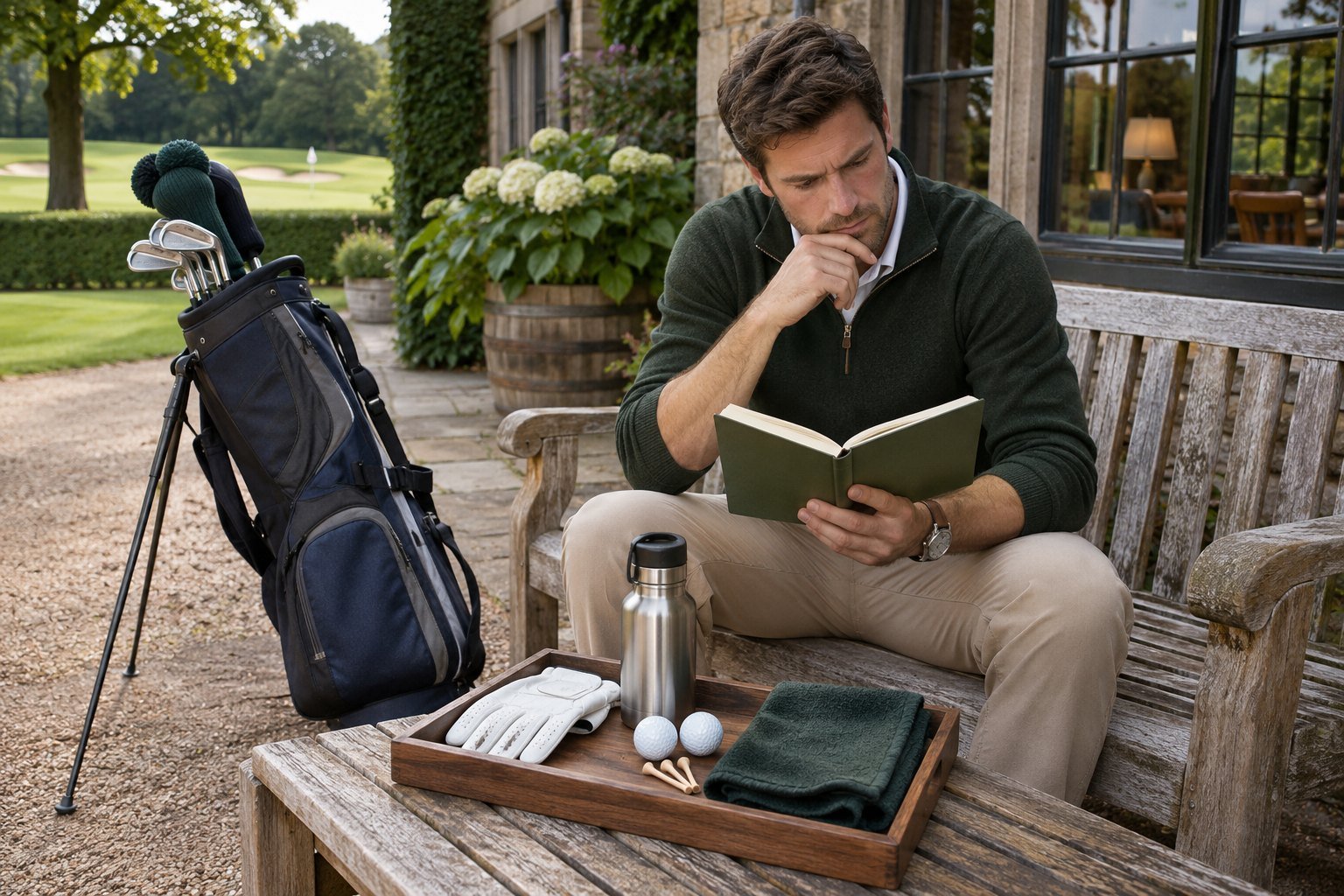
Plan a place for the items you actually need. AI illustration of a generic walking-round load.
A useful golf bag pocket layout is one you can operate without repeatedly moving other equipment out of the way. The number of pockets matters less than whether your bottle, weather kit, small tools and personal essentials have accessible homes at the same time.
For a walking round, start with the contents you actually need. A photograph of an empty bag cannot show what happens when its apparel pocket is full, a hood is attached and the bottle is in place.
This guide provides a packing worksheet and a repeatable retrieval check. Product examples come from published specifications; no hands-on comparison or timed access test is claimed.
This guide contains affiliate links. If you buy through them, Taylor’s Trailblazing Golf may receive a commission at no extra cost to you.
Choose the item and action first; decide the compartment second.
Taking an item out is only half the job. It must go back and close properly.
Consider the jacket or hood you will need to put away later.
Write what obstructs a task, then test one practical change.
Build a golf bag pocket layout around tasks
Lay out your intended round’s equipment before allocating pockets. Keep necessary items, remove forgotten contents and distinguish what you expect to use frequently from reserve supplies. Choose quantities for your own round; this is not a universal prescription for a particular number of balls or layers.
Scroll within the table to see every column.
| Task | Contents to assign | Access question |
|---|---|---|
| Restart after a lost or damaged ball | Your chosen ball reserve, with frequently used small items organised separately. | Can you find one ball without emptying the pocket? |
| Mark, repair or record | Marker, pitchmark tool, pencil and scorecard as needed. | Can each small item be found without fishing beneath loose equipment? |
| Measure a shot | Rangefinder or other equipment you actually use. | Can it be removed, replaced and secured in its intended storage? |
| Respond to the weather | Rain hood and the clothing you have decided to carry. | Can the first item needed come out before the rest gets disturbed? |
| Take a drink or snack | Your filled bottle and chosen food in suitable containers. | Will the bottle go back, and are spillable items kept apart from valuables? |
| Store personal essentials | Phone, keys and other necessary items. | Does the chosen compartment have the protection and closure these need? |
Assign a first-choice location to each group. Avoid allowing the largest compartment to become the default home for everything left over. If two tasks share a pocket, identify how the smaller item will remain findable when the larger item is packed.
A small pouch you already own can organise loose tools, provided it fits and does not obstruct the closure. It does not automatically make its contents waterproof or create extra storage. Include the pouch itself in the loaded check.

Read the openings, not just the pocket count
PING’s UK Hoofer Lite page lists nine pockets, including a valuables pouch, a zipped rangefinder pocket, a full-length opening for the apparel pocket and storage areas inside it. Those details offer more useful questions than the total alone: which opening suits your item, and will an internal section remain accessible? [1]
Callaway’s UK Fairway C listing, product ceu253701, gives a total of eight pockets. That number does not establish whether it will work better or worse for your load. Compare actual openings and occupied space rather than treating the extra pocket in another bag as an automatic advantage. [2]
Look for the depth and shape of an opening, its closure and the direction in which you reach it when the bag rests normally. A tall bottle, rigid rangefinder case or folded jacket may expose an awkward shape that a pocket count cannot describe.
Check neighbouring compartments together. An opening can be accessible when the bag is empty yet awkward with the adjacent pocket packed. Do not infer the usable size of a particular pocket from the bag’s total storage volume.
Descriptions such as valuables, apparel or cooler pocket tell you the intended role. They do not supply dimensions, a waterproof rating or a temperature guarantee unless the maker provides that information separately.
Back to the top ↑Check retrieval with the loaded bag set down
Use a clean, suitable area and arrange the bag in its intended resting position. For a stand bag, deploy the stand normally and ensure it rests securely before opening pockets. Load the actual clubs and headcovers as well as the pocket contents; an empty shell is only a preliminary check.
- Close every occupied pocket without forcing it. Note any item that prevents normal closure.
- Take out one frequently used item and replace it. Include its usual case, lid or wrapper.
- Try the same task with the hand and glove arrangement you normally use. Note whether a closure or pull is awkward.
- Repeat the weather-kit task with the hood fitted correctly. Check whether fabric or straps cover another opening.
- Restore the complete load and check the neighbouring pocket before accepting a new assignment.
Record the obstruction, not a stopwatch result. “Jacket must come out to find the hood” is useful. “Access was slow” is harder to act on. There is no justified universal pass time for retrieving a bottle or rangefinder.
If carrying the packed bag is the remaining concern, use the separate loaded golf-bag harness fitting guide. The retrieval check here assesses storage access; it does not establish carry comfort or replace that model-specific fitting process.
Plan where wet and spillable items will go
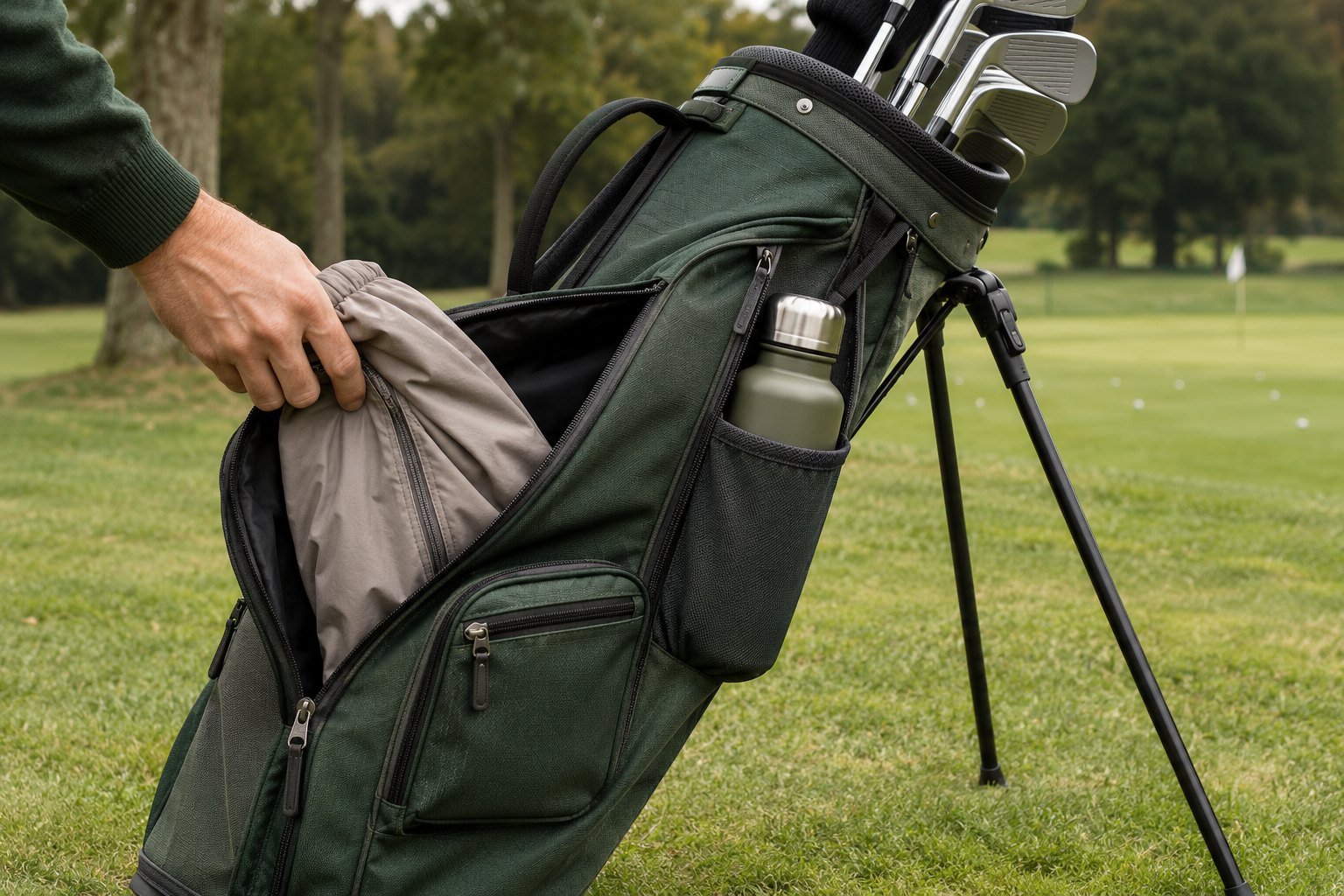
Think about the return journey as well as the start. A jacket may leave the bag dry and return damp. A towel may need a different resting place after use. Identify where these will go without sharing direct contact with spare dry clothing or personal electronics.
Use the bag’s intended bottle holder if it suits the actual container, and check that the cap is secure before packing. Do not force a larger bottle into an opening or rely on an improvised attachment. Keep the bottle’s possible leak route in mind when choosing a neighbouring valuables location.
A separate suitable pouch or compartment can help organise wet kit, but establish its protection from its own specification. A soft lining, ordinary zip or compartment name is insufficient evidence of waterproofness. Do not assume a storage pocket compensates for a leaking container.
Leave a workable route for the item you will need first when the weather changes. If the hood is underneath spare clothing, change the order or use its intended pocket. If wearing a layer frees space, check whether that same layer can be returned without squeezing the closure.
Keep food and drink in appropriate containers, with an assigned place for used packaging. Check the planned storage again when the contents change rather than assuming the original arrangement will still work.
Use a loaded-bag pocket worksheet
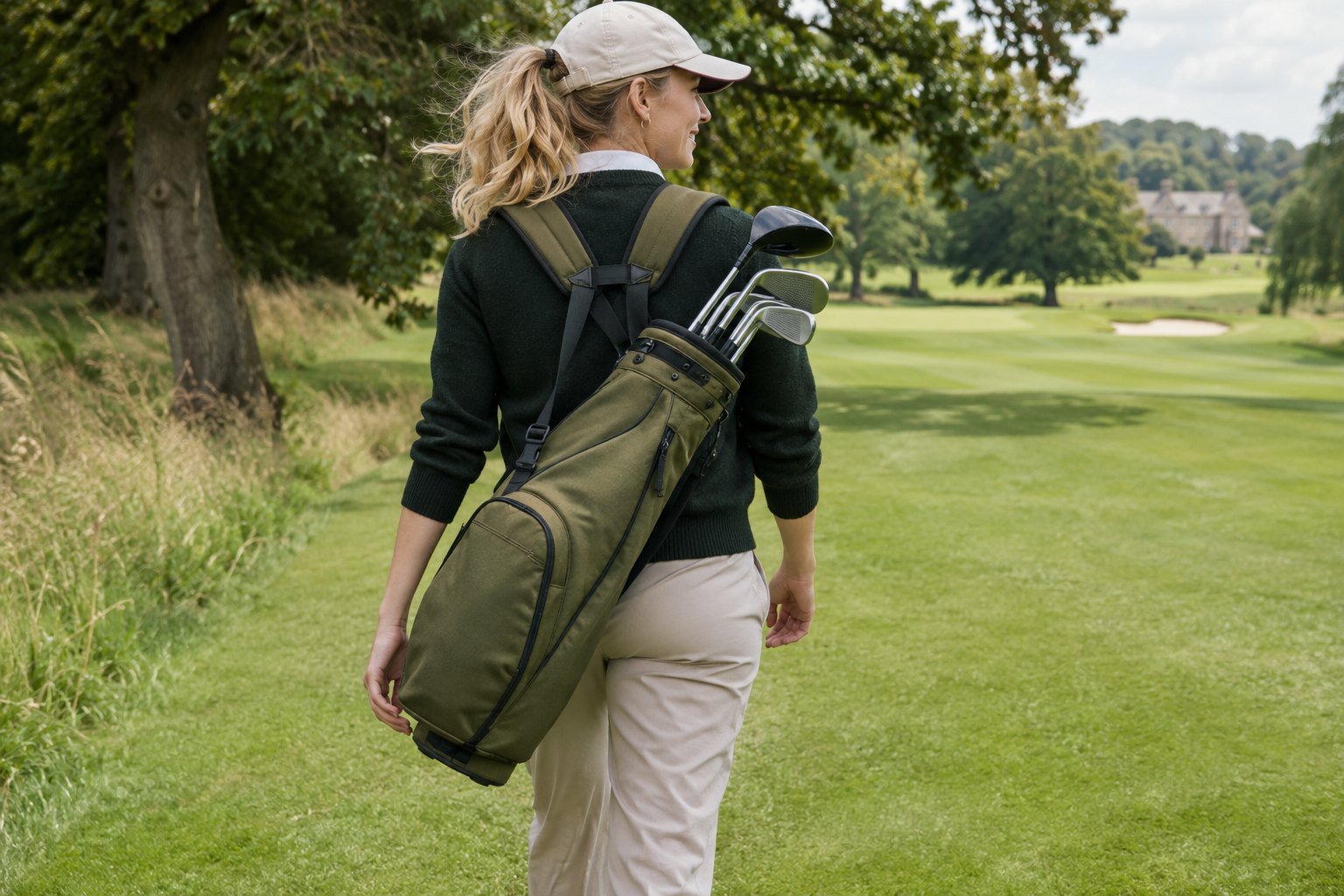
Copy the following headings into a note and complete them with your own bag. The first three entries are illustrative observations, not reported tests of the named products. Replace them with what you actually find.
Scroll within the table to see every column.
| Item and actual packed form | Assigned pocket | Retrieve and replace | One change to try |
|---|---|---|---|
| Example: rain hood, packed as supplied | Inside apparel pocket | Illustration: jacket must come out first. | Give the hood an accessible position or use its intended separate pocket. |
| Example: filled bottle with its usual lid | Bottle holder | Illustration: fits, but presses against an adjacent opening. | Check the neighbouring pocket when both are occupied. |
| Example: rangefinder in its case | Designated storage | Illustration: easy to remove; case catches on replacement. | Check opening size, orientation and closure with the actual case. |
| Your item: __________ | __________ | What happens: __________ | __________ |
| Your item: __________ | __________ | What happens: __________ | __________ |
At the top of the record, add the bag’s exact model, the intended round, the clothing and bottle used, and whether the hood was attached. A quick photograph can preserve the arrangement without a detailed packing diagram.
Make one change to an awkward task and repeat it with the rest of the load restored. Moving the hood may solve one problem while occupying space needed for a spare layer. The useful result is a working arrangement for the complete load, not an isolated pocket that looks tidy.
Use three plain outcomes: works with this load; works after the recorded change; still needs different storage. These describe the observed arrangement. They are not scores for the bag or a promise that every later round will be identical.
Keep the record short enough to use again when a larger jacket, a different bottle or an additional necessary item changes the packing.
Back to the top ↑Fix the access problem before changing the bag
Scroll within the table to see every column.
| Repeated problem | Try first | When different storage may help |
|---|---|---|
| Small items disappear under balls | Separate the working items using an existing organiser or suitable pouch. | The only available pocket is too deep or awkward for the task. |
| A layer fits only with the zip under strain | Remove forgotten contents and change the fold or assignment. | Required clothing still cannot fit alongside the rest of the load. |
| The hood hides another opening | Check the correct hood attachment and the intended access sequence. | The required items remain obstructed in the configuration you use. |
| A bottle has no satisfactory home | Check the intended holder with the actual filled container. | The holder’s opening, position or retention is unsuitable. |
| One pocket works until the next is packed | Repeat the task with both occupied and change the allocation. | The shared space cannot accommodate the required items together. |
A successful repack is a valid outcome. Do not add organisers automatically: another pouch can also consume room and introduce another closure. Start with items and compartments you already have.
If the difficulty is clubs or grips catching rather than pocket retrieval, investigate it separately with the guide to checking full-length golf-bag dividers. Moving small accessories will not explain every problem inside the club compartment.
Buy different storage when you can name the task that remains unsolved: the necessary jacket cannot close inside, the bottle has no suitable holder, or a frequently used item cannot be secured conveniently. “More pockets” is too vague a purchase brief.
Reset the layout after the round
Empty used wrappers and remove items that have no role in the next round. Take damp clothing and towels out, separate them from dry equipment, and check the condition of the pocket before repacking. Restore the chosen positions once everything is ready.
Sun Mountain’s cleaning guidance recommends thoroughly drying the bag and leaving pockets open for airflow, away from direct heat or sunlight. Follow your own model’s care instructions before applying a cleaner or washing any component. [4]
Review only the tasks that were awkward. If a tool repeatedly disappears, change its assigned location rather than accepting the same search each round. If an item stays unused, decide whether it is a necessary reserve or simply forgotten equipment; frequency alone does not settle that.
A stable layout should make the pre-round check easier: required items present, containers closed, closures usable and room available for the clothing you may remove. Update it when the expected conditions change.
Back to the top ↑Buy for a proven pocket requirement
If you want to inspect the Hoofer Lite arrangement, view the PING Hoofer Lite in Black at Clubhouse Golf. The retailer identifies article number 36415-01, nine pockets, a bottle pocket and an included rain hood. Check that exact bag with your contents; these listed features do not establish that your particular bottle or jacket fits. [3]
For an alternative layout to compare, view the Callaway Fairway C, product ceu253701, on Callaway UK. Use the same essential load and retrieval questions. Its eight-pocket specification supplies a comparison point, not a reason on its own to prefer it. [2]
Ask a shop to demonstrate the relevant openings, or obtain dimensions and photographs of the particular compartment before ordering. Read the seller’s conditions for an indoor inspection and return; do not assume an outdoor round is permitted as a trial.
Choose the layout that gives every necessary item a suitable home while preserving access with the whole bag packed. If a modest rearrangement makes your present bag work, keep the worksheet and the bag. The useful improvement is a repeatable packing routine, whether or not it requires a purchase.
Back to the top ↑Sources and research
Research reviewed on 23 November 2026. Manufacturer descriptions, official guidance and retailer information are distinguished from the original planning worksheets and editorial recommendations in this guide.
- PING UK — Hoofer LiteNine-pocket layout and named openings and storage areas. Checked 23 November 2026.
- Callaway UK — Fairway C, product ceu253701Exact UK product page and eight-pocket specification. Checked 23 November 2026.
- Clubhouse Golf — PING Hoofer Lite, BlackExact article 36415-01, bottle storage and rain-hood inclusion. Checked 23 November 2026.
- Sun Mountain — How to clean a golf bagDrying and pocket-airflow advice, published 24 March 2026. Checked 23 November 2026.
Find more equipment guidance in Golf Bags.
Illustrations in this article were created for Taylor’s Trailblazing Golf. Third-party photographs, where used, are credited beside the image or in the source list.