
Golf Shoes for Links Courses: Traction and Weather Needs
Choose for the grass, paths and weather you expect to encounter. A links address alone does not establish which outsole or upper will suit the day.
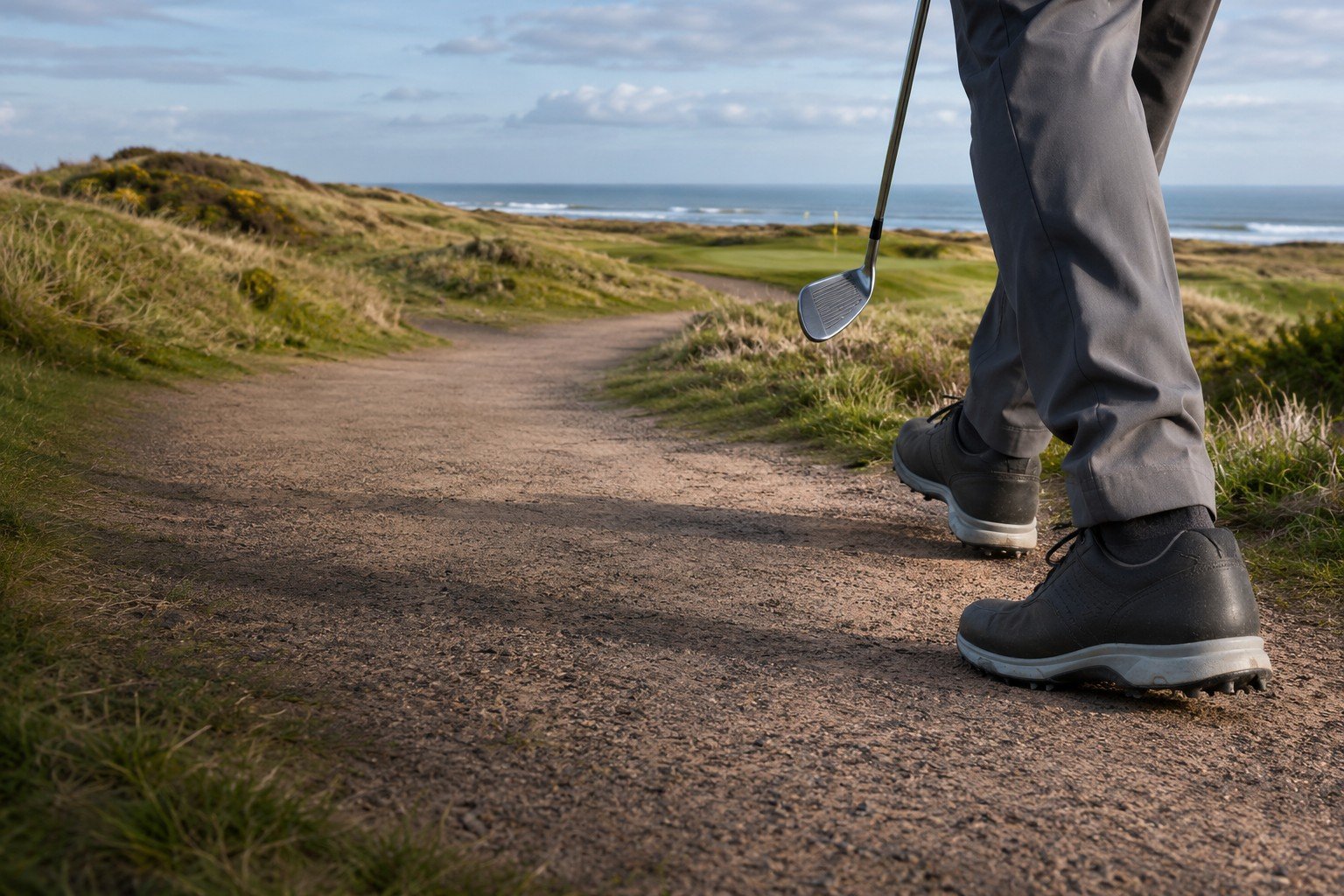
AI illustration. Links footwear decisions include paths, grass and the day’s conditions.
This guide contains affiliate links. If you buy through them, Taylor’s Trailblazing Golf may receive a commission at no extra cost to you.
Choosing shoes for a links round means considering the route and the day’s conditions together. Compare the course’s footwear guidance with the exact shoe’s sole, weather claims and fit, rather than relying on the links label alone.
Research-led guidance for UK golfers. Read how we assess golf equipment for the distinction between documented features and hands-on testing.
Separate damp grass, sandy transitions and hard paths in your plan.
Compare the pair you own in its current condition.
Waterproof specification does not establish traction.
Course footwear and clubhouse access can have different rules.
Golf shoes for links courses: plan the whole visit
Before opening a product shortlist, describe your round: expected rain, damp morning grass, the amount of walking and the paths between holes. Add any information from the club about current ground conditions and permitted routes. This turns “shoes for links golf” into a practical requirement you can compare with the pair you own.
Ask about footwear on the course and in the clubhouse separately. Prestwick’s published visitor policy, for example, permits soft spikes or spikeless golf shoes in much of its clubhouse but excludes golf shoes from the Dining Room and Smoke Room.[1] That is a specific club policy checked on 23 November 2026, not a rule for every links course. Confirm your host’s current instructions before travelling.
A separate pair for the clubhouse may be more useful than choosing your golf shoes around an assumption about indoor access. Also check where you can change and clean footwear. None of this requires buying a new playing pair if your existing shoes fit, are in sound condition and meet the day’s needs.
Do not use the course name or season as a substitute for that check. A dry forecast does not answer whether the grass will be damp when you start, and last month’s visit does not establish today’s ground condition.
Back to the start ↑Compare spiked and spikeless designs conditionally
Modern spiked golf shoes commonly use removable non-metal cleats; spikeless designs use moulded traction features in the sole. The useful comparison is the actual pattern, its condition and the surfaces you will walk across. “Spikeless” does not mean a smooth sole, and “spiked” does not describe a single tread design.
Adidas’s guidance associates its spiked designs with wet, muddy or uneven ground and describes spikeless shoes as a more versatile option.[2] Treat that as manufacturer design guidance, not a guarantee that one category will outperform every shoe in the other category.
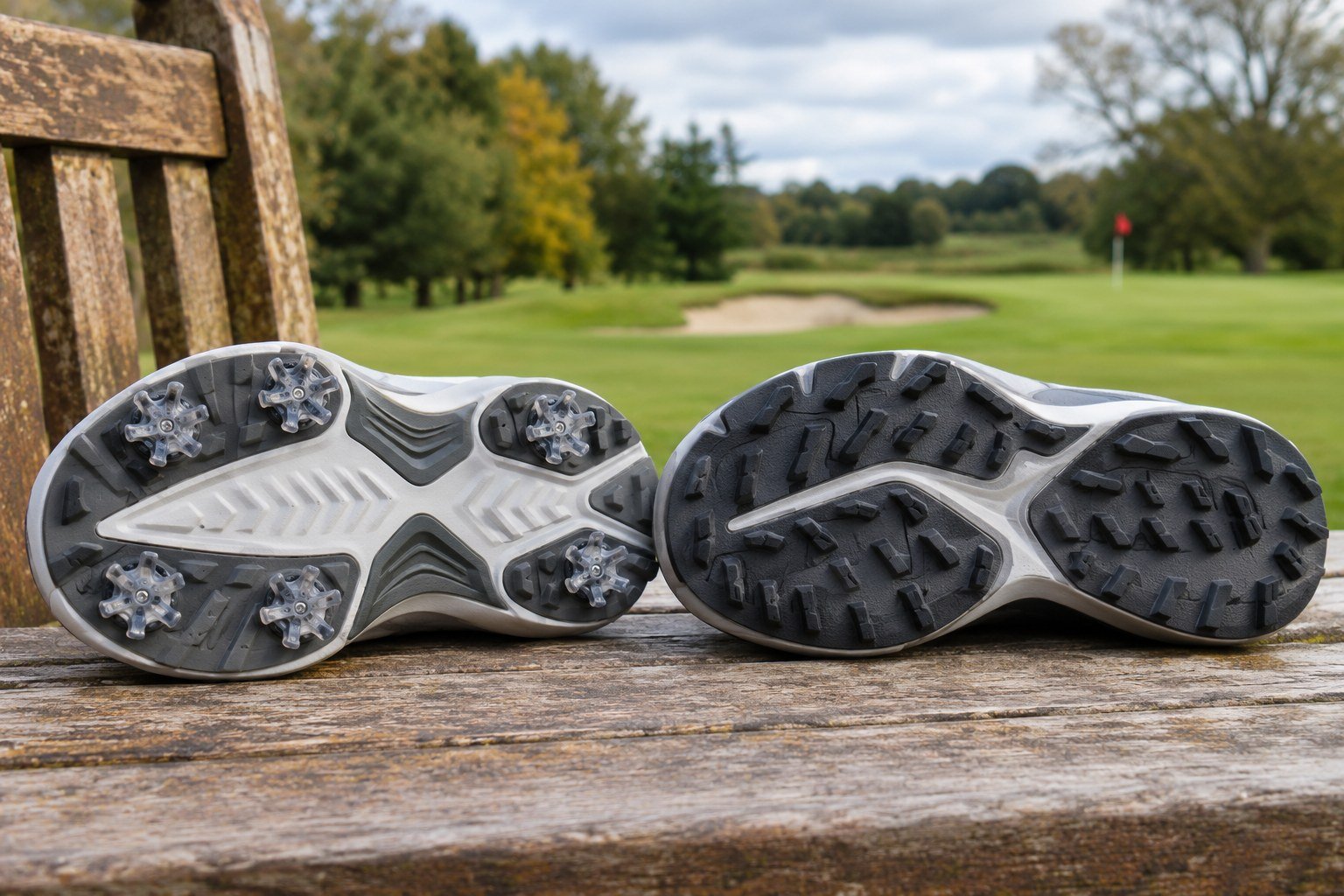
For a wet day, give a suitable cleated pair a place on the comparison list. For a mainly firm route, include a spikeless pair you find comfortable for ordinary walking. In either case, fit can rule out an otherwise appealing outsole. A shoe that lets your foot move excessively inside it has not passed the selection merely because its tread looks substantial.
Consider upkeep as part of the choice. With a replaceable-cleat design, you need the correct replacement interface and an intact shoe to fit it to. With an integral moulded sole, do not assume that worn traction features can be renewed in the same way. Ask about the exact model instead of treating the category name as a maintenance specification.
The practical trade-off is therefore broader than maximum-looking grip: comfortable fit, expected surfaces, current wear, care requirements and what the club accepts all contribute to the decision.
Back to the start ↑Use a surface and condition matrix before buying
List the transitions you expect rather than rating the course with one word such as “dry”. The matrix below is an original planning aid. It does not rank grip or prescribe a deliberate traction test.
On a small screen, swipe inside the table to read every column.
| Expected surface | Footwear priority | Practical response |
|---|---|---|
| Firm, mainly dry short grass | A well-fitting pair with sound, clean traction features. | Consider keeping familiar spikeless or cleated shoes that meet the course policy; do not buy solely for the links label. |
| Wet grass or softer turf | Compare a suitable cleated design; check the upper’s weather specification separately. | Use permitted routes and adapt your plan if footing is uncertain. A more pronounced sole does not remove the need for judgement. |
| Damp sand and sandy transitions | Accessible outsole features that you can inspect and clean using the maker’s method. | Check for accumulated sand before the next hard-surface section. Avoid choosing by an unsupported “best on sand” claim. |
| Hard paths or clubhouse approaches | Comfortable ordinary walking in the actual pair, with its sole clear of loose debris. | Take the designated route and obey indoor footwear restrictions; do not assume either outsole category makes wet paving secure. |
| Frost, flooding or restricted ground | The club’s current access and safety instructions. | Change the route or playing plan as directed. Footwear is not permission to cross closed or unsuitable ground. |
Mark the most demanding expected condition and the most frequent one. They may differ: a long firm walk with several damp transitions is a different planning problem from persistent wet grass. This helps you ask a shop about a real use case without demanding a shoe that is supposedly perfect everywhere.
If the club cannot yet confirm conditions for a future visit, retain that uncertainty in the plan. Check again nearer the day rather than solving it by ordering the most aggressive-looking sole.
Back to the start ↑Check weather protection without overlooking fit
Traction and water protection answer different questions. A waterproof upper specification does not establish how the outsole behaves on wet grass; a substantial outsole does not establish that the upper has a waterproof construction. Read both parts of the exact product description.
For a damp or rainy round, check the stated waterproof claim and any applicable warranty conditions. For a predominantly dry day, compare the feel of the upper and your comfort in it, rather than assuming the same specification is always preferable. A material name or a mesh-looking panel alone is not a complete weather rating.

Keep expectations realistic around the shoe opening. Water entering over the collar is different from a suspected failure through the upper. If a pair becomes wet inside, record the circumstances and follow the manufacturer’s enquiry process; an improvised soak test is unlikely to help a buying decision.
Use the socks and intended insole arrangement you expect to wear. Check heel retention, room across the forefoot and pressure over the top together. Do not accept an awkward fit because a shoe has the preferred outsole. If changing brands, the published golf shoe sizing guide explains how to use the actual model’s chart.
Take a dry spare pair of socks if useful for the day. Treat them as a practical comfort item, not a remedy for a shoe that repeatedly leaks or fits poorly.
Back to the start ↑Two exact examples to make the specification check useful
These men’s models illustrate two different outsole arrangements. They are research-led examples, not a tested ranking or a claim that either suits every golfer. Their value is in showing what to verify before a fitting.
On a small screen, swipe inside the table to read every column.
| Exact example | Documented specification | Question for the fitting |
|---|---|---|
| FootJoy HyperFlex 55489, White/Navy/Green | FootJoy lists Pulsar LP removable cleats with Fast Twist 3.0 receptacles and a one-year waterproof warranty in normal use.[3] | Does this cleated pair fit comfortably for your expected walking, and are you prepared to maintain the correct cleats? |
| Skechers GO GOLF Prestige SL 214126 | Skechers UK lists a lace-up leather upper, spikeless outsole and one-year waterproof warranty.[4] | Does the actual pair suit your fit and expected route? Keep the SL model identity when comparing listings. |
If the cleated HyperFlex fits your requirements, compare the White/Navy/Green HyperFlex at Clubhouse Golf. The retailer’s article number matches 55489.[5] Check the selected size and width before ordering.
For the spikeless option, use the official product specification above to identify Prestige SL 214126. You can also Explore Skechers UK when comparing the wider range. That is a general shopping link; retain the full model name when looking for this example.
Choose neither if the fit is wrong. A sound pair you already own can be the better-value answer when it meets the conditions and policy checks. These examples establish available design choices, not a requirement to replace your shoes for a particular destination.
Back to the start ↑Manage surface changes during the round
Before starting, look over both soles and make sure nothing obvious is loose, damaged or packed with debris. If a cleat is missing or a sole is separating, resolve the issue through the appropriate instructions or support route before treating the pair as ready.
Use normal, permitted walking to notice whether the shoes remain comfortable. Do not seek out wet banks, polished paving or loose sand to test a claim about grip. A deliberate slide or forceful twist tells you little about ordinary play and creates an unnecessary problem.
At a suitable stationary point, clear accumulated sand and dirt with an appropriate brush or cloth and the manufacturer’s care method. Check both shoes. There is no need to scrape the sole with a sharp implement or knock the shoes together hard enough to damage a part.
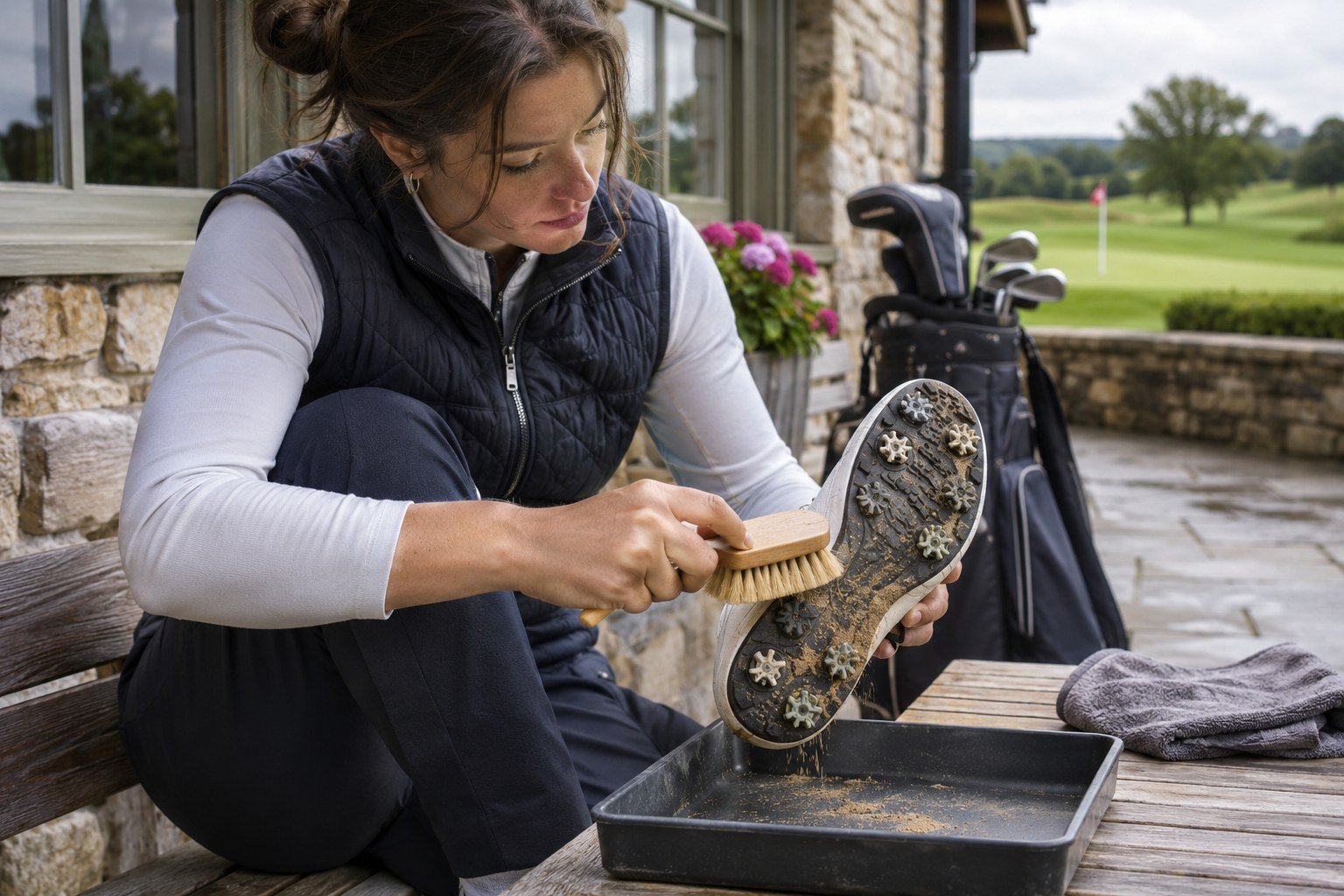
If footing feels uncertain, take the club’s recommended route or ask for guidance. Do not keep traversing a questionable patch to decide whether another outsole would have been better. For a future purchase, note the surface, the shoe’s condition and what happened; avoid turning a single incident into a universal verdict on spikeless or cleated shoes.
Back to the start ↑Clean, dry and inspect before the next round
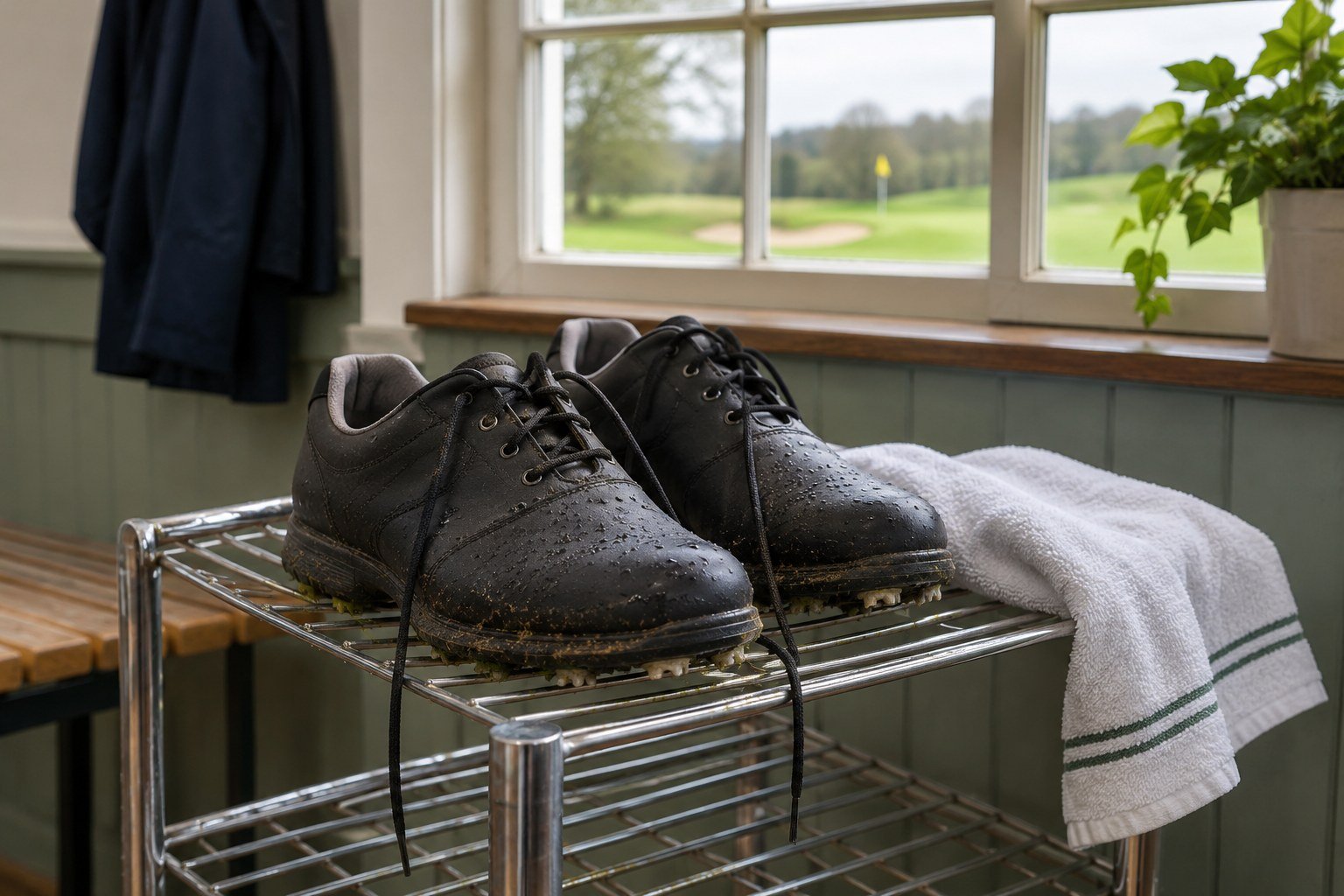
FootJoy advises cleaning dirt from non-leather outsoles, checking cleats are intact and properly secured without overtightening, and allowing shoes to dry naturally away from direct sun or external heat.[6] Follow the care instructions for your own model, including any material-specific restrictions.
Set aside enough time after the round to remove sand and inspect the pair in good light. Packed luggage is a poor place to discover a damaged sole just before the next tee time. Use a suitable bag to contain dirty shoes in transit, then unpack them for the required cleaning and drying.
For replaceable cleats, identify the exact receptacle before ordering replacements. The HyperFlex example above specifies Fast Twist 3.0; that does not make every similarly shaped replacement compatible. If a receptacle or surrounding sole is damaged, ask about the shoe rather than repeatedly tightening the cleat.
With a moulded sole, photograph any area you are concerned about and ask the manufacturer how to assess the model. There is no useful universal number of rounds after which every links shoe needs replacing. Condition, fit and the manufacturer’s guidance provide a better basis for the decision.
Back to the start ↑Make the keep-or-buy decision with a short checklist
Use this record before the visit. Keep it specific enough that a shop or the host club can answer the remaining questions.
- Host course: footwear policy, clubhouse restrictions and the date you checked.
- Expected route: wet grass, firm turf, sandy transitions and hard paths; identify what remains uncertain.
- Existing pair: exact model, outsole condition, comfortable fit and known weather specification.
- Unresolved need: for example, damaged traction features or a pair unsuitable for the expected wet conditions.
- Proposed response: permitted maintenance, a fitting comparison, a different pair you already own or a change to the playing plan.
Keep your present shoes when they meet those checks. Arrange the correct maintenance when a serviceable component is the issue. Buy when you can name the gap and verify that the candidate addresses it while fitting properly.
For a trip with successive rounds, also consider the time and space available for care between them. An additional suitable pair may be practical if you already own one; buying a second pair is not an automatic requirement of links golf.
Check the forecast and the club’s notices again close to play. Then use the chosen pair within those conditions and instructions. More footwear and care topics are available in the Shoes & Gloves guides.
Back to the start ↑Questions before you decide
Are spiked shoes compulsory for links golf?
Do not infer a requirement from the course type. Ask the host club about its current footwear policy. Separately, compare the permitted options against the expected surfaces, fit and condition of the pair you will wear.
Can waterproof spikeless shoes suit a wet links round?
They may be a suitable option for a particular golfer and route, but the waterproof claim concerns water protection, not a traction guarantee. Consider the actual sole and its condition, expected ground and any concerns you have with the pair.
Can I wear my golf shoes throughout the clubhouse?
Check the club’s own policy, including room-specific restrictions. Permission to wear soft spikes or spikeless shoes in one area may not extend to a dining room. Pack appropriate alternative footwear when required.
Sources and editorial checks
Manufacturer specifications and instructions inform this guide. The comparison and checklists are editorial decision aids, not results of hands-on product testing.
- Prestwick Golf Club — Visitor information and dress codeClub-specific example checked 23 November 2026; confirm current instructions before visiting.
- adidas UK — Spikes vs spikeless golf shoesMay 2022 manufacturer guidance; consulted 23 November 2026. Not an independent grip test.
- FootJoy UK — HyperFlex, style 55489Exact UK specification checked 23 November 2026.
- Skechers UK — GO GOLF Prestige SL, style 214126Exact UK specification checked 23 November 2026.
- Clubhouse Golf — HyperFlex White/Navy/Green, 55489Matching retailer listing checked 23 November 2026.
- FootJoy UK — Shoe CareCare guidance consulted 23 November 2026.
Illustrations in this article were created for Taylor’s Trailblazing Golf. Third-party photographs, where used, are credited beside the image or in the source list.


