How to Evaluate a Hybrid Before Buying Without a Launch Monitor
Make a useful comparison with visible targets, ordinary shots and a clear record of what happened.
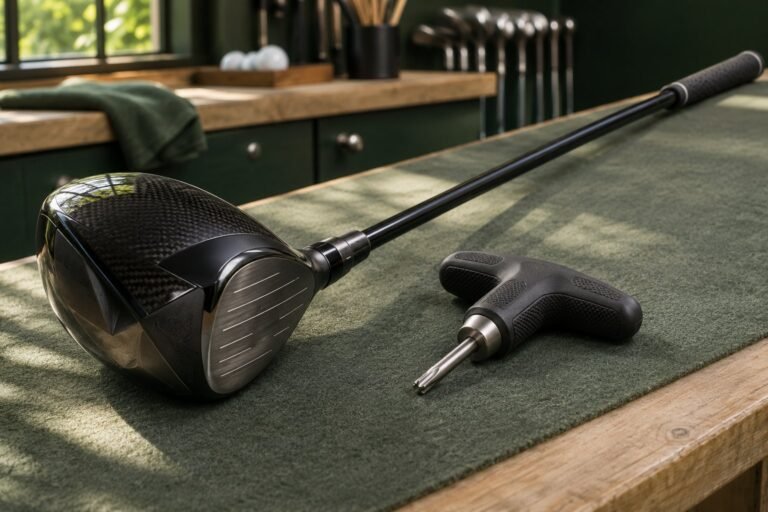
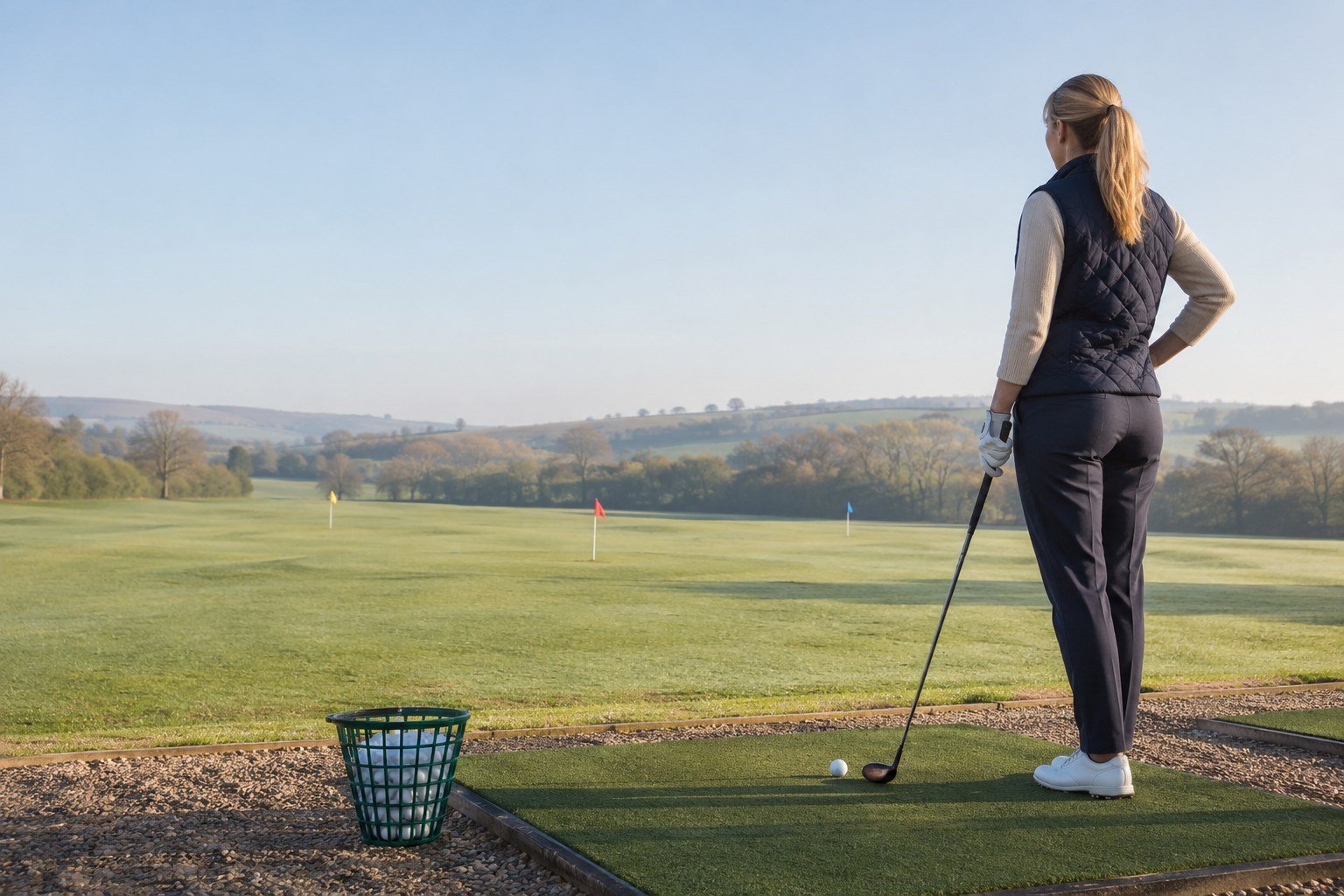
AI illustration: start with a target you can observe safely from the hitting area.
To evaluate a hybrid before buying without a launch monitor, you need a clear view of the ball and a fair comparison. One long-looking shot is not enough. You can learn whether a club repeatedly produces a useful result, provided you record what you can actually see and leave the uncertain parts unresolved.
Ad – includes affiliate links. If you buy through these links, Taylor’s Trailblazing Golf may earn a commission at no extra cost to you. Recommendations consider fit, drawbacks and alternatives.
Define the target and the current problem before evaluating the candidate.
First landings and missed targets are useful; unseen results stay unknown.
Match the strength of the decision to the strength of the comparison.
Evaluate a hybrid without a launch monitor: set an honest brief
Choose one question for the trial. You might want a club that reaches a visible landing area more often, produces fewer low skimming shots, or gives a dependable alternative to a long iron. “Is this a good hybrid?” is too broad to score. “Does it improve this particular shot compared with my present option?” gives you a useful comparison.
Scroll within the table on a small screen.
| Observation | A useful conclusion | A conclusion to leave open |
|---|---|---|
| Repeated first landings in a visible target area | This club reached the chosen area this often under these conditions. | Its exact normalised carry or a guaranteed on-course yardage. |
| Shots finishing clearly left or right of the target corridor | The visible misses favoured this side during the session. | The precise face angle, club path or cause of every miss. |
| A visibly different flight | One club produced a higher-looking or lower-looking flight from this viewpoint. | A numerical launch angle, spin rate or landing angle. |
| Contact and comfort | You can describe the feel, effort and repeated contact problems. | Sound alone proves centred contact or greater ball speed. |
| A ball disappearing into glare or a hollow | The landing was not observed. | A guessed landing point added to a distance average. |
Trackman defines launch angle, spin rate and landing angle as separate technical parameters.[1] A high-looking arc does not give you numerical values for them. Keep your record in plain terms such as “first bounce inside the target” or “landed well right”.
This approach can support a shortlist or a clear practical buying decision. It does not promise the most finely tuned specification. If the purchase depends on a narrow distance gap or a particular stopping flight, accurate measured evidence may be the next step.

Arrange the trial before you hit the first ball
Ask the shop, club or practice facility what you may try, where you may hit and which balls to use. Confirm the conditions for borrowing a demo and whether there is a way to try it from grass. A short shop-net session may establish comfort, but it cannot show a landing pattern you never see.
Bring the club that currently performs the proposed job. If you do not own a hybrid, that reference might be a long iron or fairway wood. Titleist’s fitting guidance similarly starts with the golfer’s existing clubs to establish a baseline.[2] The purpose here is to test an improvement over your own option, not to collect impressions of unrelated clubs.
Write down the full candidate build before starting: model, playing hand, loft and setting, shaft model and flex, playing length and grip. Ask the person supplying the demo to confirm anything uncertain. A later purchase should reproduce the club you evaluated.
- Use one candidate at a time against the reference. Add another only after you have a clear reason to do so.
- Use the same hitting position, target and ball type for the comparison.
- Choose a session in which the landing area is visible and the weather is reasonably steady.
- Keep a notebook or phone note and, if possible, ask a companion to record what they see from a safe position behind the hitting line.
Follow the facility’s access rules throughout. Do not walk onto an active range to retrieve balls, pace out distances or place your own markers. Use the targets already provided, or an arrangement explicitly supervised and permitted by staff.
Back to top ↑Check the balls, surface and distance markers
Use the range evidence for the range question
Ask whether the supplied balls are full-flight or distance-limited and whether the bucket contains a consistent type. Their age and condition matter too: Trackman notes that worn range balls can be inconsistent in flight and launch.[4] Set visibly damaged balls aside before hitting, following the venue’s instructions, rather than removing inconvenient results afterwards.
Do not add an invented percentage to turn a range-ball result into your playing-ball distance. Trackman’s software treats ball conversion and weather normalisation as separate processes using shot information.[3] An unaided trial does not perform either calculation. The safer conclusion is that one club reached the chosen range target more usefully on the day.
If the venue permits a later comparison with your normal ball, keep it as a separate session. For choosing a consistent playing-ball model, our monitor-free short-game ball comparison addresses a different, complementary decision.
Record the surface honestly
A mat trial is evidence from that mat. For a hybrid intended mainly for fairway shots, seek a suitable grass check when permitted. Titleist identifies real-turf interaction as an important part of fitting hybrids.[2] Keep mat, fairway and any light-rough observations separate rather than merging them into one apparently precise result.
Find out what the marker actually measures
Ask whether the posted distance applies from your bay or from another reference point. Check that you can see where balls first touch down, not just where they roll to. An uphill target, a distant bank or a flag viewed at an angle is not a reliable invitation to estimate carry to the nearest yard.
You can still compare broad landing areas without exact yardages. Write “short of the nearer flag” or “between these two markers”. If the first bounce is hidden, change the target or limit the session to contact and comfort.

Define a useful shot before the attractive one arrives
Pick a visible area with a front, a back and a sensible left and right boundary. Use existing flags, target greens or clearly distinguishable landmarks. Choose an area that represents the job you need, rather than moving it to wherever the candidate happens to land.
For an approach club, the first landing matters more than a long roll across the range. For a tee option, you may care about a different landing corridor. Compare those roles separately; a good tee result should not silently become evidence for performance from the turf.
A brief you can copy
“From this hitting position, I want the ball to first land beyond the near marker, before the far marker and between the two side references. My current problem is too many shots falling short. A big miss to the right would also make the replacement less useful.”
This is a planning example, not a fixed target size. Make the boundaries broad enough to judge from the bay. If two observers would have to argue about which side of an imaginary line a ball landed, the target is too precise for this method.
Choose how to describe the important misses before starting. “Short”, “long”, “left”, “right” and “unseen” are enough. Record more than one description when a shot is both short and wide. There is no benefit in forcing every ball into a falsely exact coordinate.
Back to top ↑Use short alternating groups, with the misses kept
Warm up in your usual way and take a few familiarisation shots with the candidate. Then say when the recorded comparison begins. The warm-up is not part of the score, but poor shots after that point remain in the record.
One workable session uses groups of three shots. Hit the reference, then the candidate, then repeat. Take a break and reverse which club starts. This gives twelve recorded attempts with each club if you complete both passes:
Scroll within the table on a small screen.
| Pass | Order | Recorded attempts |
|---|---|---|
| First pass | Reference 3 → candidate 3 → reference 3 → candidate 3 | 6 with each club |
| Rest and reassess | Check that conditions, visibility and your comfort remain suitable. | No obligation to continue if they have deteriorated. |
| Second pass | Candidate 3 → reference 3 → candidate 3 → reference 3 | Another 6 with each club |
Use your normal effort and a fresh routine for each shot. You are assessing a club you can play, not searching for the swing that produces one spectacular result. Stop if discomfort, fatigue or changing conditions make the comparison unhelpful.
If a genuine interruption occurs, note it immediately. For example, the session may pause because a member of staff enters the area. Do not quietly reclassify an ordinary topped or heavy shot as “not representative” simply because it hurts the candidate’s tally.
Keep the club settings fixed during each comparison. If the fitter changes a loft setting or shaft, start a separate record for that build. Otherwise you may end up buying a specification that never produced the group of shots you preferred.
Twelve attempts are not proof of a lasting advantage. The value is in the structure and the preserved misses. A small or inconsistent difference calls for another representative comparison, not a stronger claim.
Back to top ↑Record the first landing and the limits of the observation
Make one row per attempt. You do not need a dedicated app, a paid accessory or a decimal-point distance estimate. Keep the sheet simple enough to complete before the next ball.
Scroll within the table on a small screen.
| Field | What to write | Why it belongs |
|---|---|---|
| Club and shot number | Reference 1, candidate 1, and so on. | Keeps every recorded attempt visible. |
| Build and conditions | Use a sheet header for loft/setting, shaft, surface, ball type and weather. | Prevents different trials being mixed. |
| First landing | Inside target, short, long, or unseen. | Separates flight from subsequent bounce and run. |
| Side | Inside corridor, left, right, or unknown. | Makes a distance gain’s directional cost visible. |
| Contact and effort | An honest description: felt heavy, felt thin, comfortable, forced, or uncertain. | Adds your observation without claiming an exact strike location. |
| Relevant note | For example: gust arrived, ball lost in glare, or clean view of the first bounce. | Preserves uncertainty rather than inventing precision. |
A shot can be short and right. Keep both notes. “Useful” means the first landing was confirmed inside both the required distance area and the side corridor. If you did not see enough to decide, mark it unknown; do not assume it was good because the flight looked attractive.
Separate an unobserved landing from a known poor shot. Both stay in the attempt count, but they answer different questions. Several unknowns are a reason to improve the viewing conditions, not evidence that the club itself is unreliable.
Sound and feel can help you describe the experience. They should not become invented impact coordinates or ball-speed readings. If locating the strike precisely is important, ask a fitter for an appropriate method rather than diagnosing it from noise alone.

Read the whole pattern before deciding to buy
The example below is entirely invented to show how to read the record. It contains no measured carry or spin values and is not a product test.
Scroll within the table on a small screen.
| Outcome | Current club | Candidate |
|---|---|---|
| Confirmed useful first landing | 7 | 6 |
| Observed short of the target | 3 | 1 |
| Observed outside the side corridor | 1 | 4 |
| First landing not seen | 1 | 1 |
The candidate has fewer short shots, but also fewer confirmed useful landings and more sideways misses. Its longest-looking shot does not settle the decision. For this particular brief, the sensible response is to investigate the side pattern before buying.
These figures are simple counts. In your own sheet, short and sideways counts may overlap, so do not add every column into a percentage. An unknown landing remains unknown. Nor does a difference of one shot establish that either club is permanently better.
Look at where the benefit occurred. Did it appear in both passes, or only after several consecutive swings? Did your reference club also improve or deteriorate? If both changed together, conditions or your swing on the day may explain part of the result.
Repeat only the unresolved question. If the candidate clearly feels uncomfortable, you need not keep hitting to complete a quota. If it looks promising but the landing area was hard to see, improve visibility. If it works on a mat but its main job is from grass, seek that specific missing evidence.
Back to top ↑Use three decision gates: buy, repeat or get help
Buy when the improvement is clear enough for the job
A purchase becomes reasonable when the candidate repeatedly improves the intended shot, its ordinary misses are acceptable, the comparison conditions are relevant, and the exact build is known. You can make that practical decision without claiming that every launch parameter has been optimised.
Before ordering, match the model, playing hand, loft, shaft, length and setting to the trial. Confirm what the order includes and which return terms apply. If the successful demo cannot be reproduced, keep looking rather than treating a similar-looking listing as equivalent.
Repeat when the evidence is close or incomplete
Keep your current club while you resolve a small difference, changing wind, unseen landings or a mat-only result. A second suitable session is more useful than turning uncertain observations into a confident distance claim.
Get fitting or coaching help when the question needs it
Seek measured fitting help when the decision depends on a narrow carry gap, stopping flight, or why two builds behave differently. Take your sheet and the clubs involved. Titleist’s fitting process uses launch information and trials of different builds; your notes can give that session a more precise starting question.[2]
If contact is too inconsistent for either club to show a useful pattern, a coach or fitter can help decide what to address first. Our guide to what to expect from a club-fitting session explains the service questions to ask before paying.
When the trial does justify shopping, use your written specification to compare hybrid listings at a suitable retailer or manufacturer. A product page is a place to confirm the order, not a replacement for the evidence you have just collected.
The aim is to leave with an honest answer: a useful improvement, a clearly defined next check, or a reason to keep your money. Any of those is a successful outcome from a trial without a launch monitor.

A few further questions
Can a phone video replace the missing monitor readings?
A video may help you remember what happened or give a coach something to discuss. Ordinary uncalibrated footage should not be treated as a measurement of spin, carry or landing angle. Keep your record based on the visible outcome, and obtain suitable measurement if a numerical claim is necessary.
What if I have no existing club that can reach the target?
Your comparison can ask whether the candidate adds a usable shot, rather than whether it beats a direct replacement. Keep a familiar club in the session as a reference for your contact and conditions. Judge the candidate against the target you set, then check how its intended role fits beside your other clubs.
Sources and method
This guide brings together manufacturer information and the sources below. The comparison methods and decision aids are editorial suggestions for your own fitting or trial. No personal product test or measured performance result is claimed. Read how we review golf gear for the site’s evidence standards.
- Trackman — Definitions of ball-flight and club parameters
Checked 22 November 2026. - Titleist UK — Club-fitting guidance
Checked 22 November 2026. - Trackman — Normalisation and ball conversion explained
Checked 22 November 2026. - Trackman — Using consistency and recognising range-ball variation
Checked 22 November 2026.
Illustrations in this article were created for Taylor’s Trailblazing Golf. Third-party photographs, where used, are credited beside the image or in the source list.