Strong-Lofted vs Traditional-Loft Irons: Distance and Gap Trade-Offs
Extra carry earns its place when the approach flight, neighbouring clubs and total cost work together.
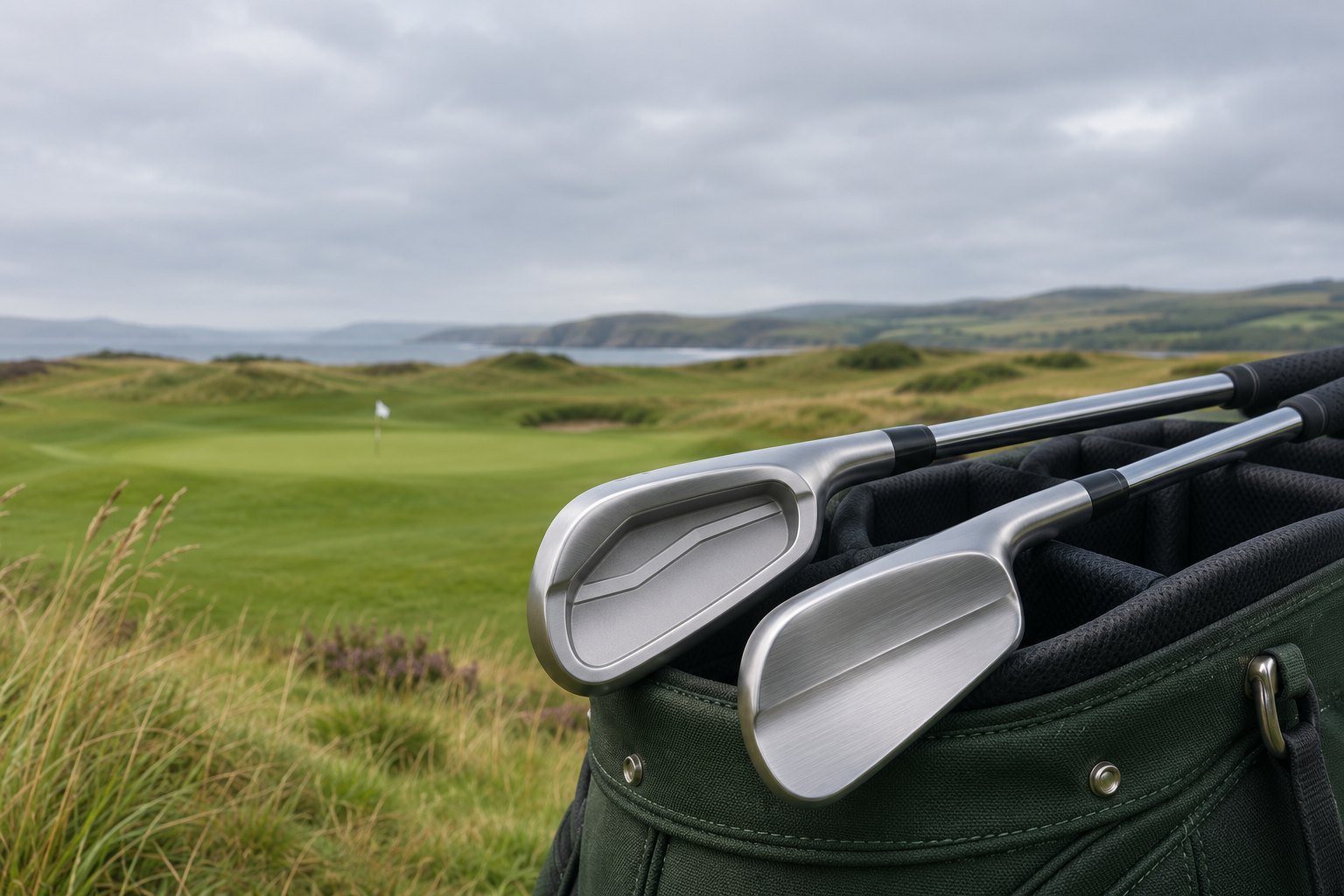
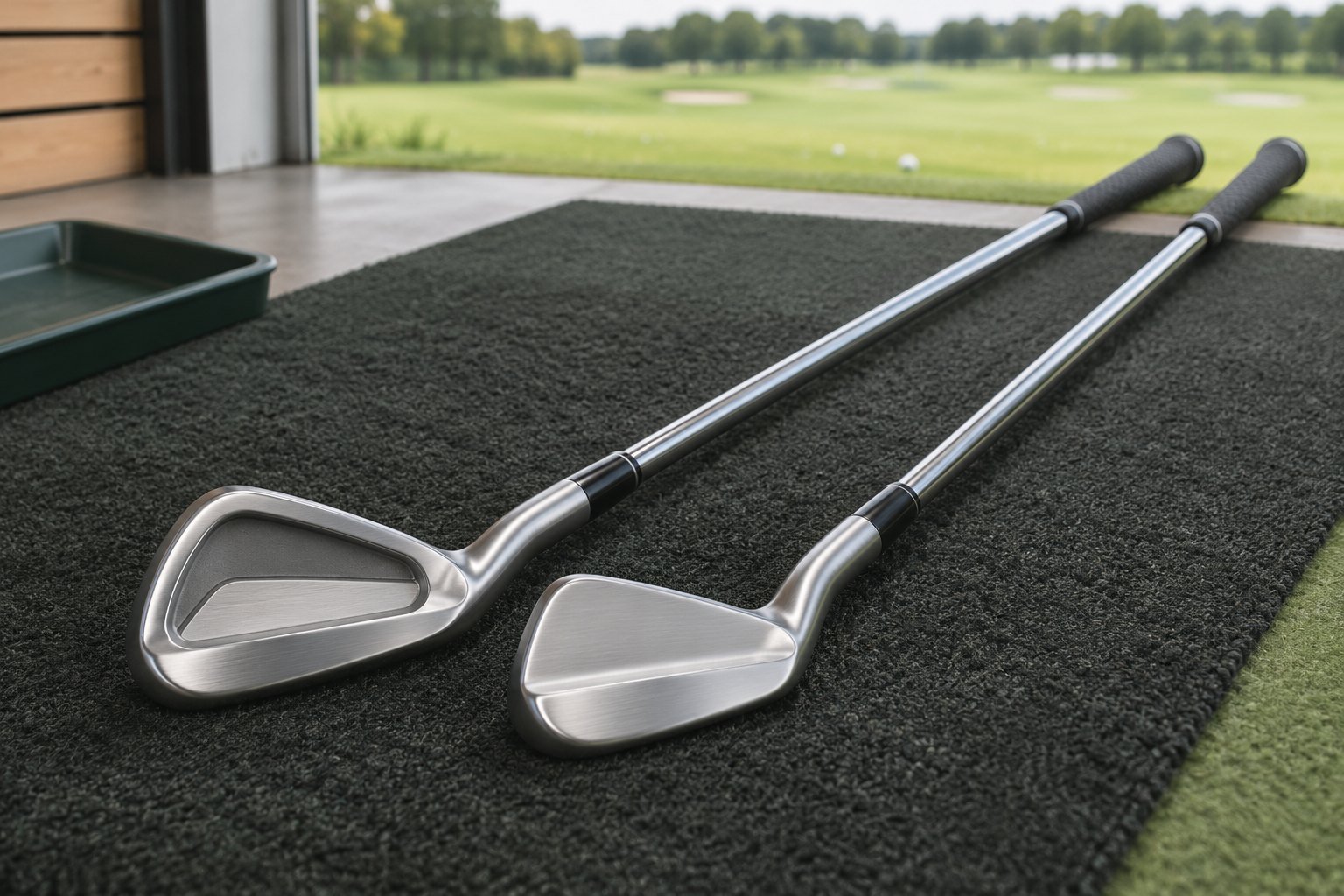
AI illustration: compare the complete clubs and the shots they need to cover.
A strong-lofted vs traditional-loft irons comparison needs to answer more than which 7-iron travels furthest. You are choosing a sequence of approach clubs, and the useful result has to survive the longest irons, the pitching wedge and the clubs already in your bag.
This research-led guide uses exact Titleist specifications to explain the comparison, then an original decision process for weighing your own results. The examples identify different builds; they do not rank either model for a particular golfer.
Ad – includes affiliate links. If you buy through these links, Taylor’s Trailblazing Golf may earn a commission at no extra cost to you.
Name the comparison
A stronger loft is relative to a defined club, not a quality rating.
Follow the ball down
Useful approach distance includes where the shot lands and what happens afterwards.
Finish the bag before the bill
Confirm the long-end roles and wedge transition before pricing the change.
Strong-lofted vs traditional-loft irons: define both sides
A stronger loft means a smaller loft angle relative to the club you are comparing. Treat “traditional” as a prompt to name that reference set, rather than as a complete specification. A model name without its generation can also leave the comparison ambiguous.
For a concrete example, the T100 and T350 below belong to Titleist’s T-Series generation introduced in July 2025. [2] The figures are from its current UK specification chart, using standard lofts and the explicitly labelled standard men’s lengths. [1]
| Comparison | T100 | T350 |
|---|---|---|
| 7-iron loft | 33° | 29° |
| 7-iron standard men’s length | 37 inches | 37 inches |
| Club at 29° / standard men’s length | 6-iron / 37½ inches | 7-iron / 37 inches |
| Pitching-wedge loft | 45° | 43° |
The same-number 7-irons differ by 4° of loft. The same-loft 29° pair differs by half an inch in listed length. [1] Neither comparison isolates the effect of loft: the complete head and shaft assemblies also need identifying.
T100 is simply the higher-loft comparator in this example. Calling it “traditional” would not make it a universal benchmark or establish that it is the right alternative for you. Use the same approach with the exact models you are considering.
Ask three questions before interpreting extra distance
A same-number comparison is a reasonable shopping starting point, provided the actual specifications remain visible. Follow it with a closer loft comparison, then judge the complete clubs by the shot you want to play.
| Comparison | What to compare | What it can establish | What it leaves unresolved |
|---|---|---|---|
| Same number | The two 7-irons, with exact builds recorded | How those labelled clubs perform for you | Why a result differs when specifications also differ |
| Same or similar loft | Clubs with matched or nearby published lofts | Whether the number is hiding a different place in the loft sequence | Differences in head, length, shaft, delivery and strike |
| Same intended shot | Each set’s club for the approach you want to play | Which complete option gives useful carry, flight and misses for that job | How untested clubs at the ends of the set will perform |
For the third comparison, choose a familiar approach requirement and ask the fitter which club in each set should cover it. It is acceptable for one set to use a different number. Compare how reliably each option carries to the intended area and how usable the misses are, rather than rewarding a particular numeral.
Where the available samples differ in shaft, length or lie, record those differences. A practical fitting can still select a helpful complete build without proving which individual component caused the result. Describe the conclusion at that level.
Do not arrange to bend two demonstration heads merely to make this comparison appear controlled. If an altered loft is being considered, the fitter must assess that exact head and the appropriate build before any modification.
Back to top ↑Decide what extra carry would do for your golf
Write down the problem before the trial. Perhaps an approach you regularly face requires a club you struggle to use, or the longest reliable iron leaves a hole below your hybrid. The useful objective is a manageable shot for that distance, not simply a longer result from a favourite club number.
Trackman identifies ball speed, launch angle and spin rate as primary influences on carry. [3] That is why the printed loft alone cannot explain a distance result. Read the measured flight of the complete club, and avoid attributing a gain entirely to one specification.
Compare the proposed build against your current club for the same job. Keep the ball and measurement settings consistent, include normal imperfect contact and return to the baseline during the session. If the result depends on deleting ordinary misses or on a few unusually forceful swings, you have not yet established the dependable shot you wanted.
A stronger-loft option deserves consideration when its normal results solve the stated problem and remain acceptable elsewhere. A higher-loft option deserves the same fair test. The number on either sole should not decide the outcome in advance.
Back to top ↑Judge the landing as carefully as the carry
An iron shot normally has somewhere useful to finish. Ask for height, landing angle, spin and dispersion alongside carry, and relate those measurements to the approach you intend to play.
Trackman’s landing angle is measured relative to the horizon at the launch elevation. All else equal, a flatter landing angle produces more bounce and roll. [4] That makes descent part of the comparison, but it does not turn one angle into a complete prediction of stopping distance.
| Record | Question to answer |
|---|---|
| Typical carry and its variation | Does the club cover the intended distance often enough to be useful? |
| Height and landing angle | Does the flight suit the approach and the space available after landing? |
| Spin and strike observations | Do the useful results survive your ordinary contact pattern? |
| Left-to-right and front-to-back spread | Where are the misses relative to the target and its hazards? |
| Ball and environment | Are the comparison settings and likely course conditions clearly identified? |
Ask the fitter to explain the flight in relation to your speed, contact, intended club role and normal greens. A single mandatory launch, spin or descent target is less useful than understanding why a particular result fits that job. Keep the actual observations and the fitter’s interpretation together.
Check what any displayed total distance represents. Trackman calculates total using landing conditions and assumes a flat surface of normal hardness. [5] Treat that as a modelled result. Where practical, confirm the useful approach flight in representative outdoor conditions before assuming that the predicted roll describes your usual green.
Make the longest proposed iron earn a place
Request a trial of the longest iron you would actually order, plus the club immediately below it and the hybrid or fairway wood above it. A successful middle-iron demonstration leaves those relationships unanswered.
Record which club provides a clearly useful longer shot under comparable conditions. If the longer iron’s ordinary carries repeatedly finish near the next iron’s, write down that bunching instead of relying on its occasional longest strike. The observation is a reason to investigate the fit or composition; it does not diagnose the cause by itself.
It may be worth testing a different loft configuration, another iron model or a hybrid for that role. Choose among those options by the resulting shot and its fit beside the clubs you retain. Do not assume a low-loft iron must be carried because it appears in the available model range.
A useful request for the fitting
“Please compare the longest iron in the proposed set with its two neighbours. I want to see whether it supplies a distinct, usable shot and what I would keep or replace if it does not.”
For a mixed set, test the actual changeover pair too. The final order should identify each head and build at that join, rather than assume that matching brand names produce an established distance progression.
Back to top ↑Cost the wedge transition before buying the set
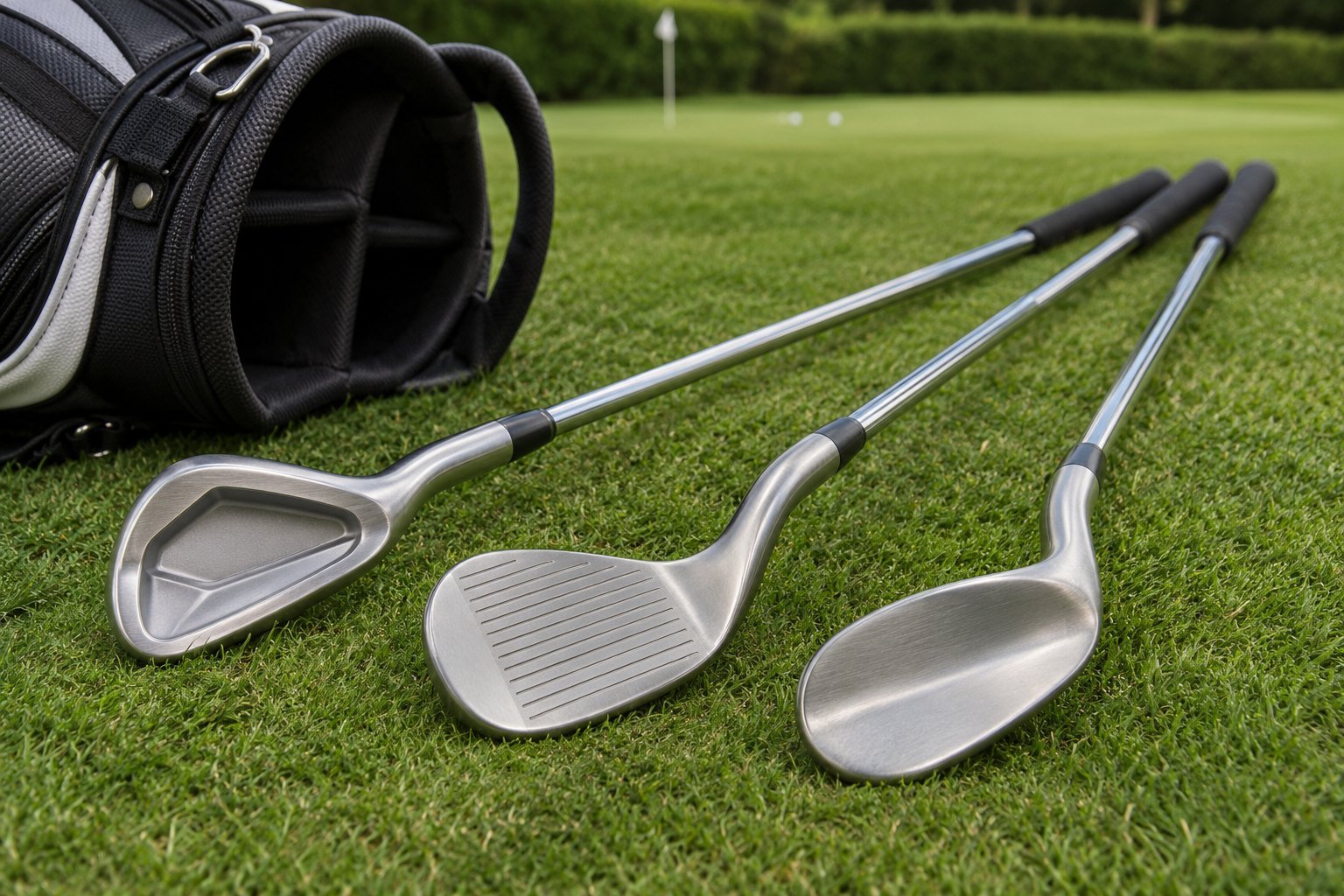
The pitching wedge is the other end of the same decision. In the example above, T100 lists 45° and T350 43°. [1] The difference belongs in your whole-bag comparison even if the demonstration used only a 7-iron.
Keeping an illustrative 50° wedge leaves a 5° loft interval after that T100 pitching wedge or 7° after the T350. [1] Measure the actual carry gaps before deciding whether another wedge is needed.
Check which set wedge options are actually included in the quote and which cost extra. Then consider the shots you play around the green as well as full-swing distance. A solution that fills a full-shot gap still needs to leave you with workable shorter-shot choices.
Keep a purchase note with four entries: the proposed iron set, any additional wedge, any long-end replacement and fitting or build charges. Request the complete total for the exact configuration. If the required additions exceed your budget, compare a different set composition or retain the existing clubs while you resolve the gaps.
There is no need to force identical degree intervals or buy a wedge solely because its stamp falls between two others. The expenditure should solve an observed shot requirement. Leave space in the plan for clubs that already do their jobs well.
Choose the route supported by the whole comparison
Use this decision table after testing the relevant clubs, not after a single best shot. It deliberately allows the same distance result to lead to different decisions when flight, gaps or cost differ.
| What the evidence shows | Route | Reason to choose it |
|---|---|---|
| A tested stronger-loft build provides useful approaches, distinct long-end shots and a workable wedge transition | Consider the complete tested build | The benefit survives the whole-bag checks |
| The candidate is longer, but its approach flight or ordinary misses are unsuitable | Try an alternative build, including more loft where appropriate | Carry alone has not solved the intended shot |
| The middle works, but the longest irons bunch together or the short end needs expensive additions | Reconsider the set composition and total quote | A good demonstration iron is not yet a complete purchase |
| Your current clubs already cover the jobs, or the comparison is inconclusive | Keep the current set and record what remains uncertain | There is no supported reason to pay for a change yet |
Where a result is close, write the unresolved question in the report. It could concern the longest iron, normal-turf contact, the wedge transition or whether the difference repeats. Agree a focused follow-up rather than treating an incomplete comparison as a recommendation to order.
Equally, do not reject a useful stronger-loft build solely because it changes familiar club numbers. If it covers the required shots and fits the rest of the bag at an acceptable cost, the numbering change is something to learn rather than a defect.

Make the quote match the clubs that earned the decision
Before paying, compare the written order with the successful trial: model generation, hand, included clubs, loft configuration, shaft, flex, length, lie and grip. Ask for any difference between the trial and the order to be explained. This protects the usefulness of the comparison you have just made.
If those are the models you have decided to investigate, Clubhouse Golf has separate Titleist T100 steel-shaft and Titleist T350 steel-shaft listings. Check the actual generation and selected build against the written recommendation; older sets can share the same main model name. The linked listings are shopping references, not a substitute for establishing which build suits you.
Our guide to golf club fitting fees covers the service and report to agree before an appointment. For this decision, ask specifically for evidence at the long and short ends as well as the demonstration club. A stronger-loft set is ready to buy when the complete arrangement makes sense.
Back to top ↑What to do next
Choose the set that gives you useful approaches throughout the bag. Stronger lofts can be part of that answer when the tested flight, strike pattern, neighbouring gaps and total cost work for you. A higher-loft build, a different composition or the clubs you already own may be the better answer. Let the complete comparison decide.
Sources and further reading
Sources checked on 22 November 2026. Product descriptions and terms can change; confirm the details for the exact item before buying.
Illustrations in this article were created for Taylor’s Trailblazing Golf. Third-party photographs, where used, are credited beside the image or in the source list.