
Golf Trousers for Shorter Leg Lengths: Hem Clearance in Wet Grass
Fit the waist, check the shoes and keep the hem clear without guessing from height.
Original conceptual illustration; not a product or test photograph.
Golf trousers for shorter leg lengths need to do more than look tidy beside a changing-room mirror. The hem must work with your golf shoes, stay clear of the ground as you move and leave enough room for a comfortable stance. A familiar waist size or a label saying short cannot settle all three questions.
This guide takes a measurement-led approach to a very practical problem: avoiding an unnecessary wet, muddy fold of fabric around your heels without turning every pair of trousers into cropped trousers. The checks below are suggested buying and fitting exercises, not results from a wear trial. Manufacturer examples show how differently brands describe length; they are not a ranking of garments we have tested.
Start with trousers and shoes you already own. A few observations about where the waistband sits, how the fabric falls and which part actually gets wet will make your next purchase more deliberate. You may need a different leg length, but you may instead need a more stable waist, another cut or a separate waterproof layer.
Stable waistband
Judge length only after the upper fit is settled.
A known reference pair
Keep garment and body measurements separate.
Rear hem and shoe
Inspect both legs after ordinary movement.
Fit is not waterproofing
A suitable shell may solve a different problem.
Golf trousers for shorter leg lengths: judge the complete fit
Clearance is a relationship, not a universal number
There is no single hem-to-ground measurement in this guide that every shorter golfer should copy. Shoe height, trouser opening, rise, walking movement and the way you prefer the waistband to sit all affect the result. Consequently, treat clearance as something to check on your own body with the shoes you will actually wear, rather than something promised by an inseam label.
For a useful starting assessment, stand naturally on a clean, level floor. Look at the rear hem, the front where fabric meets the shoe and the inside edge near the sole. You are looking for unwanted dragging, bunching or catching. A slightly different appearance at the front and back is not automatically a fault; persistent contact with the floor deserves attention.
Decide which problem you are solving
Write a specific description before shopping. For example, the rear hem folds under the heel, the lower leg feels restrictive when kneeling, or the waistband slips and brings the hem down with it. These are different problems. A shorter inseam might address the first while doing little for the second or third.
Also distinguish wet fabric from dragging fabric. Even neatly fitted trousers can touch wet grass when the grass is tall enough. Therefore, do not expect tailoring to keep every part of your lower leg dry in every condition. Your aim is to avoid unnecessary contact and choose suitable protection, not create an impossible all-weather clearance guarantee.
Measure a useful reference pair
Record how the garment was measured
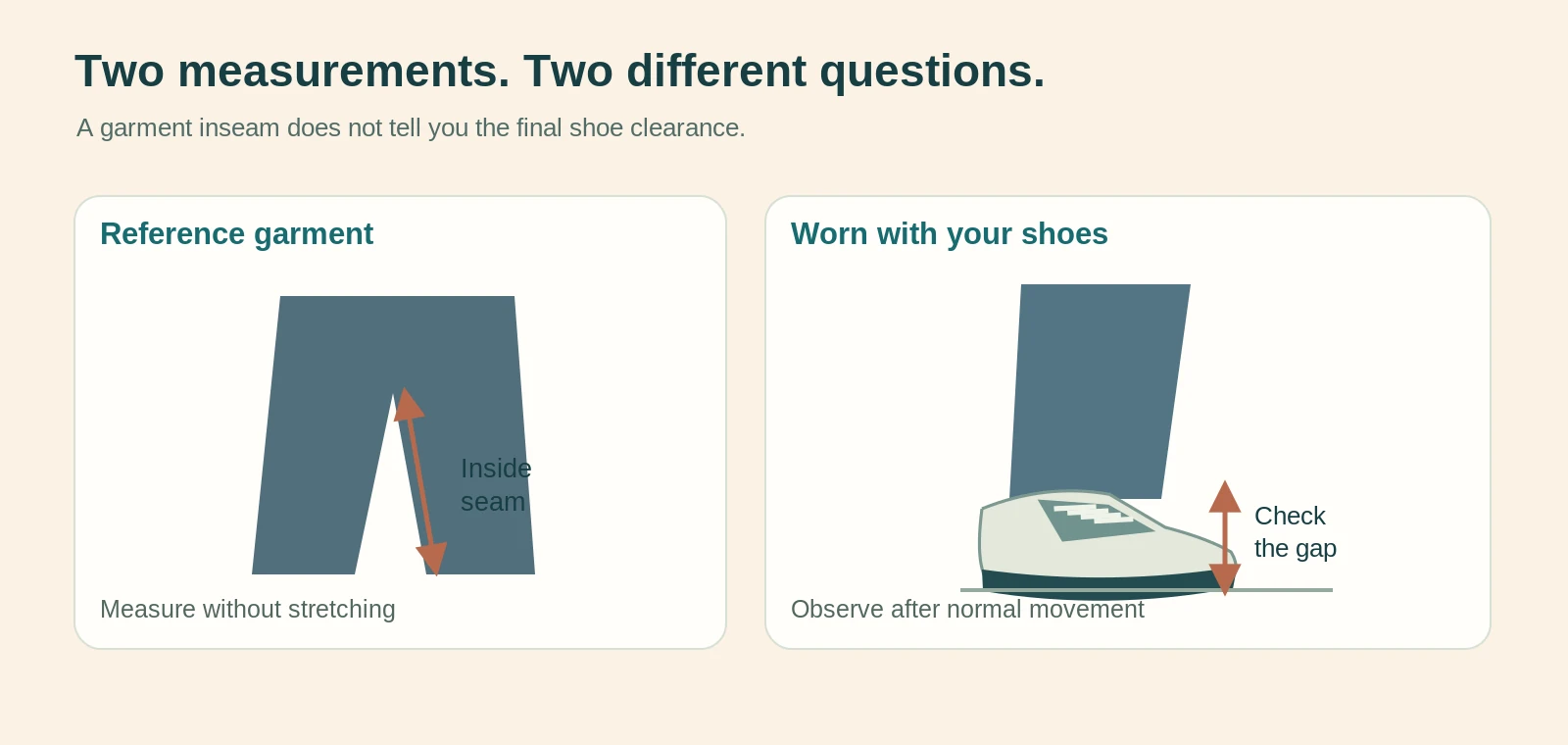
Choose a clean pair whose fit you understand, rather than automatically choosing your newest pair. Lay it flat without stretching it and measure the inside leg along the seam from the crotch junction to the finished hem. Record that this is a garment measurement. Repeat once, because a folded crotch or curved seam can change the reading you write down.
Separately record the size printed on the label. The two records have different jobs: the label helps locate the product, while the measurement helps compare actual garments. Do not quietly substitute one for the other when asking a retailer a question. A clear enquiry says that your reference pair measures a particular length along its inside seam and explains how it fits.
Body measurements belong to the brand's method
When a manufacturer requests a body measurement, follow that method rather than submitting your flat garment measurement. Galvin Green's size guidance distinguishes body sizing from garment details and describes the measurement points to use. That distinction matters more than trying to force every brand into a single homemade chart. [1]
Ask someone to help where the tape position is difficult to see. Wear suitable close-fitting clothing and keep the tape straight without pulling it tight. Then note the units and whether shoes were worn. The purpose is a repeatable record, not a supposed precision that the measurement method cannot support. Recheck whenever the fit of your existing clothes has materially changed.
Settle waist, rise and seat before changing length
A moving waistband changes the experiment
First try the trousers with the waistband at its intended, comfortable position. Walk around and return to the mirror. If it slides down, the apparent excess length may partly be a waist-fit issue. Conversely, hauling the waistband unusually high can make an unsuitable pair seem short enough for a moment without producing a fit you will keep during a round.
Use the belt you would normally wear, but do not rely on severe tightening to rescue an obviously loose waist. Note any bunching or pressure created by that solution. A trouser cut that needs constant adjustment is a poor reference for deciding whether you need the next shorter leg option. Establish the upper fit first, then judge the hem again.
Room to move is part of length selection
Check the seat and upper thigh while sitting, taking a comfortable golf stance and making a small, unforced bend. If the fabric becomes tight across these areas, shortening the hem will not create more room there. Similarly, a leg that rides up markedly during movement may reflect the whole cut rather than simply insufficient cloth at the bottom.
Treat the movement check as a comfort observation, not a diagnosis of your posture. You do not need to change your golf setup to fit a pair of trousers. Instead, compare another size or cut while keeping the shoes and usual waistband position consistent. A good buying decision should leave you concentrating on the shot, not managing where the garment sits.
Check the hem with your actual golf shoes
Look from more than one angle
Wear the golf shoes and socks intended for the trousers. A slim trainer used in the shop may support the hem differently from your course shoes. Use a mirror or a photograph taken near shoe height, checking both legs. Keep the camera level enough that a steep angle does not make one hem appear much longer than the other.
Inspect the back first, because excess material can be less obvious from above. Then check the front fold and the inner leg. Finally, take a few ordinary steps and look again. Do not pull the fabric into an ideal position before each photograph; you want to see where it settles by itself after movement.
Compare clean-floor positions, not imagined weather
On a dry indoor floor, check whether any edge touches the floor, passes under the shoe or catches on the footwear. These observations are easier to interpret than a wet outdoor trial while return eligibility is still important. Keep labels attached and follow the retailer's try-on conditions. Do not assume an outdoor fitting session will leave the item returnable.
Once you own the trousers, a normal course walk can add useful information about local conditions. However, photograph the original dry fit first. Otherwise, a damp or dirty hem can become a vague complaint without showing whether the problem began with excess length, a slipping waist, tall grass or an unsuitable fabric choice.
Use a short indoor movement check
Build a repeatable sequence
Try the same simple sequence with each candidate: stand naturally, walk across the room, sit, stand again and adopt your usual address position without swinging a club. Where safe and comfortable, include a modest step up and down. This is a proposed fitting routine, not a requirement to bend deeply or practise a full swing indoors.
After each movement, notice whether the hem returns to a sensible position or needs pulling down. Also check whether the lower leg catches on the shoe when you step. Keep the floor clear, use clean footwear and stop any movement that feels uncomfortable. The purpose is to compare garments, not test your mobility or create an exercise session.
Record the result in plain language
A useful note might read: rear hem clear when standing; front fold acceptable; waistband stable; slight catching on right shoe after stepping. That is more useful than a score of eight out of ten with no explanation. Repeat the troublesome movement once to see whether the observation is consistent, without turning a small uncertainty into a lengthy performance test.
Then change one variable. Try the alternative leg length in the same waist and cut, or keep the length while trying a different cut. If you change waist, shoe, rise and taper together, it becomes difficult to know which feature solved the issue. Simple comparisons produce better shopping questions and reduce the temptation to order several almost identical unsuitable pairs.
Separate everyday trousers from rain protection
Fabric descriptions answer different questions
Stretch, water repellency and waterproof construction are not interchangeable promises. A trouser may be comfortable for movement without being intended as an outer rain shell. Read the exact product description and care label rather than treating a photograph of someone playing golf in grey weather as evidence of waterproof performance.
For example, Galvin Green describes its waterproof trousers as an outer layer that can be worn over other clothing. That creates a different fit question from choosing an everyday golf trouser worn directly over underwear. The appropriate comparison includes layering space and hem adjustment, not just whether both products offer a size labelled short. [2]
Do not shorten your way around the weather
If the ordinary trouser fits well but becomes damp during prolonged wet conditions, removing more length may not address the main issue. Consider whether you need a suitable outer layer instead. Equally, buying a waterproof shell with generous length does not excuse an edge that drags or catches when worn over your normal outfit.
Describe the intended use before choosing. A summer pair for occasional dew, an everyday pair for mixed conditions and a shell for sustained rain can justify different decisions. You need not buy all three at once. Start with the condition that actually causes difficulty, while recognising that a clothing adjustment cannot guarantee dry socks or shoes through unrelated routes of water entry.
Fit waterproof overtrousers as a separate garment
Try the complete layering combination
Put the shell over the trousers and shoes it will cover, not over unusually thin clothing chosen only for a fitting. Set its waist comfortably, then repeat the standing and walking checks. Pay attention to whether the inner trouser pulls the shell down or creates bulk near the knee. A shell that looks generous by itself may fit differently when layered.
Next inspect the lower-leg openings using only the manufacturer's intended adjustments. A zip, tab or drawcord may change how the hem sits, but it should not be forced into an improvised configuration. Keep loose cords safely managed according to the garment design. Compare both legs after walking, because an adjustment that looks neat when seated may sit differently once you move.
Preserve the shell's intended construction
Before altering a waterproof garment, ask the manufacturer or a suitably experienced alteration service what the work would involve. Ordinary shortening can be a different job where taped seams, lower-leg zips, reinforced edges or adjustable cuffs are present. Do not assume a standard high-street trouser hem is an equivalent alteration.
Ask whether the proposed work changes any care requirements, intended weather protection or applicable warranty terms. Obtain that answer for the exact garment rather than relying on a general assurance that waterproof trousers can be shortened. If the answer is unclear, a better-fitting factory length may be the more straightforward purchase, even when the initial shopping choice is narrower.
Short inseams and petite cuts are not the same request
Ask which proportions have changed
A short-leg option may change the offered inseam without addressing the proportions you find awkward elsewhere. A petite-labelled range may use another pattern, but the meaning still needs checking with the particular brand. Do not assume either label guarantees a shorter rise, a different knee position or a particular opening. Ask what the selected garment actually changes.
This matters when the knee area or pocket position feels misplaced even though the hem can be shortened. Describe those concerns to the retailer rather than ordering an alteration that only removes fabric at the bottom. A trouser can have the desired inside-leg measurement and still be an unsuitable overall cut. Keeping those questions separate can save a purchase that never had a realistic route to the fit you wanted.
Use photographs for your own comparison, not a body rule
Take simple front, side and rear photographs of the reference pair in the intended shoes, without rearranging the cloth between views. Repeat with the candidate pair in similar conditions. Look for the specific problems already identified rather than trying to match a model's pose or a fashion rule about how shorter golfers should look.
A useful comparison might show that one garment clears the heel but catches above the shoe, while another falls freely but needs a modest length discussion. Neither photograph is a measurement of waterproof performance. Keep the images with the garment names and use them to ask a focused question about cut or alteration. The purpose is a practical record of your clothing, not an assessment of your body or a prescription for everyone with a similar height.
Choose a leg shape that works with the shoe
Straight and tapered cuts solve different problems
A narrower opening can reduce loose fabric around the shoe, but it may also sit on top of the footwear instead of falling over it. Therefore, compare what happens after walking rather than choosing a taper solely because it looks tidy on a product photograph. A straight leg may fall more freely, while a very wide opening may leave unwanted fabric near the ground.
These are fitting possibilities, not universal rules about which shape shorter people should wear. Your shoe profile and preferred amount of coverage matter. Check the lower leg while seated as well as standing, because fabric that catches above the shoe can expose more sock than you intended. Decide whether that matters to you before changing the length.
Cuffed and cropped options are deliberate choices
A jogger-style cuff or intentionally cropped design can avoid a conventional hanging hem, but it is not automatically the correct solution. Check whether the cuff feels comfortable, whether the garment remains suitable for your club's dress expectations and whether the exposed area works with the weather protection you need.
Do not confuse a trouser that accidentally sits too high with one designed to be worn that way. Look at the garment description and assess your own coverage preference. An intentional ankle-length fit may suit one outfit while being a poor choice for someone trying to cover the top of a particular shoe. The useful question is suitability, not whether one silhouette is universally more flattering.
Read length options without trusting the word short
Compare the published inches or centimetres
Manufacturer examples checked on 4 October 2026 illustrate the naming problem. PING's Tour trouser page lists leg lengths of 29, 31, 33 and 35 inches. FootJoy's FJ Par trouser page lists 30, 32 and 34 inches. These are product-page examples, not a promise that every waist, colour or current stock combination is available. [3] [4]
A shopper comparing only the shortest named option could therefore miss a meaningful difference in the published length. However, the number still does not tell you everything about rise, opening or fabric drape. Use it to narrow the search, then check the complete fit. Do not describe either brand's whole range using the measurements of one selected model.
Published model examples, checked 4 October 2026. Length options are not a fit or stock guarantee.
| Example | Published lengths | What still needs checking |
|---|---|---|
| PING Tour Tapered Trousers | 29 / 31 / 33 / 35 inches | Waist, cut, shoe interaction and selected variant. |
| FootJoy FJ Par Golf Trouser | 30 / 32 / 34 inches | Actual fit and availability of the required combination. |
| Your reference pair | Measure and label your method | How it behaves with your normal shoes and waistband position. |
Ask a retailer questions it can answer
Give the exact model, waist size, colour and leg option when requesting clarification. Ask whether the published length is a garment inseam, whether the particular variant is available and whether the retailer can provide a measurement method. These are more answerable questions than asking whether a product will fit a short person.
Where the page is unclear, keep a copy of the response with your order notes. Avoid ordering solely because a generic size chart appears elsewhere on the site; it may cover a different garment family. Also confirm the actual return conditions before removing labels or arranging alterations. A careful pre-purchase enquiry is useful only if it refers to the pair you will receive.
Decide when a professional alteration makes sense
Start with a well-fitting upper garment
An alteration is worth discussing when the waist, seat and overall cut already work and the remaining concern is genuinely excess length. Bring the intended shoes and explain the clearance problem. Ask the alteration specialist to assess both legs with the trousers sitting naturally, rather than requesting an arbitrary amount off the bottom based only on your height.
Do not cut first and investigate later. Shortening can be irreversible in practical terms, particularly where the original construction or spare fabric does not allow the result to be let down again. Pinning or marking should be done safely by someone competent; remove pins before any movement test that could catch skin or fabric.
Specify the desired result, not only a number
Say that you want the rear hem clear of the floor during normal walking while retaining your preferred shoe coverage. Then let the specialist explain what can be achieved with that cut. If narrowing the opening is also proposed, treat it as an additional change rather than assuming it is part of ordinary shortening.
Ask about the finished appearance, stitching, treatment of existing details and whether the quoted work covers both legs. For specialist fabrics, check manufacturer guidance first. A cheaper garment plus alteration is not automatically better value than a factory length that fits: the sensible comparison includes the total work, uncertainty and whether the final result remains suitable for its intended weather use.
Make wet-grass observations useful after purchase
Identify where the moisture starts
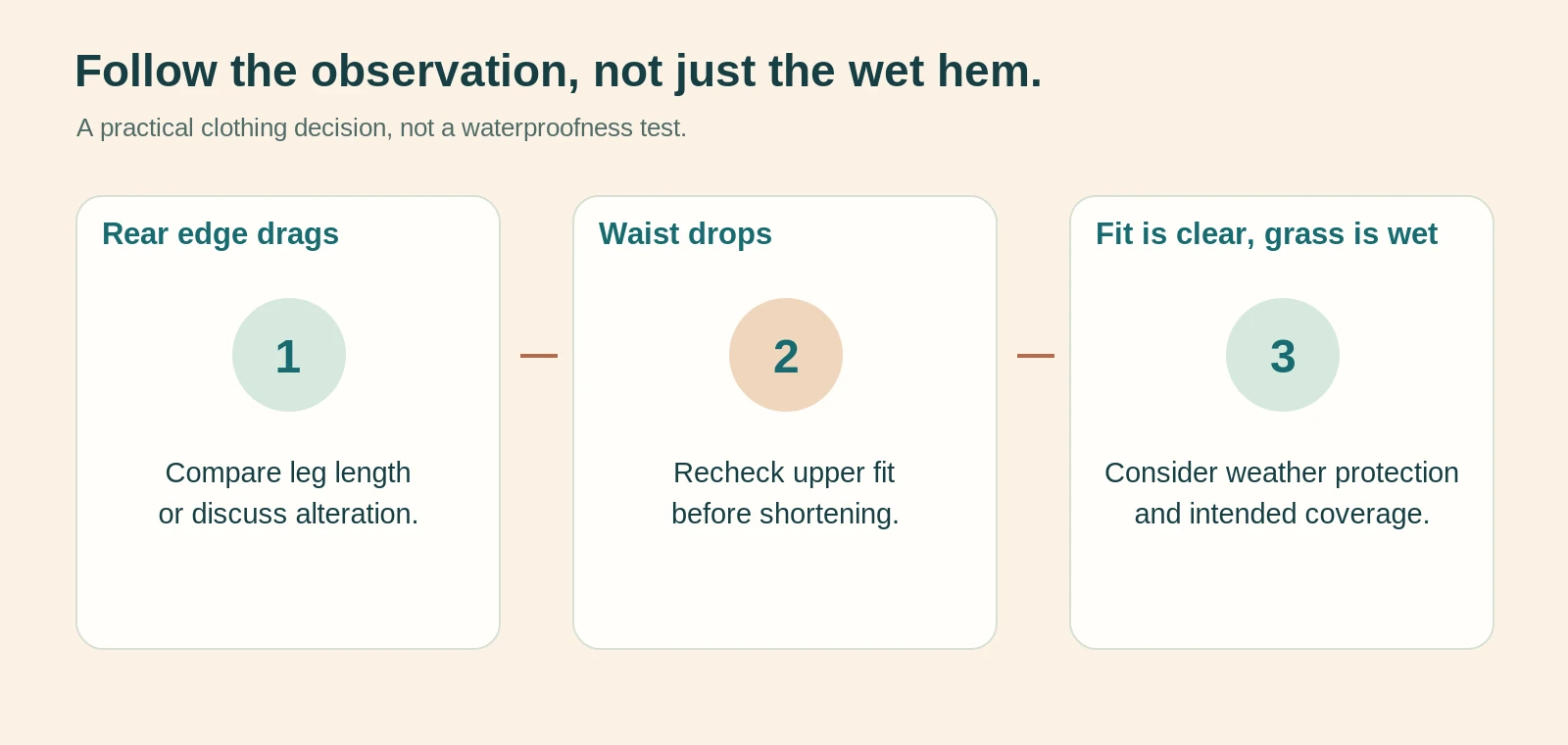
On a routine walk, note whether dampness appears at the rear hem, front fold, inside edge or higher up the leg. Do this without deliberately entering unsafe or prohibited ground to test clothing. A simple photograph after normal use can help separate a dragging rear edge from wider contact with long, wet vegetation.
Also note whether the waistband stayed in place. If a previously clear hem is now low, repeat the dry fit before concluding that the garment has changed length. Your notes need not include invented moisture percentages or laboratory-style claims. They simply help you decide whether to adjust how the trousers are worn, discuss an alteration or use another garment for those conditions.
Set realistic expectations for coverage
No sensible hem position avoids every blade of wet grass. Raising the hem may reduce one contact point while leaving more sock exposed. Consequently, choose a balance that works with your footwear and usual course conditions, rather than pursuing dryness by repeatedly shortening an otherwise comfortable pair.
For a golfer who regularly plays through wet rough, a suitable shell may be more relevant than the smallest available inseam. For someone whose rear hem trails on paved paths, fit remains the immediate problem. Keep those decisions separate. Once you know which problem is recurring, you can spend on the feature that addresses it instead of replacing trousers because of a vague all-weather expectation.
Care for the garment without changing the fit experiment
Follow the exact label
Read the sewn-in care label before washing or applying heat. Do not use a general internet instruction for cotton trousers on a technical golf garment. Galvin Green's care advice, for instance, distinguishes fabric groups and gives specific directions for its waterproof products, including suitable washing and reactivation treatment. Those directions should not be transferred automatically to another brand or fabric. [5]
Keep the label information available after purchase, especially if it is difficult to read once worn. Avoid experimenting with very hot water, aggressive stain treatment or a tumble-drying programme simply to remove a wet-grass mark. Where the manufacturer gives no clear answer for a stubborn stain, ask rather than assuming a stronger treatment is harmless.
Recheck before blaming the original length
After the first permitted wash and dry, compare the trousers with your original notes. Use the same measurement method and a similar condition: dry garment, natural waistband position and intended shoes. If the fit seems different, that record makes a retailer enquiry more specific than saying the pair now feels odd.
Do not deliberately try to shrink a garment as a substitute for buying the right length. That would make the result difficult to predict and could affect more than the hem. Similarly, avoid stretching wet fabric to force a longer leg. A stable, cared-for reference pair is valuable precisely because you can compare it consistently with the next purchase.
Three buying situations, three different decisions
The hem drags but the waist is stable
Consider a hypothetical golfer whose trousers fit comfortably above the knee and remain in place, but the rear edge touches the floor with course shoes on. A shorter version of the same cut is a logical first comparison. If that option does not exist, a professional alteration discussion may be sensible, provided the garment construction allows it.
The key observation is that the problem remains after the waist and footwear have been checked. There is no need to assume that every garment in the wardrobe must lose the same amount. A different rise or opening could produce another result. Keep this particular pair's measurements with its model name rather than turning them into a universal personal prescription.
The trouser looks long only after walking
Now consider a pair that initially clears the floor but falls lower after a few minutes indoors. First investigate waist stability and the overall cut. Shortening it immediately might create an unnecessarily high hem when the waistband is corrected, while leaving the original slipping problem unresolved.
A third golfer has tidy dry-floor clearance but damp lower legs after walking through wet rough. In that situation, compare intended weather protection and layering before altering the hem. These examples are decision illustrations, not reported tests. They show why the same complaint, wet trousers, can lead to a length change, a different upper fit or a separate waterproof layer.
Build a compact purchase record
Keep only information you will reuse
Your record can be a phone note containing the model, labelled waist and leg, measured inseam method, normal shoe pairing and the result of the indoor check. Add a short description of any recurring wet-grass contact after purchase. Include the care method actually used if a later change in fit needs investigation.
For alternatives, record why each was rejected. Too much fabric at the heel is different from tight at the knee or unstable waistband. This prevents the next shopping session from becoming another search for the same nominal size in a different colour. You are building a useful reference, not a complicated clothing database.
Order the smallest sensible comparison
Where retailer conditions and your budget permit, compare the most relevant adjacent length or cut rather than a large spread of unrelated garments. Keep all try-on activity within the stated return conditions. Check the complete outfit before committing to alterations, and avoid letting a temporary discount decide a fit question the garment has not yet passed.
A practical stopping point is a pair that stays comfortable, behaves predictably with your shoes and does not need constant attention. You do not need to find a mathematically perfect hem. Once the main problems are resolved, preserve the measurements and wear the trousers in their intended conditions, adding appropriate weather protection when that is the more relevant tool.
Pros and cons of the main approaches
Factory short lengths
A factory short option offers the simplest route when its upper fit and leg shape already work. It keeps the original hem construction and avoids arranging alterations. However, the available length increments may still miss your preferred result, and the smallest published inseam is not guaranteed in every waist or colour. Treat availability as a variant-level question, not a property of the whole brand.
A shorter label can also create false confidence. You still need the shoe and movement checks. The advantage is convenience and preserved construction; the limitation is that ready-made sizing cannot describe every combination of body proportion and footwear. Neither point makes factory sizing inherently superior to a competent alteration of a suitable garment.
Alterations and alternative silhouettes
Professional shortening can refine a pair that otherwise fits well. The trade-off is additional work, possible loss of return eligibility and greater complexity around specialist construction. Discuss waterproof seams, cuff adjustments and zips before agreeing the job. Do not treat an unexplained promise that it will be fine as the same thing as an assessment of the exact garment.
Cuffed or cropped styles offer another route, particularly when you prefer less fabric around the shoe. In exchange, you may get different coverage or an appearance that does not suit your intended setting. Choose them because their complete fit works, not because shorter golfers are supposed to wear one particular silhouette. Practical comfort and appropriate coverage remain the useful tests.
Common mistakes that make the problem harder
Measuring the wrong thing
Comparing a body measurement with a flat garment inseam can send a careful shopper towards the wrong option. Another mistake is measuring from a different crotch point each time, then treating a small difference as meaningful. Write down the method, repeat it and use the brand's own instructions when submitting measurements for sizing advice.
Likewise, do not assess clearance in socks and assume golf shoes will simply improve it. They can change where the fabric rests. Check both legs without pulling them into position, and avoid using a single flattering photograph as the whole fitting decision. Movement and waistband stability often explain more than a neatly arranged front view.
Solving weather with unnecessary shortening
Repeatedly reducing length because wet grass still touches the trousers can create poor coverage without solving the conditions. First establish whether fabric actually drags. If it does not, consider the intended weather use and whether a shell is needed. A dry indoor fit and an outdoor moisture observation answer different questions and should be recorded separately.
Finally, do not wash, cut or wear a new garment outside before understanding the return conditions. Nor should you assume a waterproof trouser can be altered exactly like an ordinary woven pair. Keep irreversible changes until the fit problem is clear and the proposed work has been checked for that specific construction.
Frequently asked questions
Is a 29-inch inside leg always short enough?
No. It is a useful published option, not a universal fit guarantee. Waist position, rise, opening and shoes still influence where the hem ends up. Compare the measurement with a reference pair whose fit you understand, then repeat the movement check. If the retailer uses a different measurement method, resolve that before treating a numerical difference as decisive. A person can reasonably need different labelled lengths in different cuts.
Should golf trousers touch the top of the shoe?
That depends on the intended design and your coverage preference. The practical concern in this guide is unwanted dragging, catching or excessive bunching, not enforcing one fashion rule. Check the front and rear separately and see where the fabric settles after walking. A small front fold does not automatically mean the rear hem is too low. Conversely, an attractive front view can hide material trailing behind the heel.
Will a narrower leg opening keep the hem dry?
It may change how fabric sits around your particular shoe, but it cannot guarantee dryness. A narrow opening can catch above the footwear, while a wider one may fall lower. Compare the actual combination rather than assuming one shape always performs better. Wet grass can still reach the lower leg even with suitable clearance, so consider the garment's intended weather protection as a separate decision.
Can waterproof golf trousers be shortened?
Possibly, but the exact construction must be assessed first. Ask the manufacturer or an alteration specialist familiar with that garment type about seams, zips, reinforcement and adjustable cuffs. Establish whether the proposed work affects intended protection or warranty terms. Do not cut them yourself on the assumption that a conventional hem is the only detail involved. A suitable factory length may be the simpler option where alteration advice is unclear.
Should I buy a smaller waist to reduce the length?
Not merely for that purpose. A smaller waist can create an unsuitable fit elsewhere while leaving the actual leg-length issue unresolved. First select a comfortable, stable upper fit, then compare the offered inseams or a suitable alteration. If the original waistband slips, another waist or cut may indeed help, but that is correcting waist fit rather than using discomfort as an improvised method of lifting the hem.
What should I take to an alteration appointment?
Take the trousers, the golf shoes and any normal belt or relevant underlayer. Explain where the hem catches or drags and how you prefer the waist to sit. Bring the garment's care information, especially for a technical or waterproof fabric. Ask for a proposal based on the complete fit before agreeing a cut length. Keep the discussion about the result you need rather than prescribing a change based only on your height.
Final recommendation: fit first, weather protection second
Choose golf trousers for shorter leg lengths by checking the complete garment with your actual shoes. Establish a stable waist and comfortable upper fit, compare the published inseam, then observe the rear hem and lower-leg opening during a short indoor movement check. That sequence makes a shorter factory option or a professional alteration a considered decision rather than a guess.
After purchase, separate dragging from normal contact with wet vegetation. A correctly fitted everyday trouser may still need a suitable outer layer in wetter conditions. Preserve the care label, keep one useful fit record and avoid irreversible alterations until the problem is specific. The best choice is the pair that works consistently for your movements, footwear and intended weather, not the one with the shortest label.
Sources and fact-checking notes
Official pages were checked on 4 October 2026. Specifications refer to the named model or document, not every product in its category. The practical checks and examples in this guide are research-led suggestions, not reported results from hands-on product testing.
- Galvin Green – size guideBody-measurement method and product sizing; not a universal hem-clearance prescription.
- Galvin Green – waterproof trousersOuter-layer purpose; individual garments need their own fit and construction checks.
- PING – Tour Tapered TrousersPublished 29, 31, 33 and 35-inch leg options for this model; no stock guarantee.
- FootJoy – FJ Par Golf TrouserPublished 30, 32 and 34-inch length options; exact variant availability can change.
- Galvin Green – product careFabric-specific care advice; follow the exact garment label.
Product pages, model options and rule guidance can change. Recheck the exact item and applicable document before relying on a technical or competition decision. No product price, availability or performance outcome is guaranteed by inclusion here.
Illustrations in this article were created for Taylor’s Trailblazing Golf Gear. Third-party photographs, where used, are credited beside the image or in the source list.