Fairway Wood Shaft Length for Shorter Golfers: Fitting Without Assumptions
Fit a complete club to a useful job, not a height label to an automatic cut.
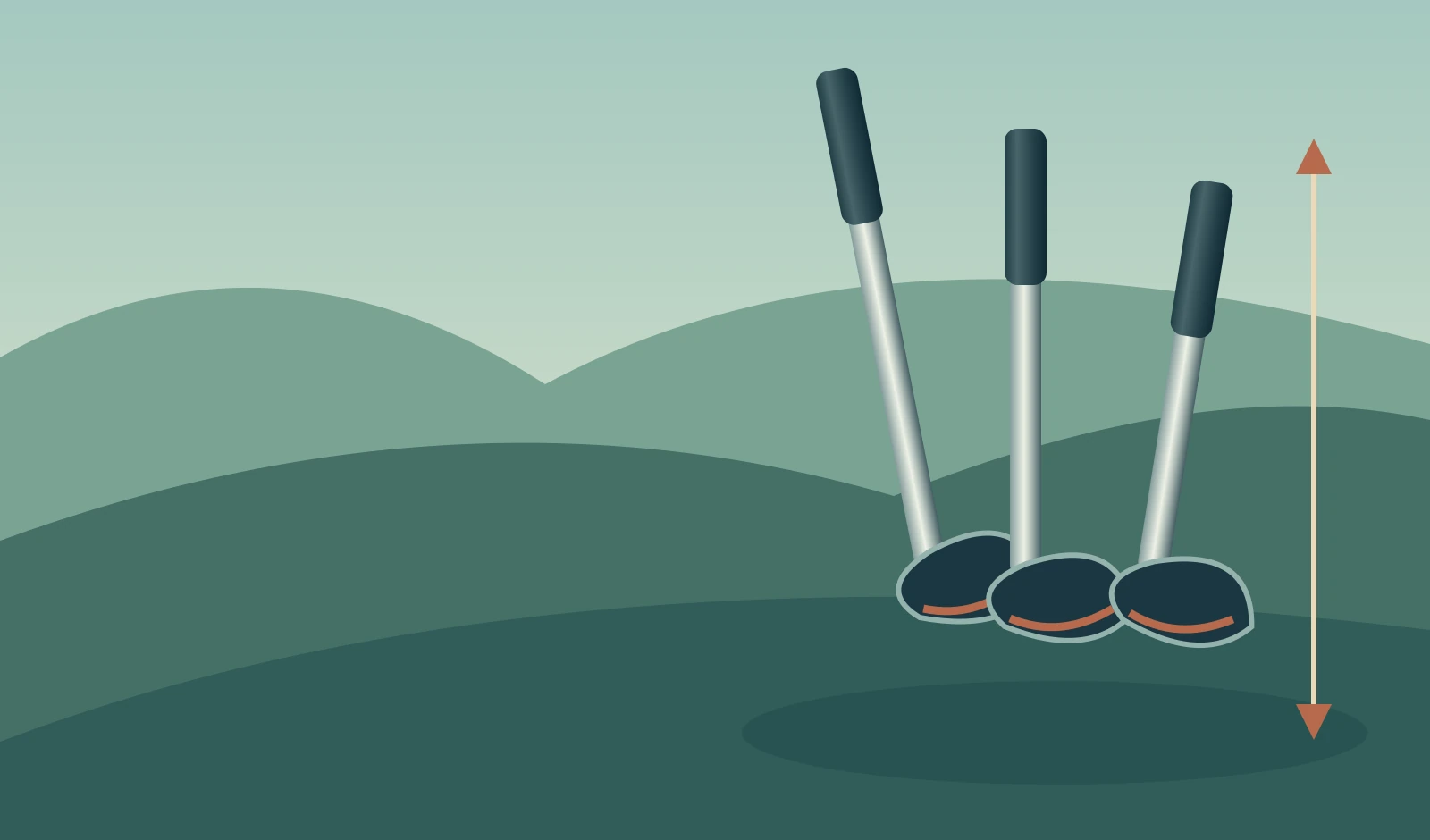
Original conceptual illustration; not a product or test photograph.
Fairway wood shaft length for shorter golfers should be a fitting question, not an automatic subtraction from a catalogue specification. Height tells you something about the player, but it does not fully describe arm proportions, setup, strike pattern or the job the club needs to do. A shorter golfer may benefit from exploring another playing length, yet the useful amount cannot be prescribed from height alone.
This research-led guide explains how to prepare that comparison without confusing a shaft measurement with a complete club measurement. Manufacturer examples show that stock lengths vary by model and loft. The suggested practice checks are a way to organise observations for a fitter, not a claim that a particular cut will add distance, cure a miss or suit every shorter person.
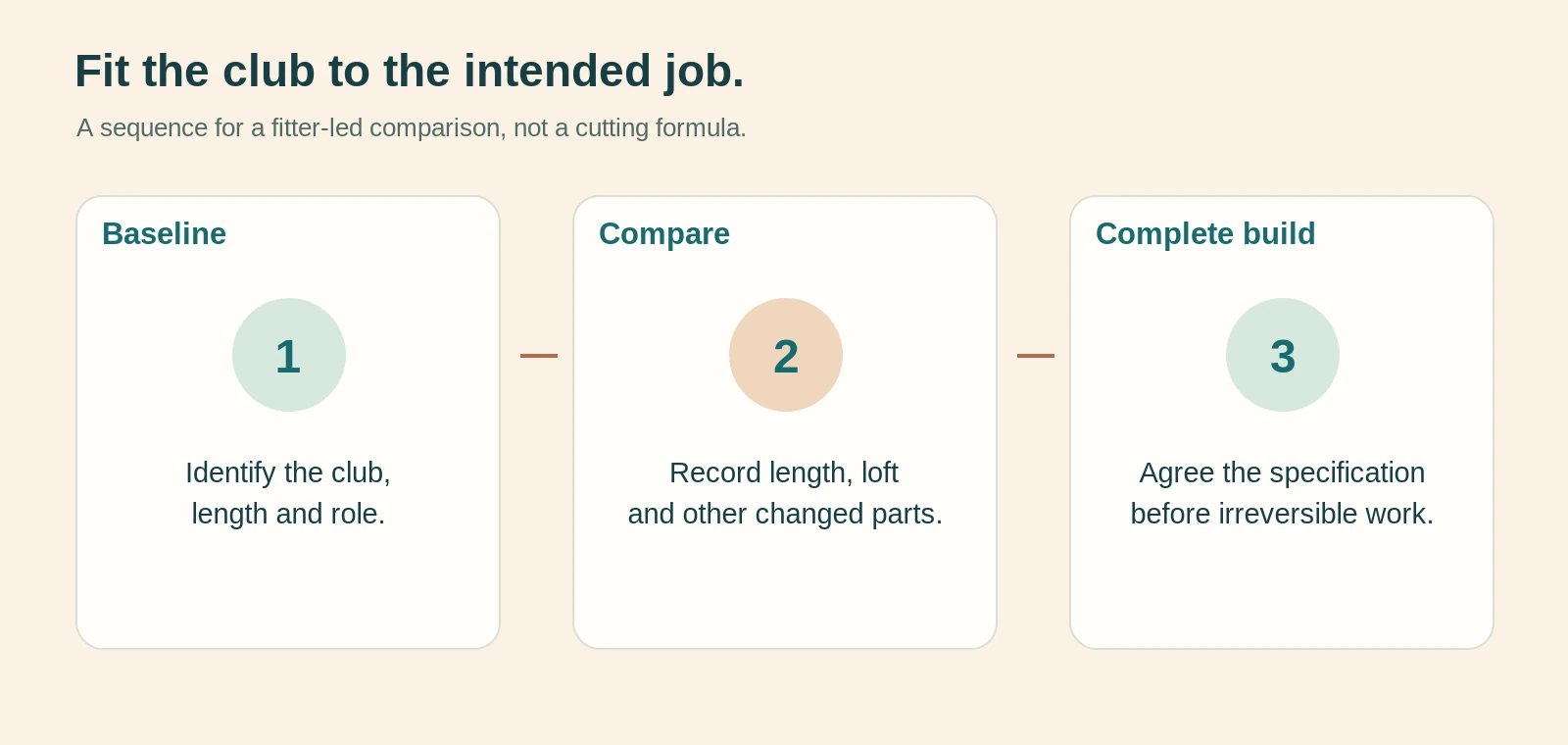
Start by identifying the club you own and the shot you want it to play. A fairway wood mainly used from a tee poses a different question from one expected to launch reliably from short grass. Before buying a replacement shaft or authorising any cutting, establish the current build and a sensible comparison that keeps those intended uses visible.
Define the shot role
Tee use and turf approaches need relevant comparisons.
Complete playing length
A loose shaft measurement is a different reference.
Ordinary outcomes
Keep loft and other changed variables visible.
Agree the build
Use exact-shaft guidance and a competent builder.
Fairway wood shaft length for shorter golfers: define the actual problem
Describe the difficulty before choosing the remedy
A useful starting note is specific: the club feels awkward to set down, strikes are inconsistent from short grass, or the club overlaps another club's usual carry. Those concerns may involve length, but they can also involve loft, head design, shaft characteristics, setup or the role assigned to the club. Do not turn every disappointing fairway-wood shot into evidence that the shaft must be shortened.
Write down when the issue appears and when it does not. Perhaps the club feels manageable from a tee but less useful from the turf, or the problem is most noticeable late in a practice session. Such observations help a fitter plan the comparison. They are more informative than a general statement that a shorter person must need a shorter club.
Make the intended job explicit
Decide whether the club's main role is a tee option, a longer approach from favourable lies, a controlled positional shot or a gap between other clubs. You can assign more than one role, but identify the priority. A fitting decision should support the shots you actually want to use rather than chasing an isolated longest strike.
Also consider whether the club needs to remain in the bag at all. Sometimes a different loft or another category of club may address the intended task more directly than changing length alone. That is a fitting possibility, not a recommendation to replace every difficult fairway wood. Keep the question open until you have a comparison that explains the trade-off.
Height is a starting detail, not a cutting instruction
Proportions and setup deserve observation
Two golfers of the same height can stand differently at address and have different arm proportions. Consequently, there is no height-to-cut table in this article. Record your height accurately if a fitter requests it, but do not let that single measurement overrule how the complete club sits and performs in a suitable fitting session.
The same caution applies to a wrist-to-floor measurement taken at home. It can be useful reference information when measured by the fitter's method, yet it does not independently determine a fairway wood's final playing length. Keep the conditions clear, including footwear and posture. A number collected differently from the fitting system's instructions can create more confusion than precision.
Do not transfer an iron chart to a fairway wood
PING's colour-code chart is a fitting reference for its iron system, using body measurements as part of the process. It should not be repurposed as a formula that tells a shorter golfer how much to remove from a fairway wood. [3] The club category and fitting method matter as much as the presence of a familiar height measurement.
If you already play shorter irons, tell the fitter, but treat that as background rather than a command to apply the same change to every wood. Explain which iron build works for you and what has been observed with the fairway wood. The aim is a coherent set of useful clubs, not identical adjustments copied across categories without assessment.
Distinguish shaft length from playing length
Ask what exactly was measured
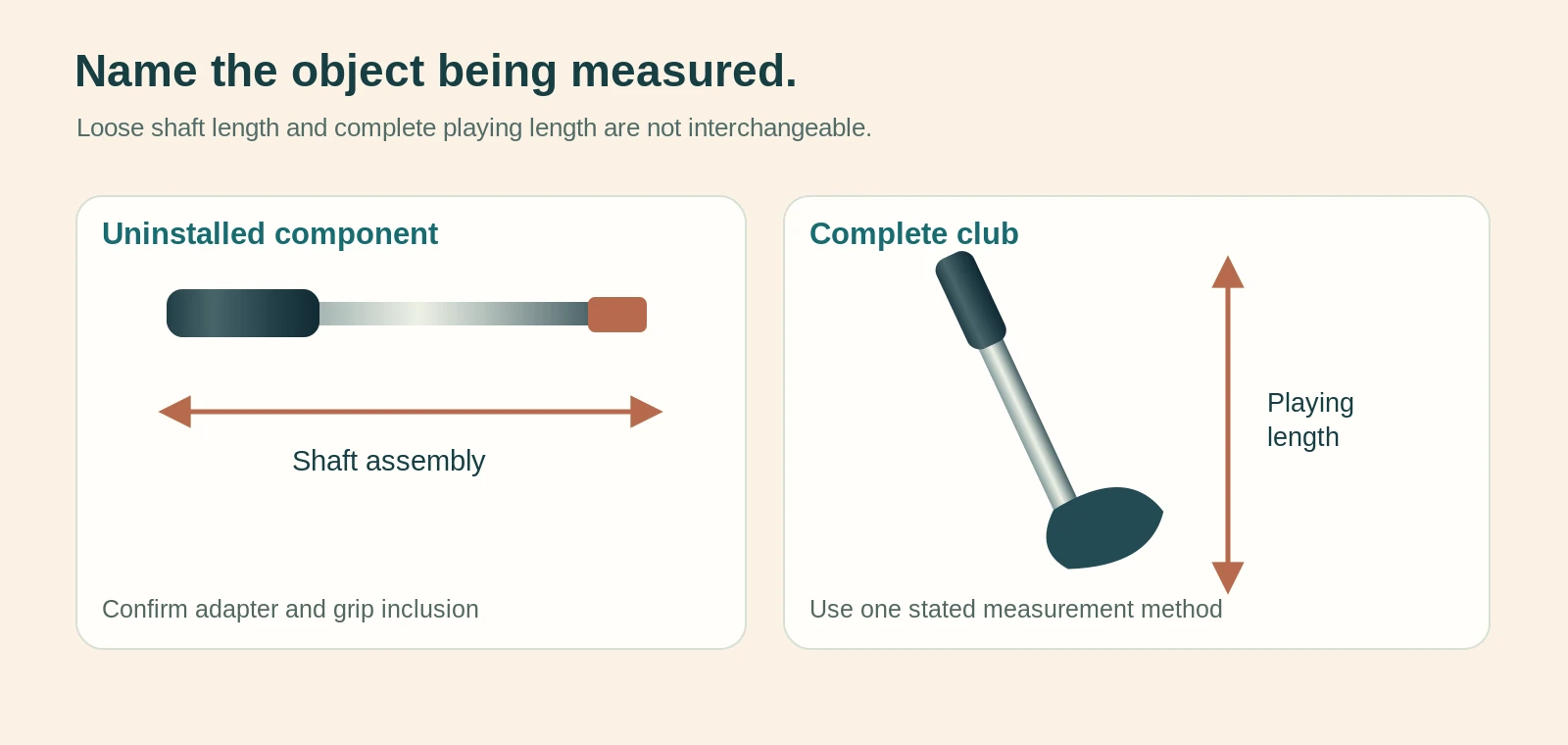
An uninstalled shaft, a shaft with an adapter and a complete assembled club are different objects. Their quoted lengths cannot be compared safely without knowing the measurement method and included components. When a seller describes a shaft as a certain length, ask whether that measurement includes the adapter and grip, and whether a finished playing length is being claimed in a specified head.
Avoid assuming that a shaft listed for one head will produce the same playing length in every compatible-looking head. The assembly and measurement convention need to be understood. Give a builder the exact head and shaft details rather than asking them to infer the result from a seller's photograph or an incomplete length description.
Use a consistent complete-club reference
For a useful fitting record, have the current club measured using the builder's normal method and record that method with the result. If you measure at home, label it as a home measurement and explain how it was taken. A small disagreement between methods should not automatically be interpreted as a manufacturing fault.
A comparison is strongest when the current and proposed builds are measured the same way. The goal is not to find a number that looks most precise, but to establish what changed between complete clubs. Without that reference, a supposed half-inch comparison may include unrecognised differences in setup, grip cap or the point from which the measurement was taken.
Read stock specifications at model level
Fairway numbers do not guarantee one length
PING's European G440 MAX specifications list both the 15-degree 3-wood and 17-degree 4-wood at 43 inches, the 19-degree 5-wood at 42.5 inches, the 21-degree 7-wood at 42 inches and the 24-degree 9-wood at 41.5 inches. The stated standard-length basis is the ALTA CB Blue 65 shaft. [1]
Titleist's GT2 specification example lists 15- and 16.5-degree options at 43 inches, 18 degrees at 42 inches and 21 degrees at 41.5 inches. [2] These examples show why a number stamped on the sole is not enough to establish the length of the actual club in front of you. Custom orders and previous alterations create further reasons to verify the build.
Published stock examples checked 4 October 2026. Verify the exact shaft/build and measure used or modified clubs.
| Model example | Loft | Published length |
|---|---|---|
| PING G440 MAX 3 / 4 wood | 15 / 17 degrees | 43 inches for both |
| PING G440 MAX 5 / 7 / 9 wood | 19 / 21 / 24 degrees | 42.5 / 42 / 41.5 inches |
| Titleist GT2 examples | 15 / 16.5 degrees | 43 inches for both |
| Titleist GT2 examples | 18 / 21 degrees | 42 / 41.5 inches |
Specifications are reference information, not personal targets
A manufacturer's stock length describes an offered build, not the length every golfer should use. Equally, a shorter custom length is not automatically an upgrade for a shorter player. Use the published information to understand the starting equipment and formulate a fitting question, then assess the complete club for its intended role.
When buying used, ask whether the club remains at its original specification and whether any work has been carried out. A seller may not know the full history; record that uncertainty rather than treating the catalogue as proof. Instead, a builder's inspection and measurement can be more useful than arguing from the year and model alone.
Consider loft alongside length without mixing the variables
A different loft may change the practical question
A golfer struggling to make useful shots with a low-lofted fairway wood may be comparing more than reach. Another loft could offer a different role or more suitable result in a fitting session. However, if the alternative also has a different length, shaft and head, the comparison does not isolate which feature made the difference.
That does not make the alternative invalid. You may prefer the complete club because it does the required job. Simply describe the conclusion accurately: this build was more useful for the task under the tested conditions. Do not translate that into a universal statement that a particular length reduction alone must have caused the improvement.
Separate the buying decision from the explanation
A fitter can organise a focused length comparison and, where appropriate, a broader comparison of different lofts or models. Keep those stages distinct in your notes. The focused test asks what happens when length changes within a controlled build; the broader test asks which complete club earns its place in your bag.
A sensible purchase does not require a single-variable explanation for every preference. It requires enough evidence to understand the likely role, the compromises and the reproducible specification. Avoid overclaiming certainty where several variables changed, especially when presenting a good session as proof that all shorter golfers should copy the final build.
Use gripping down as a trial, not a perfect substitute
It can help frame a question
Holding a familiar club slightly farther down the grip may help you describe whether a shorter effective reach feels worth exploring. Treat this as a limited, reversible observation during a suitable practice session, not a final fitting. Keep the hold secure and do not place your hands partly off the usable grip or adopt an uncomfortable position to reach an arbitrary mark.
Ask a fitter to guide the comparison where possible. Notice setup comfort and contact consistency rather than trying to force a predetermined result. A positive impression can justify testing an appropriately built shorter club; a negative impression can be useful too. Neither result fully predicts what a permanently altered build will feel like.
The complete build is not identical
Gripping down changes where the hands sit on the existing grip and how the remaining club extends above them. A permanent alteration can involve a different grip position, finished mass distribution and build choices. Therefore, the two conditions should not be described as mechanically identical or used to skip the final assembled-club trial.
This distinction matters particularly when the lower portion of the grip feels different under your hands. You might dislike that contact even while preferring the reduced reach. Record those observations separately. A fitter can then assess a shorter finished build with an appropriate grip rather than rejecting the idea solely because the improvised hand position was awkward.
Do not authorise cutting from a generic rule
Butt trimming and tip trimming are different operations
Shaft manufacturers publish model-specific trimming guidance, and the appropriate work belongs with a competent builder who understands the exact shaft and assembly. Fujikura's guidance distinguishes trimming considerations and directs golfers towards suitable fitting advice. [4] This article intentionally does not turn those instructions into a novice cutting procedure.
Do not assume removing material from either end produces the same outcome. Nor should a rule recalled from a driver or another shaft family be applied automatically to your fairway shaft. Give the builder the full model information and the intended finished club, then ask what work is appropriate and what can be tested before an irreversible change.
Ask what will be checked after the alteration
A length change is not complete merely because a ruler shows the requested number. Discuss the complete build, grip installation, head connection and any intended balance characteristics with the builder. PING notes that achievable swingweights depend on factors including shaft, length and grip, illustrating why the finished assembly deserves attention. [1]
Avoid demanding a universal amount of added head weight based on an internet shortcut. The builder should assess the particular components and intended result. After the work, use the securely assembled club in a suitable trial and confirm that the original fitting decision remains useful. The final check should concern the club you will actually play, not only the unmodified trial that inspired it.
Plan a fitting comparison that can answer a question
Establish the baseline first
Bring the current club and describe its role, known specifications and the conditions in which it causes difficulty. Warm up normally and allow the fitter to observe representative shots. Do not arrive determined to prove that a certain amount must be removed; that can make the session less informative than a clear account of the problem.
Record the baseline using ordinary shots rather than selecting only the best strike. Where a launch monitor is used, ask which measurements are relevant to your intended role and how the fitter is accounting for the conditions. Numbers should support the fitting question, not turn the session into a contest for the largest total-distance reading.
Change length deliberately
Where the fitting equipment allows it, compare suitable lengths while keeping other important variables controlled or clearly documented. The fitter may need to make build adjustments to create a meaningful comparison. Ask what changed rather than assuming every club with the same head name is otherwise identical.
Keep the trial long enough to settle into the equipment but avoid treating fatigue as a meaningful fitting result. A small number of carefully observed comparisons is often more useful than many hurried combinations. The conclusion should identify the promising build, the evidence supporting it and any remaining uncertainty that needs another session or an outdoor check.
Judge strike patterns without chasing one perfect shot
Look for a useful ordinary result
For a fairway wood, the best single strike can distract from how the club behaves on ordinary attempts. Discuss the spread of outcomes, the frequency of usable contact and whether the club performs the job you assigned it. These observations can be more relevant than a rare shot that travels farther than the alternatives.
Do not delete every poor strike from your thinking, but do not automatically treat every mishit as a verdict on length either. A fitter can help distinguish a meaningful pattern from an unsettled swing or an unsuitable comparison. Keep the explanation proportional to the evidence rather than claiming a length change guarantees a tighter pattern in every future round.
Keep comfort and outcome notes separate
Write one set of notes about address, reach and handling, and another about the observed shots. A build can feel comfortable without yet producing a convincing role in the bag. Conversely, an impressive shot pattern during one session should not require you to ignore an awkward or concerning setup sensation.
The useful fitting decision considers both. Where the evidence points in different directions, ask what should be compared next rather than forcing a premature winner. You are looking for a reproducible club that fits the intended task, not a number that wins an argument about whether shorter golfers need shorter fairway woods.
Test the lies you actually intend to use
Tee shots and turf shots are separate checks
A fairway wood used mostly from a tee should be assessed for that task, while a club intended for approaches needs a suitable turf comparison. A strong result from one does not automatically establish the other. Explain the balance of uses before the session so the fitter can avoid recommending a club on evidence unrelated to your main need.
Where a safe outdoor trial is available, include representative favourable lies rather than testing only an ideal mat position. Keep the conditions and permissions appropriate. You do not need to manufacture difficult rough lies to prove the club's versatility. The first question is whether it performs the sensible job you expect to assign it during normal play.
Avoid judging the build from an unsuitable lie
If the lie would make the intended shot unwise with any fairway wood you are comparing, it may not be a useful fitting test. Separate club suitability from shot selection. A shorter shaft is not a promise that the club becomes appropriate for every lie or that you should attempt a shot previously outside your comfortable options.
Discuss any recurring scenario with the fitter, including whether another club would be a more sensible tool. Sometimes the best outcome is clearer knowledge of when to use the fairway wood, not a modification intended to make it universal. A well-defined limitation is useful information, especially when it prevents a purchase based on unrealistic expectations.
Check carry gaps rather than catalogue labels
Use the clubs around the fairway wood
Bring the neighbouring clubs to the fitting where practical. A new build needs a useful place between them, not simply a pleasing specification by itself. Compare the relevant carry behaviour and intended shots under suitable conditions. Keep total distance, which includes the result after landing, separate from the carry question when that distinction matters to the task.
Suppose a hypothetical golfer has two clubs producing very similar ordinary carries despite different numbers on their soles. Altering one club's length is only one possible response. Another loft, another role or removing the duplication may be worth discussing. The example is a planning situation, not a distance prediction for any particular height or handicap.
Accept that the longest option may not be the best fit
A slightly shorter useful carry could still make sense if the club provides a more dependable role in the bag, but that judgement needs evidence from the fitting rather than a generic promise. Conversely, giving up a needed gap for a build that merely feels fashionable may be a poor trade-off.
Describe the compromise openly: what task becomes easier, what distance relationship changes and which shots remain outside the intended use. A fitting recommendation is stronger when those points are explicit. Avoid presenting the chosen length as universally optimal when it was selected to solve a particular golfer's bag composition and playing needs.
Women, men and juniors: do not substitute a category for a fit
Product labels are not complete specifications
A club marketed to a particular group may offer different stock shafts, lengths or weights, but the label does not establish that it is suitable for every shorter golfer in that group. Read the actual build information and compare the complete club. Equally, there is no reason to reject a workable option solely because its marketing category is unfamiliar.
Ask the fitter to focus on the player's proportions, normal movement, intended use and observed results. Keep assumptions about strength or preferred length out of the conversation unless supported by the actual fitting. A practical equipment decision should follow the person in front of the fitter, not a stereotype attached to a product rack.
Growing players need an appropriate professional approach
For a junior, avoid adopting an adult shortening formula from an article. The relevant fit can change as the player develops, and a competent junior fitter or coach can assess suitable equipment and future review points. This guide does not prescribe a growth allowance or a length adjustment for children.
For any golfer, revisit a fit when the equipment's role or practical suitability has changed, rather than assuming the original specification remains correct forever. That does not mean routine changes are always necessary. It means a documented successful build is a reference to reassess thoughtfully, not a rule that should override new observations.
Buying used or ordering a replacement shaft
Request a complete description
Ask for the exact shaft model, flex marking, adapter where present, grip and the way length was measured. Request clear photographs of relevant markings and ask whether the shaft has been trimmed or otherwise altered. A seller may not have the build history, so decide whether that uncertainty is acceptable rather than filling the gaps with catalogue assumptions.
Compatibility also needs confirmation for the exact head and adapter system. A shaft that appears to be the desired length is not automatically safe or suitable to install. Have a competent builder assess any uncertain assembly before use. This article is about fitting length, not a substitute for component-compatibility checks.
Agree the expected finished build before paying
When ordering a custom shaft or alteration, specify the head it will be used in and the desired finished playing-length convention. Ask how the supplier will account for the grip and assembly. Keep the response with the order so that a later measurement question can be discussed against an agreed description.
Avoid buying a bargain shaft merely because its raw or adapter-to-grip measurement resembles the number from your fitting. The final club may not reproduce the same build. A lower purchase price is not useful if the component cannot safely or practically deliver the intended result without additional work that was never considered.
Separate shaft flex labels from the length decision
Record the actual shaft model
A flex letter is only part of a shaft description. When a fitting comparison uses different models, record the complete names and any stated weights or build details supplied by the fitter. Do not assume that two shafts carrying the same letter make an otherwise controlled length comparison.
Likewise, do not describe shortening as automatically moving a club into the next flex category. The effect of a modification depends on the shaft and work performed, and a generic letter does not explain the completed build. Refer model-specific questions to the shaft maker's guidance and a competent builder. The useful buying record identifies what was actually fitted instead of replacing that information with a rule about shorter meaning stiffer.
Keep your preference separate from a technical explanation
You may find one complete shaft-and-length combination easier to use during a fitting without knowing which characteristic produced that impression. Report the preference and the observed results, then ask the fitter to explain the limits of the comparison. There is no need to invent a technical cause to make the preference legitimate.
This is especially important when trying a stock alternative whose shaft differs from your current club. A promising result can justify further investigation, but it should not become proof that every golfer of your height needs the same length. A controlled follow-up or a documented complete-build choice is more defensible than a universal explanation based on one successful combination.
Reconcile an indoor fitting with the intended outdoor job
Record the test environment
An indoor mat session can provide useful fitting information, but it is still a particular environment. Note the ball type, surface and whether the comparison used tee shots or shots from the mat. Ask the fitter how those conditions relate to the fairway wood's intended use on the course, especially when ordinary turf contact is the concern you want to investigate.
Do not dismiss the session simply because it was indoors, and do not treat it as evidence for every outdoor lie. The sensible question is what was learned and what remains uncertain. A result that clearly narrows the options can be valuable even when a later outdoor trial is needed before authorising a final build.
Plan the follow-up before collecting the club
Discuss whether an appropriate trial or follow-up appointment is available and what it covers. Record the actual terms rather than assuming every custom-built club can be returned after play. Keep any first-use checks within the agreed arrangement, and raise a meaningful discrepancy with the fitter before making further alterations yourself.
For the outdoor follow-up, return to the original task: representative tee shots, favourable turf lies or the intended carry gap. Use ordinary outcomes and note conditions without trying to reproduce one memorable indoor strike. A coherent fitting record connects those stages and gives the fitter something concrete to assess if the completed club does not perform the role expected.
Keep a fitting record you can reproduce
Record the club, not just the cut
Your final note should include head model and loft setting, shaft model and stated flex, measured playing length and method, grip details and any builder-recorded balance or assembly specifications. Also record the date and the intended role that justified the choice. This makes the result easier to reproduce than a note saying one inch short.
Keep any uncertainties visible. For example, a used club's previous shaft work may remain unknown even after a useful fitting session. A clear record can distinguish the characteristics measured now from an assumed factory history. That honesty matters when a future repair or replacement requires another builder to understand the equipment.
Confirm the assembled club after collection
Inspect the club with the builder, follow any relevant use or curing instructions and raise unexpected differences before making your own adjustments. A finished club should match the agreed description, but the most important follow-up is whether it remains suitable in ordinary use. Record any concern clearly and seek the fitter's advice rather than immediately authorising another cut.
Do not interpret an unfamiliar first swing as proof that the fitting failed, nor persist with a concerning assembly because you have already paid. Separate adaptation, performance uncertainty and equipment security. A loose connection or damaged component is a stop-use issue, not something to play through while gathering more fitting data.
Pros and cons of exploring a shorter build
Potential practical benefits
A different playing length may be worth exploring when the current club creates a specific reach, setup or contact concern. That fitting comparison can help establish whether another build serves the intended role more usefully. The benefit is not guaranteed by being shorter; it is the opportunity to match the complete club more closely to the task and player.
A shorter trial also gives a useful contrast with stock specifications. However, the value lies in the observed comparison, not in rejecting catalogue lengths as inherently wrong. Some shorter golfers may find a stock build appropriate, while others prefer a custom result. The fitting process should allow either conclusion without treating one as a failure.
Costs and limitations
An alteration can be irreversible and may require attention to grip, assembly and balance. A different length can also change the bag's distance relationships. Therefore, a decision based only on a comfortable stationary pose is incomplete. Test the intended shots and understand the final build before committing to the work.
There is also a risk of using equipment changes to avoid clarifying the shot task or seeking relevant coaching. A fitter can help determine what the club comparison actually shows. The goal is not endless adjustment; it is a suitable, documented build with realistic expectations and a clear understanding of where it belongs in the bag.
Common mistakes that weaken the comparison
Cutting according to height alone
Do not subtract a standard amount because another golfer of similar height did so. Their proportions, head, shaft, grip and intended use may differ. Likewise, do not copy an iron-chart recommendation directly onto a fairway wood. Use measurements to prepare the fitting, then compare the actual club for the shots it needs to play.
Another error is confusing a loose shaft's length with finished playing length. Always establish what is included and how it was measured. This is particularly important when buying online, where a plausible number can conceal an incomplete description. A clear question before purchase is more useful than trying to resolve an avoidable mismatch after installation.
Treating one long shot as the winner
A single excellent strike does not establish the most useful club. Look at ordinary outcomes, intended carry relationships and whether the build remains manageable from the lies you plan to use. Keep multiple changed variables visible instead of crediting every difference to shaft length.
Finally, do not perform irreversible trimming or improvised head-weight changes to recreate a promising trial without a builder's input. The finished assembly needs to be appropriate and secure. A practical fitting record should lead to a controlled build, not a chain of guesses made because the first improvised change seemed encouraging.
Frequently asked questions
How much shorter should a fairway wood be for a short golfer?
There is no universal amount. Height alone does not determine the appropriate playing length, and a fairway wood's role matters. Start with the current build, describe the difficulty and compare suitable alternatives with a fitter. Keep loft, shaft, grip and other changes documented. The useful outcome is a complete club that serves the intended task, not an adjustment copied from another golfer's height.
Is gripping down the same as cutting the shaft?
No. It can provide a limited, reversible observation about reduced reach, but it changes the hand position on the existing grip and leaves the rest of the build intact. A permanently shorter club may feel different after the grip and assembly are completed. Use gripping down to frame a fitting question, not to skip a properly built trial or prescribe irreversible work.
Can I use my iron fitting chart for a fairway wood?
Not as a direct cutting formula. An iron fitting system applies to its specified club category and method. Tell the fitter about the iron build that suits you, but have the fairway wood assessed separately for its intended role. Similar body measurements do not make the clubs interchangeable fitting problems. The complete assembly and observed shots still need consideration.
Will a shorter fairway wood lose distance?
This guide cannot predict a distance change for an individual golfer. The result depends on the complete build and how it is used. Compare representative carry outcomes and the club's place in the bag rather than relying on a generic gain-or-loss rule. A fitting should make the trade-off explicit, including whether the chosen club remains useful for the shots it is meant to cover.
Should I choose more loft instead of a shorter shaft?
That is worth discussing when the current club does not perform its intended task, but it is not an automatic alternative. A different lofted club may also change length, head and shaft, so the comparison can involve several variables. A fitter can separate a focused length trial from a broader search for the most useful complete club. Either may be relevant to the final decision.
Is a replacement shaft advertised at the right length enough?
No. Confirm the measurement method, included grip or adapter, exact compatibility, build history and expected finished playing length in your head. A loose component's length is not a complete club specification. Where the history or assembly is uncertain, have a competent builder assess it before use. A matching number in an advert does not establish a safe, reproducible fit.
Final recommendation: fit the role and document the build
Approach fairway wood shaft length for shorter golfers as a controlled comparison. Establish the current playing length, clarify the intended shots and use body measurements as supporting information rather than a cutting formula. Compare ordinary outcomes, not just the longest strike, and keep loft and other build changes visible.
Before any irreversible alteration, agree the complete specification with a competent fitter or builder. Then confirm the assembled club in suitable use and retain a record that can be reproduced. The best result is not necessarily the shortest club or the stock club; it is the build that earns a clear, useful place in your bag without relying on assumptions about height.
Sources and fact-checking notes
Official pages were checked on 4 October 2026. Specifications refer to the named model or document, not every product in its category. The practical checks and examples in this guide are research-led suggestions, not reported results from hands-on product testing.
- PING Europe – G440 MAX fairwayEuropean stock loft/length examples; ALTA CB Blue 65 length basis and build-dependent swingweight note.
- Titleist – GT2 fairwaysNamed loft and stock-length examples; not a prescription for an individual golfer.
- PING Europe – colour-code chartIron fitting reference; not transferred into a fairway-wood cutting formula.
- Fujikura – tip trimming guidanceExact-shaft trimming and fitting considerations; this article provides no novice cutting procedure.
Product pages, model options and rule guidance can change. Recheck the exact item and applicable document before relying on a technical or competition decision. No product price, availability or performance outcome is guaranteed by inclusion here.
Illustrations in this article were created for Taylor’s Trailblazing Golf Gear. Third-party photographs, where used, are credited beside the image or in the source list.