
Oversized Putter Grips: Measuring Comfort Without Masking Setup Problems
Choose a comfortable shape without overlooking the putter underneath it.
Original conceptual illustration; not a product or test photograph.
Oversized putter grips can change the way a putter sits in your hands, but the largest option is not automatically the most comfortable or the best fit. Width, shape, length, taper and mass all deserve attention. A grip can feel pleasantly substantial in a shop and still be awkward on your own putter, particularly when its outline changes where your hands settle.
The useful question is not whether a big grip will quiet every unwanted movement. It is whether a particular grip helps you hold a suitably fitted putter comfortably and repeatably without hiding a setup issue. This guide uses manufacturer specifications and a suggested comparison process; it does not report hands-on testing, promise improved scores or prescribe a grip for pain or a diagnosed condition.
Start with the putter you already use. Note its current grip, the reason you are considering a change and whether the concern is really in the hands or elsewhere in the setup. Then compare a small number of shapes and builds, keeping comfort observations separate from what happens to the ball. That produces a more useful decision than choosing by size name alone.
Where is the concern?
Describe the hand contact, not just a wish for a bigger grip.
Width is not everything
Flat faces, depth and taper affect the comparison.
Check mass and length
The same stated width can hide a different grip build.
Putter and bag
Confirm installation, use and everyday storage.
Oversized putter grips: define what you want to improve
Describe the contact problem
Try to replace a vague complaint such as the grip feels wrong with a specific observation. Perhaps the lower hand feels crowded, the flat front encourages an awkward thumb position or the grip seems bulky in one direction. Another golfer may simply dislike the current surface. These concerns point towards different comparisons even though all might initially be described as wanting a bigger grip.
Write down when the concern appears. Is it present while standing over the ball, only during longer putts or mainly when you change hand placement? A short description can help a fitter distinguish a shape preference from a length or setup concern. It also gives you something meaningful to revisit after a trial rather than judging every new grip by its novelty.
Set a modest, testable aim
A useful aim might be to settle both hands without repeated adjustment or to find a shape that feels manageable across your usual putting routine. Avoid promising yourself a particular reduction in putts before the comparison begins. The grip is one part of the complete putter and cannot independently guarantee the outcome of every stroke.
Keep a clear stopping point. If a sample creates discomfort, insecure contact or an obviously awkward setup, there is no need to persist simply because it is popular. Conversely, a comfortable sample deserves a properly fitted trial, not an immediate claim that it has corrected the stroke. Separate promising feel from demonstrated on-green suitability.
Check the putter setup before changing the grip
Do not use bulk to disguise unsuitable reach
Stand with your current putter in a normal, comfortable address position. Notice whether you are reaching awkwardly, holding it unusually low or changing posture mainly to accommodate the club. These observations do not diagnose the cause, but they are good reasons to discuss the complete putter fit before treating grip diameter as the only available adjustment.
A larger grip does not change the shaft's playing length or independently establish a suitable lie. If the putter's overall fit is uncertain, ask a competent fitter or coach to assess the setup. A grip comparison is more informative when the club underneath it is already a sensible starting point for the player.
Keep the comparison tied to your ordinary method
Use the hand arrangement you normally intend to play. Switching simultaneously to a different grip style, a new putter length and a much larger handle changes several things at once. That may be part of a deliberate coaching plan, but it is not a simple test of oversized grip comfort.
Record intentional changes so the explanation remains honest. You can prefer a complete new setup without proving which single component caused the difference. The danger is not making several changes with professional guidance; it is forgetting that they happened and attributing every result to the grip's width.
Read shape before reading the size number
Cross-sections are not interchangeable
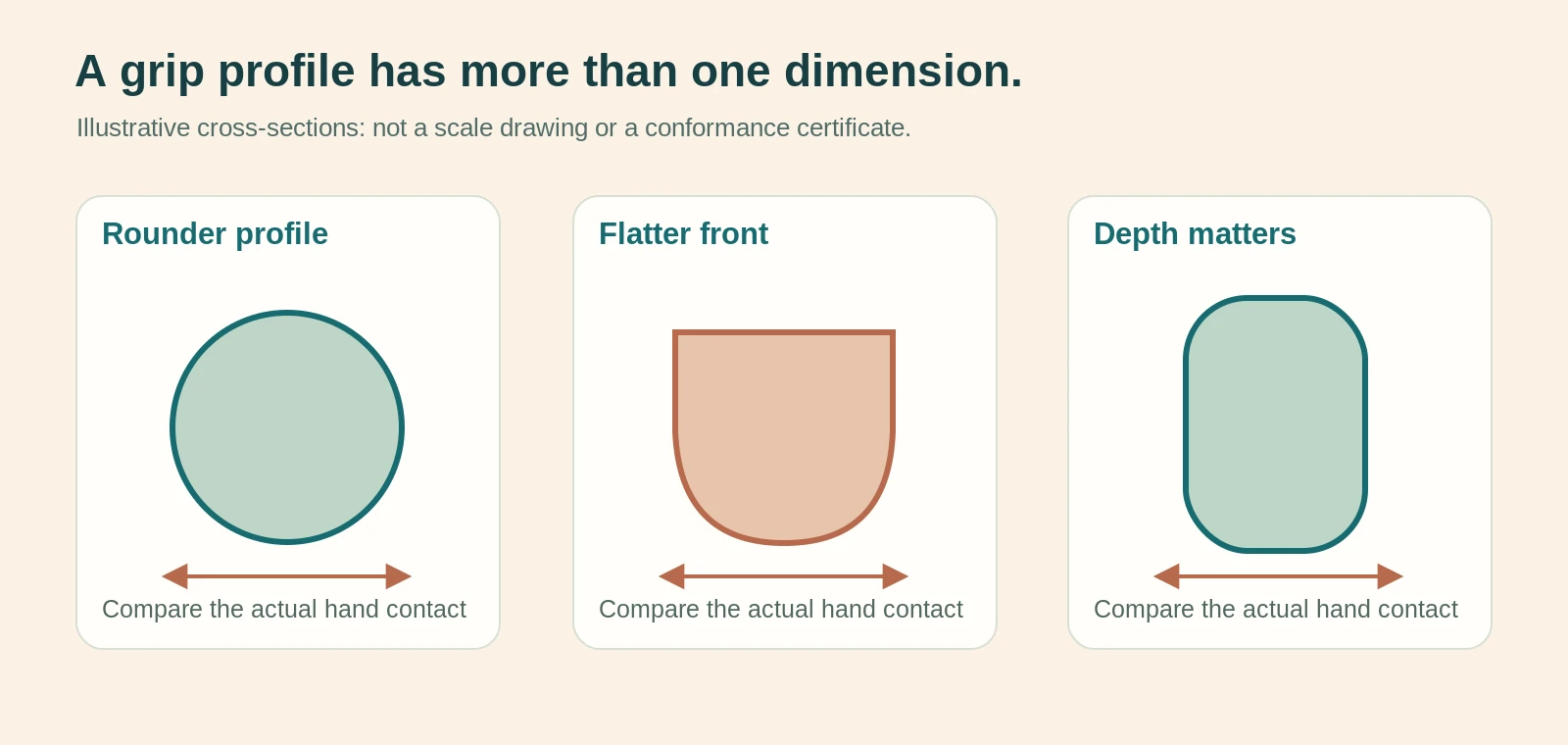
Putter grips can present different front faces, rounded areas, shoulders and taper profiles. A nominal width does not describe all those contact surfaces. Compare how the actual shape meets your hands rather than assuming two grips with similar dimensions will feel alike. An oversized rounder profile may feel very different from a broad, flatter face.
Golf Pride's Reverse Taper range, for example, includes Flat, Pistol and Round shapes. Those labels identify distinct profiles rather than one universal oversized form. [1] Use manufacturer descriptions to select samples, then judge the actual contact. Do not treat the name of a shape as evidence that it must suit a particular putting style or hand size.
A larger number is not a ranking
Size names and model numbers belong to each manufacturer's system. They are not a ladder from beginner to advanced, nor a guarantee that a larger number is more stable. Read the published dimensions and model description, then compare the grip on a suitable club. Keep the exact product name in your notes so a later order reproduces the sample you liked.
Where a retailer offers only loose samples, use them to assess broad shape preference rather than full playing feel. A loose grip in the hand lacks the complete putter's balance and installed orientation. It can narrow the shortlist, but it should not be the final test of how the putter will behave during your stroke.
Measure width, depth and usable length
One diameter can mislead on a non-round grip
For a grip that is not circular, record the relevant width and depth rather than inventing a single diameter from its circumference. A tape wrapped around the outside does not tell you how a flat face or rounded back will contact the hands. Use the manufacturer's dimensioned specification where available and ask which direction its quoted width describes.
If a fitter measures the existing grip, agree the position along its length. A tapered or shaped grip can differ from top to bottom. Avoid compressing a soft surface with measuring tools and treating the squeezed value as the true dimension. The aim is a consistent comparison, not a home certification of the product's size.
Distinguish overall length from hand space
A longer grip may provide more room for a chosen hand position, but overall length alone does not describe which parts you will comfortably use. End caps, contours and transitions can matter. Try the intended hand arrangement on the fitted sample rather than assuming the published length equals an uninterrupted contact area.
Also consider whether the new grip changes where you naturally hold the putter. If your hands move down or up substantially, the comparison now includes a setup change. That may be intentional, but it should be recorded. A simple note about hand position can explain why two grips of similar width feel different on the same putter.
Separate grip width from grip mass
Similar widths can conceal different builds
SuperStroke lists its Zenergy Tour 3.0 at 1.26 inches wide, 10.50 inches long and 66 grams. Its Zenergy XL Tour 3.0+Plus is also listed at 1.26 inches wide, but is 13.75 inches long and 100 grams. Both list a 0.58-inch core. These are manufacturer specifications checked on 4 October 2026, not measurements from this article. [2] [3]
The comparison shows why width alone cannot describe the change being made. A longer, heavier grip may affect the complete putter's feel differently from a shorter grip with the same stated width. Do not assume that choosing the same nominal width preserves every other aspect of the build.
Manufacturer specifications checked 4 October 2026. Same published width, different length and mass; no performance ranking.
| Specification | Zenergy Tour 3.0 | Zenergy XL Tour 3.0+Plus |
|---|---|---|
| Width | 1.26 inches | 1.26 inches |
| Length | 10.50 inches | 13.75 inches |
| Stated grip mass | 66 g | 100 g |
| Core | 0.58 inches | 0.58 inches |
| CounterCore weight | Not included | Not included |
Discuss the complete putter balance
Tell the fitter which grip is currently installed and whether any additional weight is present. Ask how a proposed change will be assessed on the complete putter. Avoid assuming that every heavier grip is automatically a counterbalanced improvement or that a preferred static feel guarantees better pace control.
Keep the outcome practical: does the assembled putter remain manageable through the strokes you intend to make? A fitter can help interpret changes without turning a component mass into a universal performance prescription. The relevant comparison is the club you will use, not the loose grip weighed in isolation.
Treat removable weights as an additional variable
Check what is actually included
Some grips accept an additional weight or accessory, but that does not mean it is included or suitable for every build. SuperStroke's cited Tour and XL product pages state that the separate CounterCore weight is not included. [2] [3] Read the exact model information before assuming an advertised compatible system is already part of the purchase.
When comparing samples, record whether either has an added weight. Otherwise, you may believe you are comparing two grip shapes while also comparing different complete builds. Ask the fitter to identify the components and explain the intended purpose of the configuration rather than guessing from the appearance of the end cap.
Do not improvise an internal modification
Use only appropriate components and a competent installation method for the exact grip and putter. Do not push improvised weights into a shaft or alter an accessory because it seems close enough to fit. A component that rattles or is not securely fitted is not something to tolerate while deciding whether the added mass improves feel.
If you are exploring weighting, treat it as a separate fitting stage after establishing a promising grip shape. That makes the comparison easier to interpret. You may ultimately prefer a combined change, but the record should say what was changed and what the trial actually showed, rather than crediting all of it to an oversized label.
Observe comfort without turning it into a medical claim
Use specific, ordinary descriptions
During a sample comparison, note whether the hands settle easily, whether an edge feels intrusive and whether you keep repositioning the fingers. Those are useful equipment observations. You do not need to assign a medical explanation or claim that a grip reduces strain simply because it feels comfortable during a brief session.
Keep the duration and setting in mind. A few minutes in a shop can identify an obvious dislike, but it is a limited test of longer-term preference. A promising sample should be checked on the complete putter in an appropriate practice setting before you make a confident purchase decision.
Stop when symptoms need another kind of help
Pain, numbness, persistent tingling or another concerning symptom should not be used as a cue to keep increasing grip size until something seems tolerable. Stop the comparison and seek appropriate professional advice. This guide does not prescribe equipment to treat a health condition or replace assessment by a qualified clinician.
Similarly, do not interpret a comfortable oversized grip as proof that an uncomfortable putting setup is now suitable. Comfort at one contact point does not explain the whole body position. A fitter or coach can help assess equipment and setup questions, while healthcare concerns belong with the relevant healthcare professional.
Build a fair shape comparison
Keep the putter and conditions as similar as possible
Where fitting equipment allows, compare grip options on the same or closely matched putter builds. Use the same type of ball and a consistent practice surface. If the heads, lengths or weights differ, record that limitation. You can still form a preference, but the result is not a clean comparison of grip shape alone.
Begin with a normal address and a few comfortable strokes in a safe practice area. Do not force the grip into a hand position that feels artificial just to match a manufacturer's photograph. Instead, notice whether the shape supports the method you intend to use and whether it introduces a new adjustment you would need to make every time.
Alternate rather than exhausting one option
A simple proposed comparison is to use one sample for a short group of putts, move to the other, then return to the first. This is not a validated fitting protocol; it is a way to avoid giving the second sample all the benefit of warming up. Keep the groups manageable and stop before fatigue turns the session into a different comparison.
Write a few words after each group before discussing the product's selling points. Record comfort, hand placement and any repeated difficulty. Returning to the original sample can reveal whether the new option genuinely addresses the stated problem or simply felt interesting because it was unfamiliar.
Test start direction separately from finishing distance
Use a clear directional task
On an appropriate practice surface, choose a visible start reference that can be used safely without damaging the surface or placing rigid objects in the stroke path. Observe whether the ball begins along the intended reference, while keeping the task modest. A coach can help set up a suitable exercise and interpret the result.
Do not claim that a few putts prove a grip has corrected face control. The comparison can reveal a repeated practical difficulty worth discussing, but it is not a laboratory measurement of every part of the stroke. Record what you saw without converting it into a broad promise about future performance.
Give pace its own observation
Then use a separate distance-control task with an appropriate stopping area. A grip that feels appealing on short, firm putts may deserve another look during longer strokes. Note whether you can make the required movement comfortably and whether the outcome is sufficiently consistent to justify further testing.
Keep the surface and target arrangement unchanged between samples where possible. A ramped indoor target, a flat stopping zone and an outdoor hole provide different feedback, so do not combine them into one unexplained success rate. Describe the task and conditions with the result. That makes the observation useful to a fitter instead of producing a misleading overall score.
Watch for setup changes hidden inside a comfortable grip
Check hand height and position
After trying a new grip, compare where your hands naturally settle with the original setup. Have they moved significantly down the shaft, apart from one another or around the front face? These are not automatically bad changes, but they mean the trial involves more than surface comfort.
A fitter or coach can help decide whether the changed position suits the complete putter and intended method. Do not use a larger grip to avoid that discussion when the club is being held in a markedly different way. The useful question is whether the whole arrangement is sensible and repeatable, not whether one component feels pleasantly substantial.
Check what you are using as an alignment cue
A pronounced flat face or visual line can influence how you orient your hands or the putter at address. During the trial, notice whether you are trusting the grip's appearance more than the head's actual alignment. If the installed orientation is uncertain, have it checked rather than compensating with an unusual hand position.
This is particularly important after regripping. A shape that felt helpful on a demonstration putter may feel different if installed differently on yours. Give the installer a clear reference and inspect the completed club together. Do not accept a setup compensation as the inevitable price of using an oversized grip when the installation itself needs review.
Check conformance and permitted use separately
Oversized does not mean unrestricted
The R&A's Equipment Rules allow certain non-circular putter grips, but the grip still has to meet the applicable requirements. The maximum cross-sectional dimension is 1.75 inches, or 44.45 millimetres, measured in any direction. Other shape and construction requirements also apply, so staying below one dimension is not independent proof that a modified grip conforms. [4]
Choose a legitimate product and obtain appropriate advice before unusual modifications. Do not add moulded hand supports or reshape a grip on the assumption that putters have no restrictions. If the exact product or alteration raises a rules question, seek a ruling through the appropriate equipment or competition channels rather than relying on a home measurement alone.
A conforming grip does not approve every stroke method
Equipment conformity and the way the club is used are separate matters. Rule 10.1b addresses anchoring during a stroke. [5] A longer or larger grip should not be interpreted as permission to use any body-supported method. Check the actual rule and seek competent advice where a proposed technique is unclear.
This guide does not teach a new anchoring or alternative-hold method. Its focus is comparing equipment comfort within a suitable, permitted putting setup. Keep that boundary clear when reading product marketing or watching another golfer: a visible grip style does not, by itself, explain the legality of the complete stroke.
Compare familiar feel with a genuinely better match
Give the old and new shapes an equal task
A familiar grip can feel natural because you know where your hands go, while a new profile can feel attractive simply because it is different. Neither first impression settles the fitting decision. Use the same modest task with both samples and return to the original after the new option, recording whether the stated contact problem is actually reduced.
Do not demand instant perfection from an unfamiliar shape, but do not dismiss a persistent awkwardness as something you must learn to tolerate. A fitter can help distinguish a reasonable comparison period from an unsuitable setup. The important record is the repeated observation, not a loyalty test between the old grip and a product you hoped would be better.
Avoid chasing a result that has not been defined
If the aim is to reduce repeated hand repositioning, count or note those repositionings during a small group of normal attempts. If the aim is to avoid an intrusive edge, describe when that edge is noticeable. Those observations connect the trial to the original question more directly than a general impression of stability.
Keep any count labelled as a personal practice observation rather than a clinical or scientific score. It can help you decide which sample deserves a longer trial, but it does not prove that the product will improve performance for another golfer. A specific, modest result is more useful than a confident claim that the hands felt quieter with no explanation of what was observed.
A buying decision can reasonably end with the current grip
Look for an actual advantage, not a compulsory change
After comparing several shapes, you may find that the existing model remains the most manageable option. That is a useful fitting outcome. If its surface is worn, a like-for-like replacement may be more appropriate than changing size solely because the comparison began with an intention to buy something larger.
Record what the alternatives failed to improve. Perhaps a flat face felt intrusive, the longer model changed your hand position or the larger profile complicated bag access. Those details prevent the next product launch from restarting the same search without reference to what you already learned. A rejected option can provide valuable information even when it never becomes a purchase.
Keep the decision open to a future change in circumstances
Retaining the current grip is not a claim that it will remain right forever. A different putter, intended hand method or practical concern could justify another fitting discussion later. The point is to change equipment in response to a defined need, not because a bigger size appears to be the next stage of progress.
Store the successful specification with the putter details and revisit it when a real issue appears. That makes future comparisons narrower and more useful. A good equipment process should eventually let you stop shopping and practise with a suitable club, rather than creating an endless sequence of grip changes whose purposes become difficult to remember.
Make sure the grip works with your bag
Check the full path into the putter well
An oversized grip may fit through the opening of a bag's putter slot yet catch farther down. Before buying a bag or committing to a very large grip, check the actual combination where possible. Insert and remove the putter normally without forcing it, and consider the bag in the loaded condition you would use on the course.
Do not assume a product description saying oversized putter well covers every grip shape, accessory or end cap. Ask for relevant dimensions and confirm how they are measured. A wide flat profile can behave differently from a round profile with a similar advertised width, particularly at a narrow internal point.
Avoid making storage a daily struggle
If the grip catches, do not solve the problem by yanking the putter repeatedly or modifying the bag without understanding its construction. Consider whether another compartment, another compatible bag arrangement or a different grip is more practical. The chosen equipment should work as a system, not only look suitable when each item is considered separately.
Also check that the grip does not rub against a sharp or damaged edge. Ordinary care and a sensible storage route can help preserve the equipment, but the correct response to a catching problem is a fit assessment rather than forcing it. Include this check before assuming a comfortable trial grip is ready for everyday use.
Plan the installation as part of the fitting
Give the installer a clear reference
Specify the exact grip model, size and any agreed accessory, together with the successful sample or fitting record. Discuss orientation relative to the putter head and confirm whether any other part of the build is changing. A request for the big version of a familiar brand leaves too much room for misunderstanding.
Ask the installer to check the shaft and grip compatibility and to explain when the completed club may be used. Follow the actual product and installation instructions rather than borrowing a cure time from another material or method. A grip that feels dry is not necessarily ready for play, and a loose installation should never be used as a trial.
Inspect the finished putter before evaluating performance
At collection, confirm the intended model and any added component. Address the putter normally and raise an unexpected orientation or fit concern with the installer. Do not attempt to twist the grip into a new position after the job or compensate with an awkward hold because you are reluctant to question the result.
Then use the assembled putter in an appropriate practice session. Keep the original fitting notes so you can distinguish a genuine change from a vague memory of the sample. If the finished build feels materially different, discuss the actual components and installation before assuming the whole idea of an oversized grip was mistaken.
Care for the exact grip material
Read the manufacturer's instructions
Putter grips can use different outer materials and constructions, so avoid a universal cleaning recipe borrowed from rubber swing grips. Follow the maker's advice for the exact model, including any instructions around added weights or ports. Do not soak, abrade or apply solvents to a grip simply because another product tolerated that treatment.
Inspect for damage, unusual movement and wear that affects your hold. If the grip twists on the shaft or an accessory becomes loose, stop using the putter and have it checked. That is an equipment-security issue, not an opportunity to see whether a firmer grip pressure makes the problem disappear.
Retain the successful specification
When the grip eventually needs replacement, the model, shape, mass and any fitted accessory are more useful than a photograph of the colour. Keep those details with your putter record. A later product with a similar appearance may not reproduce the same dimensions or feel, so confirm the actual specification before ordering.
Revisit the fit when your preferences or setup have changed, not merely because a new size name appears in a catalogue. A grip that continues to work does not need replacing for the sake of a trend. Equally, a previous preference is not a reason to ignore a new discomfort or practical problem that deserves assessment.
Three comparisons that can prevent a mistaken purchase
Same width, different length and mass
Imagine a golfer choosing between the two SuperStroke examples because their published widths match. The longer version also has a different stated mass, so a change in complete-putter feel cannot be attributed to hand width alone. The sensible next step is a fitted comparison that records those variables, not an assumption that the longer model is simply the same grip with spare room.
This example uses published specifications but does not claim a performance difference. Its purpose is to show why a buying checklist needs more than one dimension. A product can be entirely suitable while still changing more of the build than the shopper first realised.
Comfortable shape, awkward completed setup
A second golfer likes a loose sample but, once fitted, moves the hands substantially lower to find the comfortable part. That creates a reason to review the complete setup and playing length rather than declaring the grip a success based solely on contact comfort. A fitter can help identify whether another shape or build better supports the intended method.
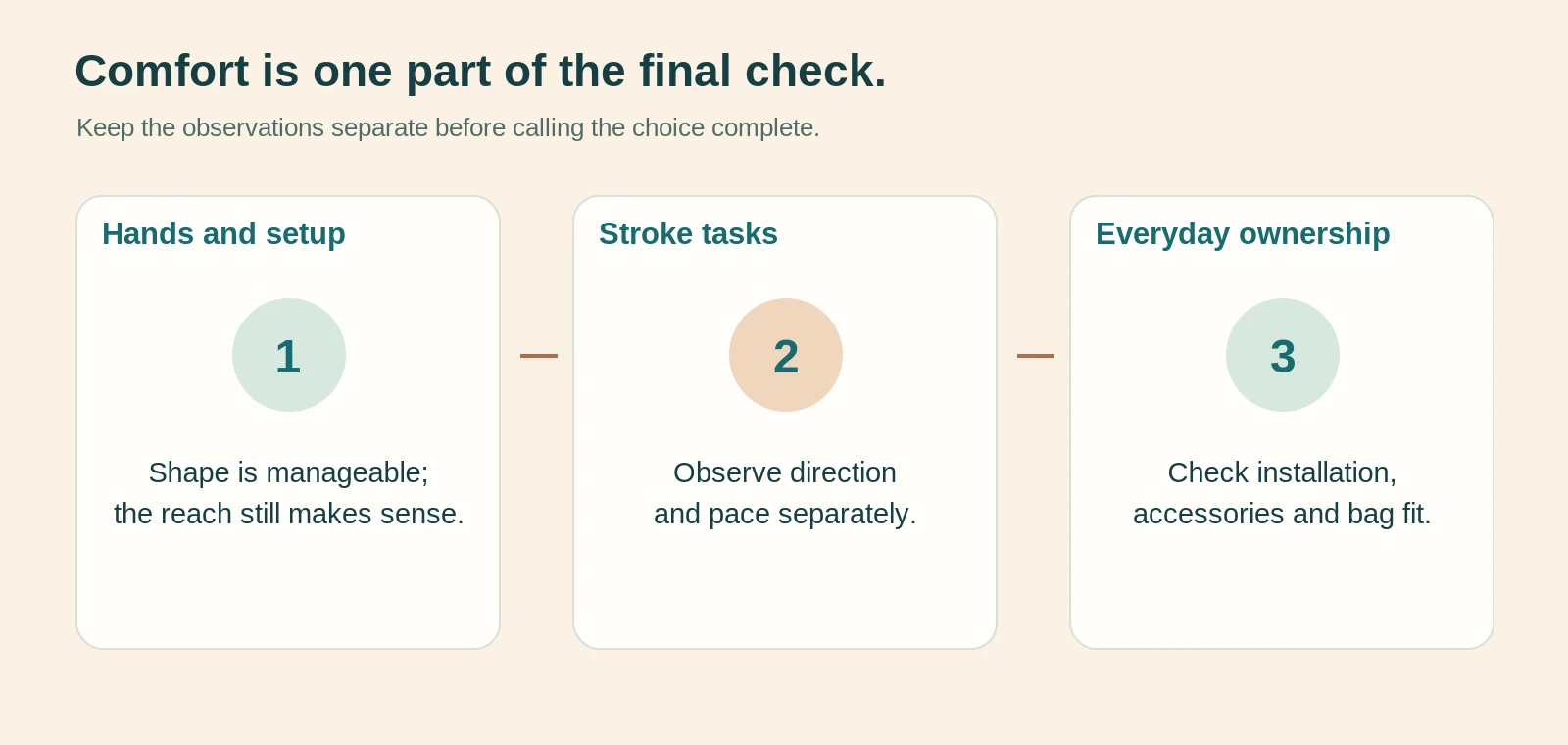
A third golfer finds a grip comfortable on the green but cannot remove it easily from the bag. That is a practical compatibility problem, not evidence that the putting fit is wrong. Assess the storage system before forcing the grip through it. These examples show why the final choice must work in the hands, on the putter and during ordinary ownership.
Pros and cons of moving to an oversized grip
What it may help you explore
A larger or differently shaped grip gives you another way to organise hand contact. It may provide a more comfortable surface for your preferred hold, or make a particular contour easier to recognise. Those are legitimate reasons to compare samples, provided the claims remain personal observations rather than guaranteed corrections to the stroke.
The strongest case for changing is a clearly described concern that the new fitted grip addresses without introducing another problem. A popular tour association or bold stability claim is weaker evidence for your purchase than a suitable trial on the complete putter. Choose the result you can explain, not the story that sounds most impressive.
What the size label cannot promise
An oversized grip does not independently establish the right putter length, lie, head or technique. It can also alter the complete build through mass, length and hand position, and it may create a bag-fit issue. These are reasons to compare carefully, not reasons to reject the category outright.
There is also a risk of confusing a comfortable first impression with proven scoring improvement. Keep practice observations modest and repeatable. A sensible result may simply be a more manageable hold and a reproducible specification. That is useful without claiming that the grip removes every unwanted movement or guarantees fewer putts.
Common mistakes when comparing big putter grips
Changing everything and crediting one feature
Do not switch putter head, length, hand method, grip shape and added weight, then claim that width alone produced the result. Record the complete change. A combined fitting can be entirely appropriate, but its explanation should remain as broad as the actual comparison.
Another mistake is measuring a non-round grip's circumference and converting it into a supposed playing diameter. Check the relevant width, depth and profile instead. Also avoid treating size numbers from different manufacturers as directly equivalent. Exact model information prevents an enthusiastic trial from becoming an incorrect order.
Ignoring the final installation and bag
Do not test a loosely fitted grip or use a new installation before it is ready. Nor should you accept an unexpected orientation and compensate by moving your hands awkwardly. Raise the issue with the installer and assess the actual completed putter.
Finally, check the grip's path through your bag and the security of any accessory. A comfortable grip that catches daily or contains a loose component is not a finished equipment solution. Resolve the practical issue before relying on it in play, and keep rules questions separate from assumptions about what an oversized product must allow.
Frequently asked questions
Are oversized putter grips better for small hands?
There is no universal answer. A larger grip may feel manageable to one golfer with smaller hands and awkward to another. Shape, depth, taper and hand arrangement matter alongside width. Try relevant samples on a suitable putter rather than applying a swing-grip hand-length chart directly. The goal is comfortable, secure contact in the complete setup, not fitting a stereotype about which hands should use which size.
Will a big grip stop my wrists moving?
This guide does not make that promise. Manufacturers may describe intended effects, but an individual stroke needs appropriate observation and, where needed, coaching or fitting advice. A grip can change the contact you feel without automatically correcting technique. Record what happens in a suitable trial and avoid turning a few putts into a universal claim about removing movement or improving scores.
Does a heavier grip mean the putter is counterbalanced?
The complete build needs to be understood rather than inferred from one component's mass. Ask the fitter what grip, shaft, head and any added weight are present and what configuration is being compared. A product's compatibility with a separate weight does not mean that weight is included. Evaluate the assembled putter and keep weighting changes distinct from the initial shape comparison.
How large can a putter grip legally be?
The R&A specifies a maximum cross-sectional dimension of 1.75 inches, or 44.45 millimetres, in any direction, alongside other requirements. That dimension alone does not certify a grip or a modification as conforming. Consult the Equipment Rules and seek appropriate advice for an unusual product or alteration. Equipment conformity also does not settle whether every intended stroke method is permitted. [4]
Can a larger grip fix an uncomfortable putting posture?
Do not assume so. The overall putter length, lie and setup may need assessment. A grip that feels comfortable in the hands can still conceal an awkward reach or a substantial change in hand position. Discuss the complete fit with a qualified fitter or coach, and seek healthcare advice for concerning symptoms rather than using grip size as a treatment.
What should I compare before ordering?
Compare the exact shape, width and depth, overall and usable length, stated mass, core compatibility and any optional weight or accessory. Then check the fitted putter and the bag's putter well. Record the sample you preferred and the conditions of the trial. This produces a reproducible request for the installer and avoids buying a superficially similar model that changes several important details.
Final recommendation: choose a shape that supports a sound setup
Shortlist oversized putter grips by the contact problem you are actually trying to solve. Compare shape and dimensions first, keep mass and accessories visible, then test the complete putter for comfort, start direction and pace as separate observations. Check the bag and installation before calling the choice finished.
A grip should support a suitable setup rather than distract from a length, lie or technique question. Choose a legitimate, appropriately fitted product and keep the successful specification. The worthwhile outcome is a comfortable, manageable putter you can describe and reproduce, without promises that a larger handle automatically fixes the stroke.
Sources and fact-checking notes
Official pages were checked on 4 October 2026. Specifications refer to the named model or document, not every product in its category. The practical checks and examples in this guide are research-led suggestions, not reported results from hands-on product testing.
- Golf Pride UK – Reverse TaperFlat, Pistol and Round profile examples; no unverified performance claim adopted.
- SuperStroke – Zenergy Tour 3.0Published 1.26-inch width, 10.50-inch length, 66 g mass and 0.58-inch core; optional weight separate.
- SuperStroke – Zenergy XL Tour 3.0+PlusPublished 1.26-inch width, 13.75-inch length, 100 g mass and 0.58-inch core; optional weight separate.
- R&A – Equipment Rules, Conformance of ClubsPutter-grip dimensions and other shape/construction requirements; not home certification.
- R&A – Rule 10Rule 10.1b anchoring restrictions: equipment conformity and permitted use are separate.
Product pages, model options and rule guidance can change. Recheck the exact item and applicable document before relying on a technical or competition decision. No product price, availability or performance outcome is guaranteed by inclusion here.
Illustrations in this article were created for Taylor’s Trailblazing Golf Gear. Third-party photographs, where used, are credited beside the image or in the source list.