

Matte vs Gloss Golf Balls: Visibility, Cleaning and Surface Wear
Separate the finish, the colour and the background before naming a winner.
Original conceptual illustration; not a product or test photograph.
Matte vs gloss golf balls is often presented as a simple choice between a bright, easy-to-find ball and a traditional shiny one. That framing leaves out several important variables. Colour, cover material, construction, model generation, condition and the background against which you are looking can all change the comparison. A finish label alone cannot tell you which ball you will see most clearly or prefer to play.
This guide focuses on visibility, cleaning and surface wear rather than claiming a universal performance winner. It uses manufacturer specifications and the Rules of Golf, alongside suggested personal comparisons. There are no original robot tests, laboratory durability results or hands-on round statistics behind the recommendations. Where a manufacturer makes a visibility claim, it remains a manufacturer claim rather than a measured advantage for every golfer.
Start with a small, clearly identified selection and compare it under conditions you actually encounter. Keep finding a stationary ball separate from tracking one in flight. Likewise, separate a dirty surface from a damaged cover. Those distinctions make it easier to choose a ball for practical reasons without turning a colour preference into an unsupported claim about spin, distance or lifespan.
Exact model and generation
Do not compare unknown recovered balls as controlled samples.
Separate the tasks
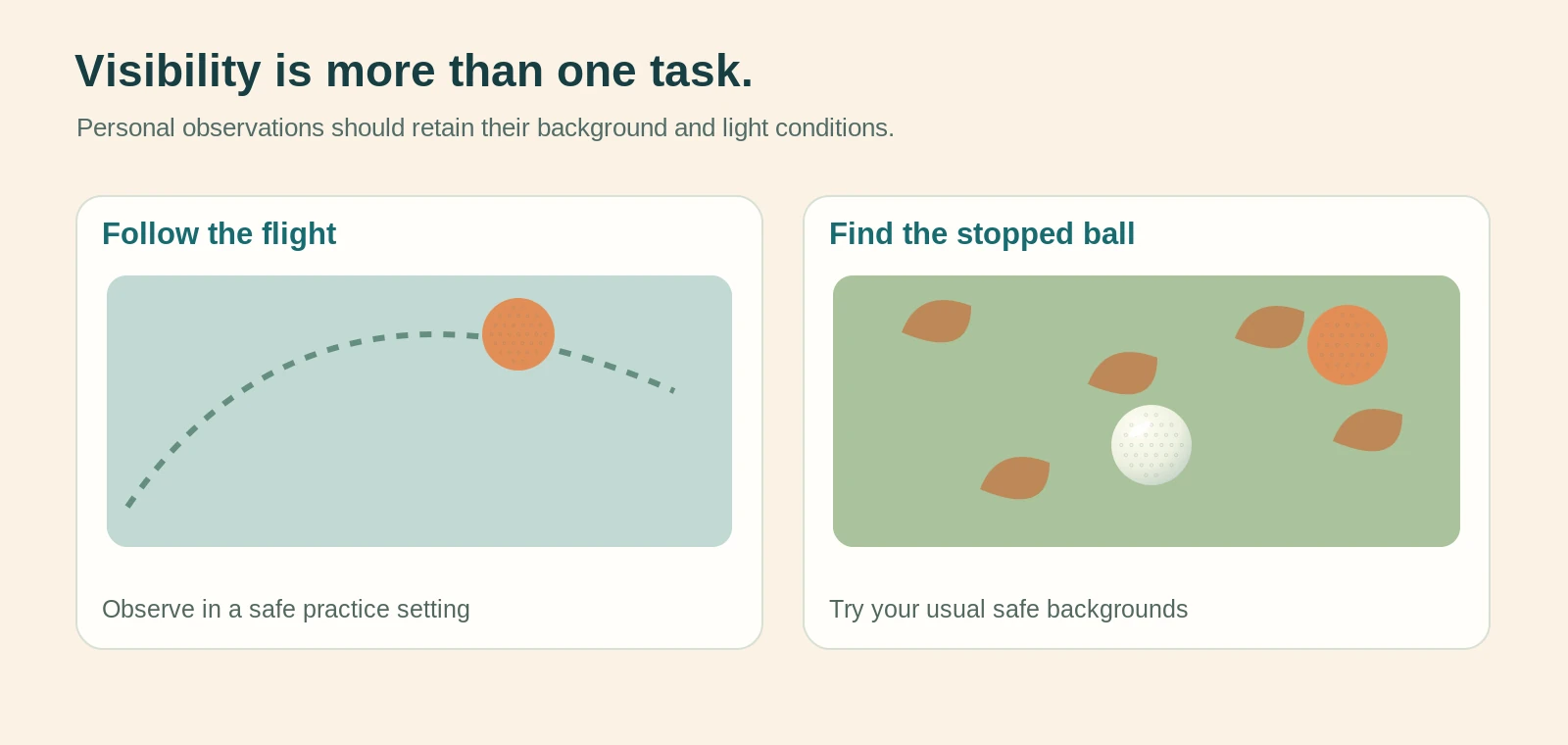
Flight tracking is not the same as finding a stopped ball.
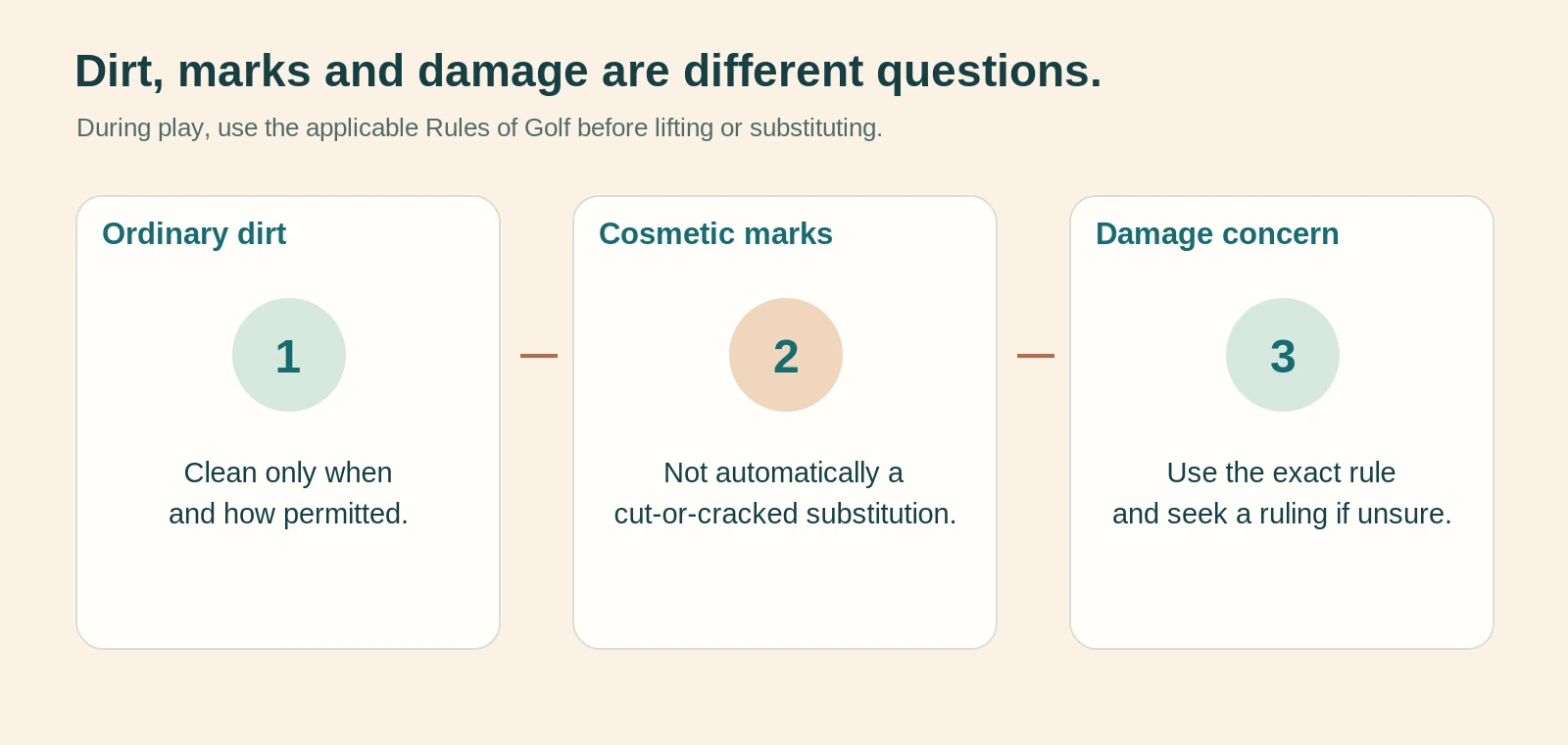
Dirt is not damage
Inspect without promising a restored performance.
Know the permission
A scuff is not automatically a cut-or-cracked-ball substitution.
Matte vs gloss golf balls: identify what is being compared
Finish is only one part of the description
Before judging two balls, record their exact model, generation where known, colour and finish. A matte orange ball and a gloss white ball differ in at least two visible characteristics. If they also use different covers and constructions, a playing comparison changes several more variables. You can still prefer one, but the result does not isolate finish alone.
Use the packaging or official product page to identify the ball rather than relying only on its appearance. A recovered ball with an uncertain history is a poor reference for a new model. Mark uncertainty honestly and keep it out of any comparison intended to inform a repeat purchase.
Decide what the comparison needs to answer
You might want a ball that is easier to locate among leaves, easier to track against a particular sky or more pleasant to look at when putting. These are different tasks. A ball that stands out on a short-grass practice area may not be your favourite in the air or against the rough on your home course.
Name the priority before testing. Otherwise, the most striking colour in a shop can become the assumed answer to every visibility question. A deliberate comparison can be small and practical: which of these identified balls is easiest for me to locate in my usual setting, and does it remain a suitable ball for the shots I intend to play?
Do not confuse matte finish with cover material
Manufacturer examples show the distinction
Srixon's official European comparison lists Soft Feel and Soft Feel Brite as two-piece ionomer balls, with gloss and matte finishes respectively and a stated compression of 58 for both. That is a useful product-family example, not proof that every matte and gloss ball shares the same construction or plays identically. [1]
For contrast, Srixon's prior-generation Q-STAR TOUR DIVIDE page describes a matte urethane cover. It is explicitly a prior-generation example, not presented here as the latest model. [2] Together, the examples show why matte should not be treated as another word for ionomer, or gloss as another word for a particular performance category.
Keep performance claims model-specific
Read performance specifications and claims for the exact model, not the finish category as a whole. A difference you notice in a short-game comparison could relate to several aspects of the balls rather than the visible sheen. Without a controlled test, it would be misleading to assign the whole difference to matte versus gloss.
This guide therefore does not promise that one finish spins more, travels farther or behaves better in wet conditions. Those claims would need relevant evidence that separates the finish from the rest of the design. For a buying decision, first identify suitable ball models, then compare the available finishes and colours for your practical visibility and care preferences.
Model-specific published examples, checked 4 October 2026. These identify design categories, not a finish-only performance test.
| Example | Published construction / cover | Finish point |
|---|---|---|
| Srixon Soft Feel | Two-piece ionomer; stated compression 58 | Gloss in the cited comparison. |
| Srixon Soft Feel Brite | Two-piece ionomer; stated compression 58 | Matte in the cited comparison. |
| Q-STAR TOUR DIVIDE (prior generation) | Urethane cover in the cited model | Matte and split-colour; several visual features differ. |
Separate seeing the ball in flight from finding it on the ground
Flight tracking is its own task
During an appropriate practice session, note whether you can follow a ball through the part of flight that matters to you. Keep the light, viewing position and background in the description. A ball that looks vivid in the hand may not provide the clearest flight view from your usual playing position.
Do not ask someone to stand in a dangerous place to watch a ball, and do not hit additional shots on a course where doing so would be unsafe or delay play. A designated practice area and suitable permission are the right setting. The purpose is a personal observation, not a contest to prove that one colour is universally easier to see.
Ground search uses another background
Once the ball has stopped, the relevant contrast may be with grass, leaves, bare soil or another surface. Check the backgrounds you actually encounter rather than choosing a single favourable photograph. A ball that is obvious on a clean practice green can be less convenient in a cluttered setting.
Keep the search task separate in your notes. Write easier to locate against this background rather than more visible in every situation. That wording is not a weak conclusion; it is an accurate and useful one. A ball purchase should reflect the situations you want to improve, not an unsupported ranking that pretends every environment is the same.
Use a safe stationary visibility comparison
Choose ordinary, accessible backgrounds
A simple proposed check uses a few balls placed on permitted, safe ground: short grass, a patch with light leaf cover and a typical rough edge where you can stand securely. Avoid protected areas, steep banks, water edges and places where other golfers may hit towards you. Obtain permission where needed and collect every ball afterwards.
Start close enough that the task is straightforward, then compare from a sensible viewing position. Do not hide balls so deeply that the exercise becomes a search game unrelated to ordinary visibility. Keep the ball's condition similar and make sure one is not partly covered while another is fully exposed.
Change the order and position
Move the balls between positions so one colour does not always occupy the easiest background. Ask a helper to place them without telling you which position contains which ball, where that is practical and safe. This does not create a laboratory study, but it can reduce the influence of knowing exactly where your favourite ball was placed.
Record a simple description of the result and any uncertainty. You do not need a dramatic percentage to justify a preference. If the difference is small or changes with the background, say so. The most useful conclusion may be that colour matters more to you than sheen, or that neither finish offers a consistent advantage in the settings you tested.
Include the light you normally play in
Compare more than the brightest moment
If your golf often begins in softer morning light or continues under overcast skies, include those conditions in a sensible comparison when they occur naturally. Do not assume a midday observation settles every future round. Equally, do not continue playing in unsafe darkness merely to test a colour.
Write down whether the sky was bright, overcast or changing, and whether the ball was in open light or shade. These descriptions are enough for a personal record. Avoid assigning technical lighting values you have not measured or presenting a phone photograph as a precise representation of what your eyes experienced.
Keep eyewear and viewing position consistent
Use your usual golf eyewear where relevant. If you change glasses or sunglasses during the comparison, record that as another variable rather than blaming every change in appearance on the ball. A preference that works with your normal equipment is more useful than one obtained under an arrangement you would not use on the course.
If seeing the ball is persistently difficult or your vision has changed, seek appropriate eye-care advice rather than expecting a new finish to solve the issue. This guide is an equipment comparison, not a vision assessment. A brighter-looking product should not be presented as treatment for a medical or visual condition.
Think about colour and finish as separate buying decisions
Try a closer comparison where available
Where a suitable product family offers relevant alternatives, compare those before jumping between unrelated balls. You may not be able to hold colour, finish and construction perfectly constant, so record the difference that remains. A reasonably controlled personal comparison is better than pretending a completely unmatched pair proves a general rule.
For example, comparing a white gloss ball with a bright matte ball can answer which complete option you prefer to see. It cannot establish whether colour or finish caused that preference. Keep the conclusion at the level the comparison supports. There is nothing wrong with buying the preferred complete option without a scientific explanation for every part of the result.
Avoid universal colour recommendations
This article does not identify one colour as the easiest for every golfer to see. Your usual backgrounds, light and personal perception belong in the decision. A manufacturer's statement that a colour is designed for visibility can help identify a candidate, but it should not replace your own appropriate comparison.
Also consider how easily the ball can be distinguished from other players' balls. A personal identification mark remains useful even when your chosen colour seems unusual. Do not rely on colour alone as proof of identity, especially where other golfers may be using the same product or where lighting makes colours appear less distinct.
Check the view at address and while putting
Visibility is not only a search problem
A ball that is easy to find may still be less pleasant for you to look at over a putt. Compare the appearance at your normal address position, including any alignment markings you intend to use. Notice whether the markings are easy to identify without repeatedly lifting or rotating the ball outside what the rules permit during play.
Use a practice setting for this comparison. Keep the putter and surface consistent, and distinguish a visual preference from a claim that the ball has improved your stroke. A particular colour or finish may help you feel more comfortable looking at the ball, but that does not independently demonstrate better direction or distance control.
Two-tone designs introduce another feature
A two-tone ball can provide an additional visual reference, but it changes more than gloss level. The cited prior-generation Q-STAR TOUR DIVIDE uses a split-colour design as well as a matte cover. [2] Do not compare it with a single-colour ball and credit every observation to matte finish alone.
If you like a two-tone reference, record that preference explicitly. Another matte ball without the same visual division may not reproduce it. The practical buying record should identify the exact feature you value so a replacement purchase does not rely on an oversimplified memory that matte balls were easier to line up.
Keep condition matched when comparing visibility
Clean new samples and worn samples answer different questions
A fresh bright ball beside an old stained white one is not a fair starting comparison of finishes. Begin with samples in similar condition where possible. Then, if ordinary wear matters to your purchase, record how each particular ball looks after comparable use rather than assuming the initial appearance will remain unchanged indefinitely.
Do not invent a lifespan from a small number of rounds. Ball impacts, loss, storage and use conditions can differ considerably between individual samples. A personal record can still help you decide whether a particular finish remains convenient for you, but it cannot establish that all matte or all gloss balls last a fixed number of holes.
Separate an appearance preference from damage
A mark that bothers you visually may not be a cut or crack, while a small structural defect should not be dismissed because the colour still looks attractive. Inspect the surface carefully when you are permitted to do so, and follow the relevant rules during play. Keep the equipment-condition question separate from whether you like its appearance.
For a buying comparison, photograph the same area under similar light if you want a record. Do not enhance one image or change the background to make a preferred finish look cleaner. The record should help you remember an actual observation, not create a persuasive but inconsistent before-and-after demonstration.
Clean conservatively and follow model-specific advice
Start with a gentle inspection routine
Away from play, inspect the ball and remove ordinary loose dirt gently with water and a soft cloth where appropriate. Follow any specific instructions from the ball manufacturer for further cleaning. This is a conservative handling suggestion, not a tested restoration method or a guarantee that every stain can be removed without affecting the surface.
Avoid treating a dishwasher, strong solvent, abrasive pad or extreme heat as a routine way to improve appearance. There is no need to turn cleaning into a modification project. If ordinary care does not resolve an uncertain surface issue, ask the manufacturer rather than escalating the treatment until the ball looks new.
Judge the result without promising restoration
After cleaning and drying, inspect the ball again under good light. Note whether the issue was removable dirt, a persistent mark or visible damage. Do not claim the original performance has been restored simply because the surface looks brighter. Appearance is useful information, but it is not a complete test of the ball's construction or history.
For comparisons, use the same suitable cleaning approach on both samples and record it. Otherwise, a more aggressive treatment on one ball can make the finish comparison misleading. A practical care preference might be that a particular model remains easy for you to inspect; it should not become a universal claim that one finish always cleans more easily.
Know when cleaning is allowed during a round
Permission to lift is not always permission to clean
Under Rule 14.1c, a ball lifted from the putting green may be cleaned. Elsewhere, cleaning is generally allowed when a ball is properly lifted, but there are exceptions, including lifting to check for a cut or crack, to identify it beyond what is necessary, because it interferes with play, or to check a condition where relief is not then taken. Consult the rule for the exact situation. [3]
That means a care routine suitable at home should not be transferred automatically to every moment on the course. Before lifting or wiping a ball during play, establish the applicable rule and procedure. A dirty matte or gloss surface does not create a special exemption from those requirements.
Ask before turning uncertainty into a penalty
Where you are unsure, consult the Rules of Golf or the Committee rather than assuming another player's casual habit applies. Keep any local rule relevant to the day's conditions separate from the general rule. An equipment article cannot anticipate every situation or replace a ruling for a specific incident.
The practical preparation is simple: understand your normal marking and cleaning procedures before the round and carry suitable basic care items. You should not need an elaborate cleaning process between shots. The objective is lawful, ordinary maintenance and clear identification, not preserving a showroom appearance at the expense of the rules or pace of play.
Distinguish scuffs from replacement permission
Damage rules have a specific threshold
Rule 4.2c permits substitution under that rule when the ball can clearly be seen to be cut or cracked and the damage occurred during the hole being played. Mere scratches, scrapes or damaged or discoloured paint do not meet that particular threshold. Other rules may permit substitution, and changing balls between holes is a separate matter. [4]
Do not describe every visible scuff as automatic permission to change balls mid-hole. Equally, do not dismiss a genuine cut or crack because it seems small. Follow the applicable inspection and replacement procedure, and seek a ruling when the situation is unclear rather than making the decision from a finish preference.
Avoid performance-changing surface alterations
Rule 4.2a prohibits playing a ball whose performance characteristics have been deliberately altered, with examples including deliberate scuffing, heating or applying substances other than in cleaning. [4] Do not sand, polish, coat or otherwise modify a ball to make its finish match a preferred appearance or an imagined performance benefit.
For ordinary ownership, replace an unsuitable ball through the appropriate route instead of trying to engineer a new surface. A comparison of matte and gloss products concerns legitimate manufactured options, not a recipe for changing one into the other. Cleaning, inspection and deliberate alteration should remain clearly separated in your thinking.
Do not infer wet-condition performance from appearance
A surface look is not a spin test
A matte finish can look different when damp, and a glossy ball may show visible reflections, but those observations do not establish a universal wet-shot performance ranking. This article has not conducted a controlled test separating finish, colour, cover construction, club condition and strike. It therefore does not assign a wet-spin advantage to either category.
When performance in particular conditions matters to your ball choice, seek relevant model-specific evidence and professional fitting advice where useful. Keep your own small practice observations labelled as such. A couple of chips or one memorable round should not become proof that every ball with the same sheen behaves alike.
Keep the practical visibility question intact
You can still ask a narrower question: can you see and inspect this particular ball comfortably under the conditions you normally play? Record the answer without expanding it into a technical claim about aerodynamics or friction. That narrower conclusion can be valuable for buying decisions and requires less speculation.
Also keep the club and ball condition appropriate during any practice comparison. A dirty clubface, mismatched balls or changing lies introduces more uncertainty. The aim is not to build a laboratory in the garden, but to avoid a confident explanation that the evidence cannot support.
Buying small quantities can make the comparison clearer
Avoid committing to a large stock before trying the option
Where suitable small quantities are available, a modest initial purchase can let you assess the complete ball without filling a cupboard with an untested colour. Check the exact model and generation so a later repeat order matches the sample. No prices are quoted here because current offers are not the basis of the decision.
Do not assume that a sale listing with a familiar family name contains the latest construction or the same finish you tried. Read the description and ask the seller where the information is incomplete. A discounted prior-generation model can be a deliberate choice, but it should not be mistaken for another product through vague naming.
Keep mixed or recovered balls out of a controlled comparison
A mixed bag can be useful for some casual purposes, but it is a weak basis for deciding between finishes when model and condition are unknown. Different generations or refinished surfaces may obscure what you are actually comparing. Keep the trial samples identifiable and retain the packaging or product details.
This does not mean every recovered ball is unusable. It means an uncertain sample should not be used to make a strong claim about a whole category. Your purchase decision becomes easier when the evidence comes from the actual products you are considering rather than an assortment whose histories cannot be established.
Use photographs as notes, not as a visibility verdict
A camera image is a different viewing task
A phone photograph can help you remember the background and ball position, but the displayed image is not the same experience as locating the ball with your own eyes on the course. Framing, screen brightness and image processing can change what looks most obvious. Do not choose a finish solely because it appears more striking in a close-up photograph.
For a personal record, keep the camera position, background and lighting as similar as practical. Avoid filters or selective enhancement. Label the picture with the actual ball model and the observation you made at the time. That prevents an attractive image from replacing the more relevant note that the ball was difficult to see from your ordinary standing position.
Separate your view from another person's preference
A playing partner may identify a different colour more easily or prefer another appearance at address. Treat that as their observation rather than a reason to erase yours. A useful joint comparison lets each person write a brief impression before discussing it, reducing the pressure to agree with the first confident answer.
There is no need to turn the disagreement into a claim about either person's eyesight. The practical purchase is for the golfer who will use the ball. Where a persistent visual difficulty causes concern, an eye-care professional is the appropriate source of assessment. A casual colour comparison should remain an equipment preference exercise, not an amateur diagnosis.
Sort a mixed ball pocket before the comparison begins
Identify the samples you intend to use
Place the candidate balls together and check their printed model markings, colour and visible condition. Keep any unknown or differently marked ball out of the comparison. Retain the original sleeve or a photograph of its description so the exact version can be identified later, particularly when several generations share a familiar family name.
A simple separate pouch or labelled storage space can prevent your test samples becoming mixed with practice balls or recovered balls. You do not need an elaborate tracking system. You just need confidence that the ball compared today is the product you intend to order again, rather than a similar-looking substitute discovered in the bag.
Make ordinary identification easy
Apply your normal suitable identification mark without attempting to coat or change the ball's surface characteristics. Check that the mark remains distinguishable against the selected colour. If another player uses the same colour or pattern, agree how you will identify your own ball through the normal rules and procedures rather than relying on a distant impression.
After a round, separate balls with an uncertain history or a condition concern from the comparison group. Record a specific issue before deciding whether further manufacturer advice is needed. This keeps a practical buying exercise from accumulating uncontrolled samples until every observation becomes a general story about matte or gloss rather than the actual balls you selected.
Choose a finalist using the task that matters most
Rank priorities before ranking balls
Write your priorities in order, such as locating the ball on the usual rough edge, following flight and seeing alignment markings at address. Then compare the observations under those headings. Do not give equal weight to an easy test that is rarely relevant and a difficult task that regularly affects your enjoyment of the game.
For a hypothetical choice, one ball might be clearly preferred against the usual leaf cover while the other is only marginally preferred on a clean putting surface. A golfer whose main concern is finding the ball could reasonably choose the first, provided the model otherwise suits their play. Another golfer may rank the tasks differently. The example is a decision method, not a result from a product test.
Use a tie to simplify the purchase
If both options remain similarly useful, acknowledge the tie. You can then choose according to the complete ball model, your appearance preference or straightforward availability without inventing a finish advantage. A comparison is successful when it supports a sensible decision, even if it does not produce a dramatic winner.
Buy the identified finalist in a sensible quantity and retain the details. Revisit the choice only when a meaningful condition changes or a genuine problem appears. Otherwise, the process can become an endless search for a universally visible ball that the evidence never promised. A suitable, familiar option is often a more useful outcome than an increasingly complicated set of unsupported rankings.
Build a visibility record that stays useful
Separate the tasks into short notes
Use headings such as flight, short grass, leaf cover, address view and cleaning inspection. Under each, write the condition and your observation for the exact ball. A note that one colour was easier to locate among pale leaves is more useful than a general nine-out-of-ten rating without context.
Repeat only the comparisons that matter to your usual golf. There is little value in testing many artificial backgrounds you never encounter. A compact record helps you make a decision and then move on. It should not become an elaborate scoring system that gives a false impression of scientific certainty.
Keep disagreements rather than smoothing them away
If one ball is easier to track but another is easier to find, retain both observations. You do not need to force them into a single universal winner. Decide which task matters most to you or whether another colour in a suitable model deserves a small trial.
Likewise, record when the difference is too small to matter. That can free the buying decision to focus on the ball model's overall suitability, availability and your preferences. A fair comparison is allowed to end without a dramatic finish advantage. Not every useful equipment choice needs a headline claim.
Three common situations and sensible responses
The bright ball wins only on the practice green
Imagine a golfer who finds a matte bright ball immediately on short grass but struggles to distinguish it among a particular kind of leaf cover. The sensible conclusion is background-specific. Continue the comparison in the setting that causes the real problem rather than declaring the colour universally superior from the easiest scene.
A different colour or another suitable ball may be worth trying, but there is no need to assume the finish itself failed. The original comparison changed colour and sheen together. Keeping that distinction visible prevents one disappointing search from turning into an unsupported technical explanation.
A persistent mark is mistaken for a ruined ball
A second golfer notices a stain that remains after gentle cleaning and assumes the ball's performance must be compromised. The appearance alone does not establish that. Inspect for actual damage, consult manufacturer advice where needed and keep the rules for substitution separate from a preference for an unmarked surface.
A third golfer likes a two-tone ball's putting appearance but describes the benefit simply as matte finish. Recording the split-colour feature would make the next purchase more accurate. These hypothetical examples show why the best buying notes identify the task, the actual feature and the limits of the observation rather than relying on a broad finish label.
Pros and cons of matte and gloss choices
Matte options
A matte option may offer a colour and surface appearance that you prefer for particular backgrounds or at address. That is a legitimate reason to consider it. Some models also provide distinctive visual designs. However, the finish category alone does not identify the cover material, construction, durability or a guaranteed visibility advantage.
The useful approach is to choose a suitable model and assess its actual appearance under relevant conditions. Keep care observations model-specific and do not assume every mark means the surface is damaged. A matte ball can be a good personal choice without needing a universal claim that it is easier for everyone to find.
Gloss options
A gloss option may provide the appearance you already recognise and a selection of colours within models you prefer. Familiarity can be practically useful, but it is not proof that gloss is inherently easier to track or clean. Compare the specific ball rather than relying on a traditional-versus-modern story.
Neither category removes the need for identification, inspection and correct cleaning procedures. The trade-off may turn out to be mostly personal visibility and appearance, or another model characteristic may matter more. Let the actual comparison determine the decision instead of treating either finish as the automatically serious or automatically innovative choice.
Common mistakes when choosing a finish
Treating a colour result as a finish result
A bright matte ball beating an old white gloss ball in one search does not isolate finish. Colour, model, condition and background all changed. Describe the result honestly and repeat a closer comparison where possible. A useful personal preference does not require a scientific explanation that the test cannot support.
Another mistake is confusing matte with a particular cover material or performance tier. Read the exact model specification and generation. A familiar family name or a vivid product image is not enough to establish construction, and an old listing should not be silently treated as the current version.
Over-cleaning or changing the ball incorrectly
Do not use aggressive treatment to force a stained ball back to a new appearance, or deliberately alter its surface to chase a performance idea. Keep manufacturer care guidance and the Rules of Golf in view. A visible scuff does not automatically permit substitution under the cut-or-cracked-ball rule.
Finally, do not ignore a genuine damage concern merely because the ball remains easy to see. Inspection, lawful substitution and personal appearance preference are separate decisions. Keeping them separate helps you avoid both unnecessary replacement claims and careless use of equipment whose condition needs attention.
Frequently asked questions
Are matte golf balls easier to find?
They may be easier for you to locate in a particular colour and setting, but there is no universal result established here. Compare identified balls against your usual backgrounds and separate colour from finish where possible. A manufacturer's visibility claim is a reason to consider a sample, not proof of an advantage for every golfer. Record the conditions and accept that the preferred option may change with the background.
Does matte mean the ball has an ionomer cover?
No. The cited Srixon examples include a matte ionomer Soft Feel Brite and a prior-generation matte urethane Q-STAR TOUR DIVIDE. Read the exact product specification rather than using finish as a substitute for cover material. Also distinguish the current model from older generations when buying or comparing, because a familiar name does not guarantee identical construction across all versions. [1] [2]
Do glossy balls last longer?
This guide does not establish a general durability ranking. Individual model construction, impacts, care and condition complicate a finish-only comparison. Keep a modest record of the exact balls you use and inspect their surfaces appropriately. Do not convert a few personal rounds into a universal lifespan claim or assume a cleaner-looking surface proves that every aspect of the ball remains unchanged.
Can I clean a ball whenever it looks dirty?
Not during a round without regard to the rules. Rule 14.1c distinguishes situations where cleaning is permitted from exceptions attached to certain reasons for lifting. Check the exact rule and any applicable local procedures before lifting or wiping the ball. A matte finish does not receive a special cleaning exemption, and a home care routine should not be copied into every on-course situation. [3]
Can I replace a ball because the paint is scuffed?
Not solely under Rule 4.2c's cut-or-cracked-ball provision. That rule has a specific damage threshold and procedure. Other rules may permit substitution, and changing balls between holes is separate. When uncertain, obtain a ruling rather than treating an appearance preference as automatic permission. This distinction applies to matte and gloss balls alike. [4]
Should I choose the easiest ball to see even if another model suits my play better?
Treat visibility as one part of the complete decision. Identify suitable ball models, then compare their available colours and finishes. You may find an option that satisfies both needs without relying on a universal finish rule. A fitting or structured model comparison can help where the trade-off is unclear. Avoid making the entire choice from a single attractive colour sample in a shop.
Final recommendation: choose by task, model and condition
Start the matte vs gloss golf balls decision with an exact model description and a specific visibility task. Compare flight tracking, ground search and the view at address separately. Keep colour, cover material, generation and condition visible in the explanation, especially when they differ between samples.
Clean conservatively, inspect appropriately and follow the Rules of Golf during play. Neither finish earns a universal promise about visibility, spin or lifespan from the evidence used here. The best choice is a suitable ball you can see, identify and care for comfortably in your usual conditions, with a purchase record clear enough to buy the same option again.
Sources and fact-checking notes
Official pages were checked on 4 October 2026. Specifications refer to the named model or document, not every product in its category. The practical checks and examples in this guide are research-led suggestions, not reported results from hands-on product testing.
- Srixon / Dunlop Europe – Soft Feel BriteOfficial Soft Feel / Brite construction, finish and compression comparison; visibility remains a manufacturer claim.
- Srixon / Dunlop Europe – prior-generation Q-STAR TOUR DIVIDEExplicitly a prior-generation matte urethane, split-colour example; not described as the latest model.
- R&A – Rule 14Rule 14.1c cleaning permissions and exceptions; use the full rule for a particular situation.
- R&A – Rule 4Ball alteration restrictions and the cut-or-cracked-ball substitution threshold and procedure.
Product pages, model options and rule guidance can change. Recheck the exact item and applicable document before relying on a technical or competition decision. No product price, availability or performance outcome is guaranteed by inclusion here.
Illustrations in this article were created for Taylor’s Trailblazing Golf Gear. Third-party photographs, where used, are credited beside the image or in the source list.