
Mini Driver vs Fairway Wood Off the Tee: Which Role Is Missing?
Give the next club a clear job: a better tee option, a useful turf shot, or both.
- Tee-shot decision grid
- Turf use matters
- Audit the bag first
AI-generated illustrations show generic golf equipment and settings. They are not photographs of the named products or records of product testing.
Choosing between a mini driver and a fairway wood off the tee starts with the hole you are trying to play. Perhaps the driver brings a bunker into reach, your 3-wood leaves too much approach, or you want a second tee option without sacrificing the club you trust from grass. Those are three different buying problems.
This research-led guide separates those jobs, compares a few documented builds and gives you a practical way to judge a trial. The useful purchase is the club that improves a recurring shot while leaving the rest of your bag able to do its work.
Name the missing shot
Describe the target area and the costly miss before choosing a club category.
Keep turf duty visible
A convincing tee session does not establish whether the club replaces your fairway wood from grass.
Compare exact builds
Read head size, loft and finished length for the actual model and shaft being offered.
Choose what comes out
A new tee option needs to justify any approach, recovery or wedge role it displaces.
Mini driver vs fairway wood off the tee: start with the job
Use this grid to choose the first comparison. It is an editorial decision aid: the suggested club still has to earn its place through your own trial.
| Your recurring problem | First comparison to arrange | What must improve |
|---|---|---|
| You want another tee option and already have a dependable club from grass | Current tee club against a mini driver | The new club reaches a useful area with fewer costly outcomes |
| One wood must handle tee shots and longer approaches | Current wood against suitable fairway builds | Both jobs remain useful; neither is judged from tee shots alone |
| Driver is too long for a particular landing area | Current fairway or hybrid against any proposed mini | The finish stays short of trouble while leaving an acceptable next shot |
| Your fairway wood works from a tee but rarely produces a useful turf shot | A more lofted fairway or suitable hybrid, alongside the tee option | A dependable turf role is added without unnecessary overlap |
| The existing clubs already cover both jobs | Keep them as the baseline | A purchase needs a clear additional benefit |
Scroll within the table to see all columns.
A mini becomes easier to justify when you can name the holes where you would select it. “I fancy something between my driver and 3-wood” is a starting thought. “I need a tee club for this landing area, and my 5-wood already covers the long approach” is a much clearer brief.
What the labels hide: compare the actual club
The 2025 Callaway Elyte Mini specification sheet lists 11.5° and 13.5° heads, both at 340cc and a stated length of 43.75 inches. PING’s UK G440 MAX page lists its 15° 3-wood at 186cc and 43 inches, and its 17° 4-wood at 180cc and 43 inches. PING bases those standard lengths on the ALTA CB Blue 65 shaft. [1][2]
| Exact model example | Listed loft | Head volume | Listed length |
|---|---|---|---|
| Callaway Elyte Mini, 2025 | 11.5° or 13.5° | 340cc | 43.75 in |
| PING G440 MAX 3-wood | 15° | 186cc | 43 in |
| PING G440 MAX 4-wood | 17° | 180cc | 43 in |
Scroll within the table to see all columns.
These examples explain why the choice involves more than a different number on the sole. The mini has a substantially larger head volume here, while the two fairway options have different lofts at the same listed length. None of those figures tells us how far you will hit them or how widely your shots will finish.
Record the loft setting, shaft model, flex marking, grip and complete playing length of each demo. If the length question becomes central, our fairway wood shaft-length guide explains how to discuss the assembled club with a fitter.
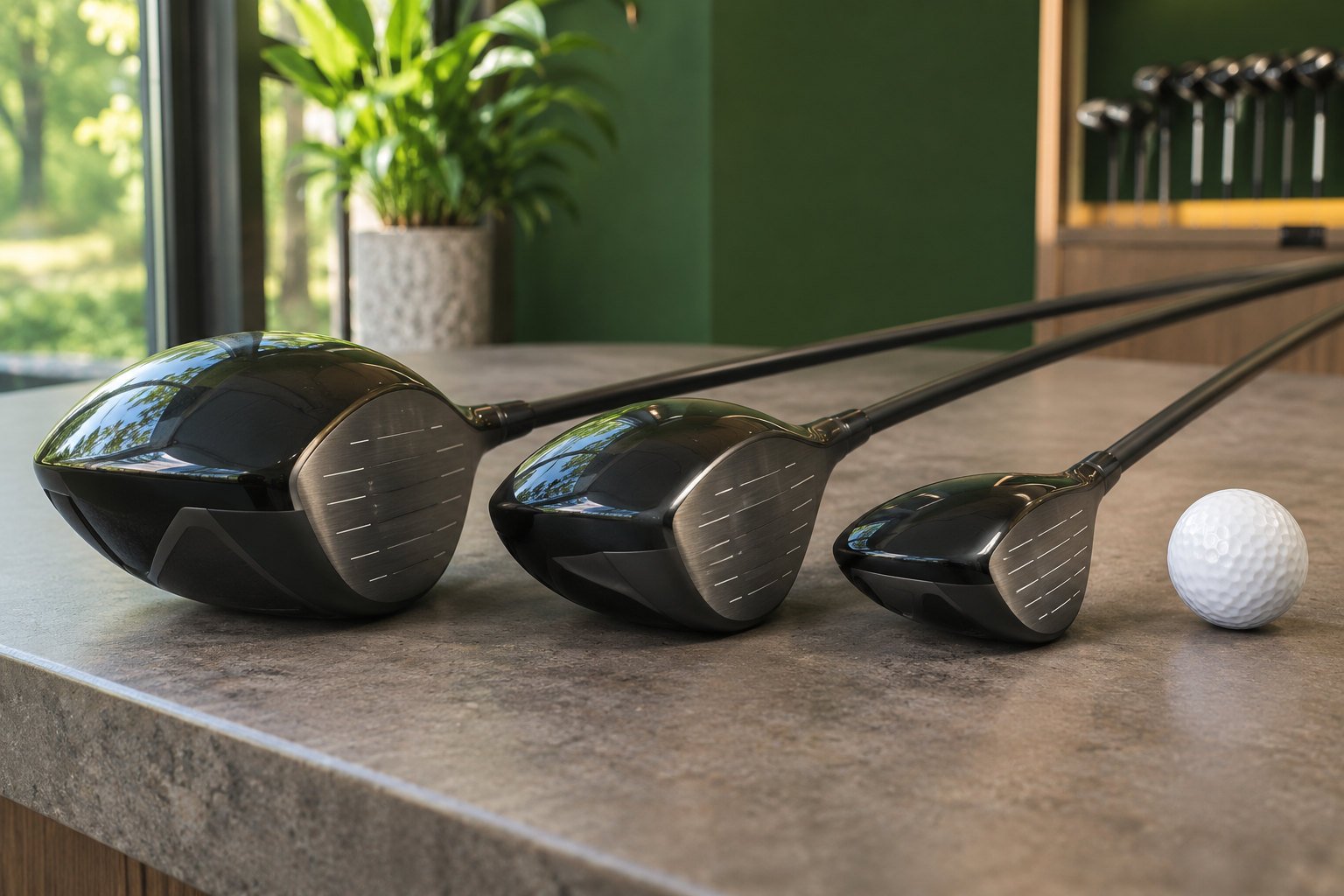
Give the tee shot a usable landing area
“Straighter” needs a destination. Sketch the hole you have in mind and identify four things: the carry needed to clear the first obstacle, the nearest trouble beyond the landing area, the miss you can tolerate and the next shot you want to leave. Use the tees you actually play.
Imagine a hole where the driver’s ordinary finish reaches a bunker, while your existing fairway wood stays short. A mini is useful only if its shot pattern improves the position you can leave. A little more distance than the fairway wood may simply bring that bunker back into play.
Separate three tests
- Does the club clear what must be carried? A good total-distance figure cannot answer a carry question.
- Where do all the shots land and finish? Look at short, long, left and right outcomes.
- What is the consequence of the common miss? Rough with a clear approach and a lost ball are different results.
On a launch monitor, ask which plot you are viewing. Trackman distinguishes carry at the launch elevation from total distance to a calculated resting position; its lateral measurements likewise distinguish the carry point from the calculated finish. A simulated run-out needs checking against the hole’s actual slope and ground. [4]
You can agree a provisional target area with the fitter and count the shots that meet the task. Keep the whole group visible, including the ones that fail. A narrower group that finishes in the wrong place is not a good answer to that particular hole.
Set a separate target for a different hole if the role changes. A club that suits a lay-up before trouble may not supply the carry needed elsewhere.

Decide how much work the club must do from grass
If the fairway wood is your main long-approach club, compare its proposed replacement both from the tee and from a sensible fairway lie of the kind you normally play.
Make the second session about the approach: useful carry, ordinary contact, landing behaviour and whether the next club down still leaves a sensible gap. The longest shot from a perfect tee does not establish any of those things.
There is no need to demand that a mini handle turf shots if you intend to use it only from a tee. Equally, do not remove a useful fairway wood merely because a mini looks manageable at address. Keep the turf requirement in the buying brief until it is demonstrated.
Include a fairway wood with more loft
A fairway comparison need not begin and end with a 3-wood. The verified PING example offers a 17° 4-wood as well as its 15° 3-wood. That gives you a concrete alternative to discuss when the proposed club must cover both roles. [2]
For a trial from grass, use an appropriate practice area and representative favourable lies. If the recurring problem is a ball buried in rough or an awkward recovery, ask whether a hybrid or a simpler recovery choice deserves that bag slot. Do not make one wood responsible for every difficult position.
Audit the club that would leave your bag
Write your current clubs down before adding another one. Rule 4.1b limits a player to 14 clubs at the start of and during a round. A driver, mini and fairway wood each occupy a place in that count. [3]
Then assign the long clubs their actual jobs. Use the following audit as a blank planning exercise; it contains no assumed yardages or test results.
| Bag role | What to write down | Question before a swap |
|---|---|---|
| Longest tee option | Current club and the holes where you choose it | Would the mini supplement it or replace it? |
| Shorter positional tee shot | Target areas that suit your present fairway or hybrid | Does the proposed club reach a different useful area? |
| Longest dependable turf shot | Club, acceptable lie and ordinary carry range | Who does this job if that club leaves? |
| Next approach club | The club below the wood and its useful shots | Does the new arrangement create an awkward gap? |
| Club removed to make space | Every recurring shot you currently use it for | Are those lost options worth the new tee role? |
Scroll within the table to see all columns.
Two tee clubs can coexist sensibly. For example, you might retain your driver, trial a mini for selected holes and keep a lofted wood for approaches. That arrangement still needs room and evidence that each club earns its place.
Another golfer may be better served by a driver and one fairway wood that covers both tee and turf duties. If you already carry fewer than 14 clubs, there is no need to fill the empty slot simply because it exists. Check the role first and the club count before the next round.
Run a trial that can change your decision
Take your current driver and fairway wood to the fitting. They are the alternatives the new club must beat for its assigned job. Agree the target areas, relevant turf requirement and exact builds before examining the results.
- Warm up, then record a baseline with your own clubs. Use the same ball type and record the conditions.
- Give each candidate a fair introduction. Use a suitable tee height for that head and keep it consistent within that club’s recorded group. Note the height rather than assuming one setting suits every head.
- Alternate short groups between clubs, with rests when needed. This helps you notice whether a promising result survives returning to the familiar club.
- Keep every genuine shot in the record, including poor strikes. Mark a confirmed equipment misread separately; a bad swing is still useful evidence.
- Record carry, lateral outcome, strike location where measured, and the number of shots that satisfy the intended task. Keep tee and turf results separate.
- Repeat the promising comparison on another day before committing where possible. Check relevant outdoor conditions if the first session was indoors.
A modest practice sample can help select the next trial, but it cannot establish your long-term penalty rate. Keep the number of attempts beside any count of useful shots, and resist turning a small difference into a confident percentage improvement.
Keep the purchase and its explanation separate
If the mini and fairway wood have different heads, lofts, shafts and lengths, you are comparing two complete options. You can prefer one without claiming that head size alone caused the result.
Ask the fitter to explain any trade-off that could affect the decision, including a shorter typical carry, an occasional damaging miss or weaker turf use. There is no universal launch angle, spin figure or fixed yardage gap that this article asks you to chase.
If neither option improves the intended shots, keep the present clubs and discuss whether fitting, coaching or a different target choice would be more useful than another purchase.
Buy the build you compared
When a candidate earns its place, retain the fitting specification. Confirm the exact head and model year, handedness, loft, setting, shaft, complete length and grip against the order. For a used club, ask about alterations and have uncertain assembly or condition checked by a competent club builder before use.
The figures above describe the 2025 Elyte Mini. Check that a listing and its selected options describe that model, especially if a specification table appears to describe a full-size driver. Ask the seller to resolve a disagreement before paying.
If this model is on your shortlist, view the Elyte Mini listing at Clubhouse Golf and confirm the actual build offered. To explore the manufacturer’s current alternatives, browse Callaway’s UK golf-club range. The range link covers clubs generally.
Check the current price for your selected specification and the seller’s trial and return terms. A helpful comparison should end with a reproducible order and a clear reason for the change.
A few further questions
Can a mini driver replace my only driver?
Yes, it can be considered for that role. Compare the tee shots and approaches the change would leave on your usual course, including holes where carry is essential. Keep the driver if the mini’s advantages on selected holes do not justify losing your useful longest tee option.
Could I shorten my current driver instead?
Ask a fitter whether a suitable shorter build is worth comparing before buying a mini. Cutting an existing shaft is an irreversible build change and does not reproduce a mini driver’s head. Discuss the complete assembly with a competent builder and trial a suitable option before authorising alterations.
Choose the job before the club
Take one troublesome tee shot and your completed bag audit to a fitter. Trial a mini if the missing job is clearly off the tee and turf duties are already covered. Trial suitable fairway builds if one club must handle both. Make the purchase only when the recurring benefit is clear enough to justify the cost, the bag space and the shots you give up.
Sources
Sources checked on 21 November 2026. Product names refer to the exact models described.
- Callaway — 2025 Elyte Mini Driver official specification sheet11.5°/13.5° lofts, 340cc heads and listed 43.75-inch length. Manufacturer specifications checked 21 November 2026.
- PING UK — G440 MAX FairwayUK 3-wood and 4-wood loft, head volume and length; standard-length basis is the ALTA CB Blue 65 shaft. Checked 21 November 2026.
- The R&A — Rule 4, The Player’s EquipmentRule 4.1b(1), limit of 14 clubs. Checked 21 November 2026.
- Trackman — 40+ Trackman ParametersDefinitions of carry, total, side and side total. Used to distinguish airborne distance from calculated finish; checked 21 November 2026.
Illustrations in this article were created for Taylor’s Trailblazing Golf. Third-party photographs, where used, are credited beside the image or in the source list.