Adjustable Driver Weights: What to Check Before Moving Them
Know which part can move, what the change is meant to do and how to get back to your starting setup.
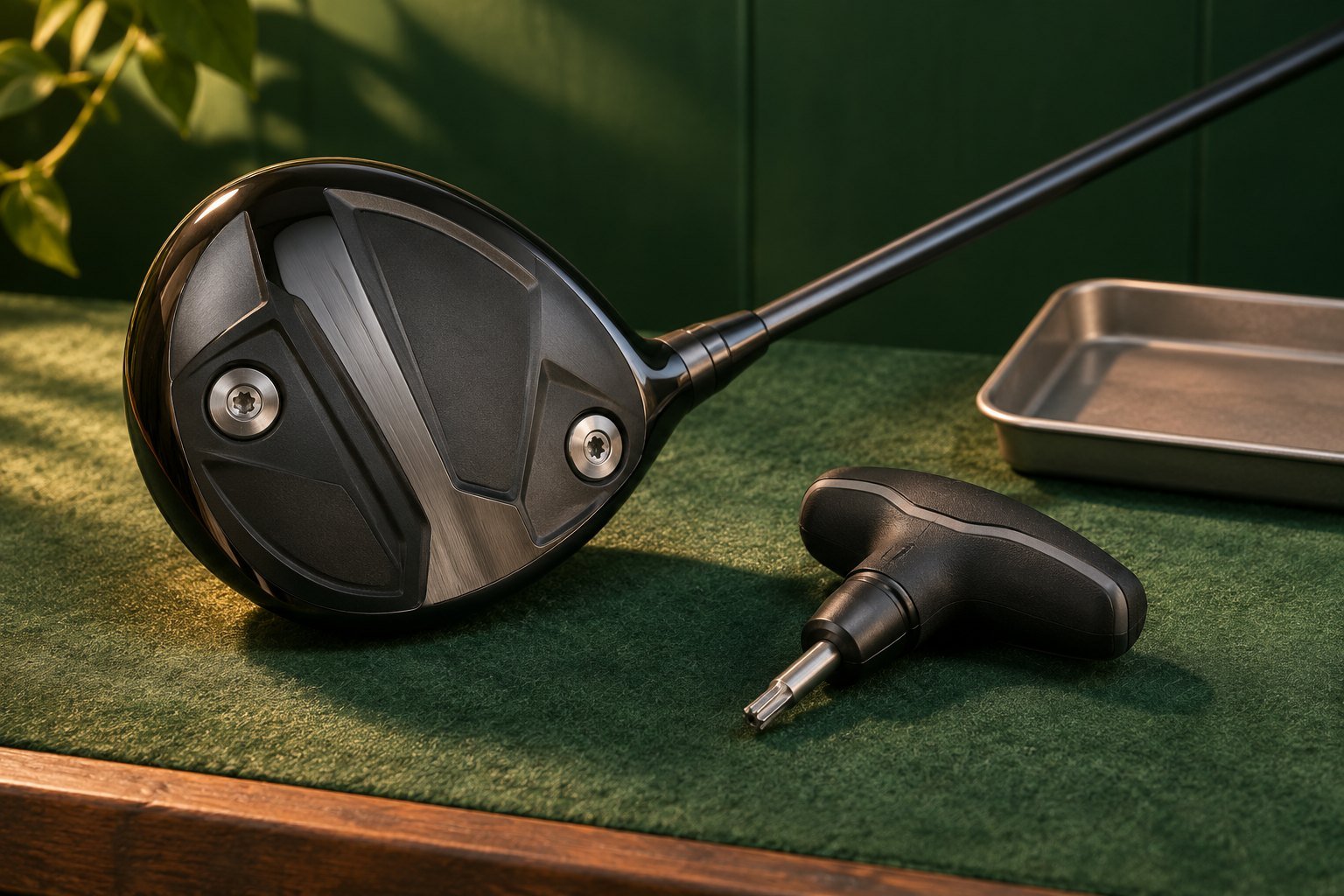
AI illustration of generic equipment. Use the actual model manual for weight positions and hardware.
Adjustable driver weights are tempting because the change looks small: loosen a screw, move a piece and see what happens. The useful work starts before the screw turns. You need to know whether that part is intended to move, whether the installed weights belong to the exact head and what question the next setting is supposed to answer.
This guide gives you a practical way to prepare and record an adjustment. It uses named manufacturer examples to show why instructions differ. It does not prescribe a setting for your swing or claim that the illustrated clubs have been tested by this website.
Ad – includes affiliate links. If you buy through these links, Taylor’s Trailblazing Golf may earn a commission at no extra cost to you.
A screw is not an invitation
First establish whether the manufacturer describes that particular weight as adjustable.
Position and mass are separate
Moving approved weights differs from adding heavier replacements to the head.
Keep a route back
A clear starting photograph and written settings make the comparison useful.
Identify your adjustable driver weights before choosing a setting
Read the full name on the head, including suffixes such as MAX, LS or 10K. Similar names can conceal quite different hardware. PING describes the G430 MAX as having a 25 g moveable backweight; its G430 MAX 10K instead has a fixed backweight. The presence of a visible fastener does not make those systems interchangeable. [1] [2]
| System you identify | Question to resolve | What to avoid |
|---|---|---|
| A weight with defined positions | Which positions and tightening procedure does this model permit? | Leaving it between marked positions unless the manual allows that |
| Several interchangeable sole weights | Which mass belongs in each port, and which combinations are documented? | Assuming all screws or ports accept the same parts |
| A fixed or service weight | Is owner adjustment actually authorised? | Removing it simply because a tool fits |
| An unidentified replacement weight | Can the maker or supplier confirm the exact application? | Using appearance, thread engagement or a seller’s broad fit claim as proof |
Keep the relevant manual or manufacturer’s page with the club details. A video showing a different generation can explain the idea without supplying the instructions for yours. If the exact variant remains uncertain, pause here; a range session will not resolve a parts-identification problem.

Separate moving a weight from changing the head’s weight
There are two different questions: where the existing mass sits, and how much mass the head carries. Swapping an approved pair changes its distribution. Replacing one with a heavier part also changes the total. Record both, otherwise two apparently similar experiments may be quite different.
TaylorMade’s standard Qi35 example uses 3 g at the front and 13 g at the rear; its Qi35 LS has two front positions with 3 g weights and a 13 g rear weight. The company’s guidance describes different placement options for these two heads. A diagram for one is not a recipe for the other. [3]
Titleist likewise treats headweight as a fitting variable affecting feel, and provides different weight options in relation to the club build. That is a reason to discuss a changed playing length with a fitter, rather than copying a weight from a friend’s driver. [4]
For a first comparison, use an approved configuration with the parts already supplied, if the instructions offer one. Buying a collection of aftermarket weights before you have a clear question adds cost and uncertainty at the same time.
Back to top ↑Use this check before the wrench comes out
This is an editorial preparation checklist, not a substitute for the model’s assembly instructions. Work through it before every unfamiliar adjustment. A missing answer belongs in the stop column, rather than being filled with a guess.
| Check | Record or confirm | Stop when |
|---|---|---|
| Head identity | Full model, variant and handedness | The instructions name a different head |
| Permitted adjustment | Official positions or approved weight combination | You cannot establish that this part is user-adjustable |
| Installed parts | Weight markings and the original location of each part | Any weight or retaining part is unidentified |
| Tool and method | Tool specified for this particular operation | You are relying on bit shape alone |
| Condition | Clear seating surfaces and visibly sound fasteners | There is cracking, distortion, damaged hardware or unexpected movement |
| Starting setup | Photographs, hosel position and weight arrangement | You could not restore the original configuration confidently |
| Purpose | One observation you want the comparison to clarify | The plan is simply to change everything and hope |
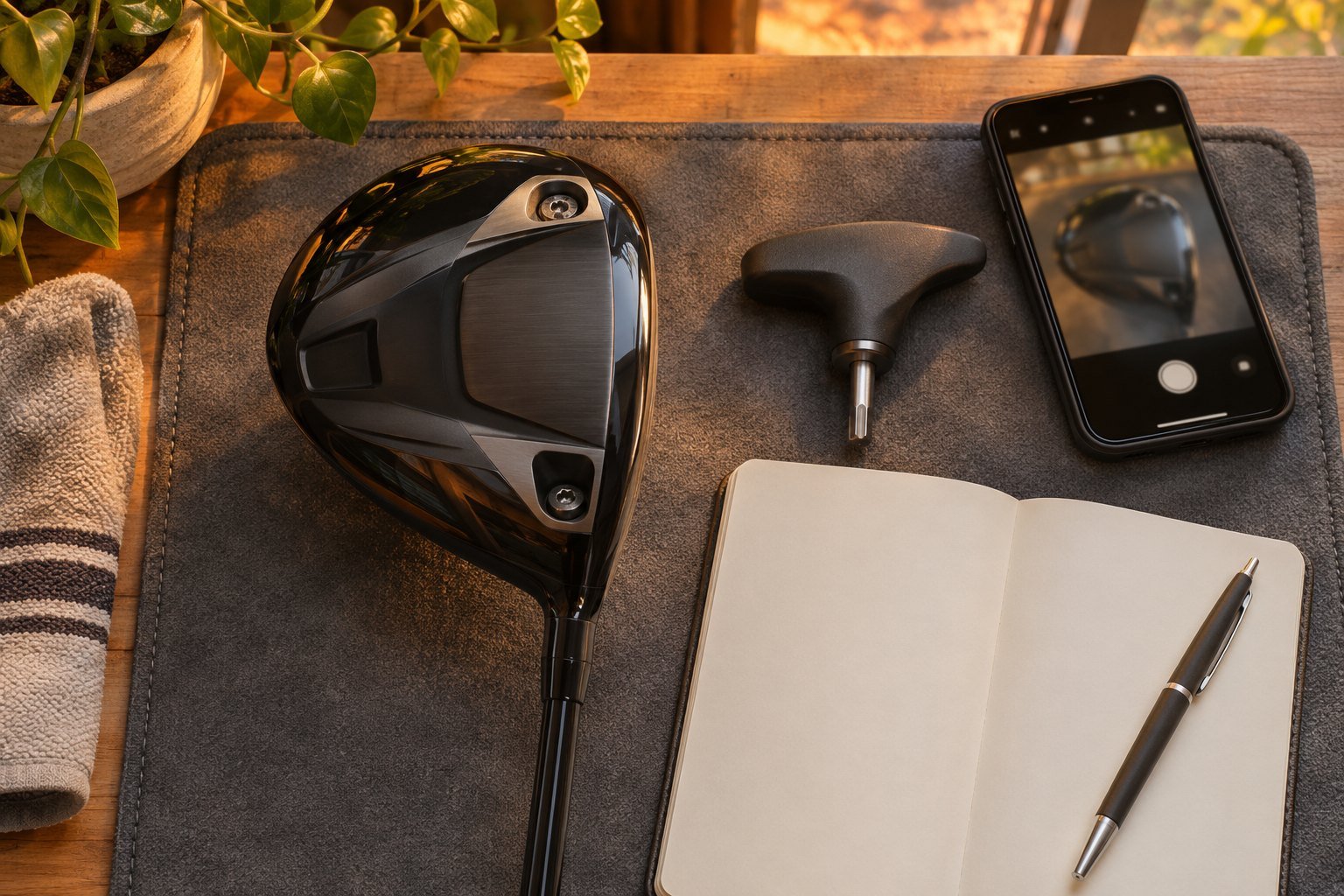
A photograph should show the whole sole as well as any readable weight markings. A close crop of a single screw can lose the distinction between the front, rear, heel and toe positions. Keep loose parts together in a clean tray and support the club securely while following its instructions.
Visible checks can reveal a reason to stop. They cannot certify that an uncertain component or hidden joint is sound. Ask a qualified club technician or the manufacturer to inspect a suspect head before it is used.

Give the change one clear job
Write a short question before choosing the alternative configuration: can a documented setting make the usual miss more manageable, or can it provide a more useful flight without making ordinary strikes less reliable? Avoid a target such as ‘gain distance’ with no definition of which shots count.
For Qi35, TaylorMade describes moving more weight forward as a lower-launch, lower-spin choice with less forgiveness than the rearward arrangement. It describes heel and toe choices for Qi35 LS as different flight-bias options. These are the manufacturer’s design tendencies, not promised results for an individual golfer. [3]
The practical trade-off is the reason to compare all the shots. One longer drive does not settle whether a setting suits you if the next few misses are much harder to play. Equally, a quieter-looking flight may be useful even without a striking distance change.
Keep wider buying questions separate. Our guide to high-MOI and low-spin drivers helps frame those trade-offs; the job here is to record one permitted change accurately.
Back to top ↑Follow the model’s method without improvising
Use the instructions for the weight mechanism itself. A hosel screw and a sole weight can look similar without establishing that the same tool, release procedure or tightening requirement applies. There is no universal torque number offered in this guide.
Check whether the fastener should merely be loosened or removed, how the weight locates in its seat and how completion is indicated. Do not add lubricant, thread-locking compound, extra washers or substitute screws unless the manufacturer specifically calls for them. Do not use a power driver or force a reluctant part as a shortcut.
After adjustment, confirm the documented arrangement and that the parts are seated as intended. If anything binds, a weight does not sit correctly, the tool cannot engage securely or movement remains, stop. Repeated tightening is not a diagnosis. Keep the club out of use until the issue is resolved.
The R&A’s equipment requirements for adjustable mechanisms include secure fixation and conforming adjustment configurations. That is another reason to stay with the approved system rather than treating any apparently attached weight as acceptable. [5]
Keep a comparison log that records the ordinary shots
Use this worksheet at a practice session with a sound, correctly assembled club. It is a way to organise observations, not a performance test already carried out by Taylor’s Trailblazing Golf. You can copy the headings into a notebook or ask a fitter to help record them.
| Record | Starting setup A | Alternative setup B | Return to A |
|---|---|---|---|
| Exact weights and positions | Write each location and mass | Identify the one change | Confirm restoration |
| Other club settings | Hosel, shaft and playing length | Keep the same | Keep the same |
| Practice conditions | Ball type, tee height and target | Keep comparable | Note any weather change |
| Shot pattern | Start direction, curve and usual miss | Record the full pattern | Does the original pattern return? |
| Useful result | Carry and spread if reliably measured | Use the same measurement method | Check whether the difference persists |
| Comfort and repeatability | What felt manageable? | Any new difficulty? | Any fatigue or adaptation? |
Decide beforehand how you will handle mishits and obvious interruptions. Do not erase the difficult shots from one setting while keeping them for the other. If fatigue, gusts or a change of range balls dominates the session, mark the comparison inconclusive and revisit it.
Returning to A can help reveal whether you were improving through practice rather than because of B. It still does not isolate every variable. A fitter becomes useful when the observed difference is small, inconsistent or difficult to explain.
Back to top ↑Decide whether to keep the setting, seek help or buy nothing
Keep the original setting when the alternative offers no clear benefit. A driver does not need a visible adjustment to justify owning its adjustment system. The ability to return to a familiar setup is itself useful.
Ask for a fitting when several approved positions give confusing results, when changing weight and loft together seems necessary, or when you need measured launch, spin and strike information. Ask for a technician when the problem concerns a screw, seat, weight, rattle or uncertain replacement part. Those are different appointments.
TaylorMade’s Qi35 weight-kit sheet separates arrangements intended to change flight from arrangements associated with changed club length. Its existence should not be read as permission to shorten a shaft at home or treat extra headweight as a universal correction. Discuss the whole build with a fitter. [6]
If you are comparing complete replacement drivers, establish the fitted specification before browsing. You can browse the driver range at Clubhouse Golf. Confirm the exact build and parts support before ordering; that link does not identify a compatible spare weight.

Finish performance adjustments before the round
Under Rule 4.1a(3), you must not make a stroke with a club whose playing characteristics you deliberately changed during the round, including a suspension of play. The penalty for that stroke is disqualification. The rule includes an exception when an adjustable feature is restored as nearly as possible to its original position before the club is used. [7]
Do your experiments in practice and record the chosen setup before starting. If hardware comes loose or a club is damaged during play, consult the applicable rule and a referee or the Committee. Treating a repair question as an opportunity to improve the setting can create a separate problem.
Back to top ↑A few final questions
Can a missing weight be replaced by one with the same number of grams?
Mass alone is insufficient. You still need the correct part for that head, including its shape and retaining hardware. Obtain an exact part confirmation from the manufacturer or an authorised supplier before using the club. Do not play with an empty port unless the manufacturer expressly permits that configuration.
What should I pass on when selling an adjusted driver?
Give the buyer the exact model, installed weight markings, current positions, hosel setting and any known changes to the shaft or playing length. Include the correct tool and spare parts if they form part of the sale. Clear photographs make the setup easier to identify without suggesting that your preferred setting will suit the next owner.
What to do next
Start with the manual and a clear photograph, then make one approved change with one question in mind. Keep the original configuration if the comparison does not produce a useful difference. Spend on a fitting when the question is performance, and on professional inspection when the question is the hardware. Neither uncertainty is solved by another random turn of the wrench.
Sources and further reading
Sources checked on 22 November 2026. Product descriptions and terms can change; confirm the details for the exact item before buying.
- PING — G430 MAX Driver: moveable backweight and exact-model specifications
- PING — G430 MAX 10K Driver: fixed backweight
- TaylorMade — Three Ways to Optimize Your New Qi35 Driver (2025 model guidance, Australian manufacturer page)
- Titleist — SureFit Performance Guide: weight options and headweight fitting
- The R&A — Equipment Rules, Part 2: adjustability requirements
- TaylorMade — Qi35 Trajectory Adjustment System Weight Kit: model-specific arrangements
- The R&A — Rule 4.1a: clubs and changes during the round
Illustrations in this article were created for Taylor’s Trailblazing Golf. Third-party photographs, where used, are credited beside the image or in the source list.