Wedge Shaft Weight: Fit With Your Irons and Playing Style
Give each wedge a job, read the actual shaft specification and compare the complete club on the shots that matter.
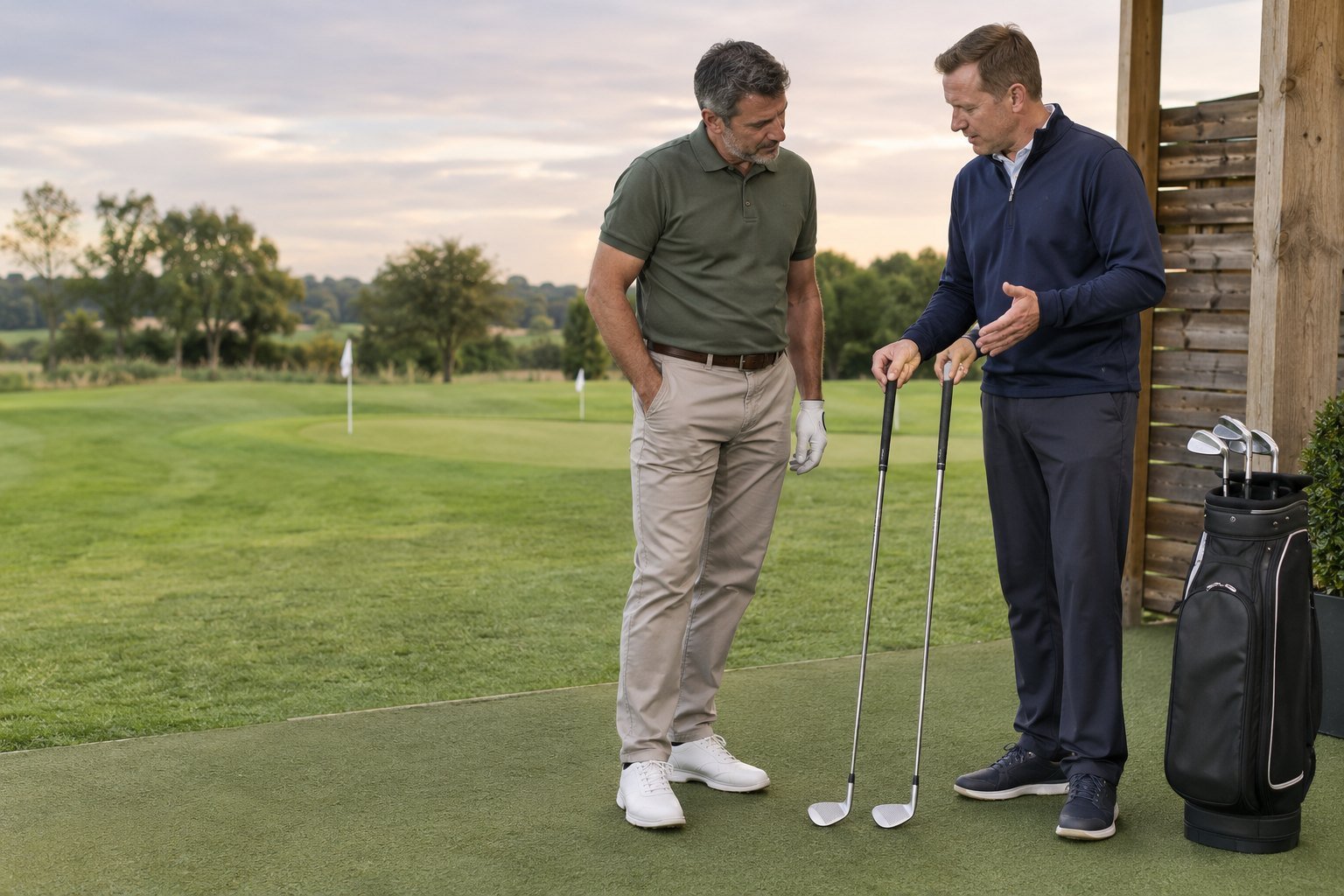
AI illustration of a fitting discussion. The clubs are generic and do not depict the named shaft models.
Wedge shaft weight is easier to choose when you start with the shot. A gap wedge used mainly for full approaches has a different brief from a sand wedge that spends its life playing controlled pitches, bunker shots and chips. Your irons provide a useful reference, but the wedge still needs to earn its place on its own jobs.
Start by identifying the shaft and build you already use. Then compare suitable trial clubs, keeping full swings and partial shots in separate records. The aim is to find a repeatable combination of contact, distance control and usable feel—not to reach a prescribed number of grams because of your handicap or the lettering on a shaft.
This guide contains affiliate links. If you buy through them, Taylor’s Trailblazing Golf may receive a commission at no extra cost to you.
Record whether it mainly covers full approaches, controlled pitches or greenside shots.
Take the short irons and wedges you use now, with their exact shaft details where known.
A catalogue shaft figure, prepared component weight and complete-club weight answer different questions.
Keep the common misses and judge the candidate against the wedge’s actual role.
Give each wedge a job before choosing its shaft
Write one sentence about each wedge: “mostly full approaches”, “my controlled-pitch club” or “mainly bunkers and greenside shots”. Add a second role where it matters. The club’s loft label alone does not tell the fitter how you use it.
Nippon says its MODUS³ Tour iron shafts can suit wedge players who favour full swings. It presents the dedicated Wedge range as an alternative for short-game feel. [1] Use that distinction to shape a comparison.
Bring the 9-iron, pitching wedge and specialist wedges to the appointment. Titleist’s published wedge-fitting outline starts with the existing 9-iron and pitching-wedge specifications, then progresses through full-shot and greenside checks. [6] The surrounding clubs give the fitter a useful reference for what you want to retain.
If the current setup already gives you dependable results, say so. A fitting can confirm that there is little reason to change. If something feels awkward, describe when it happens: on a full approach, a controlled pitch or after switching from your short irons. That is more useful than arriving with a weight increase already decided.
Back to top ↑Separate the shaft figure from the finished club
Nippon states that its catalogue shaft-weight data is measured before cutting. [1] A published gram figure therefore needs its measurement basis attached. The builder’s prepared shaft and your complete wedge are different objects.
Swipe within the table to see all columns.
| Term | What it describes | What to ask |
|---|---|---|
| Raw or uncut shaft weight | The shaft component before it is cut for the intended build. | Does the maker explicitly identify the listed weight as uncut, and which model and flex does it cover? |
| Prepared shaft weight | The component after the builder’s required cutting and preparation, before the remaining club is assembled. | Is this a measured build record or an estimate? Leave it unknown if it was never recorded. |
| Total club weight | The mass of the complete assembled wedge, including head, shaft, grip and assembly materials. | What does the finished club actually weigh on a suitable scale? |
| Swingweight | A separate balance measurement, commonly written with a letter and number. | What is the reading for this complete build at its agreed playing length? |
GolfWorks distinguishes total weight from swingweight, which describes weight distribution around a fixed fulcrum. [5] Record both when available. Neither the shaft’s gram figure nor a swingweight code is a complete description of how a club will suit you.
You do not need to dismantle a sound wedge to discover its prepared shaft weight. Ask for existing build records and have the complete club measured. An honest blank is preferable to treating a catalogue number as a measurement of an installed component.
Read the specification behind the model number
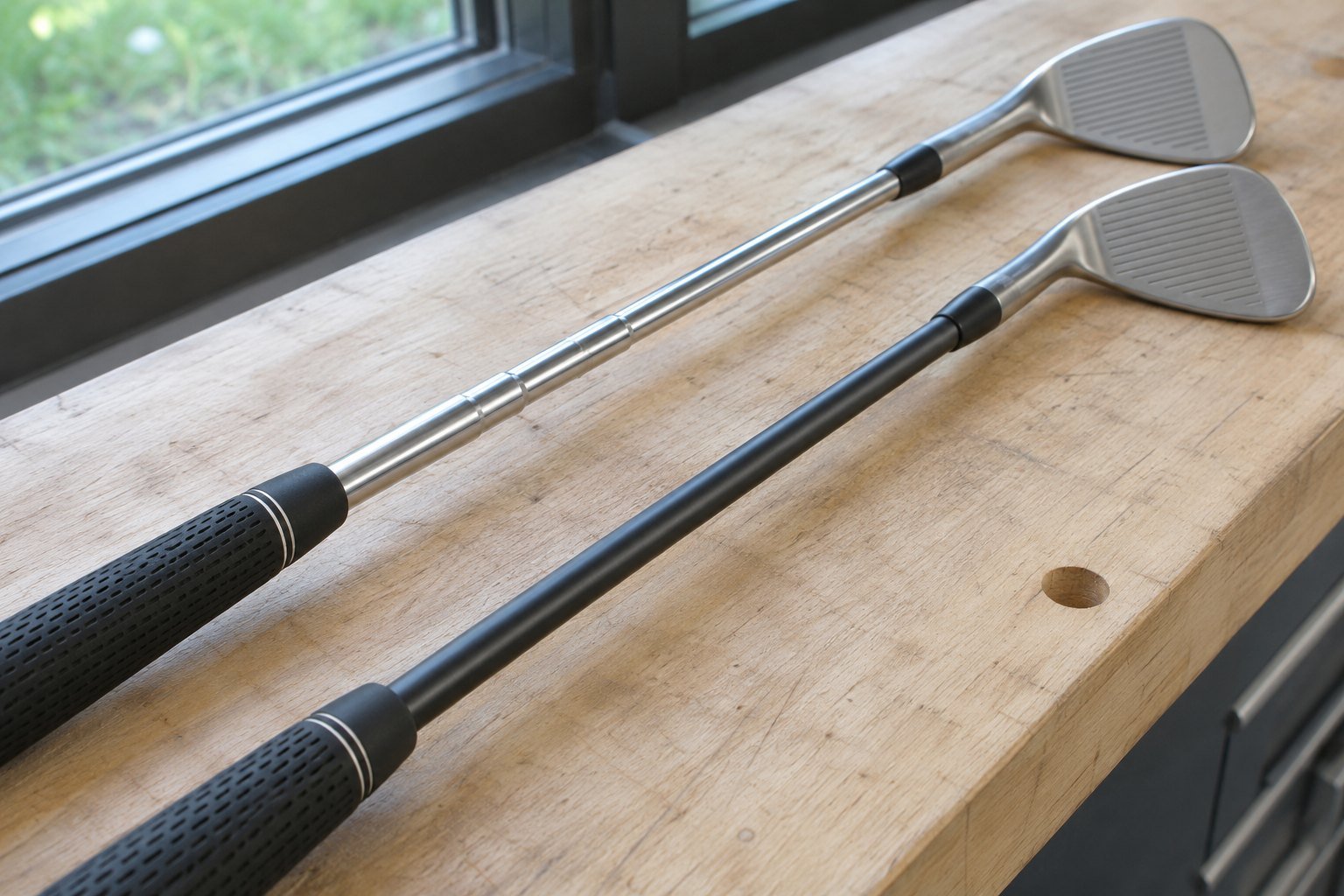
These current steel-shaft examples show why the exact model and flex belong beside the weight. They are reference specifications, not a ranking or a list of shafts that will automatically fit your wedge head.
Swipe within the table to see all columns.
| Manufacturer and range | Listed variants and shaft weights | Listed shaft length | Listed tip diameter |
|---|---|---|---|
| Nippon N.S.PRO MODUS³ WEDGE [2] | 105: 111g; 115: 122g; 125: 133g. All labelled Wedge flex. | 37 inches | 0.355 inches |
| KBS HI-REV 2.0 WEDGE [3] | Regular: 115g; Stiff: 125g; X-Stiff: 135g. | 37 inches | 0.355 inches |
| True Temper Dynamic Gold 115 Wedge [4] | Wedge flex: 115g. | 37 inches | 0.355 inches |
Notice that Nippon’s Wedge 115 is listed at 122g. The model number is not the gram measurement. In the KBS example, moving between the listed weights also changes the flex label, so that comparison is not a test of weight alone. [2][3]
The lengths above describe the supplied shafts, not the playing lengths of assembled wedges. Nippon explicitly confirms its before-cutting convention; the KBS and True Temper pages are presented here using their published component specifications. Confirm the measurement basis with the supplier whenever it is unclear.
Matching a tip diameter is only one part of checking a build. Ask the manufacturer or qualified builder to confirm the exact shaft, head compatibility and required professional preparation. A catalogue comparison is not an instruction to cut or install a shaft yourself.
If your irons use graphite, bring their exact specification and ask about suitable graphite and steel trial builds. Compare the transition and the required wedge shots before choosing either material.
Back to top ↑Wedge shaft weight: build a trial around the job
Use this original trial matrix to discuss candidates with a fitter. The starting points are questions to investigate; none prescribes a weight or a fixed difference from your irons.
Swipe within the table to see all columns.
| Your main use | Useful starting comparison | What would support a change? |
|---|---|---|
| Full approaches with a gap wedge | Your current build against a suitable candidate that preserves the connection with your short irons. | Repeatable contact and carry separation, with an acceptable directional pattern. |
| Mostly controlled pitches | Comparable complete wedges tested at the same intended landing distances. | A useful improvement in the spread of results and a motion you can repeat. |
| A mixture of full shots and greenside work | Separate full-shot and short-game comparisons with the same candidate. | A worthwhile overall trade-off, with no unacceptable loss in an important role. |
| Lighter iron shafts, noticeably different specialist wedges | Include an appropriate lighter wedge build if available, alongside the current reference. | Evidence that the transition and wedge shots become more useful; the contrast in catalogue weights alone proves little. |
Ask for complete demo wedges or an appropriate fitting system. Keep your current clubs intact. As far as the available equipment permits, hold the head model, loft, bounce and grind, playing length, lie and grip steady while comparing shafts. Write down any differences that remain.
When the head or grip also changes, you can still learn which complete club you prefer. You simply cannot assign the entire result to shaft weight. That distinction matters when you later ask a builder to reproduce it.
You can check Clubhouse Golf’s custom-fit centres as one possible route. Before booking, ask whether the appointment can compare the wedge shafts and shot types you need. Our guide to what a golf club fitting fee should include helps you check the scope and written outcome.
Back to top ↑For full swings, protect the transition from your irons
Begin with the short iron or pitching wedge immediately before the club being assessed. Hit your normal approach shot, then move to the wedge. Use the same ball and comparable conditions, and describe the change you notice in the setup and swing.
Keep a record of ordinary carry, direction and contact. If a candidate produces one longer shot but leaves a less useful spread, the extra distance has not answered the fitting question. The wedge needs to cover its intended approach distance and sit sensibly beside the neighbouring club.
Alternate in manageable blocks and return to your current wedge later in the session. Keep common misses visible. If a reading is clearly faulty, note why it was excluded rather than silently removing an inconvenient result.
Do not force the new wedge to reproduce the pitching wedge’s flight or distance. The practical question is whether the transition feels manageable and the shots give you useful coverage. If loft, head design or length differs, keep those differences beside the shaft details when discussing the outcome.

For partial shots, compare the distance you intended to hit
Choose a controlled pitch you use often and another shorter shot that matters on your course. Record the intended landing area before hitting. A trial based only on full swings leaves this part of the wedge’s job unanswered.
Compare similar shots from similar lies, then repeat the useful candidates in the relevant turf or sand conditions where the facility permits. Keep bunker shots, pitches and chips in separate groups. Combining them into one average would conceal the job each result describes.
Note contact, start direction, carry or landing area and your ability to repeat the chosen motion. Where you can observe it reliably, record what the ball does after landing too, with the surface conditions. If a launch monitor provides spin readings, ask the fitter to interpret them alongside the strike and flight instead of treating the largest number as the winner.
For a wedge used in several roles, agree which matters most. A candidate that feels pleasant on short chips may still be a poor choice if it makes your important approach shots less dependable. Equally, a small full-shot difference may matter less in a club you seldom swing fully. Your record should make that trade-off visible.

Keep one complete-build record for each candidate
Ask for the final specification and retain your own observations. This worksheet keeps a shaft-weight conversation attached to the club and shots actually assessed.
Swipe within the table to see all columns.
| Record field | Details to retain |
|---|---|
| Wedge and role | Head model, loft, bounce and grind; main and secondary jobs. |
| Shaft identity | Manufacturer, complete model name, weight version and flex. |
| Weight basis | Published raw/component figure and source; any separately measured prepared-shaft figure, clearly labelled. |
| Finished build | Measured playing length, lie, exact grip and any agreed build-up. |
| Whole-club measurements | Total weight and swingweight, if measured; keep the units and measurement types separate. |
| Trial conditions | Ball, lie, surface, intended shot and any changes between candidates. |
| Results by role | Separate full-shot and partial-shot patterns, common misses and personal feedback. |
| Decision and gaps | What improved, what became less useful and what has not yet been tested. |
Keep the grip visible in the comparison. If the demo uses a different grip from the one you plan to order, ask how that difference will be addressed. Our guide to measuring and testing golf grip size covers that separate choice.
A report that says only “heavier wedge shaft” leaves too much unresolved. The full model, finished dimensions and observed shot roles give the builder a specification that can be checked.

Order the successful build, or keep the wedge that works
My recommendation is to start close to the iron setup you already like for a full-swing wedge, then let a role-specific trial determine whether a different build is worthwhile. For a partial-shot wedge, give those controlled shots enough attention to justify the choice. Neither route requires every wedge to carry the same shaft or a universal step up in grams.
Before approving a reshaft, ask a qualified builder to assess the existing head and shaft, confirm compatibility and provide the complete fitted cost. Include the shaft, grip, labour, agreed specification checks and any delivery. Compare that with the cost of a new club built to the required specification, including any fitting fee or confirmed credit.
If a new Callaway wedge is on your shortlist, you can browse the current Callaway UK wedge range. Confirm whether the chosen head can be supplied with your agreed shaft and build. The reference shafts above are not a claim that every model is available in that retailer’s custom options.
Keep a sound current wedge when the alternative has not shown a useful, repeatable benefit. If the fitting leaves a particular shot untested, resolve that before paying for permanent work. The Irons, Wedges & Putters guides cover the surrounding equipment choices; this decision belongs to the shots your wedge must produce.
Back to top ↑Sources and further reading
Sources checked on 22 November 2026. Product descriptions are attributed to their makers; the comparison methods and buying judgements are editorial guidance.
- Nippon Shaft — FAQ: iron shafts in wedges and catalogue weight convention
- Nippon Shaft — N.S.PRO MODUS³ WEDGE specifications
- KBS — HI-REV 2.0 WEDGE technical specifications
- True Temper — Dynamic Gold 115 Wedge specifications
- GolfWorks — Glossary: total weight and swingweight
- Titleist — The Wedge Fitting Experience, published 4 March 2024
Illustrations in this article were created for Taylor’s Trailblazing Golf. Third-party photographs, where used, are credited beside the image or in the source list.