Combo Iron Sets: Blending Two Head Types Without Duplicate Gaps
Choose where the head design changes by what the neighbouring clubs do.
- Find the crossover
- Map loft and carry
- Specify every club
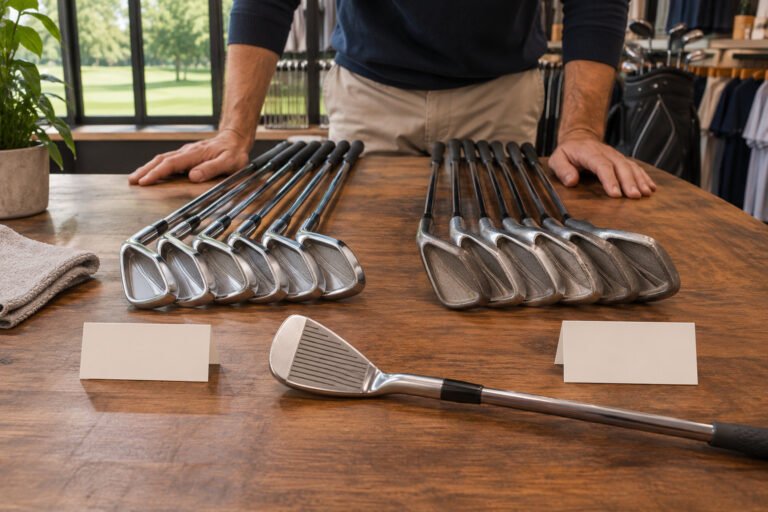
A mixed set needs a useful progression through the change of head type. AI-generated illustrations show generic golf equipment and settings. They are not photographs of the named products or records of product testing.
Combo iron sets combine two head designs within the iron run. The attraction is straightforward: keep a preferred shorter iron while finding a more useful option for the clubs that become difficult to launch, carry or control. The important decision is where the change happens, and whether it improves the sequence of shots you can play.
A tidy run of sole numbers can hide an untidy set. The new 6-iron might fly too close to the 5-iron, or leave a large step down to the 7-iron from the other family. Published lofts help expose that risk, but they do not predict your carries.
Start with the problem in your current set. Then compare the clubs around the proposed crossover, using the loft map and fitting worksheet below. The product specifications are real; the separately labelled carry example is invented to show how to read a pattern.
Start with the weak link
Name the iron and the shot that fail to do a useful job. A model change needs a reason.
Test across the join
Compare both head options near the crossover, plus the neighbouring clubs you intend to keep.
Order a complete sequence
Record head, loft, length, lie, shaft and grip for each club, then recheck the delivered set.
Find the job that needs a different head
A blend can preserve the short irons you trust while changing the part of the set that no longer produces a useful flight. Titleist describes this approach in its own blending guidance: a fitting can keep a preferred shorter-iron model and introduce another design where longer-iron performance begins to fall away. That supports testing a transition; it does not establish one correct split for every player. [1]
Write a specific reason for considering the change. “My 5-iron finishes at about the same distance as my 6-iron” is a better starting question than “I should be playing a more advanced set”. So is “I like these short irons, but the next club produces too many short approaches”.
Separate the possible aims:
- More reliable carry from a longer iron.
- A flight that is more useful for the green or landing area you intend to hit.
- Less front-to-back or sideways variation on ordinary strikes.
- A preferred look or feel in the shorter clubs, without losing a useful gap.
Preferences matter, but keep them visible as preferences. Liking a thinner top line does not prove tighter dispersion. Equally, a marginally longer average does not make an unfamiliar club the right choice. If one head family already does the required jobs throughout the set, there is no need to create a crossover.
Combo iron sets: map the lofts before choosing the split
Use the exact generation and variant. The table below takes selected standard lofts from Titleist’s current UK specification chart. T250 Launch Spec is a separate configuration and is not included in these T250 figures. [2]
| Club | T250 standard loft | T150 standard loft |
|---|---|---|
| 5-iron | 24° | 25° |
| 6-iron | 27° | 28° |
| 7-iron | 30.5° | 32° |
| 8-iron | 34.5° | 36° |
| 9-iron | 38.5° | 40° |
Scroll within the table to see all columns.
A T250 6-iron at 27° followed by a T150 7-iron at 32° creates a 5° loft step. Moving the change one club later gives a T250 7-iron at 30.5° followed by a T150 8-iron at 36°: a 5.5° step. Those are calculations from the published lofts, not measured distance gaps. [2]
This is why the instruction “use the longer model through 7-iron” is incomplete. The next head has its own loft progression. Matching brands, shaft labels or club numbers does not make the join invisible.
For your own map, list every club from one below the proposed change to one above it. Include any existing loft adjustments. If the history is uncertain, ask a qualified fitter or builder to measure the actual clubs. An original specification sheet cannot tell you whether a used iron still matches it.

Compare both sides of the crossover
Bring your present irons and ask to test the neighbouring clubs, not just one demo 7-iron. If the candidate split is between 6 and 7, a useful comparison includes the intended 5, 6, 7 and 8, with alternative heads at the uncertain positions where suitable demos are available. If the fitting cannot test a particular club, record that limitation and agree how the finished set will be checked.
Use one identifiable ball model and a consistent hitting surface. Record whether the launch monitor is reporting the session conditions or a normalised calculation, and keep that setting the same. Warm up before collecting the comparison, alternate short blocks and take a break when you cannot make representative swings. These are practical controls for this trial, not a formal test standard.
Keep the individual shots. Retain ordinary mishits in the main record and mark obvious slips or failed readings separately. A set chosen only from the best strike of each club tells you little about the approach shots you will actually face. Repeat a promising result rather than forcing a verdict from one short block.
Start with carry. Trackman defines its carry figure at the point where the flight returns to the launch elevation, often called carry flat. That is different from the final distance after the ball has bounced and rolled, and it still needs interpretation for an uphill or downhill target. [3]
For each club, record a typical carry and its spread, then the sideways pattern and the way the ball arrives. Ask for the individual-shot report so that a neat summary cannot hide a recurring short miss.

Read the gaps, not just the longest number
Illustrative example: these are invented carries for unnamed Head A and Head B. They are not results for the Titleist or Callaway products discussed in this guide, and they are not distance targets.
| Proposed club | Median carry | Recorded carry range | Step from the shorter club |
|---|---|---|---|
| Head B 8-iron | 145 yd | 139–149 yd | Starting reference |
| Head B 7-iron | 151 yd | 145–155 yd | 6 yd |
| Head A 6-iron | 172 yd | 166–177 yd | 21 yd |
| Head A 5-iron | 176 yd | 168–183 yd | 4 yd |
Scroll within the table to see all columns.
The 6-to-7 join deserves attention, but it is not the only issue. The 5-iron adds little typical carry over the 6-iron, while the 7 and 8 also sit close together in this example. Buying a different 7-iron solely to fill the largest step could leave both other problems untouched.
A median is the middle result after sorting the carries; with an even number, it is the mean of the two middle results. The full range shows the shortest and longest recorded attempts. Neither summary describes the whole pattern, and a range from a few shots is not a prediction of future extremes.
Here, the sensible next comparison is to test the other head at the 6- or 7-iron position and review the 5-iron’s separate role. Ask whether a revised blend gives the player useful choices around the uncovered approach distances. No particular yardage interval has to be imposed on every set.
Some overlap between shot patterns is normal. Two irons become a practical duplication when they repeatedly offer much the same useful shot for this golfer, not merely because one long 8-iron happens to match one short 7-iron.
Keep the landing job in the decision
A gap can look tidy while the longer club fails to serve its intended target. Titleist’s iron-fitting framework considers distance control, dispersion control and descent angle together. Those are useful comparison questions; the manufacturer’s fitting framework should not be turned into one universal flight window for every golfer. [4]
For an iron you use into greens, ask whether its flight and landing behaviour make the carry usable. A low shot that carries the required distance but repeatedly runs beyond your normal target may need a different decision from a tee-shot iron used to find an open landing area.
Where the facility permits, check the candidate blend from representative grass as well as the fitting surface. Record contact, start direction and the observed finish. If you have only indoor evidence, leave the turf and real-green response as an open check rather than claiming it has been settled.
You may prefer a more forgiving-looking head for longer approaches and a smaller shape for shorter shots. Another golfer may find the change distracting, or gain no measurable benefit. The useful result is a set you can select confidently for distinct shots, with a transition that remains manageable late in a round.

Use a club-by-club blend worksheet
Make one row for each club in the proposed set, including the ones you intend to keep. A single note saying “standard stiff” is not a complete order. The worksheet should connect the physical club with the flight you tested.
| Record for each club | What to enter | Question it resolves |
|---|---|---|
| Head identity | Brand, model, generation, variant, hand and club number | Is this the exact head that was compared? |
| Loft and lie | Published or measured angles; proposed changes clearly labelled | Does the written sequence match the actual clubs? |
| Length and shaft | Finished playing length, shaft model and flex; builder’s relevant build notes | Is an unnoticed build change crossing the join? |
| Grip and balance | Grip model and finished size; agreed weight or balance specification | Is the handling progression intentional? |
| Shot evidence | Ball, setting, shot count, typical carry, spread and directional pattern | Can the result be understood and repeated? |
| Job and decision | Intended shot, keep/change decision and any follow-up | What useful role earns this club its place? |
Scroll within the table to see all columns.
Do not assume every shaft or grip must be identical; ask whether any difference is deliberate and has been assessed. If the finished grip changes across the blend, the grip-size guide explains why the model label and tape count are not the whole specification.
Trackman’s Map My Bag is one example of software that keeps carry, total distance, dispersion and gapping records together. You do not need that particular system to use this worksheet; a clear report and your own notes can serve the same record-keeping purpose. [5]
If a fitter proposes altering lofts to improve the join, ask about the permitted adjustment for that exact head, any consequences for the build and the need to retest. Leave bending and other workshop changes to a qualified professional. A proposed correction is not confirmed until the resulting clubs have been checked.

Buy the tested blend, then check what arrives
Confirm individual-club availability before treating two standard set listings as one mixed-set order. Ask for the exact head at every position, the agreed specifications and a written total. A listing for 5–PW does not by itself show that a retailer can supply your chosen 5–6 and 7–PW combination.
For the Titleist examples above, Clubhouse Golf lists T250 irons with steel shafts and T150 irons with steel shafts, with custom-fit information on the product pages. Use them to check the relevant buying options, then confirm the mixed order, handedness, component choices and delivery terms directly. These are product listings, not evidence that either blend has been fitted to you. [6][7]
If an Apex head is among the alternatives you have tested, Callaway’s UK Apex Ai150 configurator includes set and single-club choices alongside length, lie and loft fields. That makes it a useful place to specify the requested clubs, while the actual selectable combinations and order still need confirmation. A configuration screen cannot establish how a mixed set will perform. [8]
Before booking, the guide to golf club fitting fees helps you ask whether neighbouring-club trials, a written build specification and a follow-up are included. Agree what happens if the final crossover does not reproduce the fitting result.
At handover, compare the delivered clubs with the worksheet. Then repeat the gapping check with the completed set, using the same ball and clearly recorded conditions where practical. Keep the old reference data until the new sequence has earned your trust.
Choose the transition that earns its place
A successful combo set gives you a useful reason to change head design and a dependable sequence on either side. Start with the exact loft map, test the join and its neighbours, then judge carry together with spread and landing behaviour. Order every club explicitly. If the mixed set offers no clear advantage over one family, keeping the simpler arrangement is a sound fitting result.
Sources
Sources checked on 22 November 2026. Product names refer to the exact models described.
- Titleist — Designed for BlendingManufacturer explanation of choosing a transition based on iron performance.
- Titleist UK — Golf Club SpecificationsPublished T250 standard and T150 lofts; excludes T250 Launch Spec from the comparison table.
- Trackman — Parameters: Carry (Tee to Green)Definition of carry at the launch elevation.
- Titleist — T-Series Irons and 3D Iron FittingManufacturer fitting framework covering distance control, dispersion control and descent angle.
- Trackman — Know Your Numbers: Introducing Map My Bag in TPS 10.1Example of a club-mapping record containing carry, dispersion and gaps.
- Clubhouse Golf — Titleist T250 Golf Irons, Steel ShaftsRetail product listing and custom-fit ordering information.
- Clubhouse Golf — Titleist T150 Golf Irons, Steel ShaftsRetail product listing and custom-fit ordering information.
- Callaway UK — Apex Ai150 IronsOfficial product identity and set, single-club and custom-build fields.
Illustrations in this article were created for Taylor’s Trailblazing Golf. Third-party photographs, where used, are credited beside the image or in the source list.