Portable vs Permanent Golf Nets: Anchoring, Storage and Upkeep
Choose the installation and upkeep routine you can maintain, including the work that happens before and after practice.
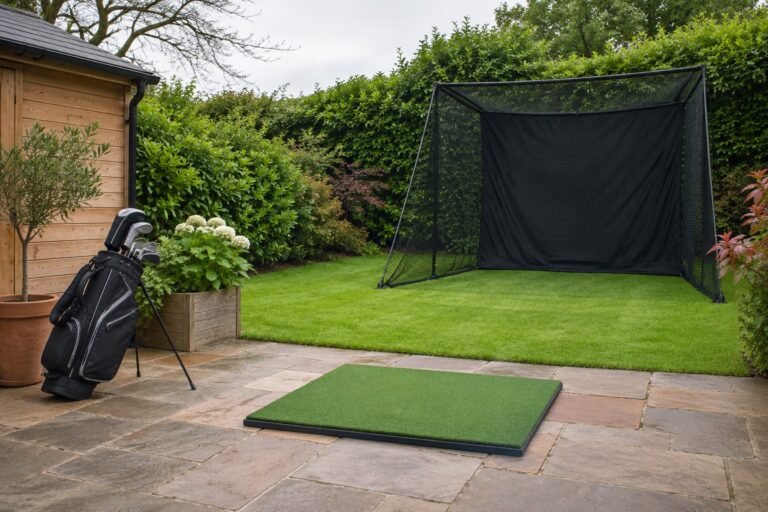
Portability is a storage routine as well as a product label. AI-generated illustration of generic equipment.
A net can be easy to put up and awkward to own. The carry bag might fit the shed while the mat does not; an apparently settled garden setup may still need dismantling when the weather changes. Those details determine how much of a short practice window is actually available.
This is a research-led comparison of installation types and manufacturer instructions. The completed weekly plan is fictional, with stated time assumptions rather than measured setup times for named products.
Useful when the space must be released, provided the full packing routine is manageable.
Useful for an appropriate dedicated location with a documented installation and care plan.
Use the fixing or weighting method for the exact model and actual surface.
Leaving a frame assembled does not remove inspection, weather or replacement decisions.
Distinguish portable, freestanding and fixed installations
For this comparison, “portable” means equipment you intend to put away between sessions. “Fixed” means a system designed to remain installed at an appropriate dedicated location. A freestanding frame may sit between those arrangements, so establish what the actual model requires instead of relying on the label.
Two manufacturer examples show the distinction. Spornia publishes specific folding and packing instructions for its SPG-7, including a two-person option. Net World Sports offers a Socketed Professional Golf Cage designed to fit into ground sockets. These are different ownership commitments, not evidence that one will be suitable for your garden. [1] [2]
A fixed installation should be specified for the site. Use the manufacturer and a suitable installer to resolve the foundations, fixings, surroundings and any necessary permission. A general comparison cannot provide a foundation design or authorise attaching a net to an existing fence, wall or outbuilding.
Also distinguish what remains installed. The frame, impact material, side protection and mat may have different storage requirements. Ask which components may remain in place and which must be removed, rather than buying on the assumption that the entire system can be forgotten between sessions.
Compare the ownership burden before comparing convenience
On a small screen, scroll sideways inside this table.
| Ownership task | Portable arrangement | Fixed arrangement | Your deciding question |
|---|---|---|---|
| Preparing the area | Clear the space and restore the complete approved layout each visit. | Keep the dedicated area available and check for changes. | Who else uses this location? |
| Securing the system | Repeat the specified fixing or weighting procedure. | Have the installation specified correctly and inspect it as instructed. | Does the approved method suit the actual surface? |
| Packing and handling | Move the net, mat, attachments and separate weights. | Plan access for maintenance and any required removal. | Can the available people manage the required routine? |
| Weather response | Allow time and space for removal, drying and storage as directed. | Obtain a model-specific adverse-weather plan. | What must happen before conditions deteriorate? |
| Inspection | Check assembly and component condition before use. | Check condition and installation before use. | Will inspection actually happen every visit? |
| Future changes | Confirm that another location also meets the requirements. | Price authorised relocation or removal if it may be needed. | How stable is your access to this space? |
Do not award points for a task that does not matter to you. A household that must clear the lawn after every session has a different constraint from one with a dedicated practice area. First eliminate arrangements that cannot meet the household’s requirements; then compare the remaining effort and cost.

Resolve the fixing method for the actual surface
Freestanding does not mean that a base can simply be left unsecured. The Net Return’s currently linked Home assembly manual explicitly requires weighting the base with sandbags. That is an instruction for that system, not a universal prescription for other nets. [3]
Before ordering, give the supplier the exact location and surface. Ask what components are required, where they go, what they attach to and whether they are included. Keep the answer with the correct manual and model identifier.
- On a lawn, confirm the specified fixing arrangement and whether the ground conditions are suitable.
- On paving or another hard surface, obtain the approved alternative if the supplied instructions assume ground stakes.
- For a socketed system, obtain an installation specification rather than copying a foundation detail from another product.
- If the approved arrangement cannot be used, change the product or location; do not invent a substitute fixing.
The FORB socketed-cage instructions include ground installation as part of assembly. [7] That helps distinguish the purchase from a folding net, but it is not a reason to undertake structural work from a short buying guide.
A photograph of a tidy setup is not fixing evidence. Nor does the weight of the frame establish what conditions it can withstand. Ask for unresolved requirements to be clarified before paying for a system whose correct installation you cannot yet describe.
Separate outdoor materials from permission to leave it up
The FORB Freestanding Golf Cage & Net is listed at approximately 50kg, yet its UK product page recommends dismantling it in high winds and also refers to windy or blustery conditions. Its size and outdoor construction do not erase that instruction. [4]
The Net Return’s support guidance advises keeping its nets out of inclement weather and laying them flat in strong winds. [5] Follow the instructions for your model; this article does not supply a universal wind-speed threshold or endorse laying down every type of cage.
Work out the weather response before the net is installed. Who will carry it out, where will the components go, and what preparation is needed while conditions are still suitable? A plan that depends on an unavailable second person is not complete.
For a fixed installation, ask what weather inspection and removal requirements remain. “Permanent” describes the intended installation, not an exemption from care. If the seller cannot explain the relevant limits or the practical response, keep that uncertainty in the comparison instead of assuming that a heavier frame resolves it.
Check the storage route, not just the carry bag
Read the actual packing sequence before buying. Spornia’s SPG-7 instructions illustrate that taking a net down includes a specific folding process and packing it into its bag; a two-person version is also provided. [1] A product’s packed dimensions do not tell you whether that process suits your available space or helpers.
Walk through the intended storage route with the complete inventory on paper:
- Where will there be room to dismantle or fold the net as instructed?
- Where will the mat, side panels, target material and fixing components go?
- Which pieces travel separately, and how will you carry them through doors or around steps?
- Where can equipment dry or air as required before it is packed?
- Can the stored system be retrieved without emptying the shed first?
Confirm the manufacturer’s cleaning, drying and storage directions. Do not assume a supplied bag means damp equipment can be sealed inside it, or that a covered patio provides the same storage conditions as an indoor space.
For a partly dismantled arrangement, record what stays outside and what comes in. Otherwise, the comparison can exaggerate its convenience by counting only the easy-to-carry pieces and overlooking the mat or separate base weights.

A fictional weekly plan: count time beyond assembly
Amir has three 20-minute opportunities each week: 60 minutes in total. His shared lawn must be cleared after practice. The figures below are invented planning assumptions, not measurements of Spornia, FORB, The Net Return or any other product. Suitable containment and an approved installation would still have to be established separately.
On a small screen, scroll sideways inside this table.
| Task | Portable plan | Fixed plan |
|---|---|---|
| Prepare or assemble | 5 minutes assumed. | 0 repeat-assembly minutes assumed. |
| Pre-use checks | 3 minutes assumed. | 3 minutes assumed. |
| Pack or put away loose items | 5 minutes assumed. | 2 minutes assumed. |
| Time remaining from 20 minutes | 7 minutes. | 15 minutes. |
| Across three visits | 21 minutes remaining. | 45 minutes remaining. |
The fixed plan looks better on repeated setup time, but it fails Amir’s requirement to release the lawn. Its installation time and cost are also outside this table. He cannot turn it into the better purchase simply by ignoring those constraints.
He could instead consider two 30-minute visits with the portable plan. The same assumed 13 minutes of preparation, checks and packing each time would leave 34 minutes across the week: 60 − (2 × 13). That is more available practice time than the three shorter visits, without changing the assumed equipment.
This is a scheduling comparison, not evidence of better golf or a product’s setup speed. Drying, weather action, a missing component or a changed layout would add work not included in these figures. Replace the assumptions with a retailer demonstration or your own ordinary-use timings when available; never shorten required checks to make the arithmetic attractive.

Make inspection part of every ownership option
Leaving a frame assembled removes an assembly task, not the need to examine its condition. The FORB freestanding-cage manual calls for checking the cage and net for defects and says not to use faulty parts. [6]
Use the product’s own checklist, with a simple dated record of anything that changes. Before use, examine the impact area, seams, attachment points, frame connections and the specified fixing components. Confirm that the setup has not moved or been altered since the previous session.
If there is damage, unexplained movement, a changed attachment or uncertainty about a connection, stop using the system and ask the manufacturer what action is required. Photograph the whole arrangement and the affected area, and retain the model details. Do not treat an improvised knot, patch or extra strap as a verified repair.
Keep upkeep costs visible too. The useful questions are whether the correct replacement components are available, how they are identified, what maintenance is prescribed and what removal or installation work would cost. No universal number of years, sessions or impacts is established here. A low purchase price does not resolve an unknown replacement route.

Choose the routine that the household can sustain
Choose a portable system when the area needs to be released and you can manage the complete approved setup, inspection, packing and storage routine. Before ordering, compare the actual handling and folding requirements—not just a claimed fast assembly time.
Choose a fixed system when a suitable dedicated location is available and its installation, upkeep and weather plan are documented. The Socketed Professional Golf Cage product page is an example to discuss with the manufacturer or installer, not a site-specific recommendation. For a folding approach, read the SPG-7 manufacturer’s packing instructions before evaluating a local purchase.
Keep a large freestanding cage in its own column until you know whether moving and dismantling it is realistic. It should not inherit the convenience of a small carry-bag net or the installation assumptions of a socketed system.
If neither routine fits your space or available time, a simpler practice task may be more useful. Our flat versus ramped putting-mat guide compares the feedback and usable space for a putting setup. Choose the practice arrangement you can use correctly and maintain, even when that means postponing a full-swing net.
Explore more Home Practice guides
Sources and checks
Sources were checked on 23 November 2026. Product ranges and buying terms can change. The practical worksheets are editorial suggestions for your own comparison.
- SPG-7 setup, take-down and packing instructionsSpornia · Checked 23 November 2026
- Socketed Professional Golf Cage and Net — UK product pageNet World Sports UK · Checked 23 November 2026
- Home / Home Series V2 assembly manual, currently linked PDF (©2021)The Net Return · Checked 23 November 2026
- FORB Freestanding Golf Cage & Net: weight and weather instructionsNet World Sports UK · Checked 23 November 2026
- Product usage guidelinesThe Net Return · Checked 23 November 2026
- 10ft freestanding golf cage and net: assembly and safety instructionsNet World Sports / FORB Golf · Checked 23 November 2026
- 10ft socketed golf cage: manufacturer installation instructionsNet World Sports / FORB Golf · Checked 23 November 2026
Illustrations in this article were created for Taylor’s Trailblazing Golf. Third-party photographs, where used, are credited beside the image or in the source list.