Target Sheets vs Plain Golf Nets: Which Feedback Is More Useful?
Choose a clearer reference, understand what it cannot measure, and keep the right components in place.
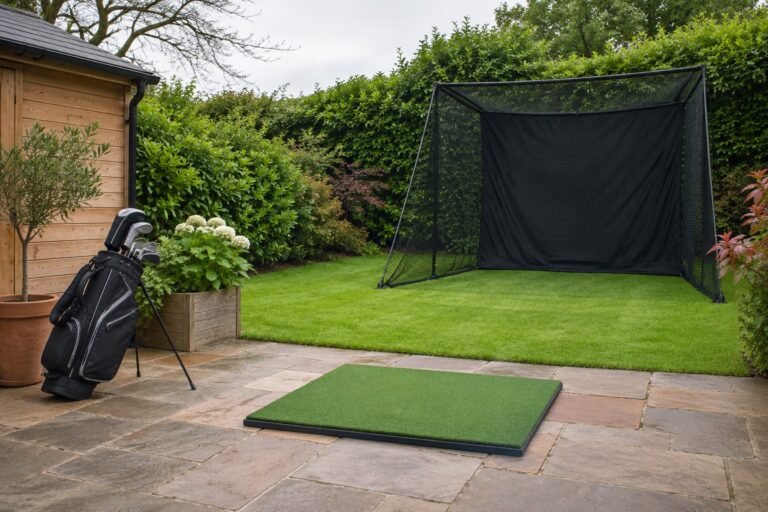
A target adds a reference point; its mounting and impact role still depend on the net system. AI illustration of generic equipment.
A large bullseye can make a net look more purposeful, but the purchase is worthwhile only if it helps with the question you are practising. Hitting its centre is not automatically evidence of a better shot.
This guide compares the information a target adds, the limits of that information and the cost of keeping the correct component in service. The worked practice record and prices are fictional examples for planning, not results from testing a net or target.
This guide contains affiliate links. If you buy through them, Taylor’s Trailblazing Golf may receive a commission at no extra cost to you.
A target can make the intended aiming area easier to describe and revisit.
A mark on the net does not measure carry distance, spin or clubface contact.
Check whether the target is optional or part of the net’s required impact system.
Start with the feedback you want to use
A useful comparison starts with a question you can answer after a session. “Did the target help me choose and recognise an aiming area?” is manageable. “Did hitting the centre prove that my seven-iron carried farther?” is not answered by the fabric.
On a small screen, scroll sideways inside this table.
| Practice question | Plain net | Target marking | What remains unknown |
|---|---|---|---|
| Can I choose a clear reference before the shot? | You must choose a consistent feature or position yourself. | A visible centre or zone makes the reference easier to describe. | Whether your setup and clubface matched that intention. |
| Can I describe where the ball reached the net? | Broad observations may be possible, but a uniform mesh gives few landmarks. | Marked areas can make an observation easier to classify. | Anything you could not actually see; record uncertainty. |
| Where did the ball strike the clubface? | The net does not record face contact. | A target on the net does not record it either. | The strike location on the club itself. |
| What were the carry, spin and complete shot shape? | Not measured by the net. | Not measured by a printed sheet. | Ball-flight information requiring a suitable observation or measurement method. |
Keep a distinction between aiming and feedback. A target can be worthwhile simply because it gives your routine a clearer reference. You do not need to turn every shot into a score. Conversely, a very detailed printed design adds little if you cannot reliably observe which area the ball reached.
If your main aim is repeated swings within a suitable practice setup, an optional target may be unnecessary. That conclusion applies only to an accessory the manufacturer permits you to omit; a required impact sheet has a separate job.

A target accessory and an impact sheet can do different jobs
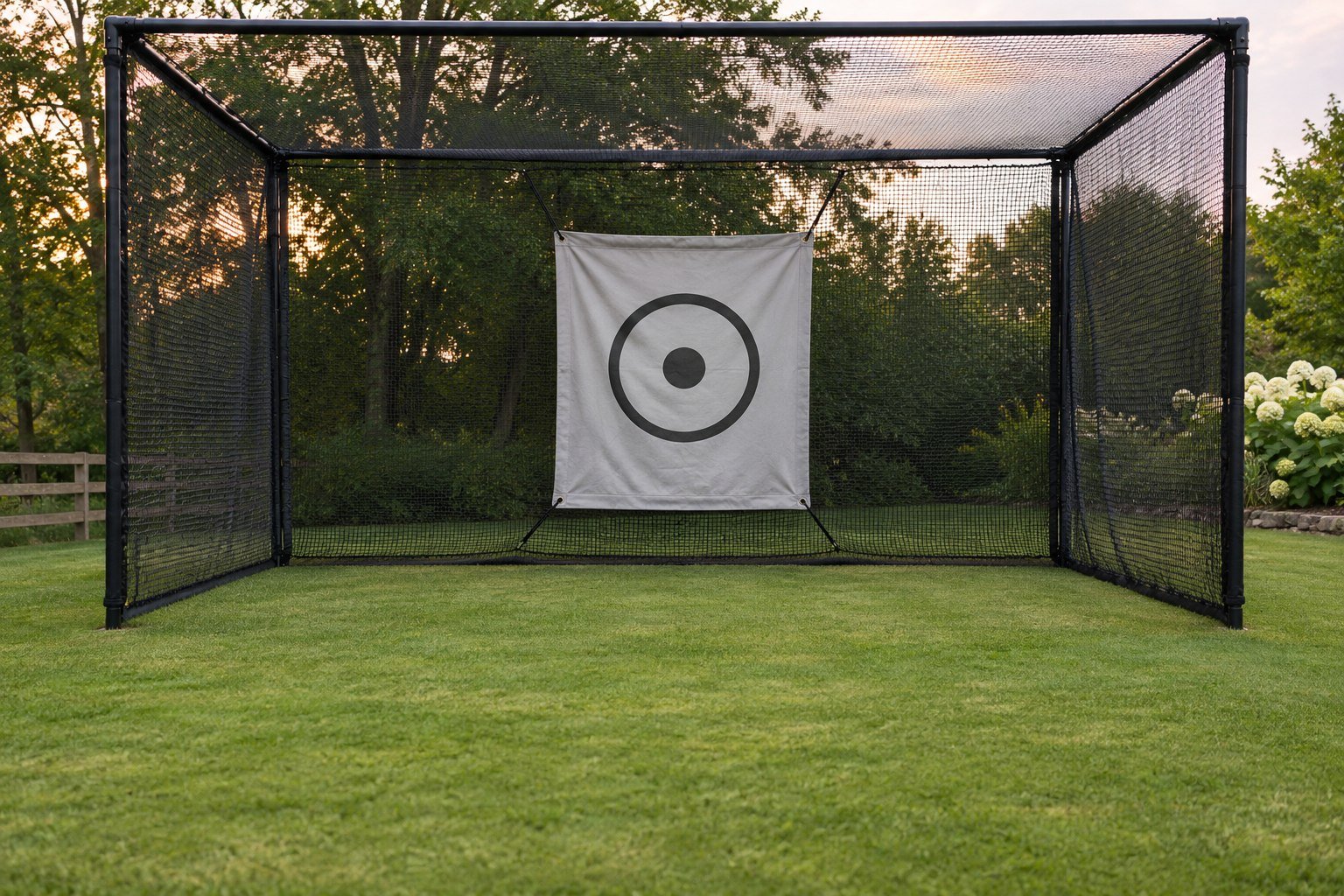
The Net Return’s Square Target is a useful example of a visual accessory. The manufacturer describes it as attaching to the rear of its Pro or Home net with eight hook-and-loop tabs, where it does not take direct ball impact. Its purpose is a moveable aiming reference. The manufacturer lists this accessory for indoor use only. [1]
Spornia describes its Bulls-Eye replacement sheet as both a visual target and an impact-absorbing layer, with variants for the SPG-5, SPG-7 and SPG-8. It also states that those new nets include a sheet. That is a different role from a marker placed behind mesh. [2]
These are manufacturer descriptions of named components, not a test of which is quieter, stronger or longer-lasting. Do not assume that any fabric target can be attached to any net, or that an impact layer can be removed because you prefer an uncluttered view.
For local product checking, Net Return Europe lists a 60 × 60 cm target, while GolfBays lists a Spornia Bulls-Eye replacement sheet for SPG-7 and SPG-8 nets. Confirm your exact version and the selected variant with the supplier. A shared brand name is not a substitute for that check. [6] [7]
Ask three practical questions: is the target optional, does it receive the ball’s impact, and does the net’s approved setup depend on it? Get those answers before comparing designs or prices.
What a centre hit does not tell you
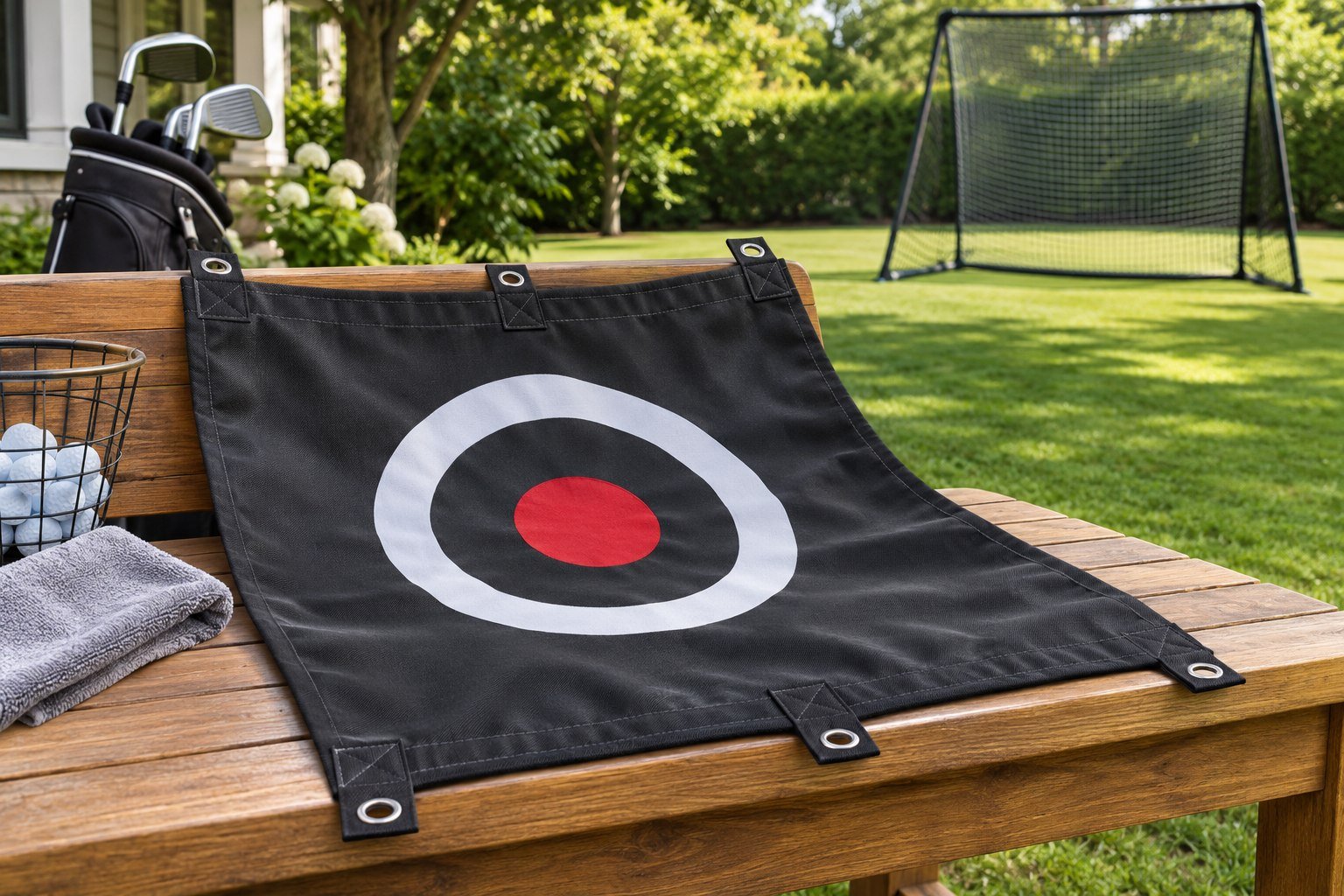
A net interrupts the flight. Where a ball reaches that nearby surface is not its eventual landing position. Changing the club, tee height or ball-to-net position also changes what you are comparing, so a single target score cannot stand in for a complete shot assessment.
Even dedicated measurement devices distinguish between directly measured and calculated information. Garmin’s Approach R10 support documentation, for example, classifies launch angle and launch direction as radar measurements and carry distance as an algorithm calculation. A printed target provides neither of those measurement systems. [3]
Use the narrowest accurate description. “I clearly saw the ball reach the upper marked area” is an observation. “That was my longest iron shot” needs evidence you have not obtained from the sheet. A quieter sound or more comfortable swing is also a different observation from a measured change in flight.
If carry distance is the question, use an appropriate range or a correctly configured measurement setup. Check which metrics the particular device measures or estimates and what space it requires. A clearer target may still help your routine, but buying one does not answer the distance question.
Compare the view without compromising the setup
Only compare configurations that the manufacturer permits. Leave all required impact layers, side protection and other containment components in place. If the target is integral to the system, assess its usefulness as supplied; do not remove it to create an artificial “plain net” trial.
The Net Return advises checking balls for damage, inspecting netting for wear such as fraying, and keeping the practice area clear of people and objects. Those are checks for its equipment, not a claim that any inspected net is automatically safe. [4]
- Write one purpose before practice: for example, choosing a clear reference or describing the area reached.
- Use the same club, ball type, hitting position and permitted setup for the comparison.
- If an optional accessory may be removed, compare short blocks with it present and absent. Otherwise compare the approved system with your stated purpose.
- After each shot, record only what you could confidently observe. Use “uncertain” when you could not see enough.
- Repeat on another occasion before deciding the first session justifies a purchase.
For a manageable record, you might use two blocks of six shots per permitted configuration, changing the order between blocks. Twelve shots is a planning suggestion, not a statistical threshold or a safety test. Stop if the setup moves, a component deteriorates or the intended practice cannot be contained as its instructions require.
Do not move nearer to make a target easier to hit or farther away to make a drill harder unless the resulting setup remains within every relevant instruction. Choose a practice task that fits the approved arrangement.
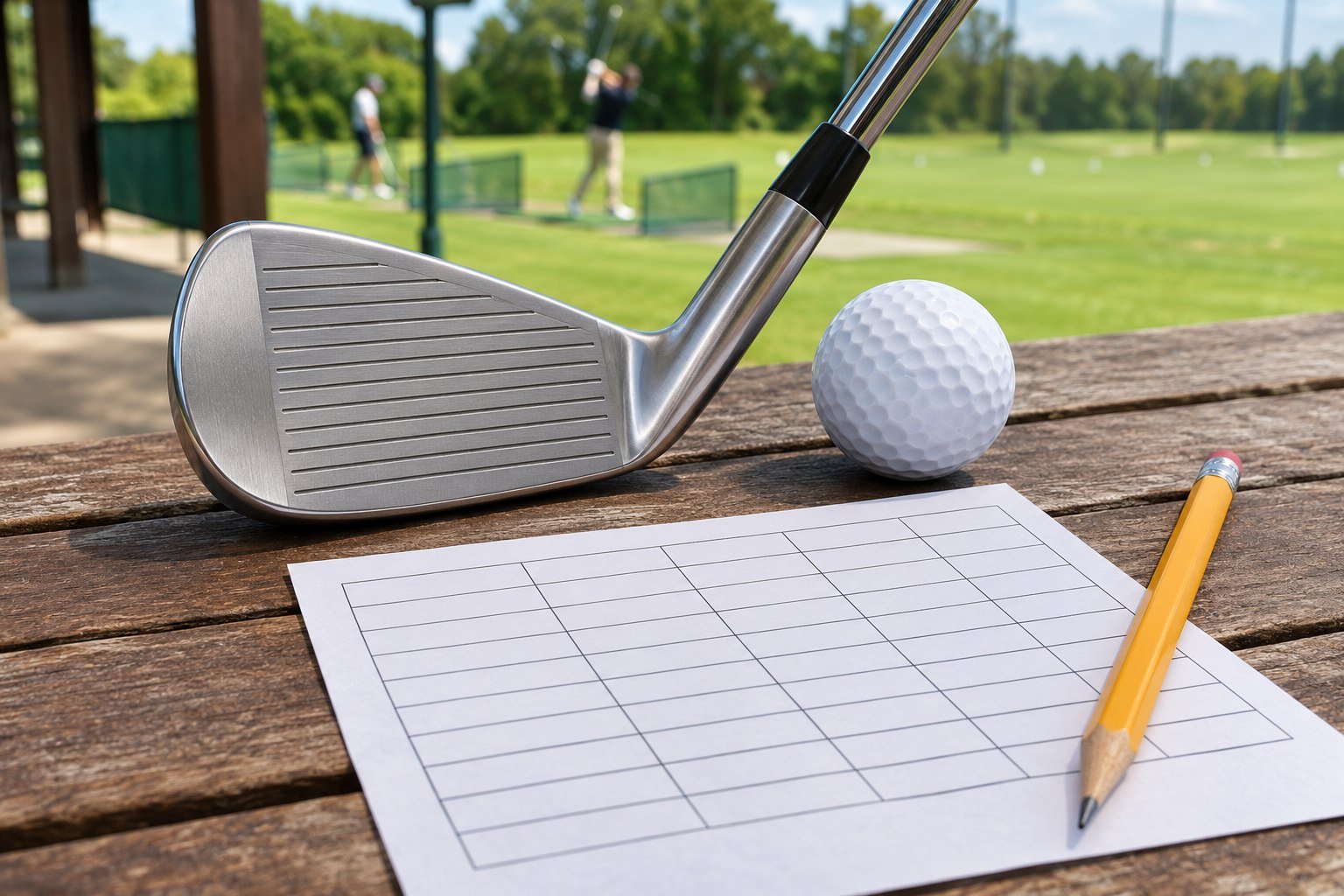
A worked record: more usable observations, not a distance claim
This fictional example shows how to interpret a comparison. It is not an author test, a product result or a prediction of what another golfer will see. Priya already owns a suitable net whose optional rear aiming accessory may be omitted under its instructions. Her question is whether a visible reference makes her notes more useful.
On a small screen, scroll sideways inside this table.
| Recorded item | Approved plain configuration | Same net with optional target |
|---|---|---|
| Net contact area confidently described | 5 of 12 shots | 9 of 12 shots |
| Net contact area recorded as uncertain | 7 of 12 shots | 3 of 12 shots |
| Carry distance | Not measured. | Not measured. |
| Comment on the routine | Reference felt difficult to describe. | The visible centre was easier to return to. |
| Next step | Keep as the comparison baseline. | Repeat before buying a replacement accessory. |
In this example, the target helped Priya classify more of her observations. It did not establish that the shots were better: the table records whether she could describe them, not how many finished near a flag. That distinction prevents a neat-looking practice record from promising more than it contains.
The opposite outcome is possible. If a graphic distracts you, encourages repeated changes to your aim or produces no clearer observations, the optional accessory has not earned its place. Retain the manufacturer-approved setup that lets you practise your chosen task with less fuss.
Keep the record short enough to use. A date, the unchanged setup, one observation category and a sentence about the next session are more valuable than a long scorecard filled with guesses.
Price the exact part and a realistic replacement scenario
First establish what you need to buy. An optional aiming accessory, a replacement impact panel and a complete net are different purchases. A lower-priced item is not better value if it leaves a required component missing.
On a small screen, scroll sideways inside this table.
| Entry | What to obtain | How to use it |
|---|---|---|
| Exact part | Model, version, selected size and approved mounting method. | Reject a quote that does not identify the matching component. |
| Delivered cost | Part price, required fittings and delivery to your address. | Compare the complete order rather than the headline price. |
| Future replacement | Current replacement availability and a delivered quote. | Model a possible replacement without inventing a service life. |
| Ongoing work | Inspection, cleaning, removal and storage instructions. | Decide whether the additional routine is worthwhile. |
For arithmetic only, imagine an optional target costs £28 and delivery £6, with all required fittings included. One order is £34. If you choose to model one later like-for-like replacement at the same prices, the two orders total £68. These are fictional prices and a chosen scenario, not a claim that a target needs replacing once a year.
If the target is unnecessary and your complete existing system is approved for use without it, £0 of additional accessory spending remains an option. If a required impact sheet is worn, that is a replacement decision before further use; omitting it is not the saving being suggested here.
Do not assume that adding a sheet will save the cost of a future net. That requires evidence about the specific combination and its wear, which this guide does not have. Pay for the clear reference or required component you can justify.

Choose the target only when it suits the practice task
A dedicated chipping target is a separate option if short chips are the actual task. Clubhouse Golf lists the Masters Pop Up Target Chipping Net with coloured aiming rings and a compact carry case. You can view that exact chipping target at Clubhouse Golf. Its chipping purpose should guide the choice; it is not a replacement for full-swing containment. Check the product instructions for the intended setting and balls. [5]
If the available space cannot support the intended swings, change the practice task. Our small-space golf practice kit under £100 guide explains a putting-led alternative and its limits. For a task where you can observe both direction and stopping behaviour, the flat versus ramped putting-mat comparison helps you choose the feedback you actually want.
Choose a compatible optional target when it gives you a useful, repeatable reference. Keep a plain view when the complete approved net already supports your purpose and the graphic adds little. Retain or replace a required impact panel according to its own instructions, regardless of which picture you prefer.
If you want carry, spin or complete ball-flight information, plan a separate way to obtain it. The best purchase here is the smallest change that answers your real practice question.
Explore more Home Practice guides
Sources and checks
Sources were checked on 23 November 2026. Product ranges and buying terms can change. The practical worksheets are editorial suggestions for your own comparison.
- Square Target: mounting position and intended roleThe Net Return · Checked 23 November 2026
- Bulls-Eye Golf Net Replacement Target SheetSpornia · Checked 23 November 2026
- Accuracy of Approach R10 Radar: measured and calculated metricsGarmin Support · Checked 23 November 2026
- Support: product usage guidelinesThe Net Return · Checked 23 November 2026
- Masters Pop Up Target Chipping Net — product ACMAS040Clubhouse Golf · Checked 23 November 2026
- Target 60 cm × 60 cmNet Return Europe · Checked 23 November 2026
- Spornia Bulls-Eye Target Sheet — BlackGolfBays UK · Checked 23 November 2026
Illustrations in this article were created for Taylor’s Trailblazing Golf. Third-party photographs, where used, are credited beside the image or in the source list.