Buying a Second-Hand Golf Bag: Zips, Bases and Strap Condition
A clean logo tells you very little. Ask for the photos and checks that show whether the bag can do its job.
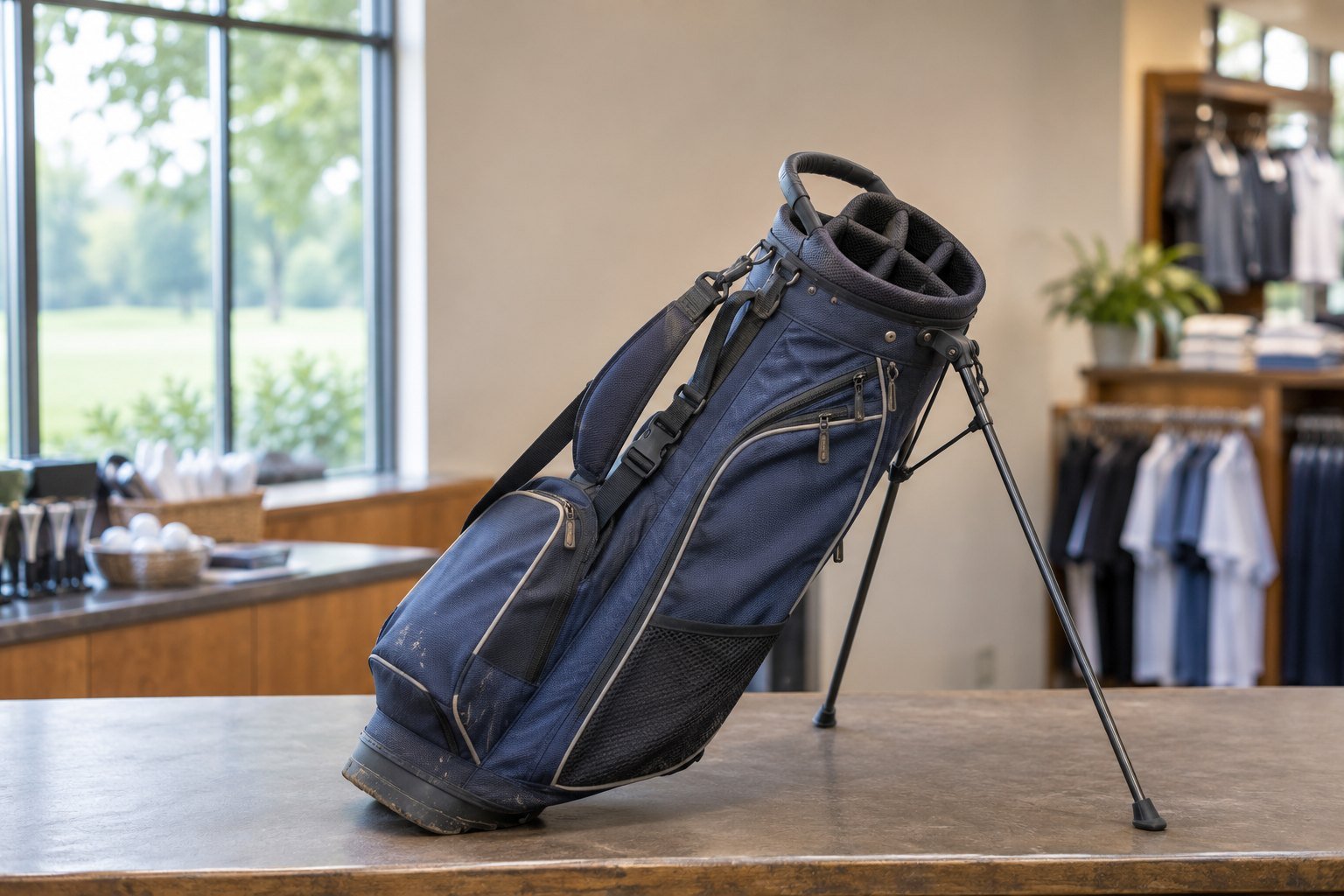
Illustrative scene: inspect the actual bag before deciding whether the price is attractive.
Buying a second-hand golf bag can make sense when the wear is cosmetic and the parts you depend on still work. The difficulty is separating an honest scuff from a split base, a failing zip or a strap anchor hidden just outside the seller’s photographs.
This guide gives you a sequence for asking questions, inspecting the bag and deciding what to pay. It is a practical screening checklist, not a guarantee that hidden damage has been ruled out. Government product-safety guidance advises checking used goods in person where possible and asking about modifications. [1]
Ad – includes affiliate links. If you buy through these links, Taylor’s Trailblazing Golf may earn a commission. Recommendations are based on the equipment decision and the available evidence.
Fading and surface scuffs may be acceptable when the bag still fits your needs.
Get the exact part and complete repair cost before negotiating.
Do not treat an unverified strap anchor, base or stand fault as a simple bargain.
Include delivery, missing accessories and confirmed repairs, not just the asking price.
Buying a second-hand golf bag starts with the right evidence
Ask for the model name, approximate purchase year and photographs of the actual item. A current catalogue photograph cannot show the condition of an older version. Establish whether it is a carry, stand or cart bag, and whether the rain hood and original carrying straps are included.
On a phone, swipe within the table to see all columns.
| Ask the seller for | What the evidence helps you check |
|---|---|
| Front, back and both sides in daylight | Overall wear, previous stitching, missing pockets or hardware. |
| A clear underside photograph | Cracks, worn-through areas, deformation and trolley fixing points. |
| Close-ups of every strap anchor and handle | Fraying, loose stitching, damaged clips and concealed repairs. |
| Each pocket open, plus the inside of the top | Lining condition, divider damage, contamination and missing pieces. |
| A short video opening the zips and deploying the stand | Whether the moving parts work normally at the time of recording. |
| Model label and accessories together | The version being sold and what actually arrives. |
Ask directly whether the bag has been repaired, modified, stored damp or involved in an incident. “Hardly used” is less useful than answers about its history. Keep the description and replies with your purchase record. A video reduces uncertainty, but cannot prove how the bag behaves under every load.
Back to top ↑Check every zip all the way along
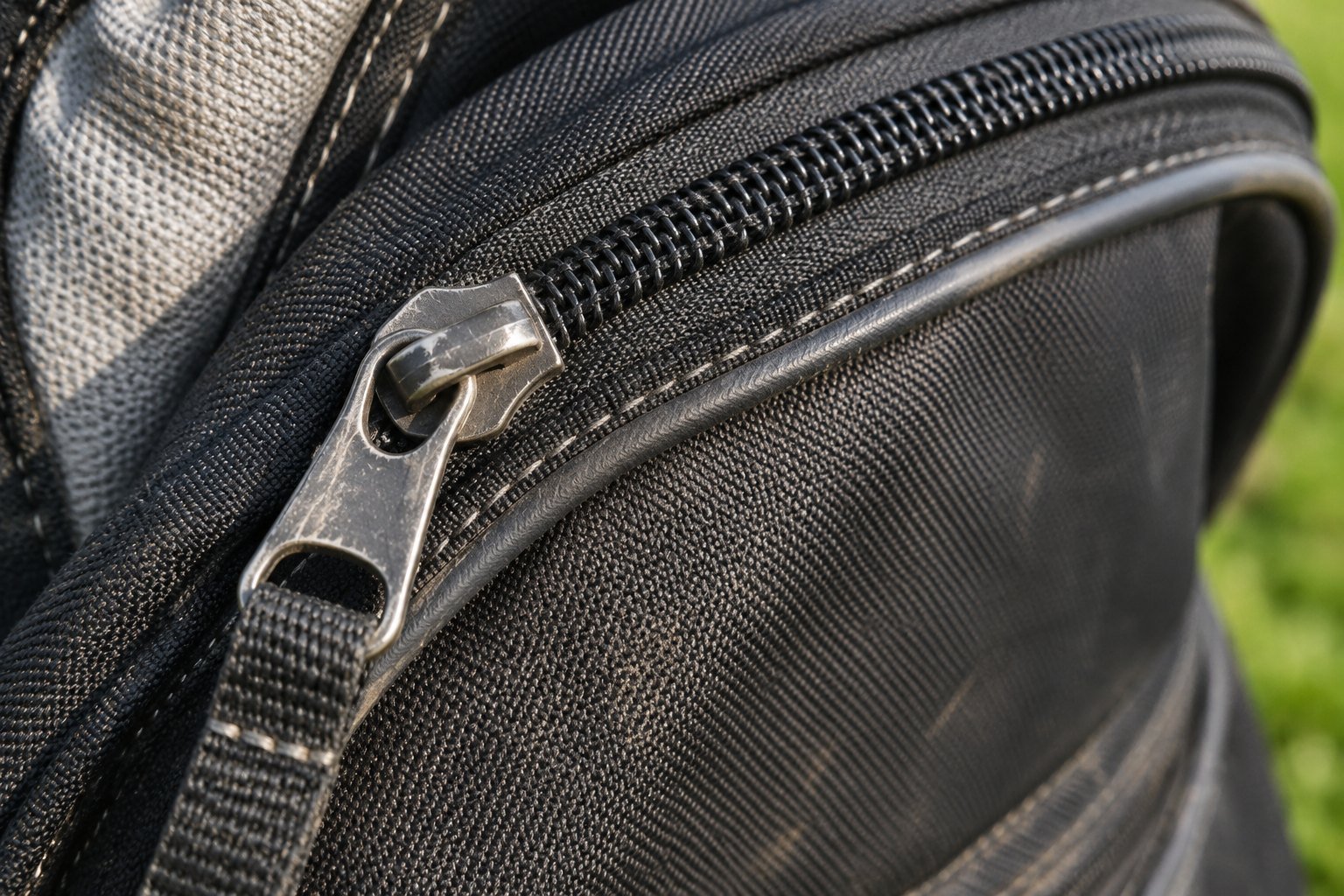
Start with the pockets empty. Open and close each zip along its normal travel without pulling harder to make it pass. Look at the teeth or coil, the fabric tape beside it, the slider and both end stops. A missing pull tab is different from a damaged slider, and both differ from a torn zip tape sewn into the bag.
Check whether the closed zip stays joined behind the slider. Note repeated catching, missing teeth, a gap that opens again or fabric pulling away from the seam. Ask the seller to show any reported fault rather than smoothing over it with “just needs a bit of oil”.
YKK warns against forcing a reluctant slider and against closing an overfilled bag under excessive tension. Those cautions are useful during inspection; they do not establish that every golf-bag zip accepts the same lubricant or repair. [2]
A bag with a faulty valuables-pocket zip has a different practical drawback from one with an unused small pocket affected. Decide what you need, then ask a suitable repairer whether the particular fault is repairable and what access to the seam involves. Do not buy on the assumption that any slider can simply be squeezed back into shape.
Back to top ↑Turn it over: base and stand condition
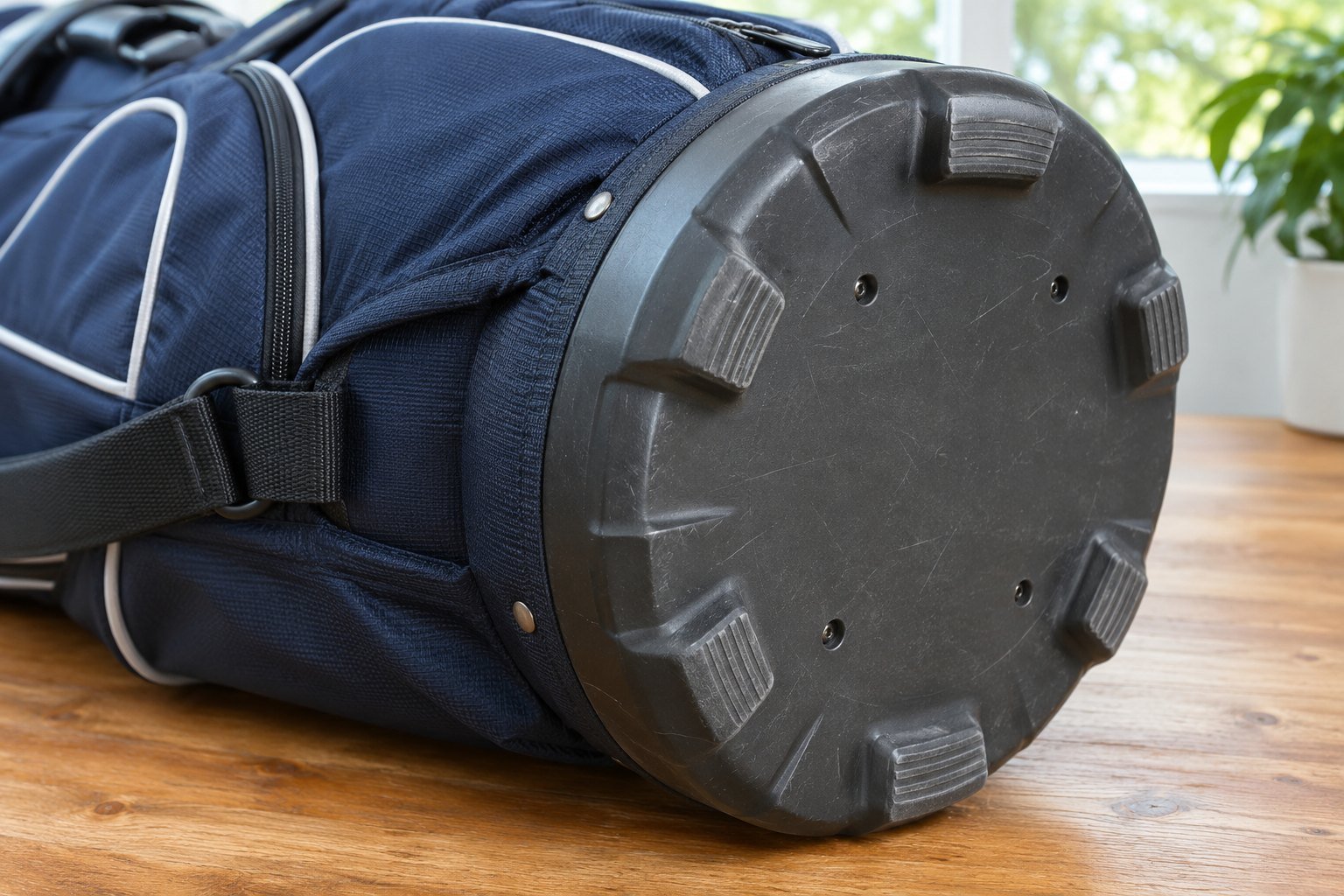
Look beyond ordinary scratches underneath. Check for cracks, missing material, obvious warping, loose fixing points and holes through to the inside. Examine the join between the base and the fabric body. Do not flex a suspicious area aggressively to “see how strong it is”.
For a stand bag, ask the seller to demonstrate deployment and retraction on level ground with the bag empty. Look for unequal legs, damaged feet, bent parts, looseness at the hinges or a mechanism that sticks. An empty demonstration is only a first check; it is not proof that a damaged stand can safely support your clubs.
If the base, leg mounting or body appears compromised, pause the purchase until the maker or a competent repairer can assess it. The Office for Product Safety and Standards notes that worn or modified used goods can have problems that are not obvious. [1]
For a cart bag, inspect any base slots or pins and try the actual trolley combination with permission. Do not accept a claim that a missing or broken fixing can be solved by drilling, gluing or simply tightening the upper strap.
Back to top ↑Follow the straps back to their anchors
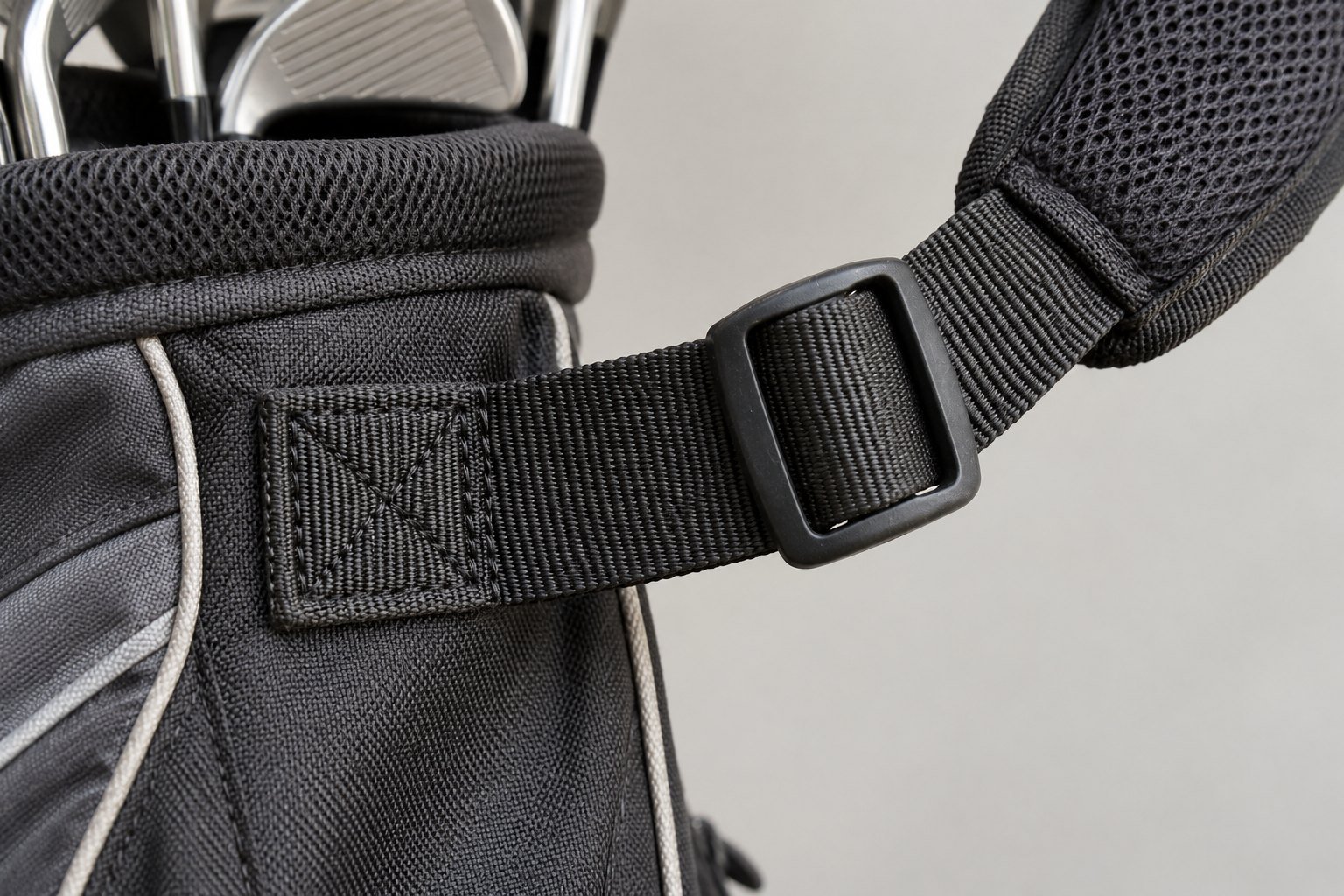
Inspect the entire webbing, not just the padded section resting on the shoulder. Pay attention to cut edges, fraying where webbing passes through an adjuster, cracks in clips and stretched or detached stitching at the bag. Check both handles as carefully as the shoulder straps.
Adjusters should move as intended and retain their setting during normal use. Avoid a heavy-load trial if anything already looks damaged. A new padded strap will not fix an unsound attachment point in the bag itself.
Replacement is model-dependent. Sun Mountain explains that some bags can be re-strapped by the user, while others need a different service arrangement. [3] That is a good reason to check the exact bag before pricing a replacement, especially if an original harness has been replaced with a generic one.
Once condition is satisfactory, assess fit separately. A structurally sound harness can still be unsuitable for your body or normal load. Our carry-harness fitting guide sets out a cautious loaded check; do not use it to test suspected damage.
Back to top ↑Look inside the pockets and divider channels
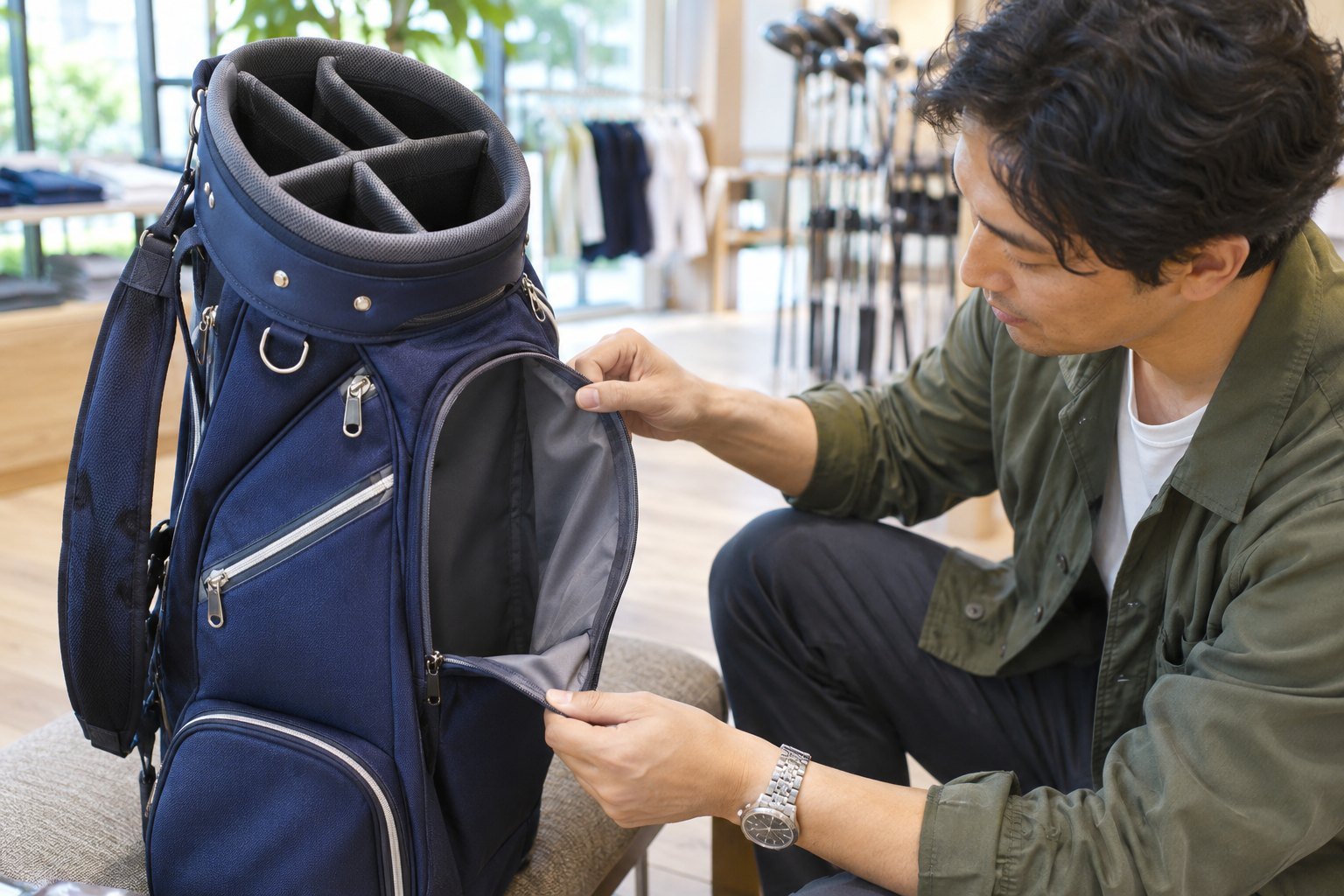
Ask the seller to empty the bag. Look for torn linings, loose divider material, sharp exposed edges and debris caught at the bottom. Check whether the clubs you intend to use can enter and leave their compartments without forcing them.
A large putter grip may behave differently from the smaller grip used in a seller’s demonstration. The top’s divider count also does not tell you everything about the channels underneath. Read our full-length divider guide if that feature is central to the purchase.
Notice persistent musty odours, visible mould, flaking coatings or damp lining. A photograph of water beading on the outside is not proof that an older bag will keep its contents dry. Ask for the original model’s weather-protection specification and whether seams or coatings have been altered.
Check that the included rain hood fits its attachment points and gives access to the clubs. If it is missing, confirm an appropriate replacement before counting the purchase as complete.
Back to top ↑Separate seller promises, returns and manufacturer cover
Establish whether you are buying from a trader or a private individual. UK consumer protections differ, and a private purchase should not be treated as equivalent to buying from a retailer. MoneyHelper explains this distinction in its second-hand buying guidance. [4] Read the actual marketplace and seller terms for your transaction rather than relying on a general “buyer protected” badge.
Ask what happens if the item arrives materially different from its description, who handles the return and what evidence is required. Keep payment and correspondence within the platform’s documented process where applicable. Do not agree to a payment route simply because the seller says it avoids fees.
A receipt is useful evidence of history, but it does not automatically transfer a manufacturer’s guarantee. For example, Motocaddy’s current golf-bag warranty states that the manufacturer’s cover is non-transferable. [5] Check the specific brand, market and original purchase conditions instead of assuming remaining months follow the bag.
If the seller cannot identify the model or explain a repair, decide whether you can inspect it locally. If you cannot resolve an important uncertainty, there is no need to turn it into a price negotiation.
Back to top ↑Compare the complete cost before making an offer
Use the lowest-priced alternative that genuinely suits you as the comparison, not the old bag’s original recommended retail price. A large historic discount means little if the used bag needs work or has the wrong layout.
On a phone, swipe within the table to see all columns.
| Illustrative used purchase | Cost |
|---|---|
| Agreed bag price | £55 |
| Delivery | £9 |
| Confirmed compatible repair, including labour | £25 |
| Total | £89 |
If a suitable new alternative were £110 delivered, the used option would save £21. All figures here are illustrative, not current quotations. Whether £21 is worthwhile depends on the condition evidence, remaining limitations and the actual seller terms. An unknown repair cost does not become zero because the seller has not priced it.
For a current comparison point, browse new golf bags at Clubhouse Golf. This leads to a retailer category, not a valuation of the bag you are considering. The category was checked on 23 November 2026. [6] Match the type, size and useful features rather than choosing a cheaper bag that would not do the same job.
Back to top ↑Buy, negotiate or leave it
Buy when the bag suits your transport method, the important parts work, the evidence is consistent and the complete price makes sense. A faded panel need not prevent years of further use, but remaining life cannot be predicted from photographs.
Negotiate when the issue is clear, acceptable to you and either cosmetic or supported by a confirmed repair route. Name the fault and the actual cost in your offer. Do not negotiate yourself into accepting an uncertain load-bearing repair.
Leave it when base, stand, strap or handle damage remains unresolved; the seller will not show the required views; or the description changes as you ask questions. An attractive colour and a low price do not answer those concerns.
Before paying
Save the model details, actual-item photos, stated faults, included accessories, agreed total and seller terms. On arrival, compare the bag with that record before loading it for a round. Raise a discrepancy promptly through the appropriate seller or platform process.
Sources and checks
Research and specifications checked on 23 November 2026. Manufacturer descriptions are identified in the text; practical checklists and worked examples are editorial guidance, not product testing.
- GOV.UK, Office for Product Safety and Standards — Buying second-hand goods — checked 23 November 2026
- YKK Southern Africa — Precautions: proper use of zippers — checked 23 November 2026
- Sun Mountain — Golf bag FAQs: replacement straps — checked 23 November 2026
- MoneyHelper — Consumer rights: second-hand purchases — checked 23 November 2026
- Motocaddy UK — Warranty Information, Golf Bags — checked 23 November 2026
- Clubhouse Golf — Golf Bags category — checked 23 November 2026
Illustrations in this article were created for Taylor’s Trailblazing Golf. Third-party photographs, where used, are credited beside the image or in the source list.