Golf Bag External Putter Wells: Fit and Damage Trade-Offs
A separate putter position is useful only when the grip moves freely, the covered head has room and the bag still works on your trolley. Here is how to check all three.
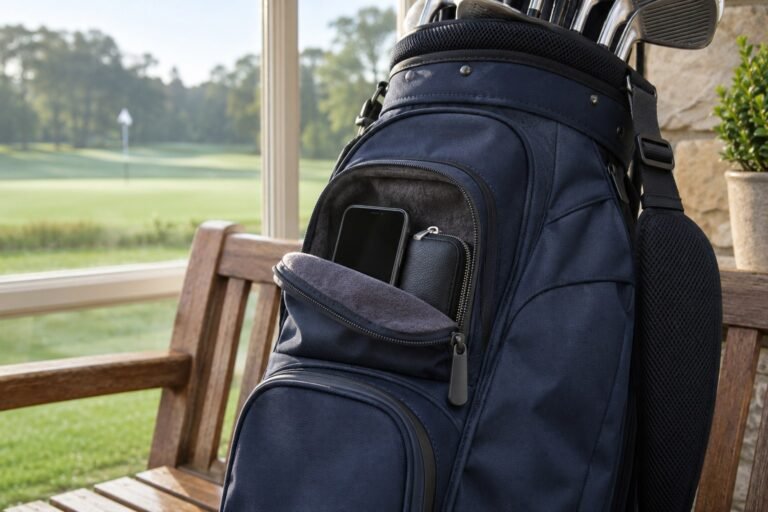
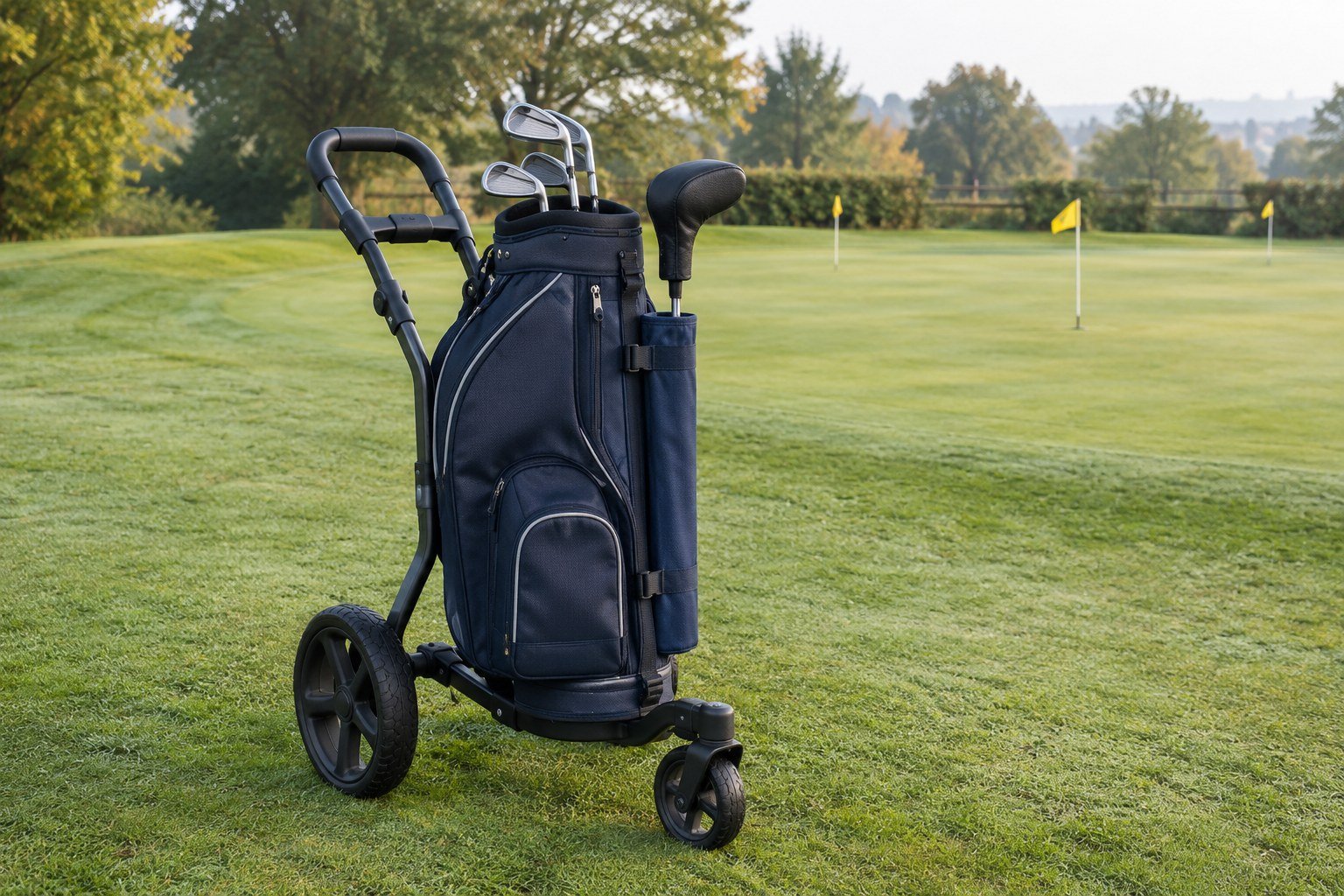
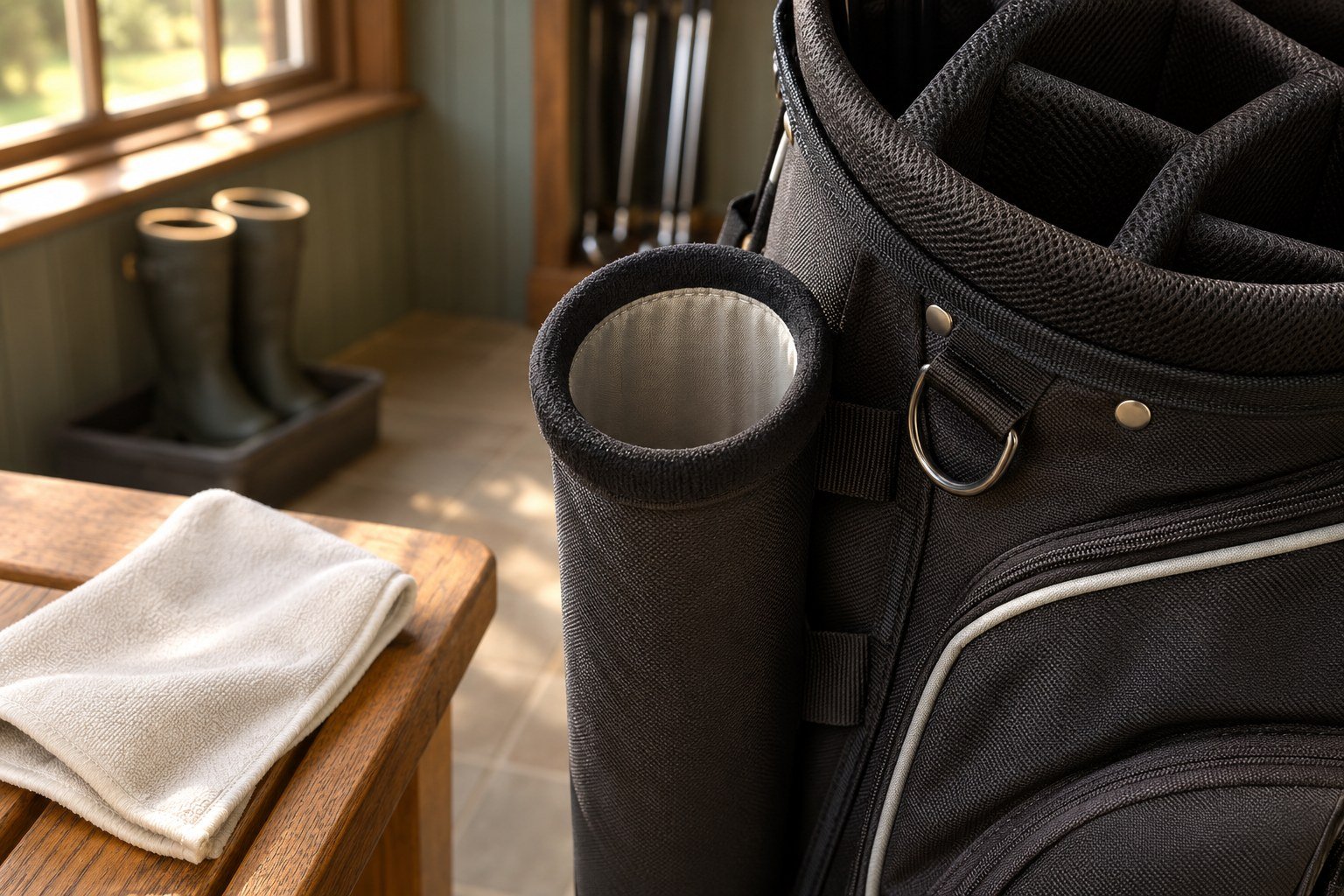
AI illustration of a generic external putter position; not a photograph of a named bag or a product test.
Golf bag external putter wells promise a convenient place for the club you reach for around every green. The appeal is straightforward: the putter has its own route into the bag instead of sharing a crowded opening with other grips.
The complication is that “putter well” describes several arrangements. A separate side bay, a large opening within the main top and an accessory that clips onto a bag are different solutions. Before buying, identify which one you are looking at and which part of your present setup is actually awkward.
This research-led guide uses published bag descriptions and a suggested, non-destructive fit check. It does not report a wear test or promise that one layout prevents damage. The aim is to help you reject a mismatch before paying for it.
This is a research-led guide. How we assess golf equipment explains the evidence behind our recommendations.
This guide contains affiliate links. If you buy through them, Taylor’s Trailblazing Golf may earn a commission at no extra cost to you.
A side-mounted bay is different from an oversized opening within the main top.
Grip clearance, resting height and covered-head space each matter.
Repeat access checks with the correct trolley straps and normal load.
A separate well is an option, not a reason to replace a suitable bag.
Golf bag external putter wells: identify the layout first
On the PowaKaddy EDGE, the manufacturer describes a putter pit on the side, separated from the other clubs. Its Dri TECH instead has an oversized putter bay integrated into the divider top. Both are dedicated putter positions, but their location is different.[1] [2]
| Layout | What to look for | The decisive check |
|---|---|---|
| External bay or well | A separate putter opening outside the main club-divider area. | Clearance around the side of the bag as well as inside the well. |
| Integrated putter well | A dedicated, often larger opening within the main top. | Space for the grip and covered head among neighbouring clubs. |
| Clip-on holder | An accessory attached to a bag, with its own support or retention arrangement. | Express compatibility with the bag, club and intended use. |
Look at a clear top view and a side view. Do not identify a tube by its appearance alone: PowaKaddy lists the EDGE’s umbrella sleeve separately from its putter pit.[1] Ask which opening is intended for the putter if the description or photograph is ambiguous.
The wider divider system is a separate purchase decision. Our guide to checking full-length golf bag dividers explains the difference between top openings and the channels below them. Here, the question is whether moving one club outside that main area improves your setup.
Back to top ↑Measure the grip, then check its complete passage
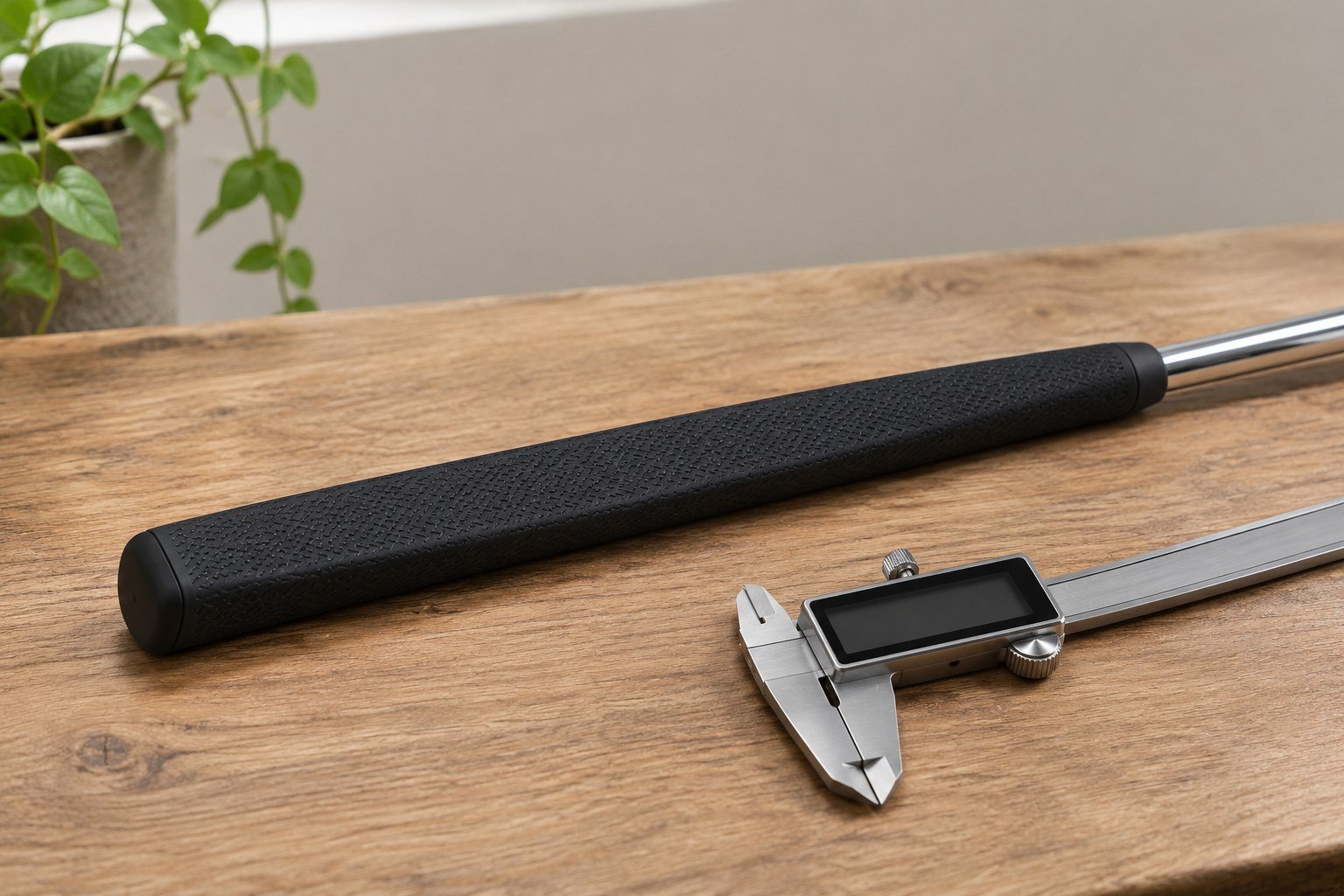
Take your own putter when trying a bag. Include any normally fitted grip-end accessory and the headcover you use. A shop’s slim demonstration grip cannot establish whether your larger or differently shaped grip will pass.
Use outside dimensions, not the grip’s core size
SuperStroke lists the Zenergy Tour 5.0 grip at 1.52 inches wide, approximately 38.6 mm, with a 0.58-inch core. The core is its internal shaft-fitting dimension; it is not the space a bag must provide around the outside.[3] The product name or size number is not a universal well measurement.
Measure the grip’s widest span and its depth without squeezing the material. Look for a wider end cap, corners, a raised ridge or an attached sensor. A flat-sided shape may need a different opening from a round grip of similar headline width. Check the actual outline, not just one number.
Then inspect the narrowest accessible part of the well entrance, including padding and the collar. Published opening dimensions, where available, are a screening aid. They do not establish that the passage remains equally wide below the top.
As a hypothetical example, a 38 mm-wide grip and a 40 mm opening leave only 2 mm across that measured direction. That is not 2 mm on each side, and it says nothing about corners, the other dimension or restrictions deeper inside. A positive subtraction is not a fit guarantee.
Use a short clearance worksheet
| Record | How to check | Reason to pause |
|---|---|---|
| Grip outline | Measure maximum width and depth; note protruding parts. | The label says oversized but the required clearance is unknown. |
| Entry and lower passage | Lower and withdraw the clean grip slowly, keeping it aligned. | Scraping, binding or a need to twist or push hard. |
| Resting height | Keep hold of the club as it reaches its normal supported position. | The head or neck is forced against an unsuitable hard edge. |
| Covered-head space | Fit the headcover normally and inspect the surrounding room. | The cover catches, is pulled off or presses into another club. |
| Usable access | Repeat removal from the position in which the bag will be used. | You have to lift the bag, loosen it or bend the shaft aside. |
Keep a hand on the putter throughout the first insertion. Do not drop it into an unknown-depth well or force it past resistance. A successful check should be an ordinary, controlled movement that you could repeat without a special technique.
Repeat the check with the bag mounted
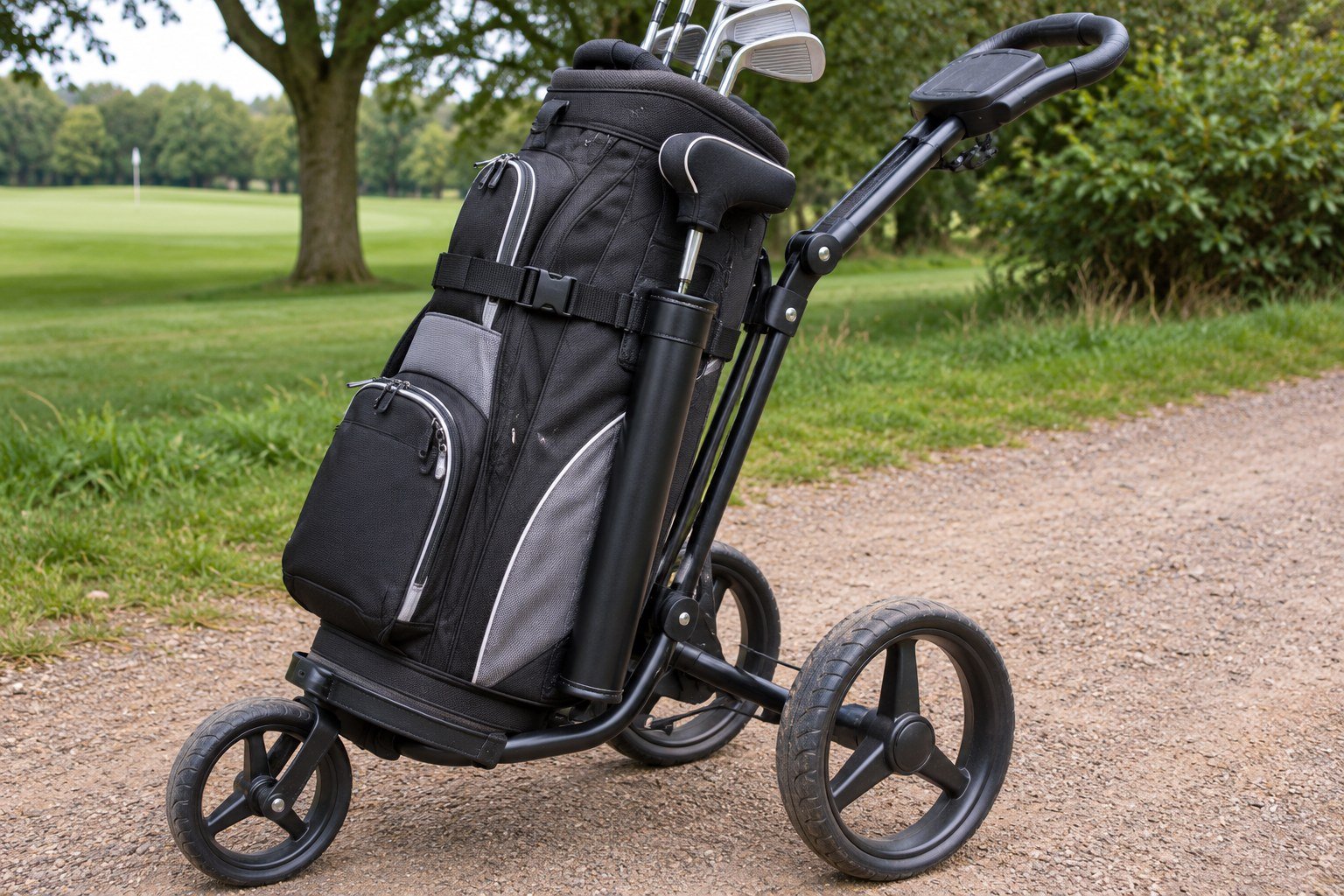
A side bay needs space outside the bag, so its convenience depends on the trolley, the strap route and the way you approach the clubs. The empty bag standing upright in a shop is only the first position to assess.
With permission, put a prospective bag on the trolley you use, or on the exact model available for demonstration. Follow both manufacturers’ fitting instructions. Keep an electric trolley switched off for this stationary check and secure the bag normally.
- Load your usual clubs and headcovers, then the clothing you normally carry. Leave room to work safely around the bag.
- Route the trolley straps as instructed. Check that no strap crosses, distorts or obstructs the putter bay.
- Remove and replace the putter from your natural standing position. Watch the headcover, the bag’s carry handle and nearby trolley fittings.
- Open the pockets you need during a round. Check whether reaching their zips pushes against the putter or its well.
- Fit the supplied rain hood as intended. Establish whether it covers the putter position and whether access remains practical.
Do not rotate a bag away from its intended base mounting or leave a required strap loose merely to make the well accessible. A solution that weakens the bag’s proper attachment has traded one problem for another.
If you alternate between carrying and trolley use, assess both modes of the exact bag. A side position that is convenient on a trolley might sit awkwardly beside your arm or carry strap. Choose around your usual routine, then decide whether the occasional alternative remains acceptable.
Separate access benefits from protection claims
An external well gives the putter a separate route. That can remove one source of crowding, but its position also changes what sits beside the shaft and covered head. Inspect those contact points rather than assuming “external” means safer.
| Where to look | What it could mean | Practical response |
|---|---|---|
| Grip and entrance | A tight collar or rough surface is rubbing during insertion. | Stop forcing access; ask about fit or condition. |
| Shaft and rim | The mounted angle brings the shaft against a hard edge. | Recheck approved bag mounting and seek an alternative position if needed. |
| Head and neighbouring objects | The covered head protrudes towards a handle, fitting or other club. | Check normal movement and keep appropriate head protection in place. |
| Outside of the loaded bag | The well or club occupies space against a boot wall or adjacent luggage. | Change the packing arrangement without loading weight onto the club. |
These are inspection prompts, not evidence that external wells cause more damage than integrated ones. No comparative wear test is claimed here. An integrated well can also be a poor fit if the collar is restrictive or neighbouring headcovers interfere.
Keep the headcover in the decision
Check the putter with its correct cover fitted. The grip usually travels down the well while the head and cover remain above it; a large mallet’s covered shape therefore needs room around the opening, even when its grip fits easily.
Dry storage matters too. Scotty Cameron’s care guidance advises drying the putter and storing it in a dry headcover; it also identifies particular carbon-steel finishes as more susceptible to corrosion when exposed to moisture.[4] Follow the care advice for your exact putter rather than applying a treatment intended for a different finish.
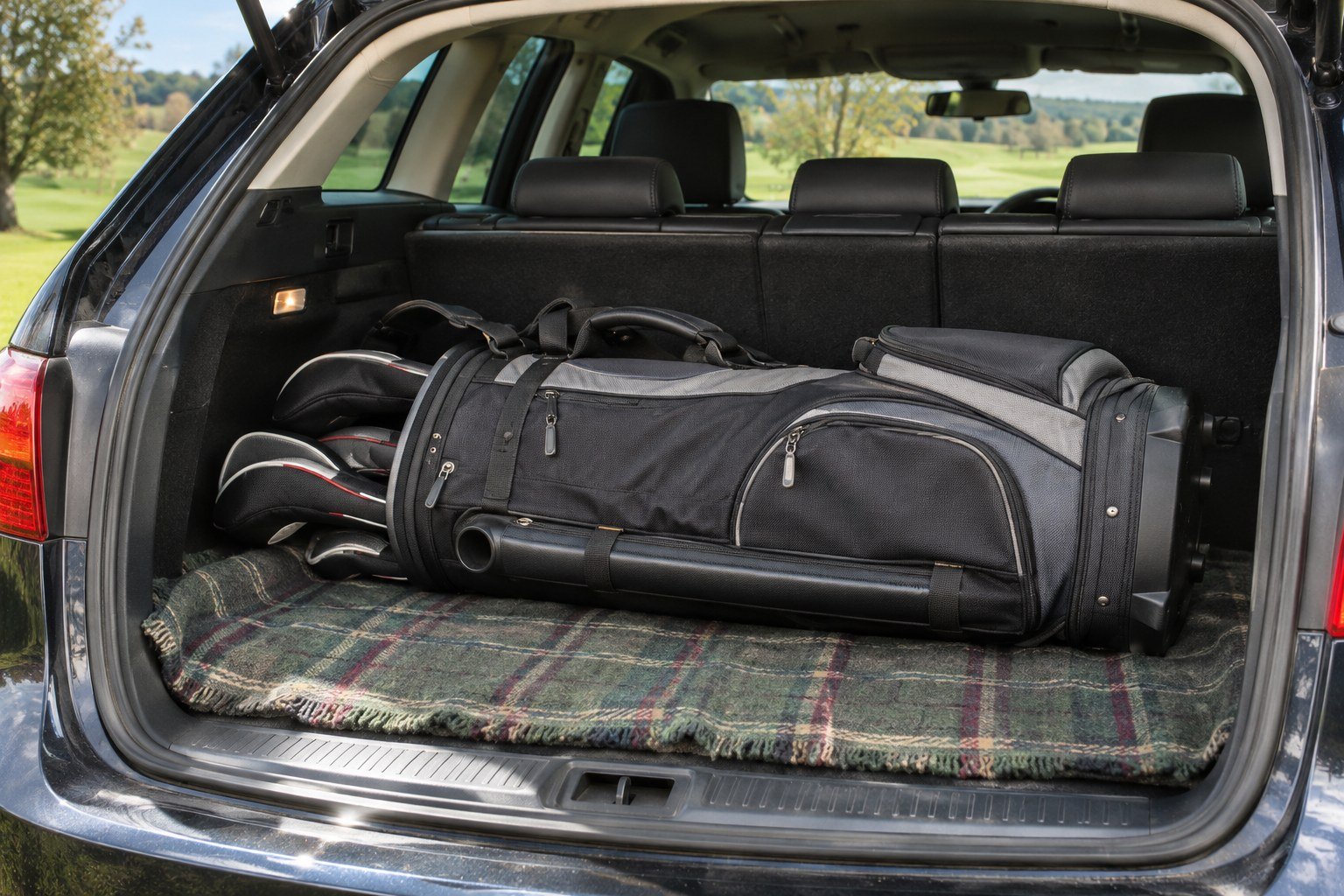
For car journeys, inspect where the complete bag rests. Do not wedge the protruding putter against the side of the boot or pile luggage onto it. A well that works during a round still needs a sensible transport arrangement.
Compare documented layouts without assuming a universal fit
The following examples show how manufacturers describe the location of the putter position. They are a shortlist for further inspection, not a ranking or a claim that your putter will fit. Product descriptions were checked on 23 November 2026.
| Bag | Documented arrangement | Question still to answer |
|---|---|---|
| PowaKaddy EDGE | External side putter pit intended for larger grips.[1] | Does the side bay remain clear on your trolley and in your transport space? |
| PowaKaddy Dri TECH | Oversized putter bay integrated into the divider top.[2] | Do your grip and covered head have enough space in the loaded top? |
| Callaway Chase Dry 14 | Fourteen-way top with an integrated putter well.[5] | Does the actual opening and lower passage suit your grip shape? |
The consulted descriptions do not give enough opening and usable-depth measurements to certify a particular putter-and-bag combination remotely. “Larger grips” is a useful design intention; your own equipment still needs checking.
For a specific external-bay candidate, view the PowaKaddy EDGE Black/White at Clubhouse Golf. The checked listing identifies article number 02922-02-01 and describes the external pit.[6] Match that option rather than assuming every bag with a similar name is identical.
If an integrated position looks more suitable, check the Chase Dry 14 at Callaway UK. Read the current selected option and availability before ordering. Neither link substitutes for the grip and mounted-bag checks above.
Back to top ↑Decide whether a different well would solve your problem
Start with the symptom, not the accessory. Write a sentence such as “my putter grip catches on an iron grip” or “the trolley strap blocks the opening”. That gives a replacement bag a clear job to do.
Consider an external bay when the putter needs separation
It is worth investigating if the main top remains convenient for the rest of your set but your putter needs repeated rearrangement. The new bay must pass the whole-club and trolley checks; moving the obstruction to the side would not be an improvement.
Prefer an integrated position when the outside space is the problem
If a side bay clashes with your trolley or makes loading the car awkward, a roomy integrated well may preserve a simpler outline. Check space above the top as carefully as the grip passage. A broad mallet cover can still overlap the neighbouring positions.
Keep the existing bag when ordinary access already works
You do not need an external well simply because you have changed to a larger putter head. If the grip passes freely, the covered head has room and the mounted bag works, there may be no storage problem to solve. A sensible rearrangement of clubs can be enough when the interference is only above the divider.
Do not change a comfortable, suitable putter grip solely to accommodate a bag you have not bought. Choose storage around your equipment needs; seek fitting advice if the grip itself is the issue.
Back to top ↑Inspect the well’s condition, especially when buying used
A product description explains the intended design. It does not show whether a second-hand bay has a cracked collar, loose attachment, damaged lining or trapped debris. Request current close-up photographs of the actual well, its connection to the bag and the base.
At inspection, use ordinary light or a torch to look at accessible surfaces. Do not push sharp tools down the passage or pull fabric aside to see farther. If you cannot establish the condition, ask the seller or manufacturer before risking your putter.
After a wet round, remove the club and let the putter, cover and accessible bag interior dry according to their manufacturers’ instructions. If the grip suddenly catches, stop and inspect before repeatedly trying again. Note whether the problem began after a new grip, accessory, trolley or change in packing.
A loose or damaged bay calls for repair advice, not an improvised packing of tape or foam. Extra material can reduce clearance or conceal the cause. Do not drill the bag, cut its lining or alter the putter to force compatibility.
Make the final choice with three observations
Before ordering, ask the seller: “Is this putter position external or integrated, and can I try my putter with its fitted grip and headcover while the bag is correctly mounted?” If buying online, request the relevant opening measurements and check the seller’s inspection and return conditions.
Then record three plain results: the putter passes freely; the covered head rests without an awkward contact point; and the mounted bag leaves normal access unobstructed. Record any unresolved question beside the exact model rather than turning a brief check into a durability score.
Choose the external well when it earns its place through better access without creating a clearance problem elsewhere. Choose an integrated well—or keep your present bag—when that arrangement fits your routine more cleanly.
Back to top ↑Frequently asked questions
Can I use an umbrella sleeve as a putter well?
Only use a compartment for the purpose the bag manufacturer specifies. The EDGE, for example, lists its umbrella sleeve and putter pit as separate features.[1] An opening that looks large enough does not establish suitable support, depth or protection for a putter.
Does a grip-end sensor change the fit check?
It can change the shape or length that needs to pass through the opening, so check the putter with the accessory fitted as intended. Do not rely on a grip-only measurement or remove an accessory each time merely to force a tight combination to work.
Should I buy a clip-on holder instead of a new bag?
It may be worth considering only when its maker confirms compatibility with your bag and putter and provides clear mounting and retention instructions. A holder that clamps or suspends the club needs its own assessment. Do not assume a generic clip offers the support of a purpose-designed well.
Sources and checks
Sources consulted on 23 November 2026. Manufacturer and retailer descriptions are attributed claims; illustrations do not show tested products. Recheck current specifications and compatibility before purchase.
Illustrations in this article were created for Taylor’s Trailblazing Golf. Third-party photographs, where used, are credited beside the image or in the source list.