

Dial-Fastening vs Laced Golf Shoes: Fit and Repairability
Check the fit, learn the release and identify the repair route.
Compare how each closure works on your foot. AI-generated illustration of generic shoes, not a named-model test.
The useful dial-fastening vs laced golf shoes comparison starts with two tasks: securing the shoe comfortably and releasing it easily. Then ask what you would do if a lace, dial or guide failed.
A dial can offer convenient small adjustments, while ordinary laces let you redistribute slack through the eyelets. The result still depends on the complete shoe and your foot. This guide uses manufacturer information and an original trial record to separate those decisions. Its images are generic illustrations, not demonstrations of the named products.
Ad – includes affiliate links. If you buy through these links, Taylor’s Trailblazing Golf may earn a commission. Recommendations are based on the equipment decision and the available evidence.
Compare comfortable walking and heel retention on both feet before judging the closure.
Demonstrate tightening, small loosening and full release using the exact system’s instructions.
Record the shoe style and fastening maker; a round dial does not identify BOA.
Separate an ordinary lace or replaceable dial part from a damaged eyelet, guide or upper.
Dial-fastening vs laced golf shoes: what changes?
A closure changes how you apply and release tension. It does not establish that the shoe is the correct size, has the right shape or will remain comfortable through a round. Use the comparison below to choose a trial, then judge the actual pair.
On a phone, swipe within the table to see all columns.
| Decision | Ordinary laces | Dial fastening |
|---|---|---|
| Applying tension | Redistribute slack through the eyelets before tying. | Use the dial and its designed cord route; feel where the upper tightens. |
| A small adjustment | You may need to untie, alter the tension and tie again. | Check how this system loosens as well as tightens; do not assume identical controls. |
| Taking the shoe off | Untie and loosen enough to avoid forcing the foot out. | Learn the maker’s release sequence and practise it before purchase. |
| Simple replacement | An ordinary worn lace may be replaceable if the eyelets and upper remain sound. | Identify the exact mechanism, part and approved repair route. |
| Damage around the fastening | A torn eyelet or upper needs assessment beyond a new lace. | A damaged sewn-in guide or housing may be outside the dial maker’s parts cover. |
The controls vary. BOA identifies Li2 on the ECCO BIOM C5 and describes adjustment in both directions. Skechers separately describes its Twist-Fit system and its own turning instructions. These names matter when you look for help or replacement parts. [1] [2]
Back to top ↑Run the same indoor trial with each candidate
Use your usual golf socks and try both feet. Follow the seller’s conditions for an indoor trial, especially if the shoes may need returning. Start with the fastening released enough to let the tongue and foot settle naturally.
- Fasten the shoes until they feel comfortably held. With ordinary laces, distribute the slack before tying; with a dial, follow its own instructions.
- Stand and walk. Note heel movement, toe contact and pressure over the top of the foot. Avoid deciding from a seated fit alone.
- Make one small adjustment. Can you ease a pressure point without leaving the rest of the shoe too loose?
- Release and refasten. Check that you can repeat the process without needing someone else to interpret the controls.
- Write down the result for each foot. A fastening that is easy to operate still needs to produce a comfortable result.

If the only way to hold the heel is to make the top of the foot uncomfortable, try another size or shoe shape. More tension is not a reliable substitute for a good fit. Our golf shoe sizing guide helps when changing brands complicates the comparison.
Also try the movements that matter to you: can you reach the dial, grasp the lace ends and use the release comfortably? If you normally adjust shoes while wearing a golf glove, include that in your own trial. Record what you can do; a convenience claim is not a result for your hands or your shoes.
Back to top ↑Identify the dial before learning its controls
Look for the shoe’s style number and the fastening brand on the product page, packaging or manufacturer instructions. Save the operating guide alongside the receipt. A photograph of a round dial is insufficient to identify the correct mechanism or repair kit.
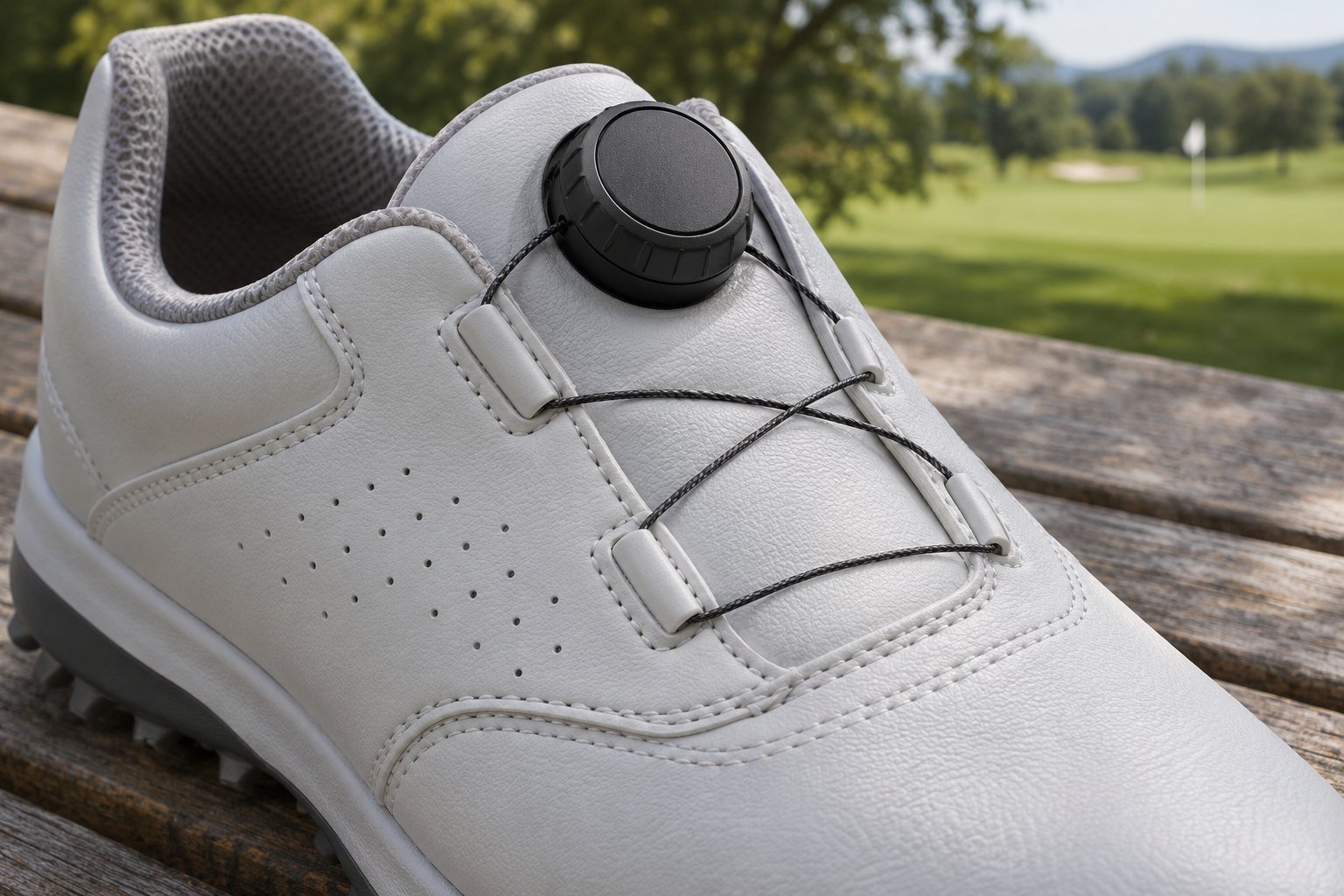
For a documented BOA example, ECCO lists the BIOM C5 132614 with BOA, and BOA’s own product page identifies Li2. [3] [1] Skechers’ Flow SI – Twist-Fit, style 214149, uses the separately named Twist-Fit system; its UK page says to turn right to tighten and left to loosen. Those are instructions for that system, not a universal dial rule. [2]
Before ordering, ask: does the dial offer small loosening steps, how does it release fully, and which parts can be replaced? If the shop cannot establish those answers, use the manufacturer’s support team. Do not assume a pull, push or twist sequence from a different shoe.
Back to top ↑Locate the failure before buying a replacement
Remove the shoe and inspect it without forcing the mechanism. Describe the symptom separately from your guess about its cause: “the dial turns but tension does not increase” is more useful than “the dial needs replacing”. Photograph the complete shoe, fastening, suspected damage and style label for the support team.
On a phone, swipe within the table to see all columns.
| What you find | Useful next step | Boundary |
|---|---|---|
| An ordinary lace is frayed | Check the eyelets and ask for a suitable replacement length and type. | A new lace does not repair a rough, detached or torn eyelet. |
| An ordinary eyelet or surrounding upper is torn | Ask the shoe maker or retailer about assessment and repair. | Do not keep tightening through the damaged area. |
| A BOA dial or cord has a fault | Use BOA’s identification and support route for the relevant part. | Do not order a visually similar kit or substitute ordinary string. |
| A sewn-in or bonded guide is detached | Send photographs to the footwear maker or retailer. | Dial and cord replacement alone will not reattach the guide. |
| Another brand’s dial system fails | Ask that shoe maker which service and parts route applies. | BOA’s cover does not establish cover for an unrelated mechanism. |

For an ordinary lace replacement, keep the old lace to compare length, width and thickness, or ask the shoe maker for its specification. Reproduce the intended lacing arrangement and check that the shoe fastens properly. If a fresh lace immediately catches or frays at the same point, have the eyelet assessed instead of repeatedly replacing laces.
For a dial repair, follow the instructions supplied for the exact identified kit or use the manufacturer’s recommended service. Stop if parts do not match or the attachment is damaged. Improvised knots, glued guides and forced disassembly are poor substitutes for an approved repair route.
Back to top ↑What BOA’s lifetime guarantee actually covers
BOA states that its guarantee applies to dials and laces for the lifetime of the product into which the system is integrated. It is not a lifetime guarantee of the whole shoe. [4] Its guarantee page excludes sewn-in or heat-welded guides and housings, as well as damage to other shoe parts such as uppers and soles. [5]
The BOA site offers a parts-identification process for a free repair kit. Use it to establish the correct components, then follow the matching instructions. A shoe maker’s separate warranty or repair policy is the relevant enquiry for damage outside BOA’s stated parts cover. Do not assume that either company has approved a claim before it assesses the issue. [5]
Keep a small repair record: shoe brand and style; fastening system; faulty part or symptom; photographs; purchase information; support contact; identified kit or quoted repair; and any delivery, service charge or waiting time confirmed by the provider. A free part does not establish that every associated service is free or immediate.
For a non-BOA dial, ask the same questions directly. A missing public parts listing is a reason to seek a clear answer before buying; it is not evidence that the mechanism can never be repaired.
Back to top ↑Keep care products away from the mechanism
Follow the footwear maker’s cleaning instructions as well as the fastening maker’s guidance. Approval for a component does not automatically approve the same treatment for the shoe’s upper, lining or adhesives.
BOA’s care guide allows external debris to be removed with a damp cloth or soft brush. It warns against lubricants, sprays and degreasers on the system, and against putting leather waxes, creams, conditioners or polish on the dial. It directs users to support if a dial becomes difficult to turn or the cord binds or its coating peels. [4]

Clean gently, allow the shoe to dry as instructed and check the closure again before the next round. Do not force a stiff dial to “work it free”. With ordinary laces, look at the eyelet contact points as well as the knot; replacing a worn lace early is a different job from repairing damaged surrounding material.
For a golf trip, check the fastening before departure. A correct spare ordinary lace is useful only for a lace problem, and a proprietary spare kit is useful only if it matches the mechanism and you can follow its instructions. Take a serviceable alternative pair if a fault has not been resolved.
Back to top ↑Turn the trial into a decision you can explain
Here is a hypothetical completed trial. It describes an invented buyer and results, not testing of any named shoe.
On a phone, swipe within the table to see all columns.
| Trial entry | Laced candidate | Dial candidate |
|---|---|---|
| Walking indoors | Comfortable on both feet after redistributing slack. | Heel feels held, but pressure over one foot persists. |
| Easing that pressure | Small lacing adjustment works for this buyer. | Loosening enough to remove pressure leaves the heel too loose. |
| Operation | Buyer can tie and untie without difficulty. | Buyer finds the control convenient. |
| Repair information | Suitable spare lace identified; eyelets appear undamaged. | System identified and support route saved. |
| Decision | Keep on the shortlist. | Reject this fit and try a different model if a dial is still preferred. |
The laced candidate wins this particular trial because it meets the fit requirement. The result says nothing about every dial shoe. If both candidates fit equally well, the next useful comparison is your repeated adjustment and release trial, followed by the clarity of the repair route.
A repair decision can also turn on one observation. In a hypothetical BOA shoe with a broken cord and no obvious attachment damage, start with BOA’s parts-identification route. If the guide has pulled out of the upper, ask the footwear maker to assess that attachment first. Neither a photograph nor this example confirms warranty eligibility. [5]
Back to top ↑A documented dial example to investigate
The ECCO BIOM C5 BOA in Black/Magnet, article 132614-52012, is one example where the maker, fastening platform and retailer listing can be matched. ECCO identifies the BOA-equipped style, BOA identifies Li2 on the C5, and Clubhouse lists the same article and colour. [3] [1] [6]
Check the ECCO BIOM C5 BOA 132614-52012 at Clubhouse Golf. Use the indoor trial before deciding whether its convenience is worth the current price to you. Confirm size, width options, model code and return conditions; a shared family name does not establish that a laced and dial version fit identically.
If you already own comfortable shoes with a worn ordinary lace or a supported replaceable dial part, price and confirm that repair first. A fastening fault does not automatically justify replacing the whole pair.
Back to top ↑Sources and checks
Research and specifications checked on 23 November 2026. Manufacturer descriptions are identified in the text; practical checklists and worked examples are editorial guidance, not product testing.
- BOA — ECCO Golf BIOM C5 and Li2 — checked 23 November 2026
- Skechers UK — Flow SI – Twist-Fit, style 214149 — checked 23 November 2026
- ECCO UK — BIOM C5 BOA, 132614-52012 — checked 23 November 2026
- BOA — Care and cleaning guide — checked 23 November 2026
- BOA — Lifetime guarantee and repair kit — checked 23 November 2026
- Clubhouse Golf — ECCO BIOM C5 BOA, Black/Magnet — checked 23 November 2026
Illustrations in this article were created for Taylor’s Trailblazing Golf. Third-party photographs, where used, are credited beside the image or in the source list.


