Storing Golf Shoes: Drying Without Damaging Materials
Dry the complete shoe gently, protect its shape and check the interior before putting the pair away for another round.
Illustrative scene: prepare an indoor drying space and follow the instructions for your exact shoes.
Storing golf shoes starts before they reach the shelf. A pair can look presentable outside while the lining or footbed still needs attention, and a well-meant shortcut can conflict with the maker’s care instructions.
This research-led guide uses manufacturer advice checked on 23 November 2026. It separates the practical drying routine from material-specific treatments, then gives you a check for deciding whether the pair is ready for storage. It makes no claim that a particular method or accessory has been tested by this site.
This is a research-led guide. How we assess golf equipment explains the evidence behind our recommendations.
This guide contains affiliate links. If you buy through them, Taylor’s Trailblazing Golf may earn a commission at no extra cost to you.
Match the method to the complete shoe and its finish, lining and removable parts.
Treat added heat and drying appliances as model-specific decisions.
Inspect the interior and insole, then store the pair without crushing it.
Identify the shoe before choosing a drying method
Begin with the model label and its care instructions. Record the upper material, any waterproof lining and whether the insole is removable. A smooth-looking panel may be leather or synthetic; appearance alone is not a reliable care label. A textile upper can also be part of a more complicated shoe.
ECCO says different materials need different brushes, creams and sprays. Its general guidance also rules out machine washing. That is a useful reason to identify the complete shoe before reaching for a familiar cleaner.[2]
| Check | Record or confirm |
|---|---|
| Model and finish | The exact style, generation and material description, including suede or nubuck where applicable. |
| Lining and footbed | Any membrane instructions and whether the insole lifts out normally. |
| Permitted cleaning | The named cleaner or method; do not substitute a generic treatment based only on colour. |
| Drying and shape support | Heat restrictions, paper or shoe-tree guidance, and any special precautions. |
If the instructions are missing, find the maker’s page for that model or ask its support team. Avoid turning uncertainty into an experiment with heat, soaking or a strong chemical.
Back to top ↑Storing golf shoes: clean, open and dry
Give wet shoes a deliberate handover when you get home. Put them somewhere you can inspect them, with a clean cloth beneath if needed, instead of leaving the drying decision until the next round.
- Take the pair out of its transport bag. Separate wet socks, towels and other kit. Check whether the bag itself needs cleaning and drying under its own instructions.
- Remove accessible dirt gently. Use the approved method for the upper and sole. Work around joins without scraping them with a sharp tool or pushing grit into the lining.
- Open only what is designed to open. Loosen the fastening and give yourself access to the tongue and collar. Do not peel out a fixed lining or force an insole that appears glued down.
- Arrange the parts without crowding. Keep each removable insole with its pair and leave the shoes in their normal shape. Check them again before longer-term storage.
For its leather and synthetic shoes, FootJoy specifies mild soap and water, air-drying at room temperature, removing the laces and taking out an insole only if it is not glued in.[1]
For soaked shoes, FootJoy describes crumpled newspaper for 8–10 hours, then replacing it with cedar shoe trees. That is its initial absorption routine, not a promise that every saturated shoe is ready to wear after ten hours.[1]
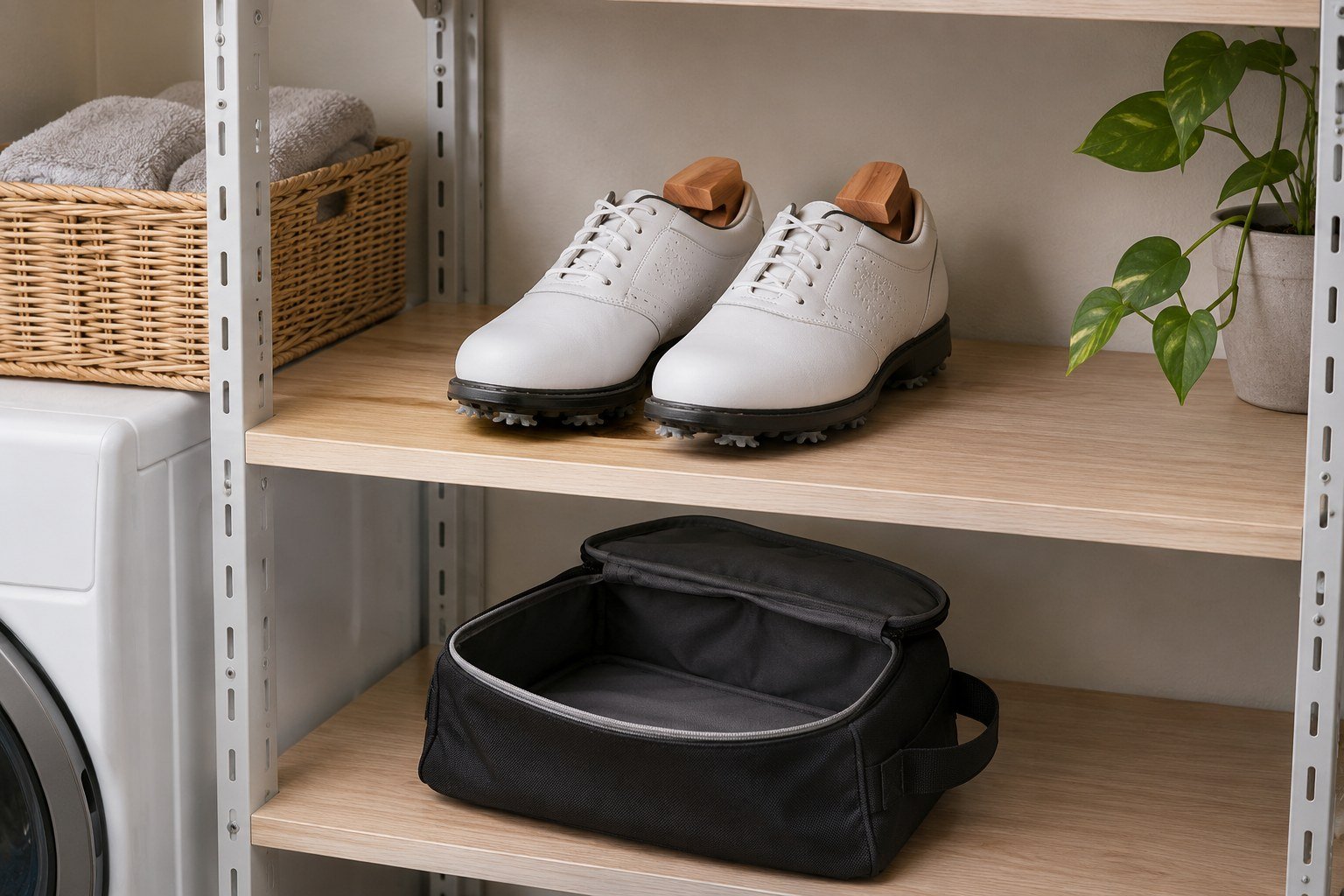
Use any paper or support gently. Filling a shoe is different from stretching it: if the upper bulges or the heel is being forced out of shape, stop and check the intended method. Keep the opening accessible for the next inspection.

Keep leather, suede, textiles and membranes distinct
The aim is to dry the pair without creating a second problem in its finish or construction. Cleaning products and the order of treatment can differ even where two shoes both contain leather.
| Material or construction | Manufacturer example | Practical boundary |
|---|---|---|
| Smooth leather | ECCO’s leather guide waits until the shoe is completely dry before inserting a cedar tree and applying its Smooth Leather Cream.[4] | Conditioning is a separate stage. Use a product approved for that finish, not whatever polish happens to be nearby. |
| Suede or nubuck | ECCO’s suede routine uses different tools and a Nubuck Conditioner after cleaning and drying.[5] | Do not transfer the smooth-leather cream step to a textured upper without approval. |
| Fabric, mesh or nylon | Skechers’ non-machine-washable guidance uses gentle detergent on a cloth, removes residue with a damp cloth and air-dries away from heat.[6] | A trainer-like appearance does not establish that the whole shoe is washable. |
| GORE-TEX footwear | GORE-TEX requires the footwear maker’s instructions too; its general care page prohibits machine washing.[3] | The membrane name does not replace instructions for the upper, sole, adhesives or complete shoe. |
Machine washing needs positive permission for the exact pair. Skechers allows it for styles carrying its machine-washable indication, with a gentle cold cycle and air-drying; it says not to machine wash leather, suede or nubuck. Do not infer permission for a golf model from another Skechers shoe.[6]
For a mixed-material shoe, ask how the maker wants the whole upper treated. Selecting a cleaner for one panel while overlooking a neighbouring finish is an avoidable guessing game.

Check the difference between airflow and added heat
Heat can seem an attractive shortcut when another round is booked. FootJoy explicitly rejects blow-dryers and external heat sources because excessive heat can damage uppers and outsoles.[1]
There is a real distinction in the published guidance: GORE-TEX says convection-style boot dryers work well, while ECCO says not to use dryers, heaters or other heat sources. Both also direct natural or room-temperature drying.[2][3]
These are not interchangeable permissions. A general membrane-care page cannot establish that a particular appliance is suitable for your complete golf shoe. Follow the shoe manufacturer’s restriction. If you are considering a drying appliance, obtain confirmation for the exact shoe and device rather than treating a low-heat or boot-safe description as approval.
For ordinary home care, choose a suitable indoor drying position and give the pair time. Do not move it onto a radiator, heated rail or other hot surface because the first check still finds moisture. If it will not be ready for the next booking, plan another suitable pair or a different arrangement.
Back to top ↑Inspect the inside before deciding it is ready
A dry-looking toe does not answer every storage question. Check the accessible lining at the toe, tongue and heel, and both sides of each removable insole. Look and feel gently; do not pull back a lining to investigate beyond normal access.
The following is a practical owner check, not a moisture measurement, a test of the waterproof membrane or proof that an enclosed part is dry. If you are unsure, allow more drying time and follow up with the maker when the condition seems abnormal.
| Observation | Next action |
|---|---|
| The outside looks dry but the accessible lining is damp | Keep the pair out of closed storage and continue the permitted drying routine. |
| A removable insole is still damp underneath | Leave it out to finish drying; do not hide it back inside the shoe. |
| Paper used under the maker’s method is wet | Remove it and reassess the shoe. Follow the maker’s instructions for further absorption and support. |
| The accessible shoe and insole are dry and the shape is normal | Complete any specified aftercare, refit the dry components and choose suitable storage. |
| A sole edge has separated or the shoe is distorted | Seek assessment. Drying or polishing cannot establish that the structure is sound. |
Do not use fragrance as the readiness test. Persistent odour, visible deterioration or recurring unexplained dampness deserves a closer look at the cleaning method, storage environment and shoe condition. Avoid a succession of stronger products without knowing which material they will contact.

Store the dry pair without crushing or reheating it
Choose a clean, dry place where the pair can sit normally, with space around it. Avoid stacking equipment on the uppers or trapping a heel beneath a heavy bag. ECCO advises regular ventilation and avoiding daily use of the same pair.[2]
FootJoy also warns against car-boot storage, where high temperatures can damage shoe materials.[1] Treat the journey home and storage between rounds as different jobs.
Follow the maker’s shoe-tree advice and choose the correct size. A tree is a support, not a device for forcing a changed fit back into place. Do not copy another brand’s insertion timing: ECCO’s smooth-leather sequence specifies a completely dry shoe before the tree and cream stage.[4]
A shoe bag can solve a transport problem without solving a drying problem. If your existing bag keeps mud away from other kit, holds the pair without squeezing it and opens fully at home, another purchase may add little.
For a simple optional carry bag, Clubhouse Golf lists the adidas Golf Shoe Bag in Legend Ink, article JD7100, with a two-way zip and wide opening.[7] View the adidas Golf Shoe Bag at Clubhouse Golf if that arrangement suits your shoes. Check the pair’s actual fit inside it; the listing does not establish a drying time.
Whatever bag you use, take damp shoes out when you reach the drying space. A bag’s ventilation claim is not a reason to skip the interior check, and a clean pair should not go back into a wet or dirty container.
Make the next round’s check part of the routine
Before the pair returns to the car, check that each dry insole is sitting correctly, the fastening works normally and no dirt or debris remains inside. Look at the sole edges and traction components rather than assuming that a clean upper means everything is sound.
Put the shoes on with your usual golf socks. If their fit has changed after soaking, drying or storage, stop and investigate rather than trying to soften them with heat or force. If replacement becomes necessary, our guide to golf-shoe sizing between brands explains why the old size label is only a starting point.
A useful care note is short: model, how wet the pair became, the approved method used, where it dried and what still seems different. That is more helpful to a manufacturer than “the shoes are ruined”, and avoids presenting a guessed cause as a fact.
Build the routine around what you can repeat: unpack promptly, use the correct method, inspect before storing, and leave enough time before the next round. Owning a second suitable pair may make that easier when you play on consecutive days, but no rotation schedule guarantees a particular lifespan.
Back to top ↑Frequently asked questions
Will wet golf shoes always dry overnight?
No universal time applies. Check the accessible lining and any removable insole before storage or wear. A booked round is not evidence that drying is complete; leave more time or use another suitable pair.
Can I put my golf shoes in a washing machine?
Only where the exact manufacturer permits it. ECCO and GORE-TEX footwear guidance prohibit machine washing; Skechers permits it only for indicated styles, with material exclusions. A mesh appearance is not permission.[2][3][6]
Should I pull out an insole that feels stuck?
No. FootJoy specifically limits removal to an insole that is not glued in. If it will not lift out normally, leave it in place and obtain the correct model instructions.[1]
Does a shoe tree replace the drying check?
No. Follow the manufacturer’s sequence and size the support correctly. A tree does not tell you whether an insole or lining is still damp, and should not be used to force a distorted shoe back into shape.
Is a shoe bag suitable for storing a still-damp pair?
Use the bag for the journey when needed, then take the shoes out for the approved drying routine. Check the bag too. Do not treat an enclosed, tidy pair as ready simply because the dirt is contained.
Sources and checks
Sources consulted on 23 November 2026. Manufacturer and retailer descriptions are attributed claims; illustrations do not show tested products. Recheck current product details, sizing and care instructions before use or purchase.
Illustrations in this article were created for Taylor’s Trailblazing Golf. Third-party photographs, where used, are credited beside the image or in the source list.