Buying Golf Equipment from Overseas: UK Import Costs and Returns
A low overseas price only becomes a good deal when the delivery bill and the way back are clear.
AI illustration of an overseas-buying context, not a real order or customs assessment.
A driver advertised abroad can appear cheaper until shipping, import charges and a possible return are added. The useful comparison is the money needed to receive the correct club, together with the practical cost of putting things right if it is unsuitable.
This research-led guide covers personal purchases sent by post or courier. The cost worksheet is for delivery to England, Scotland or Wales, not business importing or equipment carried home in your luggage. Official guidance was checked on 24 November 2026. Prices in the example are invented planning figures, not current retailer quotations.
Our research-led review approach separates official rules from the practical buying judgements in the worksheet.
Ad – includes affiliate links. Taylor’s Trailblazing Golf may earn a commission if you buy through these links, at no extra cost to you.
Check the contracting business, dispatch location and return address separately.
Record VAT, duty, carriage, clearance charges and payment costs before comparing prices.
A small saving can disappear when an international return is your responsibility.
Start with the seller and the delivery destination
Write down three addresses: the business selling to you, the place the parcel will leave and the address accepting returns. They answer different questions. A UK-facing storefront does not establish that all three are in the UK. UKICC warns that a .co.uk address or UK contact details do not necessarily identify a UK-based trader.[7]
Before comparing totals, ask for a written answer to these questions:
- Which company is named on the invoice, and is this a business or private sale?
- From which country will this exact item be dispatched?
- Does the checkout amount include UK import taxes and all carrier charges, or are some payable on arrival?
- Where must an unwanted or faulty item be returned, and who arranges the shipment?
Great Britain and Northern Ireland need separate checks
For Great Britain, GOV.UK’s parcel guidance applies import VAT to goods arriving from outside the UK and sets out duty treatment above £135. Northern Ireland’s guidance distinguishes arrivals from the EU and from elsewhere and includes whether goods are considered “at risk” of entering the EU. Use the Northern Ireland section for a Northern Ireland address; do not copy the example below across unchanged.[1]
If the seller cannot give a clear delivered-cost explanation for your postcode, pause. A price which remains uncertain at checkout is not yet a usable comparison.
Back to top ↑Understand what the £135 threshold does—and does not—mean
For ordinary non-excise goods sent to Great Britain, the £135 threshold is not a VAT-free allowance. At £135 or below, the relevant VAT is normally collected at sale; above it, import VAT is normally collected through the delivery process. Non-excise consignments at or below the threshold do not attract Customs Duty under the current Great Britain guidance. Being second-hand does not itself establish a tax exemption.[1]
HMRC uses the total consignment’s intrinsic value for the low-value rule, not each club separately. Separately identified transport and insurance are excluded from that threshold value; costs rolled into the price and not separately shown are not simply deducted. Two £90 items in the same consignment therefore are not two separate £90 allowances.[2]
Dispatch country is not proof of origin
A parcel leaving an EU warehouse does not, by that fact alone, establish entitlement to preferential duty. HMRC’s origin guidance requires the goods to meet the relevant agreement’s rules and, where required, supporting evidence. Ask the seller or carrier which origin and classification support its quote; do not substitute the shipping address for an origin assessment.[5]
Keep declarations accurate. A purchased club cannot become a customs gift because a seller writes “gift” on the carton: HMRC’s gift rules require a qualifying private gift, without direct or indirect payment by someone in the UK.[6]

Buying golf equipment from overseas: a complete cost example
Use this worksheet before deciding that an overseas offer is cheaper. Each amount is illustrative. The £6 duty input is an assumption, not a quoted tariff for golf clubs: obtain the actual classification, origin and charge for your purchase.
Import VAT is calculated on the appropriate customs value plus relevant duty and incidental expenses. HMRC includes items such as transport, insurance and customs-clearance charges in that valuation where applicable.[3] The example uses the current standard VAT rate of 20%; the applicable rate must still match the actual goods.[4]
Swipe within the table to see all columns.
| Cost or calculation | Amount | Assumption to replace with evidence |
|---|---|---|
| Golf equipment | £300.00 | Price before UK import VAT, expressed in sterling. |
| Delivery and insurance | £30.00 | All carriage to the delivery address is included. |
| Import duty | £6.00 | Assumed amount only; no tariff percentage is asserted. |
| Clearance charge | £12.00 | Included in the import-VAT base in this example. |
| Value used for import VAT | £348.00 | £300 + £30 + £6 + £12. |
| Import VAT at 20% | £69.60 | £348 × 0.20. |
| Total to receive the item | £417.60 | £348 + £69.60; no extra card fee assumed. |
| Illustrative UK delivered alternative | £430.00 | Equivalent specification and condition. |
| Apparent saving | £12.40 | £430 − £417.60, before any return. |
The handling-fee treatment matters. Here the £12 is included in the import-VAT valuation and has no separate VAT added. Your carrier’s fee may have a different treatment or already include VAT: use its itemised breakdown, rather than adding the same charge or tax twice.
Record any card conversion fee separately. HMRC has its own currency-valuation rules, so the amount charged by your payment provider is not automatically the customs sterling value.[3]
If the seller already collects the relevant UK VAT or import amounts, identify those amounts before using the table. Do not add the same VAT again. Equally, a checkout label saying “tax included” needs clarification about which tax and which country it covers.
Back to top ↑Make sure the imported item is the one you actually want
A cheaper offer is not equivalent if its build differs. Ask for the complete model and generation, handedness, loft, shaft make and model, stated flex, playing length, grip and accessories. For an iron set, list every included club. For used or ex-demo equipment, request photographs of the actual item and written disclosure of alterations and damage.
Do not treat a familiar model name as confirmation of every specification. Put the overseas description beside the UK alternative and mark each difference. An unavailable shaft detail is a question to resolve, not a blank to fill from a different listing.
Get a usable service answer
Ask the manufacturer’s UK support team whether it can handle the exact model bought from this seller and region, what evidence it needs and where a warranty claim would be assessed. Keep the answer with the order. A claim that a warranty is “international” is only useful when its coverage, eligible seller and procedure are clear.
For powered or connected equipment, also ask about the supplied charger, UK electrical compatibility, regional services and support. Obtain the exact manufacturer documentation before paying; this article does not certify any imported electrical product. If the purchase needs an unexplained modification or an unavailable accessory before it can be used, add that uncertainty to the comparison.
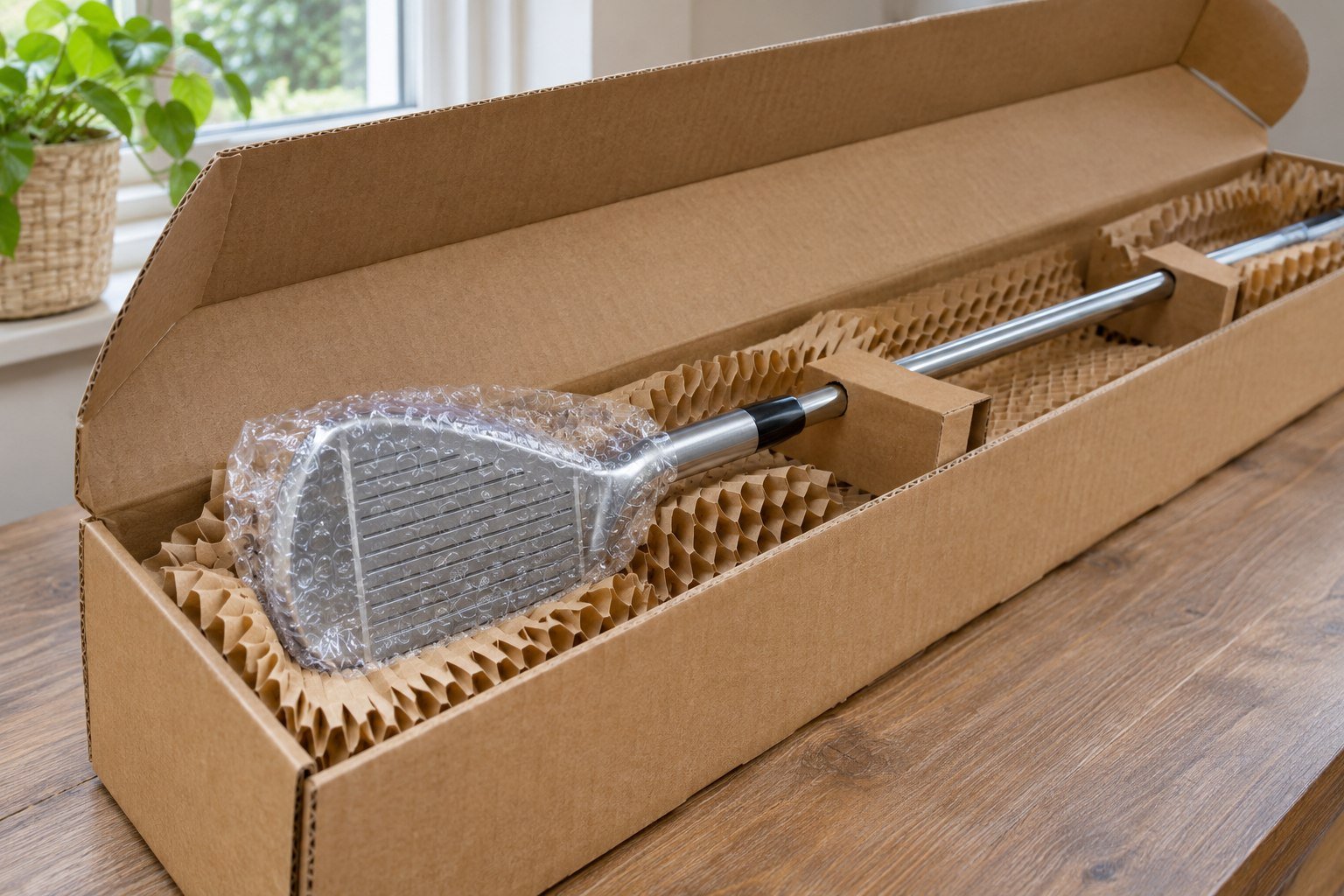
Separate changing your mind from receiving the wrong or faulty item
Ask about both situations before ordering. “Returns accepted” may not tell you whether the policy covers an unwanted purchase, a listing error, transit damage or a later fault. Keep the policy that applied on the purchase date, rather than relying on a support agent’s informal reassurance.
UKICC explains that the usual UK distance-selling framework provides a 14-day cancellation period for most goods contracts, starting the day after receipt, with exceptions including personalised or custom-made goods. It also notes that dealing with traders in other countries can be more complex.[7]
Do not assume those protections are identical or equally easy to enforce everywhere. Citizens Advice expressly advises overseas buyers to check the seller’s return terms, who pays postage and whether original delivery is refunded. Its guidance also distinguishes private purchases and made-to-order items from ordinary cancellable online purchases.[8]
For a custom club, ask exactly what has been made to your specification and how that affects cancellation. A cancellation exception is a different question from a complaint that the delivered item is faulty or does not match the order. If the seller uses “custom” to dismiss every concern, obtain advice about the particular contract.
When the parcel arrives, compare it with the order before playing with or altering the equipment. Photograph the packaging and any issue, and contact the seller promptly in writing. Describe the problem and the remedy you seek; avoid letting informal troubleshooting consume a dispute deadline.
Back to top ↑Put a price on the way back before buying
The return address is part of the purchase decision. Get a carriage quote using the packed box dimensions, weight, destination and required cover, rather than estimating from the price of sending a small domestic parcel. Ask the carrier about acceptance, compensation limits and the paperwork for returning the actual equipment.
Swipe within the table to see all columns.
| Question | Evidence to keep | Why it changes the decision |
|---|---|---|
| Where does it go? | Full return address and required authorisation. | A local shopfront does not settle the return destination. |
| Who pays the carriage? | Separate answers for cancellation, wrong item and fault. | The cost may fall differently in each situation. |
| What sum comes back? | Item refund, delivery treatment and any proposed deductions. | A refund of the club price may not restore every payment. |
| Who handles customs? | Seller/carrier return instructions and import references. | The seller refund and an import-tax claim are separate tasks. |
| What if it is lost? | Accepted packing method, tracking and appropriate cover. | Posting a valuable club without checking cover adds another uncertainty. |
Suppose return postage would cost £38 and is yours to pay in the relevant situation. Against the £12.40 saving in the example, that one expense already outweighs the saving by £25.60. This is a scenario comparison, not a prediction that the item will fail or an assertion that every seller can lawfully charge you.
Our practical rule is to choose a minimum worthwhile saving before shopping. Increase it if the exact build is uncertain or a return would be difficult. If the final saving is below that amount, or you cannot establish the likely return cost, choose the clearer alternative. Do not count an uncertain future tax refund as cash already recovered.

Keep the seller refund and the import-charge claim separate
A seller’s refund does not automatically repay every amount collected at the border. Keep the invoice, payment record, customs bill, carrier reference, correspondence and return tracking together. Identify who received each payment before asking for it back.
Swipe within the table to see all columns.
| Situation | Starting point | Important distinction |
|---|---|---|
| VAT collected at checkout | The seller or marketplace that collected it. | HMRC directs point-of-sale VAT refunds back through that seller or marketplace.[11] |
| Incorrect import charge on a Royal Mail or Parcelforce delivery | HMRC’s BOR286 guidance. | That form is for postal imports handled by those operators.[12] |
| Overpaid import charges with another courier | HMRC’s overpayment guidance; private individuals are directed to C285. | It expressly identifies a separate process for rejected imports.[10] |
| Defective goods or goods failing their contract | HMRC’s rejected-import guidance. | Eligible private individuals are directed to C&E1179; this is not a blanket refund for every change of mind.[11] |
HMRC lists a three-year limit for overpayment claims and a one-year limit for rejected-import claims, with other circumstances having different deadlines. These are customs claim limits, not permission to delay contacting the seller or payment provider.[10]
Before sending anything back, check which route fits the reason for your return and what evidence is needed. Do not assume an ordinary change-of-mind return qualifies as a defective rejected import. Ask the carrier or HMRC where the general returns guidance and a specific form leave your circumstances unclear.
Ask the carrier separately about its own administration fee. A customs-tax repayment and a refund of a commercial service charge are different claims; the worksheet should not assume both will be returned.
Back to top ↑Choose a payment route with a clear dispute process
Before paying, read the provider’s coverage and deadlines for this type of seller and transaction. Keep the checkout within the route whose protection you have checked. An invitation to move to a different payment method deserves a fresh check, even if the seller offers another discount.
Citizens Advice explains Section 75 and chargeback as different routes. For qualifying credit-card purchases, Section 75 concerns an individual item costing more than £100 and no more than £30,000; intermediaries can affect eligibility. Debit-card purchases may have a chargeback route. Neither should be treated as an automatic refund promise for every overseas transaction.[9]
If something goes wrong, make a dated written complaint to the seller and retain the response. Contact the payment provider promptly rather than waiting indefinitely for an overseas reply. Send a clear account of what was ordered, what happened, the amount disputed and the supporting records.
UKICC offers free, impartial help to eligible UK consumers dealing with overseas traders. Its process asks you to try the trader first, contact the bank or payment provider where appropriate and prepare your purchase evidence. It can explain options and sometimes contact a business; it does not guarantee recovery.[13]
Compare a UK alternative, then make the decision
Use the same specification, condition, included accessories and delivery requirement for the UK comparison. A used overseas club and a new UK club may both be reasonable choices, but the price difference is not a like-for-like saving.
For a domestic-market benchmark, you can browse golf equipment at Clubhouse Golf or compare the Callaway UK club range. These links open general retailer or category destinations. Check the actual checkout total, dispatch arrangements and return terms; no price or stock claim is being made here.
An overseas purchase can make sense when it provides the exact equipment you need, the complete cost is clear and the service and return arrangements are acceptable. Choose another route when the offer only works if an unexplained charge disappears or a doubtful specification turns out to be right. The most useful saving is one that survives the realistic cost of the whole transaction.
For other equipment decisions, see our Buying, Care & Repairs guides.
Back to top ↑More questions
Is a parcel shipped from a UK warehouse automatically an overseas import for me?
Establish where the goods are when sold and who is responsible for the transaction. A seller based overseas and a parcel crossing the border are different facts. Ask for the delivered price and tax invoice; do not add import charges simply because the brand or website is foreign.
Can I rely on a currency-converter screenshot for the final price?
Use it for an initial comparison only. Check the rate and any fee your actual payment method applies, and keep the seller’s currency amount. Recalculate the comparison if the payable price changes before you order.
Should I use the overseas club while waiting for the seller to answer a return query?
Keep it in the received condition while you clarify the process. Avoid playing with, regripping or altering it merely to decide whether to complain. Record the issue and ask what inspection or evidence the seller requires; do not use equipment which appears structurally damaged.
Sources and checks
HMRC and official consumer-advice sources inform this guide. The worked cost example uses illustrative inputs; check the charges and terms for your own order.
- GOV.UK — Tax and customs for goods sent from abroad: tax and duty
Checked 24 November 2026. - HMRC — VAT and overseas goods sold directly to customers in the UK
Checked 24 November 2026. - HMRC — Working out the VAT value using the customs value of imported goods
Checked 24 November 2026. - GOV.UK — VAT rates
Checked 24 November 2026. - HMRC — Get proof of origin for your goods
Checked 24 November 2026. - HMRC — Duties and import VAT on gifts
Checked 24 November 2026. - UK International Consumer Centre — Shopping online
Checked 24 November 2026. - Citizens Advice Scotland — Changing your mind about something you have bought
Checked 24 November 2026. - Citizens Advice Scotland — Getting your money back if you paid by card or PayPal
Checked 24 November 2026. - HMRC — How to claim a repayment of import duty and VAT if you have overpaid
Checked 24 November 2026. - HMRC — Claim a repayment or remission of charges on rejected imports
Checked 24 November 2026. - HMRC and Border Force — Report incorrect Customs Duty or VAT on items imported by post (BOR286)
Checked 24 November 2026. - UK International Consumer Centre — Help with overseas consumer disputes
Checked 24 November 2026.
Illustrations in this article were created for Taylor’s Trailblazing Golf. Third-party photographs, where used, are credited beside the image or in the source list.