
Two Wedges or Three? Choosing a Practical Short-Game Setup
Count the clubs, name the missing shot and give any extra wedge a clear job.
- Pitching wedge counted separately
- Whole-bag decision
- Keep, practise or buy
Give each specialist wedge a useful job before adding another. AI-generated illustrations show generic golf equipment and settings. They are not photographs of the named products or records of product testing.
Two wedges or three? Choosing a practical short-game setup begins with what those numbers mean. Here, we are comparing two or three wedges in addition to the pitching wedge supplied with your iron set. That makes three or four wedge-type clubs altogether, including the pitching wedge.
The additional clubs are often specialist gap, sand or lob wedges. If you already have a gap or approach wedge from your iron set, count it among those additional wedges. Its place in the bag matters more than whether it was bought separately.
The useful question is what another club would let you do, and what you would give up to carry it. This guide offers a whole-bag example, a club-slot matrix and a practice comparison you can use yourself. It does not report product testing or prescribe a wedge count by handicap.
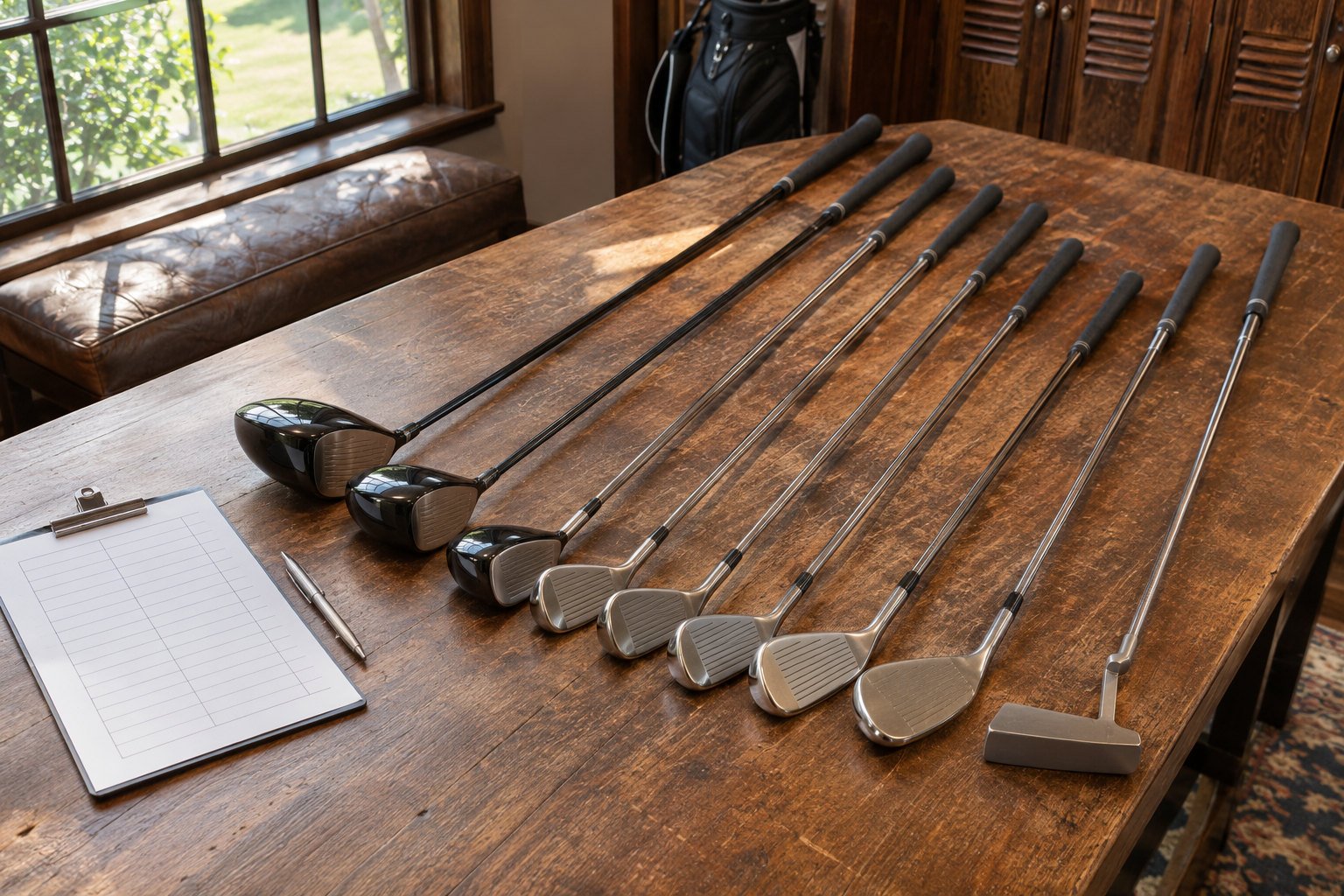
Count every club
Include the set pitching wedge, any set gap wedge and the putter. Work out the space before choosing another head.
Describe the missing job
Write down the lie, landing room and shot you need. A new loft number alone does not describe a useful addition.
Compare the whole trade-off
Assess the extra wedge alongside the club it might displace and the practice time needed to use either well.
Count the whole bag before allocating another wedge
Rule 4.1b sets the limit at 14 clubs and includes clubs carried by or for you. It also allows you to start with fewer than 14. Count the equipment you intend to take onto the course before the round; leaving a spare wedge unused in the bag does not make it disappear from that count. [1]
Here is a hypothetical bag, used only to show the arithmetic. It is not a recommended combination of woods, hybrids or irons. The five numbered irons are 5, 6, 7, 8 and 9; the set pitching wedge is listed separately.
| Clubs carried | Two additional wedges | Three additional wedges |
|---|---|---|
| Driver | 1 | 1 |
| Fairway woods | 2 | 2 |
| Hybrid | 1 | 1 |
| Irons: 5–9 | 5 | 5 |
| Set pitching wedge | 1 | 1 |
| Additional wedges | 2 | 3 |
| Putter | 1 | 1 |
| Total | 13 clubs | 14 clubs |
Scroll within the table to see all columns.
The unchanged part of this bag contains 11 clubs. Adding two wedges makes 13; adding three makes 14. With two, the golfer can simply play with 13. There is no requirement to fill the remaining place. [1]
Now suppose the same golfer wants a second hybrid for a distinct long approach. The totals become 14 with two additional wedges and 15 with three. For this planned starting bag, choose which club to leave out so the total is no more than 14. [1] The choice is now the value of that hybrid against the third wedge, not merely which wedge looks appealing.
Make the same inventory for your own bag. If a set gap wedge already occupies one of the additional-wedge places, do not count it again as part of the numbered irons.
Name the shots your setup needs to cover
Look back at ordinary rounds and list the short-game situations that keep returning. Useful descriptions include a running chip from a tidy fringe, a pitch over a bunker with room to land, a bunker escape and a shorter pitch from soft grass. “I need a lob wedge” skips the description of the problem.
For each situation, note the club you use, whether the shot choice feels clear and what tends to go wrong. Separate a contact problem from a missing option. If you struggle to strike any of your wedges cleanly from a particular lie, buying a third without investigating the cause gives you little basis for choosing it.
Frequency matters, but so does consequence. A club used occasionally may still cover a shot you cannot reasonably replace. Equally, a spectacular escape you imagine needing once a year should not automatically displace a club you rely on for several approaches each round.
Include the pitching wedge in this assessment. The comparison is between complete short-game setups; you still have the existing club available for a shot it handles well.
Use a club-slot allocation matrix
This matrix turns a wish for more options into a question you can check. It is a decision aid, not a fitting chart or a promise that a certain wedge will solve the shot.
| Job or constraint | Reason to keep two | Case for investigating a third |
|---|---|---|
| Fringe chips with room to run | Your pitching wedge and existing wedges provide choices you can judge. | A recurring lie or required flight remains awkward with the current clubs. |
| Ordinary pitches into a green | You have usable options for your usual landing areas and distances. | A separate club offers a repeatable choice for a regularly encountered shot. |
| Bunker and turf duties | The existing clubs cope with the bunker and grass conditions you normally meet. | You need to separate a particular bunker role from a different turf role. |
| Little landing room | You have a manageable shot, or a sensible safer target, with the current setup. | A trial shows you can use an extra flight option without relying on a rare perfect strike. |
| Pressure on the 14 places | An extra long club covers a more useful job than another wedge. | The wedge contributes more than the particular club it would replace. |
| Time available to practise | You are still learning the choices and distances of the existing clubs. | You have time to establish where the new club belongs and retain familiarity with the others. |
Scroll within the table to see all columns.
You do not need a positive answer in every row. You do need to be able to explain the new club’s job. “I would use it for this shot from this lie” is a stronger starting point than “a three-wedge set looks complete”.

Understand what each count asks of you
Two additional wedges
Two gives you fewer clubs to choose between and leaves more room elsewhere in a crowded bag. You also have fewer new clubs to buy if you are building the setup from scratch. It can be a practical arrangement when the pitching wedge and those two clubs cover your normal work.
The trade-off is that a smaller selection may ask you to cover more shots with each club. That might involve different swing lengths or a different landing choice. Decide whether those are shots you are comfortable practising and using, rather than assuming fewer clubs always means an easier short game.
Three additional wedges
Three can let you assign more distinct jobs: perhaps an approach club, a club you favour from sand and another for a particular greenside requirement. These are possible roles, not a compulsory gap-sand-lob formula.
The extra choice also needs explaining. If two clubs seem interchangeable every time you stand over a pitch, work out whether they offer different useful shots or simply make the decision slower. Three wedges are worthwhile only when their combined contribution justifies the place, cost and practice involved.
Neither count is a badge of ability. Use the demands of your course, the clubs you already own and the shots you can actually play to make the choice.
Match the head to the task as well as the number
A wedge’s loft does not describe its whole interaction with the ground. Vokey explains bounce in terms of the angle between the leading edge and sole, and grind in terms of shaping the sole to influence its contact with turf and sand. Its guidance also makes the choice dependent on the golfer and conditions. [2]
That is why “add more loft” is an incomplete response to every bunker or greenside problem. Tell a fitter which lies and shots matter. A useful comparison may involve a different sole in an existing role, rather than an additional club. It may also confirm that your current equipment is suitable and the next step is coaching or practice.
Check the transition from the set pitching wedge before committing to either count. Establish which approach distances each club covers in your hands, including the partial shots you intend to use. Do not turn the number of wedges into a universal list of lofts; the actual pitching wedge and your shots are the starting information.
Before booking, ask whether the session can assess the grass and bunker work you need as well as approach distances. The guide to golf club fitting fees explains how to agree the scope and the written outcome of a useful appointment.

Two wedges or three? Choosing a practical short-game setup in practice
Use a practice area where the relevant shots are permitted. Bring your current pitching wedge and wedges, plus a suitable demo or borrowed candidate if one is available. This is a proposed comparison for you to carry out; the article does not claim to have run it.
- Choose a few situations from your own list: a fringe chip, an ordinary pitch and, if relevant, a bunker shot or a pitch with limited landing room. Keep the lie and intended landing area similar while comparing clubs.
- Use the same type of ball throughout the comparison. First choose the shot you would normally play with your current clubs, then try the extra option. Alternate the order so the new club does not always benefit from your having just practised the shot.
- Record which club you chose, how readily you made the decision and whether the result left a manageable next shot. Keep poor strikes in the record. A single impressive shot should not erase the others.
- Notice the nature of any improvement or difficulty. Did the extra club add a useful flight or sole option? Did it merely duplicate an existing shot? Did the same contact problem occur across the choices?
- Return on another day before treating an unfamiliar club’s good session as a settled answer. If the third wedge would displace something, include that club’s job in your decision too.
A scratch note is enough: “short pitch, tight lie, current wedge uncertain, candidate also uncertain” tells you to investigate the shot further. “Candidate gives me a clear option here; current clubs already cover everything else” identifies a narrower reason to continue the trial.
You are looking for an understandable setup, including its limitations. If the trial is inconclusive, keep the existing clubs while you clarify the problem. There is no need to manufacture a purchase decision from mixed results.

Choose the next step: keep, practise or buy
Keep the current count
Keep it when the important jobs are covered and another wedge would mainly overlap. If there is an unused place in the bag, leave it unused until a practical need emerges. Revisit the choice when your course demands or the shots you use change.
Practise or get help first
Choose this when the difficulty follows you across several clubs, or when you cannot yet identify a useful difference between them. A focused lesson or practice session can help you separate technique, shot selection and equipment. Give the coach the actual situation you are trying to solve.
Buy to a defined specification
Consider buying when a trial supports a distinct job and the whole-bag trade-off makes sense. Write down the agreed hand, loft, bounce or grind, shaft, length and grip, plus the complete cost of the build. Do the same if the answer is to replace one existing wedge while keeping the count unchanged.
For a concrete purchasing check, Callaway’s UK Opus SP Chrome page provides hand, shaft, grip and head configuration fields. [3] The Opus SP Brushed Chrome steel-shaft listing at Clubhouse Golf offers loft and bounce selectors and access to custom options. [4] Compare the selected configuration with your written specification; the model name alone is not enough to identify the build.
These pages were checked on 22 November 2026. Confirm the exact selected club, current availability and complete delivered price at the time of ordering.
Let the missing job decide
Start with the actual bag and your normal short-game tasks. Two additional wedges can be enough when they and the set pitching wedge give you useful choices. A third earns consideration when it supplies a shot or a distinct bunker-and-turf role you can use, with room for it in the bag.
Before spending, finish this sentence: “The extra wedge would do ___, and I would make room by ___.” If there is already space, the second answer can simply be “using the spare place”. If you cannot name the first answer, keep the current setup and work on the question before buying.
Sources
Sources checked on 22 November 2026. Product names refer to the exact models described.
- The R&A — Rule 4: The Player’s EquipmentChecked 22 November 2026. Rule 4.1b(1) establishes the 14-club limit, inclusion of clubs carried by or for the player, and the possibility of starting with fewer. The whole-bag arithmetic in this guide is an original hypothetical example.
- Vokey — Wedge Bounce and Grinds ExplainedChecked 22 November 2026. Manufacturer explanation consulted for bounce, sole grind and their relationship to turf, sand, golfer and conditions. No universal bounce bands or performance guarantee are adopted.
- Callaway Golf UK — Opus SP Chrome WedgeChecked 22 November 2026. UK product identity and configuration fields verified. No selected-build availability, price or claimed performance result is inferred.
- Clubhouse Golf — Callaway Opus SP Brushed Chrome Golf Wedge, Steel ShaftChecked 22 November 2026. Exact UK steel-shaft listing and loft/bounce/custom-option selectors verified. Listing used to illustrate checking a complete specification, not to claim a particular build is in stock.
Illustrations in this article were created for Taylor’s Trailblazing Golf. Third-party photographs, where used, are credited beside the image or in the source list.