Lake Balls vs Refurbished vs New Balls: Understand the Risks
Compare what is known, what has changed and what the apparent saving really buys.
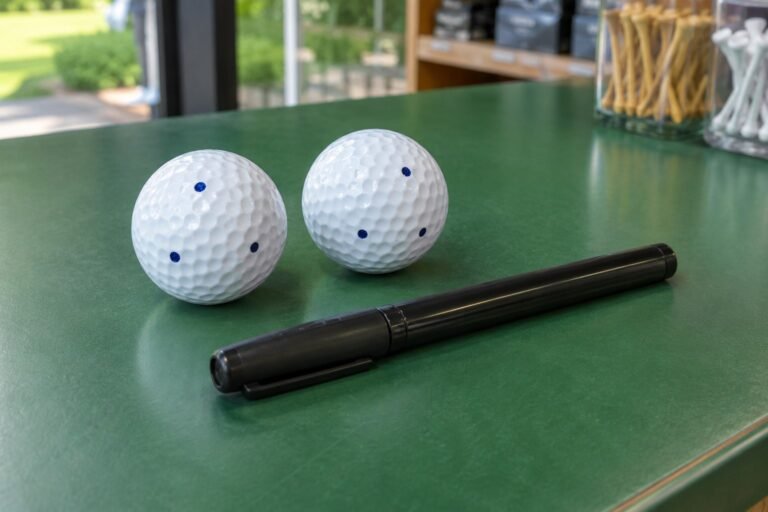
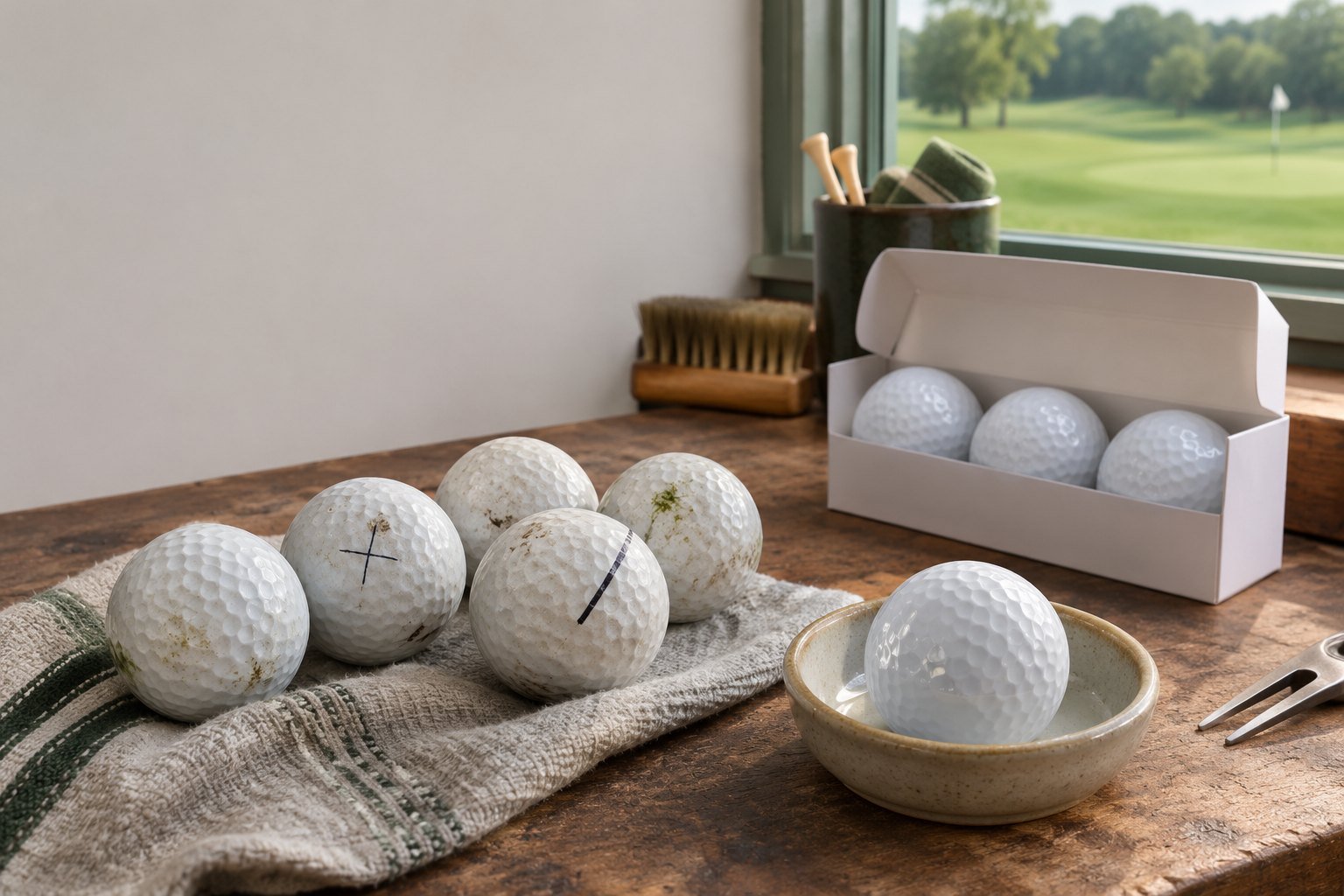
AI illustration of buying choices; appearance cannot establish a ball’s history or internal condition.
A glossy ball and a familiar logo can make a used pack look reassuring. The harder questions are how the balls were recovered, what happened to their surfaces and how many actually suit the job you are buying them for.
Comparing lake balls vs refurbished vs new balls starts with those separate questions. This research-led guide helps you choose a source and a sensible spending limit, without treating a seller’s appearance grade as a measured performance result.
This guide contains affiliate links. If you buy through them, Taylor’s Trailblazing Golf may receive a commission at no extra cost to you.
Recovery location, cleaning, refinishing and condition grade answer different questions.
A good-looking cover does not supply a record of previous use or time underwater.
Practice, model comparisons and organised events can call for different buying standards.
Divide the full delivered cost by the number that meet your stated requirements.
Lake balls vs refurbished vs new balls: separate the descriptions
The headings on a shop page can mix together origin, treatment and condition. A ball recovered from a lake might simply be washed and sorted; another recovered ball might have its finish replaced. “Lake” and “refinished” therefore need not describe different groups.
Scroll within the table to see every column.
| Description | What you are comparing | What still needs an answer |
|---|---|---|
| New | An unused ball sold as the named model and version. | Does that model suit you, and what is the complete delivered price? |
| Lake / recovered / recycled | A previously owned ball, with “lake” describing a recovery source. Cleaning and grading describe further handling. | Has it only been cleaned, or also refinished? Is the model identifiable? What previous history is actually known? |
| Refinished / repainted | A used ball whose surface has been renewed. Lake Golf Balls describes stripping, painting and restamping logos, also using “refurbished”. [1] | What treatment and markings are present, and is the ball suitable for your intended use and competition conditions? |
For a cleaned-only purchase, ask the seller to confirm that the original finish remains and that repainted or restamped balls are excluded. Do not infer this from a shiny photograph. Equally, do not assume that every listing using “recycled” promises one particular cleaning or sorting process.
Read exclusions as carefully as the grade name. Ace Golf Balls, for example, excludes refinished balls from its Pearl and Grade A categories, while its Practice category can include balls carrying refurbished or refinished markings. Those are that seller’s definitions. [2]

What a condition grade cannot tell you about water history
The useful question is not whether every lake ball is good or bad. It is whether the information available supports the confidence you need for this purchase.
Lake Golf Balls describes its Pearl grade through appearance, including shine, consistent colour and the absence of major marks. Its comparison with a ball played for a hole describes how the ball looks and feels; it is not a dated account of when that individual ball entered water. [1]
- A retrieval date does not, by itself, reveal the date the ball was lost.
- A condition label does not establish every previous strike, storage condition or treatment.
- A photograph lets you inspect visible features; it does not reveal the ball’s internal condition.
- A glossy finish supplies no useful timetable for possible immersion.
Do not build a budget around a supposed fixed number of yards lost after a certain time in water. The sources used here do not establish a reliable rule of that kind for an unknown mixed batch. A disappointing shot also cannot identify water exposure as its cause.
If uncertainty itself would undermine your confidence, price a suitable new ball. If you are comfortable accepting undocumented history for a meaningful saving, make that a conscious part of the decision.
Back to the top ↑Keep surface condition, model identity and suitability separate
Use three separate questions when looking at a pack. Can you identify what it contains? Is its visible condition acceptable for the intended job? Are you content with what is known about its treatment? A positive answer to one cannot settle the others.
A model name on a repainted surface is not, by itself, independent evidence of the ball underneath. Conversely, a player’s ink mark on an otherwise suitable ball need not be a reason to pay more for a cleaner-looking example. Set your requirements before the appearance influences the price you are willing to pay.
For rounds where you want one familiar model, specify whether mixed generations are acceptable. For basic practice, you may value quantity more highly, but a bucket containing different models and surface conditions makes it harder to attribute a particular result to any one ball design.
Put visible cuts, cracks, distorted shapes and unexplained surface changes aside for clarification. This is a buying screen, not a laboratory check or permission to substitute a ball during a round. Do not try to make an uncertain purchase acceptable by sanding, repainting or covering up its condition.

Check the competition conditions before choosing a source
Rule 4.2a requires a conforming ball for each stroke. Neither a used-ball grade nor a retailer’s broad competition claim settles that requirement for a particular ball. [3]
Check whether the committee has adopted Model Local Rule G-3: it requires the ball used for a stroke to be on the current List of Conforming Golf Balls. [4]
Clarification 4.2a(1)/2 describes a refurbished ball as second-hand, cleaned and stamped “refurbished” or similarly. Without strong evidence of non-conformity, it may be used; with the List of Conforming Golf Balls Local Rule in force, it must not be used, even if its identification markings appear on the list. [5]
Commercial descriptions of repainting and refinishing do not settle the status of every individual ball. If treatment or markings leave doubt, ask the committee about that ball before buying it for the event. An original model name is not enough to resolve the question.
The practical buying choice is to establish eligibility first, then compare price and condition. A very cheap pack has no value for an event if you cannot establish that the balls meet its requirements.
Back to the top ↑Compare the cost of the balls you can actually use
Start with the delivered total, then divide by the number that meet your stated requirements. Include the chosen delivery service and any unavoidable charges. Keep a possible refund out of the calculation until the seller has agreed it.
The following figures are illustrative planning assumptions, not retailer quotes, inspected purchases or typical rejection rates. Each order contains 24 balls; the different accepted counts show how sensitive the apparent saving can be.
Scroll within the table to see every column.
| Illustrative 24-ball purchase | Delivered cost | Assumed number meeting your requirements | Cost per accepted ball |
|---|---|---|---|
| New | £36 including delivery | 24 | £1.50 |
| Cleaned recovered | £24 + £4 delivery = £28 | 20 | £1.40 |
| Refinished | £20 + £4 delivery = £24 | 16 | £1.50 |
In this example, the cleaned recovered order saves only 10p per accepted ball against new. If 16 rather than 20 meet your requirements, its £28 total becomes £1.75 each. The cheapest pack price has not guaranteed the cheapest useful supply.
“Accepted” here means that identity, visible condition and intended-use requirements are satisfied. It does not mean that a visual inspection has certified hidden condition or factory performance. Nor does the table suggest that refinished balls typically have a particular failure rate: change every input to reflect the offer you are considering.
Consider your own inconvenience too. A small cash saving may not justify sorting, correspondence or a return journey. Conversely, a clearly described batch with wear you willingly accept may offer good value without needing to look pristine.

Use a suitable new ball as the price baseline
Compare a recovered premium model with the new alternatives you would realistically play. Looking only at the original premium model’s full retail price can exaggerate the saving relevant to your own budget.
One concrete reference is Callaway’s Warbird Distance+ Golf Balls, sold by its UK store as a dozen and described as a two-piece design. It gives you a named new pack to price; it is not evidence that a budget new ball and a recovered premium model perform identically. [6]
Check Warbird Distance+ at Callaway UK
Use the current checkout total for the quantity you need. Compare the same number of balls, and check the selected colour and pack before ordering. If you already know that a different model suits you, use that model as your baseline instead.
If you have not settled on a model, the structured short-game ball-fitting guide can help you make that decision first. Keep the model question separate from the source question: changing model, generation and condition together leaves too many possible explanations for a different result.
Back to the top ↑Match the source to the job you need it to do
There is no need to buy all your balls through the same route. Choose the amount of uncertainty that is acceptable for each purpose, then check whether the saving rewards it.
Scroll within the table to see every column.
| Your main job | A sensible starting point | Reason to pause |
|---|---|---|
| Learn the behaviour of one chosen model | A clearly identified new pack, or a carefully selected cleaned batch of that exact model. | Different generations, surface treatments or condition introduce extra questions into the comparison. |
| Keep familiar social rounds affordable | A modest order of cleaned, clearly described balls whose permitted wear you accept. | The saving disappears after delivery and exclusions, or the treatment is unclear. |
| Build a practice supply | Balls selected for the particular task, with condition and markings understood. | A mixed bucket is being used to draw precise conclusions about a specific model. |
| Buy for an organised event | Balls whose identity and eligibility can be established against that event’s conditions. | The seller offers a blanket “competition legal” assurance without addressing the actual ball or Local Rules. |
A smaller initial purchase limits the money committed while you judge the seller’s descriptions and the supplied condition. It cannot prove that a later bulk order will contain the same mix or establish the history of every ball.
Refinished balls require a reason beyond their fresh appearance. If your priority is preserving the original surface and identifying exactly what you are playing, choose a source that explicitly answers those requirements. If an understood refinished supply suits a limited practice task, price it for that task rather than as a substitute for an unaltered premium model.

Write a four-line buying decision before ordering
This short record makes it easier to compare two offers without being distracted by a larger quantity or a more flattering grade name.
Scroll within the table to see every column.
| Write down | An answer useful enough to act on |
|---|---|
| Purpose and model | The rounds or practice task, plus the exact model if consistency matters. |
| Treatment accepted | Cleaned only, or a specifically understood refinishing process; any unresolved history you accept. |
| Condition and eligibility | The wear you will accept and any competition requirements already checked. |
| Spending limit | Maximum delivered cost divided by a realistic number you expect to keep for that purpose. |
Ask for clarification when an offer cannot fill one of those lines. An honest “we do not know the recovery history” is useful information: you can then decide whether the price compensates for that uncertainty. An unexplained promise of new-ball performance gives you less to work with.
For most buyers wanting to reduce uncertainty, start with an affordable new model that suits the task. Choose cleaned recovered balls when the seller describes the treatment clearly and the saving survives realistic sorting and delivery costs. Leave an offer alone when its identity, treatment or eligibility remains important to you but unresolved.
Back to the top ↑Sources and research
Research reviewed on 23 November 2026. Manufacturer descriptions, official guidance and retailer information are distinguished from the suggested comparisons and editorial recommendations in this guide.
- Lake Golf Balls — Grading GuideSeller’s appearance grades and refinishing process; consulted 23 November 2026.
- Ace Golf Balls — Grading GuideSeller-specific refinished-ball exclusions and Practice inclusions; consulted 23 November 2026.
- The R&A — Rule 4: The Player’s EquipmentRule 4.2a; consulted 23 November 2026.
- The R&A — Model Local RulesG-3; consulted 23 November 2026.
- The R&A — Rule 4 ClarificationsClarification 4.2a(1)/2; consulted 23 November 2026.
- Callaway UK — Warbird Distance+ Golf Balls (Dozen)Exact new-pack identity and two-piece description; consulted 23 November 2026. No live price quoted.
Find more equipment guidance in Golf Balls.
Illustrations in this article were created for Taylor’s Trailblazing Golf. Third-party photographs, where used, are credited beside the image or in the source list.