Putting Mats on Carpet: Floor Level, Ripples and Realism
Separate floor slope, soft support and mat curl before trusting the roll.
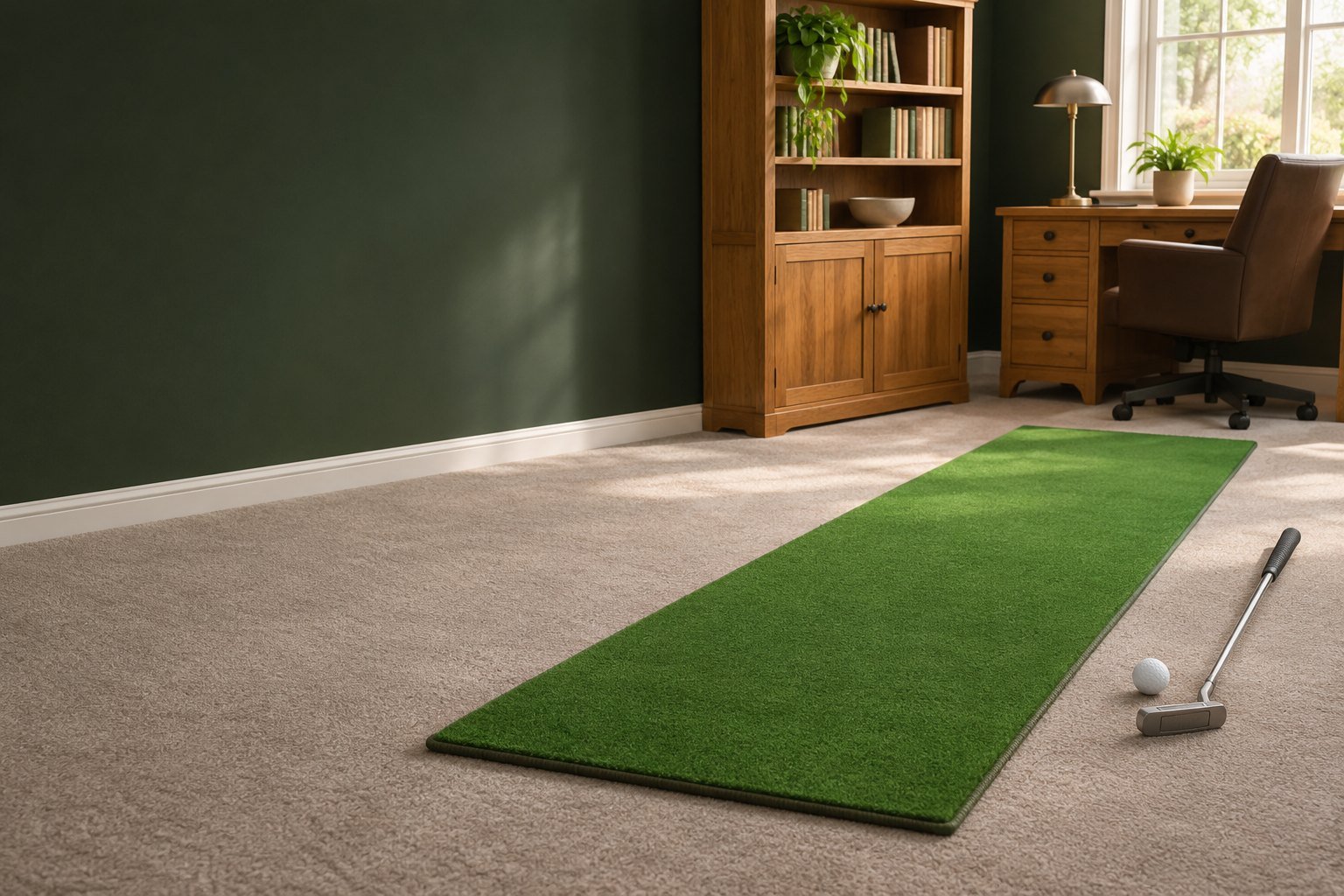
Check the floor, carpet and mat together before treating the roll as useful practice feedback. AI-generated illustration of a generic home setup.
A putting mat can look smooth on a bedroom carpet and still change shape when you take your stance. It can also lie flat across a floor that slopes. Those are different problems, and buying a thicker mat does not tell you which one you have.
Start by separating the floor, the carpet and underlay, and the mat itself. Then check whether your weight changes the surface. This guide helps you decide whether your carpeted space is suitable, whether a ripple needs product-specific care, and when moving the setup is the more useful answer.
Ad – includes affiliate links. Taylor’s Trailblazing Golf may earn a commission from qualifying purchases. Our recommendations follow the reader’s needs and the available evidence. Read our disclosure.
Four layers to check before blaming the mat
Use the table as a troubleshooting guide. These observations help narrow the possibilities; they do not certify a floor as level or prove that a mat is faulty.
Swipe or scroll the table to see all columns.
| Layer | What you notice | What to check next |
|---|---|---|
| Floor beneath the carpet | The whole lane appears tilted, or the ball repeatedly moves towards one side. | Consider the floor’s level separately from mat flatness. Drift alone cannot distinguish slope from the stroke, ball or surface. |
| Carpet and underlay | The surface feels soft, or its shape changes when you stand nearby. | Watch the playing lane while taking your normal stance. Try a permitted firmer location if the support visibly changes. |
| Mat and backing | A curl, ridge or crease is visible even with nobody standing beside it. | Inspect the underside for trapped objects, then follow the maker’s settling instructions. Record whether the same feature remains in another suitable location. |
| Stance and access | Your feet sink unevenly, you straddle a raised edge, or a door crosses the lane. | Find a comfortable, clear position first. If that is impossible, choose another practice spot before buying accessories. |
The useful distinction is between flat, level and stable under load. A surface can be flat but tilted. It can be level before you step on it and deform afterwards. Looking only for wrinkles misses both possibilities.

Decide whether the carpet can support practice
BirdieBall says its RollTech foam greens perform best on firm hard surfaces. It permits tightly woven carpet without a thick pad beneath it; its guidance is more cautious about plush carpet and soft padding. That is advice for the RollTech construction, rather than a specification every putting mat shares. [1]
PrimePutt recommends a hard floor or low-pile carpet for the most consistent roll. Its care guide explains that standing on its mat over plush or heavily padded carpet can create a dip around the feet, and suggests standing beside the mat in that situation. [2]
For your own setup, put the club down and look at the lane while you take your normal position. Does the area beside the ball visibly dip? Does a seam or lump appear? Does moving a foot change it? Standing beside a narrow mat avoids loading the mat directly, but it is still worth observing the nearby carpet. Do not change your posture just to make an unsuitable corner usable.
There is no useful universal carpet-depth cut-off in the manufacturer guidance consulted here. A short pile over soft underlay can behave differently from a similar-looking carpet over firmer support. Ask about the full floor-and-carpet combination when checking compatibility with a seller.
Would a board underneath solve it?
BirdieBall mentions a firm layer beneath its foam green as one possible arrangement over plush carpet. [1] That does not establish that any loose board will be level, rigid enough or safe in your room. Prefer another suitable location first. If a base is necessary, ask the mat supplier about support requirements and account for flex, joints, exposed edges, floor protection and storage before building anything.
Check the location without overreading the result
A small spirit level pressed into a soft mat or carpet measures the local resting surface of the tool. It cannot reveal the whole floor underneath. If a suitable hard surface is exposed, a level can help check that particular patch in two directions; a reading at the doorway does not establish the level under the entire putting lane.
For a household setup, a controlled comparison between locations is often more practical than trying to assign a slope number. Choose a second location that the mat’s instructions permit, ideally with firmer support. Keep the mat in the same condition and use the same ball and starting position. If the behaviour changes, you have useful evidence that the location matters, although the change alone does not identify its exact cause.
When no second location is available, take photographs of the laid-out mat and any visible deformation. Send the supplier a description of the carpet and underlay before adding a platform or attempting a flattening treatment.

Separate a rolled edge from a persistent ridge
First lift the mat carefully and check for debris, a cable or another object beneath it. Lay it down again without dragging furniture across it. Inspect the edge and backing in ordinary room light, before putting balls over the affected area.
An end lifting after storage is a reason to consult the settling instructions. A sharp fold, torn backing or ridge that persists in a suitable location is a reason to contact the supplier. A bump that only appears when you take your stance points you back towards the support beneath and beside the mat.
Care methods differ. Wellputt tells owners with a lifting end to roll the printed side out, starting at that end, and leave it rolled for about an hour or overnight if needed. Its storage advice is to keep the mat clean and dry, rolled rather than folded or crushed. Follow that guidance for the relevant Wellputt mat, without treating its timescale as a promise for another brand. [3]
PrimePutt says its surface does not need ironing, routine brushing or special treatments. [2] The practical rule is to find the instructions for the mat you actually own before trying heat, heavy weights, adhesive tape, reverse rolling or aggressive cleaning. Keep photographs of a new mat’s condition and ask the seller before a treatment that could alter the backing.

Make a short setup record
This is a suggested troubleshooting record, not a laboratory test or a way to prove that your stroke is correct. Its purpose is to stop several changes being mistaken for one improvement.
- Record the starting setup. Note the room, carpet type if known, underlay information, mat orientation, time since unrolling and whether any ridge is visible. Take a photograph from the side.
- Fix the simple variables. Use the same clean, undamaged ball, the same starting mark and a comfortable stance. Keep the path clear of furniture, doors, children and pets.
- Observe several short putts. Note visible hops or repeated changes of direction at a particular spot. Do not conclude that a few misses prove a surface defect; your delivery is another variable.
- Change one setup factor. Relocate to another permitted surface, or apply the maker’s settling advice. Do not simultaneously brush the surface, change balls and move the starting point.
- Repeat and compare the pattern. Record what improved, what remained and what you cannot explain. Stop if the mat moves, an edge catches your feet or the stance feels unstable.
Swipe or scroll the table to see all columns.
| Record | Write down |
|---|---|
| Support | Location, carpet and known underlay; whether you stand on or beside the mat. |
| Condition | Visible curl or ridge; settling method and elapsed time. |
| Observation | Where a hop or drift occurs; whether the lane changes under foot pressure. |
| Single change | Exactly what you moved or adjusted between observations. |
| Decision | Keep this setup, relocate, or ask the supplier with photographs. |
For example, a ridge that remains at the same place on the mat after a move deserves a different question from a dip that disappears when the mat leaves a soft carpet. Both are useful observations to report; neither is a complete diagnosis by itself.
Keep, move or replace: make the useful decision
Swipe or scroll the table to see all columns.
| Finding | Sensible next step | Buying implication |
|---|---|---|
| Mat stays smooth and stable in a comfortable stance | Keep the arrangement and use it consistently. | You may not need another mat or a base. |
| Problem improves on firmer permitted support | Use that location if it is practical and clear. | Resolve the room constraint before paying for a different surface. |
| A curl remains after the prescribed settling method | Ask the supplier for model-specific advice, with photographs. | Check the seller’s returns process promptly; avoid modifying the mat while the issue is being assessed. |
| No safe, stable position fits the room | Choose another room or practise putting elsewhere. | A larger or more expensive mat does not create clear space. |
For the wider room layout and other practice kit, use our small-space golf practice guide. If your remaining choice is the target and return design, our flat versus ramped putting-mat guide covers that decision.
Use the feedback for the surface you have
A stable home lane gives you a repeatable setting for short putting observations. It does not recreate the changing slopes, grass conditions and distances of an outdoor green. If a soft patch creates a bend in the mat, treat it as a setup problem before calling it useful breaking-putt practice.
Be equally careful with green-speed numbers. The USGA’s Stimpmeter method uses a controlled ball release and a suitable level test area; the length of a putt you make at home is not that measurement. [5] A manufacturer’s stated figure also cannot establish how your particular carpeted arrangement behaves.
Keep the home task modest: notice whether the ball starts where intended and whether the same setup produces reasonably consistent observations. Recheck pace and line on a real practice green. If you have to compensate for a visible ripple or unstable stance to get a satisfactory result indoors, return to the support check before changing your technique.

Sources and research notes
Sources checked on 23 November 2026. This is a research-led setup guide; it does not report hands-on testing of the named mat on different carpets. The troubleshooting tables and record are editorial suggestions. All photographs are AI-generated illustrations of generic equipment.
- BirdieBall — putting-green FAQ. RollTech foam guidance on firm support, tightly woven carpet, padding and a possible supporting layer.
- PrimePutt — Use & Care. Recommended surfaces, the effect of standing on plush carpet, and product-specific care.
- Wellputt — FAQ. Lifting-end advice and storage instructions for its mats.
- Clubhouse Golf — PuttOut Mini Putting Mat. Listed dimensions, construction, included storage and UK price at the review date. Affiliate link.
- USGA — Stimpmeter instruction booklet (PDF). Controlled-release method and level test-area requirement.
Explore the wider Home Practice collection.
Illustrations in this article were created for Taylor’s Trailblazing Golf. Third-party photographs, where used, are credited beside the image or in the source list.