Hybrid Golf Bags: The Compromises Behind a Stand-Cart Design
Check the loaded carry, the trolley connection and the changeover between them.
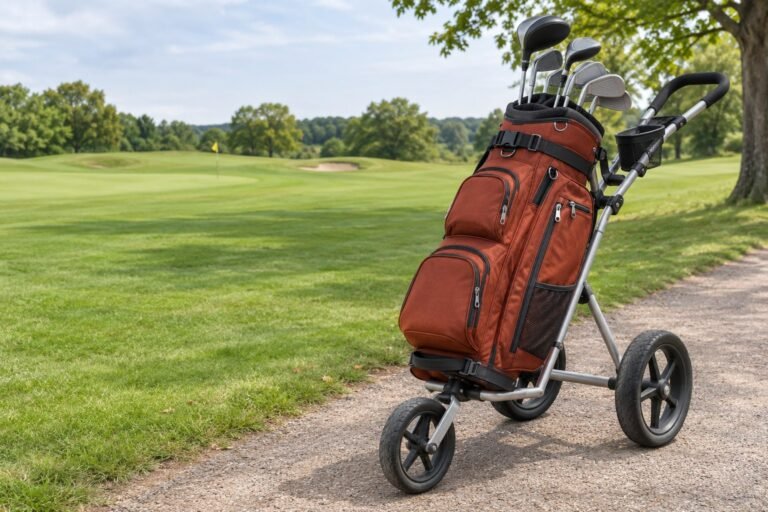
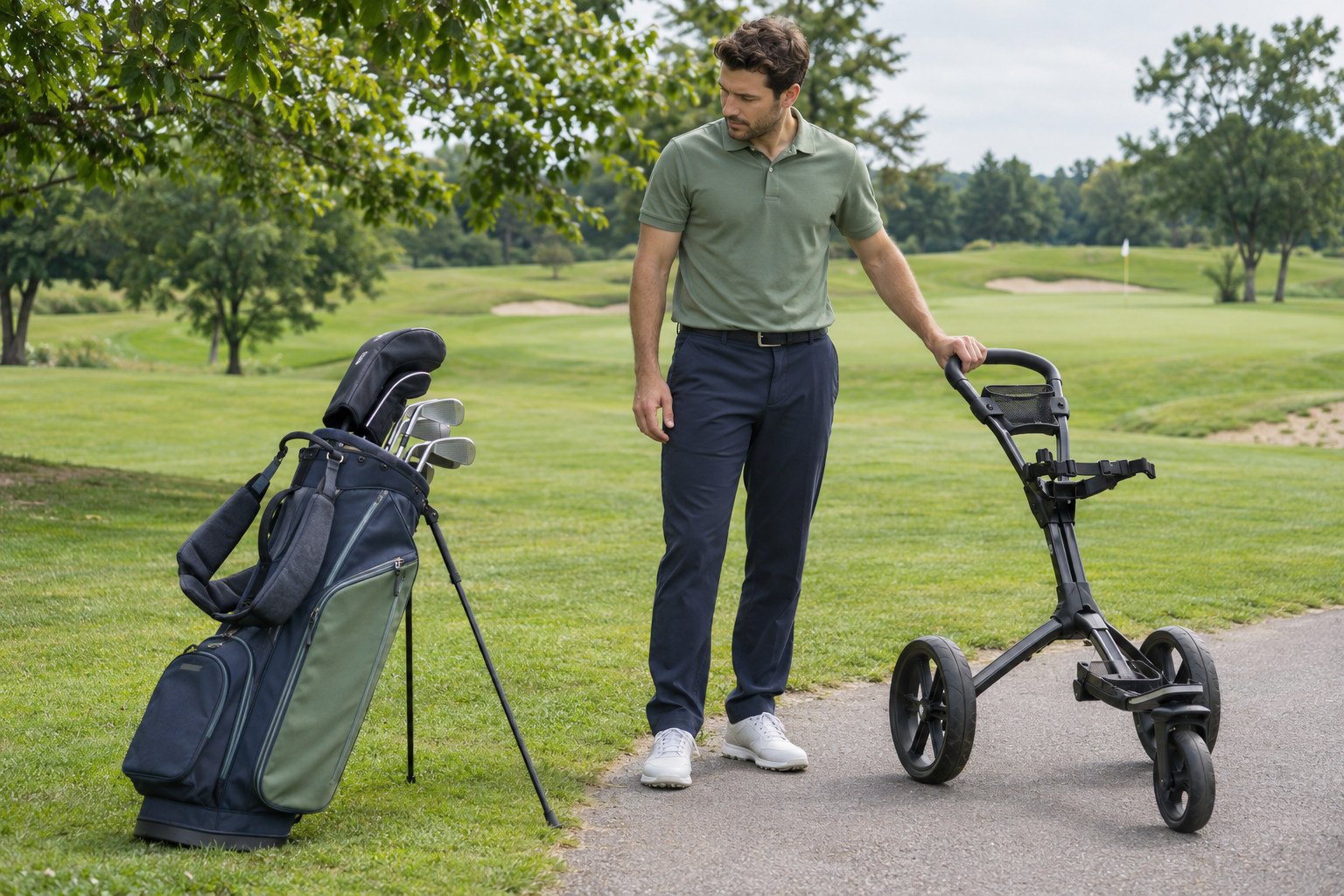
Compare carrying and trolley use with the equipment you actually own. AI-created generic illustration, not a named product or test photograph.
Some links in this guide are affiliate links. If you buy through them, Taylor’s Trailblazing Golf may earn a commission at no extra cost to you.
Hybrid golf bags promise the convenience of a stand bag with features intended for trolley or buggy use. Titleist’s Hybrid 14 and Callaway’s Fairway 14 HD illustrate that approach through different combinations of straps, top layouts and cart-facing features. [1] [2]
The useful question is what changes when the same loaded bag moves between your shoulders and your trolley. A good carry arrangement can become awkward when strapped down; a spacious trolley setup can be more than you want to carry. This guide helps you decide which concessions you would actually notice.
This is a research-led buying guide, using manufacturer descriptions and a checked UK retail listing. The comparison routine is for you to perform with the actual equipment; it is not a report of hands-on testing by this website.
Assess the same packed bag on your shoulders and your actual trolley.
Give loaded comfort and manageable bulk priority over rarely used storage.
Check whether a stand and carry harness solve a real recurring need.
Keep it unless a replacement resolves a specific problem.
What hybrid golf bags combine
Treat “hybrid” as a prompt to inspect the design. Look for a functioning stand and carry harness alongside features intended to help the bag sit on a trolley or riding cart. The useful evidence is the exact construction and its instructions, rather than the category name alone.
Swipe within the table to see all columns.
| Design feature | Potential benefit | Compromise to examine |
|---|---|---|
| Stand legs and mechanism | A resting position when the bag is off the trolley. | Whether the folded assembly clears the trolley supports. |
| Carry harness | A practical way to carry during walking rounds or short transfers. | How the harness is stored when the bag is strapped down. |
| Cart strap route | A defined place for the trolley or buggy retention strap. | Whether that route matches your equipment and keeps pockets usable. |
| More structured top and storage | A layout that may suit a fuller equipment load. | The bulk and loaded carry you accept in return. |
These are comparison questions, not benefits guaranteed for every bag. A simpler stand bag may already do both jobs adequately on your trolley. Equally, a hybrid may be a sensible replacement when your present bag repeatedly twists or blocks a pocket, provided the proposed bag resolves that problem with the approved attachment arrangement.
Separate three situations: carrying a round, pushing or using an electric trolley, and riding in a buggy. A bag that works on your own trolley has not automatically been checked on a different hire buggy. Record the equipment you really expect to use.
Two UK examples and the questions they leave open
The following examples show different design approaches. Model information was checked on 23 November 2026. They are candidates for comparison, with no overall ranking or claim that either has been physically tested here.
Swipe within the table to see all columns.
| Exact example | Published design evidence | What you still need to establish |
|---|---|---|
| Titleist Hybrid 14, product family 25TGBH14 | Titleist lists a 14-way top, double strap, integrated cart strap tunnel and 2.8 kg weight. It identifies a waterproof valuables pocket. [1] | Loaded carry, the tunnel’s relationship to your trolley strap, and the weather protection you need for the rest of the bag. |
| Callaway Fairway 14 HD, UK listing ceu253688 | Callaway lists a 14-way top with full-length dividers, LOWRIDER LANDING ZONE, ANAMATIC straps and FLEX POD base. The page describes waterproof fabric and sealed seams. [2] | The actual trolley connection, access while secured, loaded comfort and the scope of the weather-protection instructions. |
Use the complete product identity. The ordinary Hybrid 14 and Hybrid 14 StaDry are different names; the cited Titleist example is the ordinary Hybrid 14. Likewise, do not transfer these Callaway details to every Fairway bag.
The Clubhouse Golf Navy/Marble listing identifies Titleist article number TB25SX14-42, matching the selected variant shown on Titleist’s page. Its stated pocket total differs from the manufacturer page, so confirm the supplied layout with the retailer before ordering if that matters to your decision. [1] [3]
Check the Titleist listing at Clubhouse Golf View Fairway 14 HD at Callaway UK
These links help you inspect the named options. Recheck the selected colour, model details, price, delivery and returns before purchase. A successful specification comparison still leaves the physical fit questions below.
Judge the carry with your normal equipment
Begin with the equipment you reasonably expect to carry: your usual clubs, ordinary ball supply, drink and appropriate weather clothing. Keep that load consistent when comparing candidates. Otherwise, an apparently easier carry might simply be the result of leaving useful items behind.
Look beyond the headline empty weight. Ask what the published figure includes, then compare bags in the configuration you will actually use. Retain the intended carry harness and any accessories needed for that round. Do not assume the lightest listed bag will feel best, or that a more elaborate harness compensates for every extra item.
Keep the carrying check specific
With the bag’s instructions followed, assess putting it on, a short manageable walk, setting it down and retrieving an ordinary item. Notice twisting pads, movement that needs repeated correction, uncomfortable contact or difficulty controlling the load. Those observations give you something concrete to compare. A brief shop check cannot predict an entire round.
Use the published loaded carry-harness guide for the separate adjustment process. Here, the buying decision is whether carrying this bag is useful often enough to justify the rest of its design.
If carrying the realistic load is uncomfortable or awkward, stop the check and reconsider the load, fit or transport method. Do not adopt an arbitrary safe-weight target or tighten the straps repeatedly to force a result. When carrying is only the walk from the car to a trolley, judge that actual task; do not pay for a theoretical full-round advantage you never use.
Check the trolley as a complete connection
Bring your trolley, or establish the exact make and model with the retailer. Follow both sets of instructions. Park it as directed on level ground before loading and keep hands clear of moving mechanisms. A bag should be assessed in the intended supports, with its approved retention arrangement, rather than balanced loosely for a photograph.
- Check where the bag base rests. It should sit as intended without relying on a pocket, stand hinge or loose fabric for support.
- Check clearance around the folded stand legs and mechanism. Do not use extra strap tension to force a misaligned assembly into the cradle.
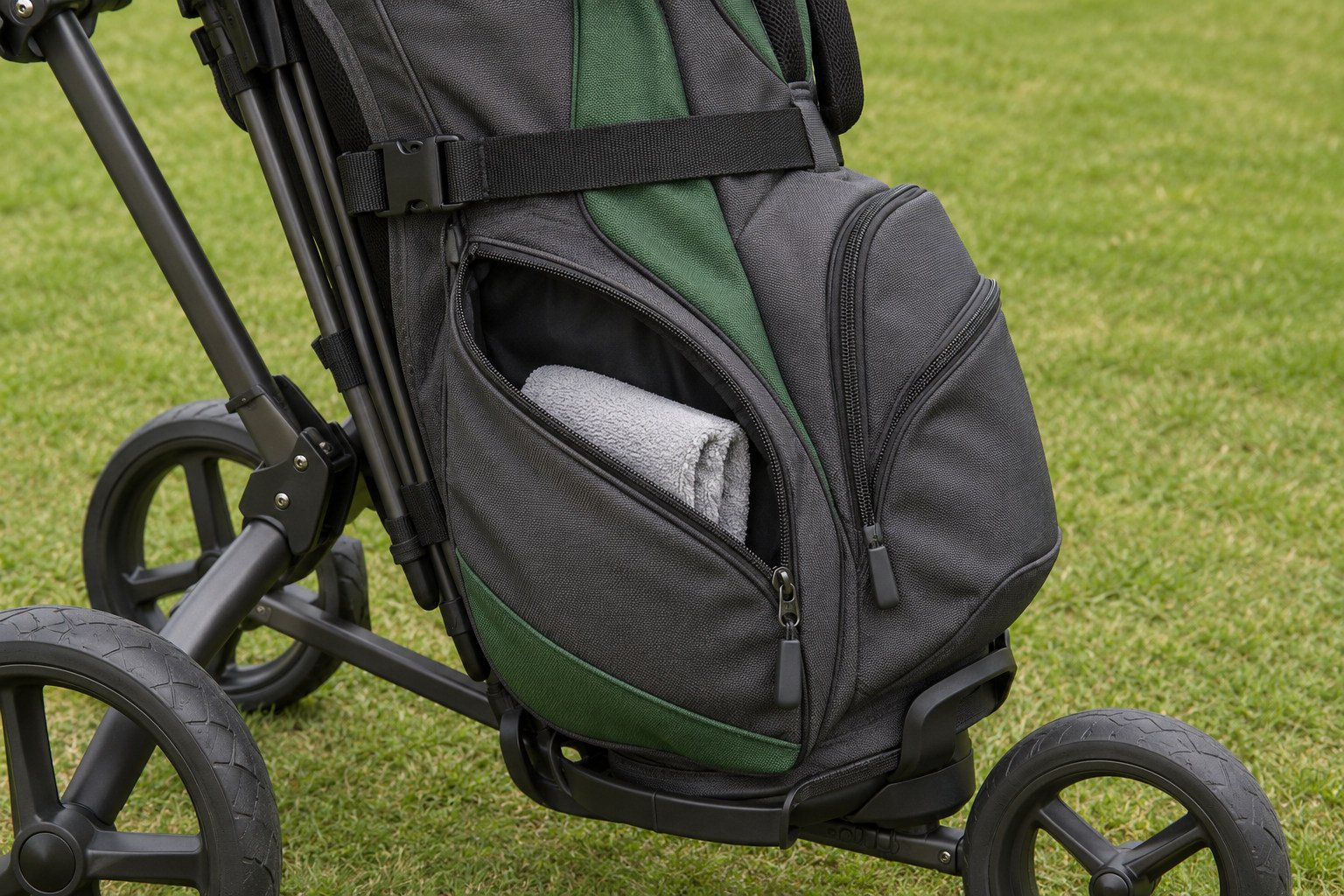
- Route the trolley straps through the permitted path. A dedicated tunnel is helpful only if your strap can use it correctly.
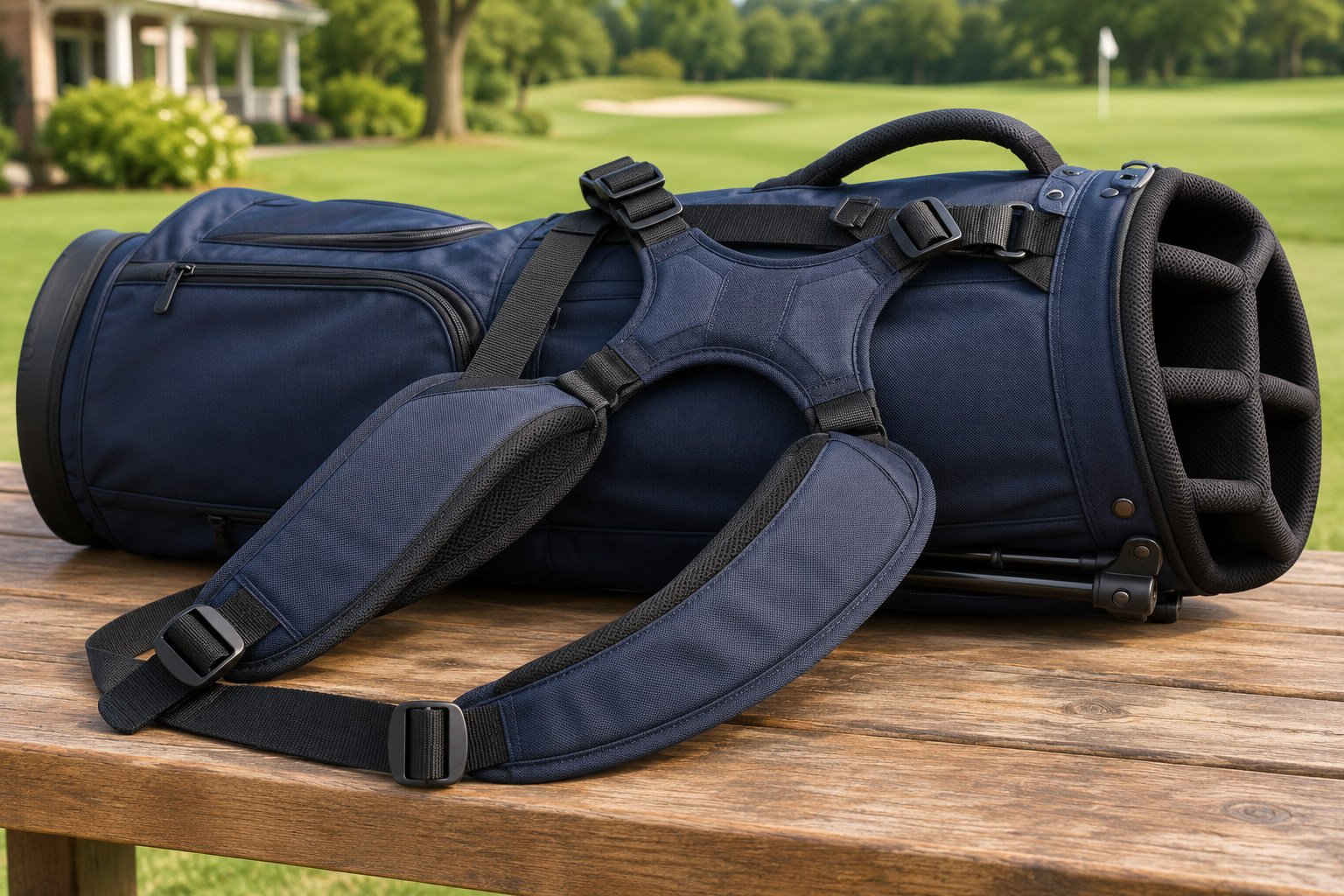
- Check that the carry harness is retained clear of the trolley’s moving parts using the bag’s intended arrangement.
- With the bag secured, retrieve a ball, your drink and an item from the clothing pocket. Then remove and return the clubs you use most.
Record the awkward action, not just “fits”. A zip that opens only after releasing the trolley strap is different from a pocket that remains easy to use. Likewise, a club that returns cleanly while the bag is standing upright may behave differently at the trolley’s working angle.
For an electric trolley, also follow its instructions for controls, battery access and cable clearance. Do not improvise an adapter, restrain the stand with cable ties or omit a required strap. Ask the relevant manufacturer about a confirmed compatible solution if the connection remains uncertain.
A buggy introduces another arrangement. Check its rack and retention straps separately when that use is important to you. “Cart-compatible” on a product page is useful design information; your own setup supplies the final fit evidence.
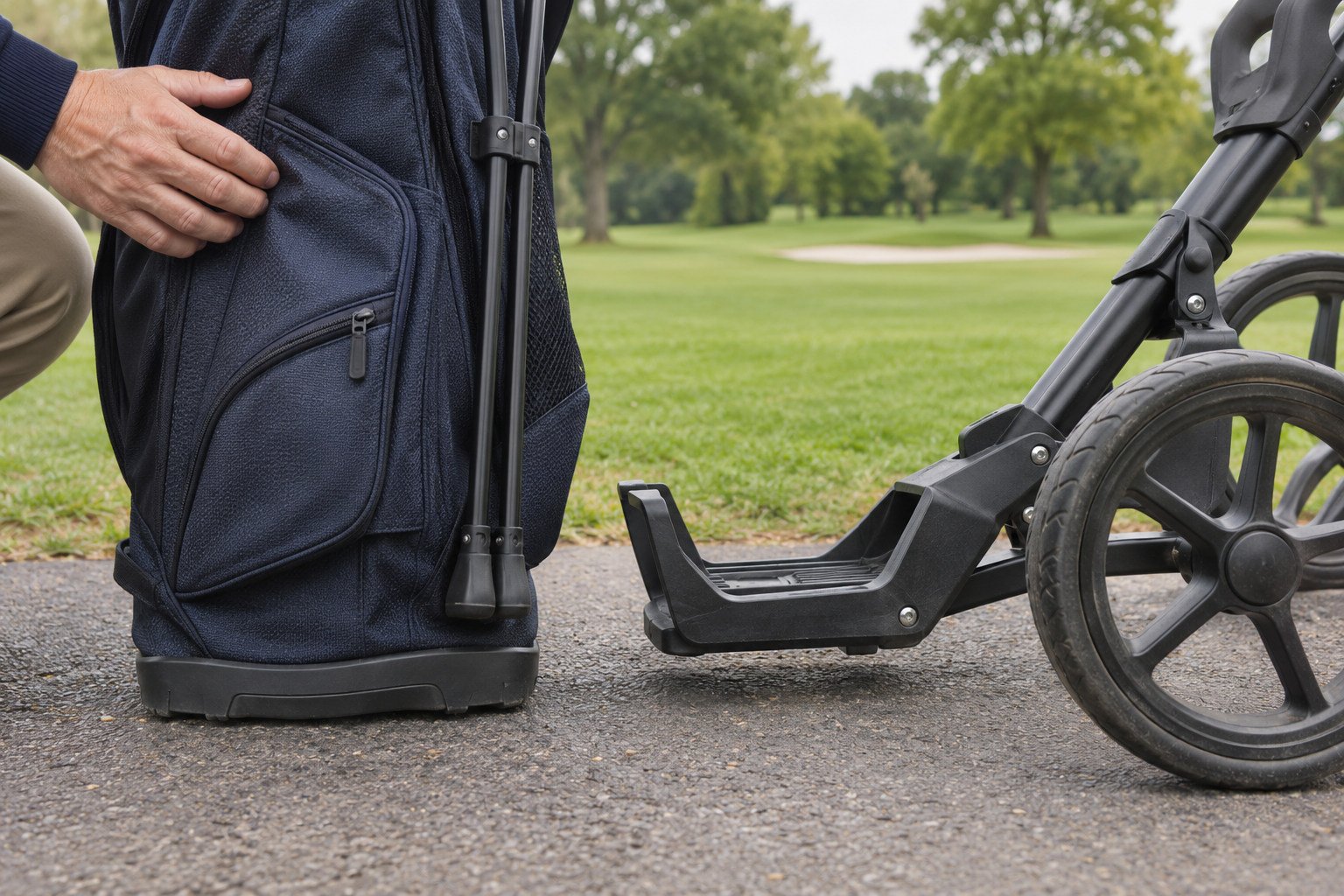
Include changeover, storage and wet-weather needs
A hybrid is most convenient when changing modes is straightforward. Set the bag down, secure or detach the harness only as its instructions allow, position it on the trolley and check access. Then reverse the process. Count the separate actions you would need to remember, especially if an accessory must be moved or a strap refitted.
Removable parts need a home. If you detach the harness, decide where it will travel and how you will avoid arriving for a carrying round without it. Do not leave loose straps or accessories where they can become trapped in wheels, hinges or the car boot.
Try the whole transport arrangement
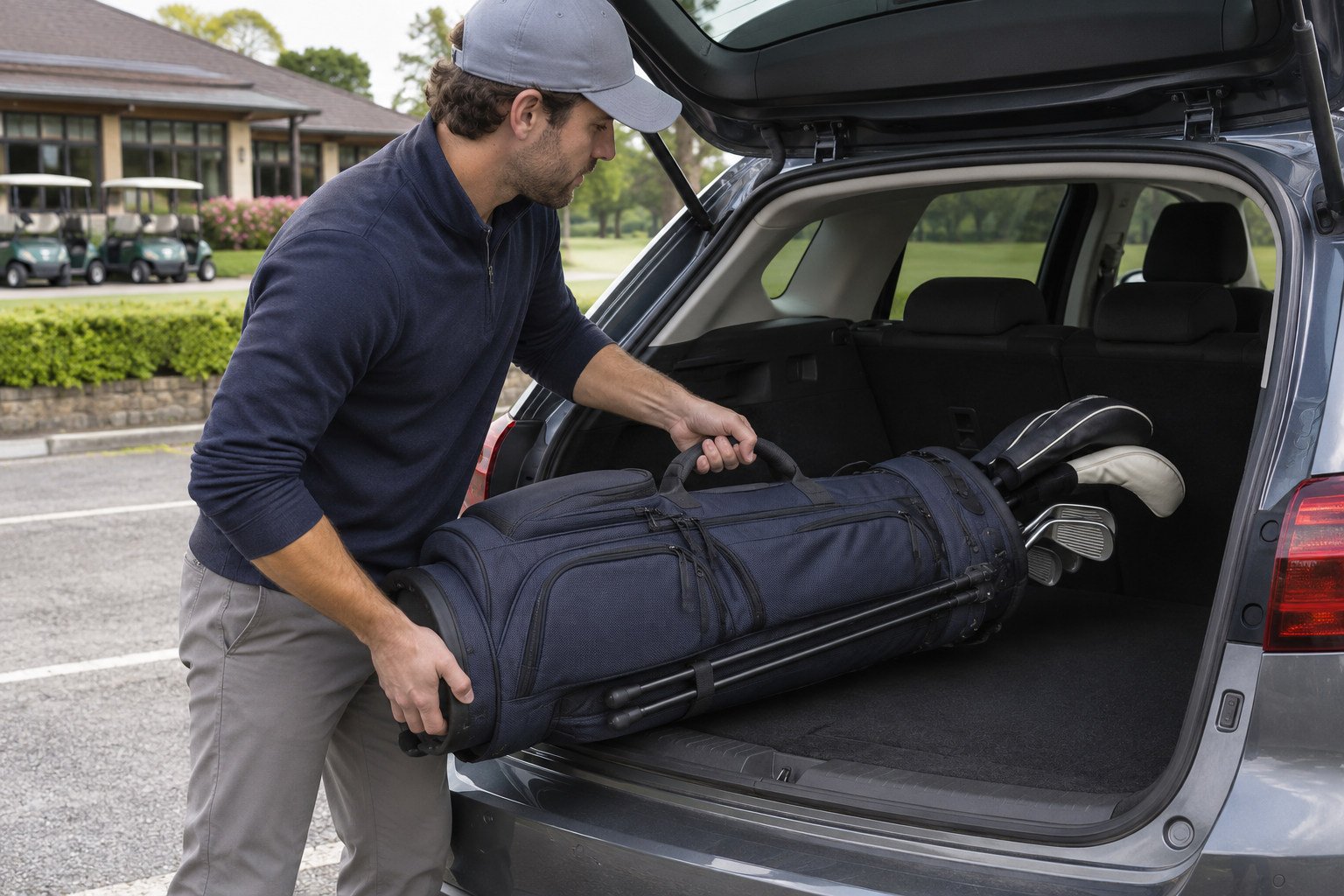
Measure the available boot space with your folded trolley and usual luggage in place. Use the bag’s intended handles for lifting, with help if needed. Check that the stand mechanism and clubs are protected during loading and that the boot closes without pressure on them. A bag that seems compact in a shop may be awkward alongside your actual trolley.
At home, consider where both the bag and trolley will be kept, and how easily you can retrieve them. One bag can simplify storage, but only if it fits the available space and can be put away without trapping straps or leaning equipment precariously.
Read the weather claim at the right level
A waterproof valuables pocket does not establish that the entire bag is waterproof. Titleist specifies that pocket on the cited Hybrid 14; Callaway makes broader fabric-and-seam claims for the cited Fairway 14 HD. [1] [2] Check the exact model’s care instructions and rain-hood arrangement. Ask whether the items you need during rain remain accessible with the hood and trolley straps in place.
Use a carry-and-trolley assessment sheet
For each candidate, record the exact bag, trolley and normal load. Complete the same tasks with your current bag if it is serviceable. That baseline shows whether the proposed purchase solves anything you actually encounter.
Use three outcomes: acceptable, inconvenient, or unresolved. An unresolved attachment, damaged component or unmanageable carry is a reason to pause that candidate. Do not average a serious fit problem into a favourable overall score.
Swipe within the table to see all columns.
| Task | What to record | Why it matters to your rounds |
|---|---|---|
| Carry the normal load briefly | Control, contact, strap movement and ease of putting it down. | Essential for regular carrying; assess only a suitable short transfer if that is your use. |
| Attach to your trolley | Base contact, stand clearance and permitted strap route. | A required fit check, regardless of the number of trolley rounds. |
| Use pockets while secured | Which items can be reached without loosening a required strap. | Repeated inconvenience matters more than unused pocket capacity. |
| Remove and return clubs | Any awkward reach or snagging at the actual working angle. | Assess with your own clubs and grips. |
| Change between modes | Parts removed, steps repeated and where loose parts go. | Frequent switching makes this a recurring task. |
| Load the car and store the kit | Space needed with the trolley, lifting access and protected storage. | The arrangement must work before and after play too. |
Finally, write one sentence: “I accept ___ because I use ___ most often.” For example, a golfer might accept an extra changeover step to avoid storing two bags. Another might reject the same step because they switch modes several times a week. These are illustrative decisions, not tested outcomes.
Keep hard requirements separate from preferences. The frequency of carrying can change how much you value a compact harness; it cannot make an insecure trolley connection acceptable. If two candidates meet the requirements, compare the inconveniences you would repeat most often.
Choose one hybrid, two bags or no replacement
Swipe within the table to see all columns.
| Your situation | Sensible direction | Cost or compromise to accept |
|---|---|---|
| Both carrying and trolley use are frequent; one candidate works in both. | A hybrid is a useful shortlist option. | Accept only the bulk, changeover and layout compromises you have identified. |
| One mode dominates and the alternative is a rare short transfer. | Start with a bag suited to the dominant mode. | You may not need a full dual-purpose design. |
| Your carrying and trolley requirements conflict strongly. | Consider keeping separate serviceable bags. | More storage, transferring contents and a check for forgotten equipment. |
| Your existing bag already completes the important tasks. | Keep it and address small organisation problems first. | A new category label alone offers no clear buying reason. |
Compare the complete purchase, including any approved accessory genuinely needed for the proposed setup. Ask about the retailer’s current returns conditions before testing equipment outside or removing labels. Do not assume a fitting uncertainty will automatically justify a return after use.
When an existing bag is damaged, obtain advice about approved repair or replacement. A hybrid label is not a repair solution. When it is simply inconvenient, name the inconvenience and verify that the alternative removes it before ordering.
The strongest case for a hybrid is practical: the same bag completes both of your regular transport tasks, the changeover is manageable and you have a clear reason to prefer storing and organising one bag. If those conditions are absent, a dedicated design or the bag you already own may be the better choice.
Questions to settle before ordering
Does a 14-way top make a bag a hybrid?
No single top layout establishes carry-and-trolley suitability. Inspect the harness, stand, base and strap arrangement as well. For the separate question of what happens below the openings, use the guide to checking full-length divider claims.
Can I remove the carry straps whenever I use a trolley?
Only use the removal and refitting method intended for that exact harness. Some configurations may offer quick-release connections, but appearance alone does not establish how yours should be used. Check its instructions and retain any detached parts safely.
What if I cannot bring my trolley to the shop?
Record its model, photograph the upper and lower supports and ask both suppliers about the exact pairing. Dimensions and photographs can narrow the options, but they may leave physical clearance or pocket access unresolved. Avoid treating an uncertain match as confirmed; arrange a suitable demonstration or agree the applicable returns conditions before buying.
Choose from the completed assessment sheet: the actual load, actual trolley and actual changeover determine whether this compromise is useful for your golf.
Sources and checks
- Titleist UK: Hybrid 14, product family 25TGBH14Manufacturer’s ordinary Hybrid 14 specification, selected Navy/Marble variant TB25SX14-42, cart strap tunnel, harness and valuables-pocket claim.Checked 23 November 2026.
- Callaway UK: Fairway 14 HD stand Bag, ceu253688Exact UK listing for top, dividers, LOWRIDER LANDING ZONE, ANAMATIC straps, FLEX POD base and weather-construction claims; manufacturer statements.Checked 23 November 2026.
- Clubhouse Golf: Titleist Hybrid 14, Navy/MarbleRetail listing identifies TB25SX14-42. Its pocket total differs from the Titleist page; confirm the supplied layout before ordering.Checked 23 November 2026.
Illustrations in this article were created for Taylor’s Trailblazing Golf. Third-party photographs, where used, are credited beside the image or in the source list.