Four-Wheel Push Trolleys: When Does an Extra Wheel Help?
An extra front wheel is useful only when the whole trolley suits your bag and your route.
Four wheels change the support footprint, but the complete design still determines handling. AI-created category illustrations show generic equipment, not the named products or a product test.
Four-wheel push trolleys are worth considering when you want a well-supported platform for a compatible loaded bag. They are less persuasive if you are mainly trying to solve awkward turning, a narrow doorway or a difficult lift into the boot. Those problems depend on the frame, steering and fold, not the number on the product label.
This guide asks whether a four-wheel design offers you a practical advantage over a suitable three-wheel trolley. It draws on current manufacturer and UK distributor information, with a buying check you can use at a demonstration. It does not claim measured stability, pushing effort or hands-on use.
This guide contains affiliate links. If you buy through them, Taylor’s Trailblazing Golf may receive a commission at no extra cost to you.
A four-wheel frame that rejects your stand bag is the wrong choice, however reassuring it looks.
Try ordinary turns with your load and ask for the approved tight-turn technique.
Use trolley dimensions, not the shipping carton or a “compact” label.
An extra wheel should solve an observed problem, not create an upgrade obligation.
Four-wheel push trolleys: what changes?
A conventional three-wheel trolley has two rear supports and one front wheel; a conventional four-wheel trolley replaces that single front support with a pair. Their contact points form different footprints beneath the bag. The practical effect depends on where those points are, the load’s position, the wheel design and the ground.
That is a mechanical explanation, not a claim that four wheels achieve a particular tipping angle or percentage improvement. More contact points do not establish how evenly the load is supported on uneven ground. You still need an appropriate bag, correct assembly and a route suitable for the equipment.
Scroll the table horizontally on a small screen to see every column.
| Your situation | Why four wheels may be worth trying | What could outweigh the benefit |
|---|---|---|
| A substantial cart bag | A suitable frame may provide reassuring support and a secure cradle. | The exact trolley may reject your bag shape or place pockets against the frame. |
| Frequent stopping on suitable level areas | A well-matched load and accessible brake can make the routine straightforward. | A poor brake or loose bag remains a problem regardless of wheel count. |
| Tight turns or confined paths | A particular design may work well in a demonstration. | Four wheels alone tell you nothing about swivel action or turning effort. |
| Uneven paths | Compare the wheel size, clearances and the maker’s intended use. | Do not assume all four wheels will stay equally loaded, or that the trolley cannot tip. |
| A small boot or stairs | Some four-wheel frames fold neatly. | The actual folded shape, unboxed weight and lifting points may be inconvenient. |
A real example: bag fit can reverse the obvious choice
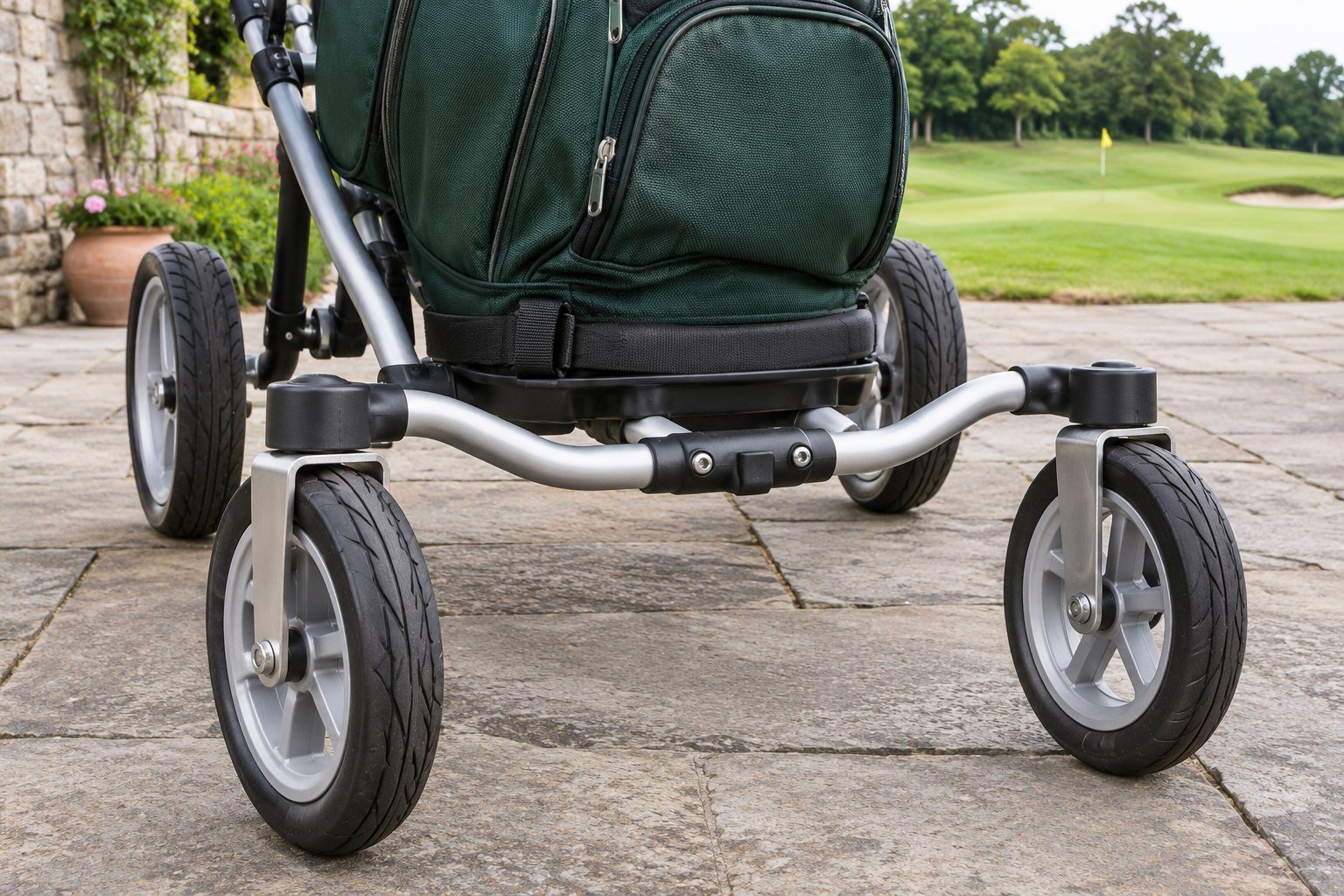
Clicgear’s own US product guidance describes the four-wheel Model 8.0+ as suitable for standard cart bags and explicitly excludes stand bags. Its three-wheel Model 4.5 guidance accommodates most stand bags. Check the version offered by your UK seller, but the lesson is clear: a bigger-looking support arrangement does not guarantee wider bag compatibility. [1] [2]
Scroll the table horizontally on a small screen to see every column.
| Feature | Model 8.0+ — four wheels | Model 4.5 — three wheels |
|---|---|---|
| Bag guidance | Cart-bag design; manufacturer’s US guidance excludes stand bags. [1] | Manufacturer says it accommodates most stand bags. [2] |
| Parking brake | Dual front-wheel brakes. [3] | Hand-operated brake engages the front wheel. [2] |
| Published folded dimensions | 15 × 27 × 17 inches, about 38.1 × 68.6 × 43.2 cm. [3] | 13 × 15 × 24 inches, about 33.0 × 38.1 × 61.0 cm, from its individual product page. [2] |
| What the figures establish | A folded shape you can compare with your own storage space. | Another shape to compare, not proof that it will fit every smaller boot. |
The centimetre figures are rounded conversions of the published inch measurements, not measurements taken by this publication. Dimension order and the way a trolley is placed can change the useful comparison; ask the seller which protrusions and accessories are included.
Also keep packaging data out of your lifting comparison. The UK distributor’s Model 8.0+ page separately lists carton dimensions and packaged weight. Those figures describe the shipped item, not the bare trolley you lift after a round. [3]
These are design examples rather than a claim about present UK stock or the best current price. A documented model is useful for understanding the trade-off even when you decide to try a different trolley.
Back to guide contents ↑Give the turning method a proper trial
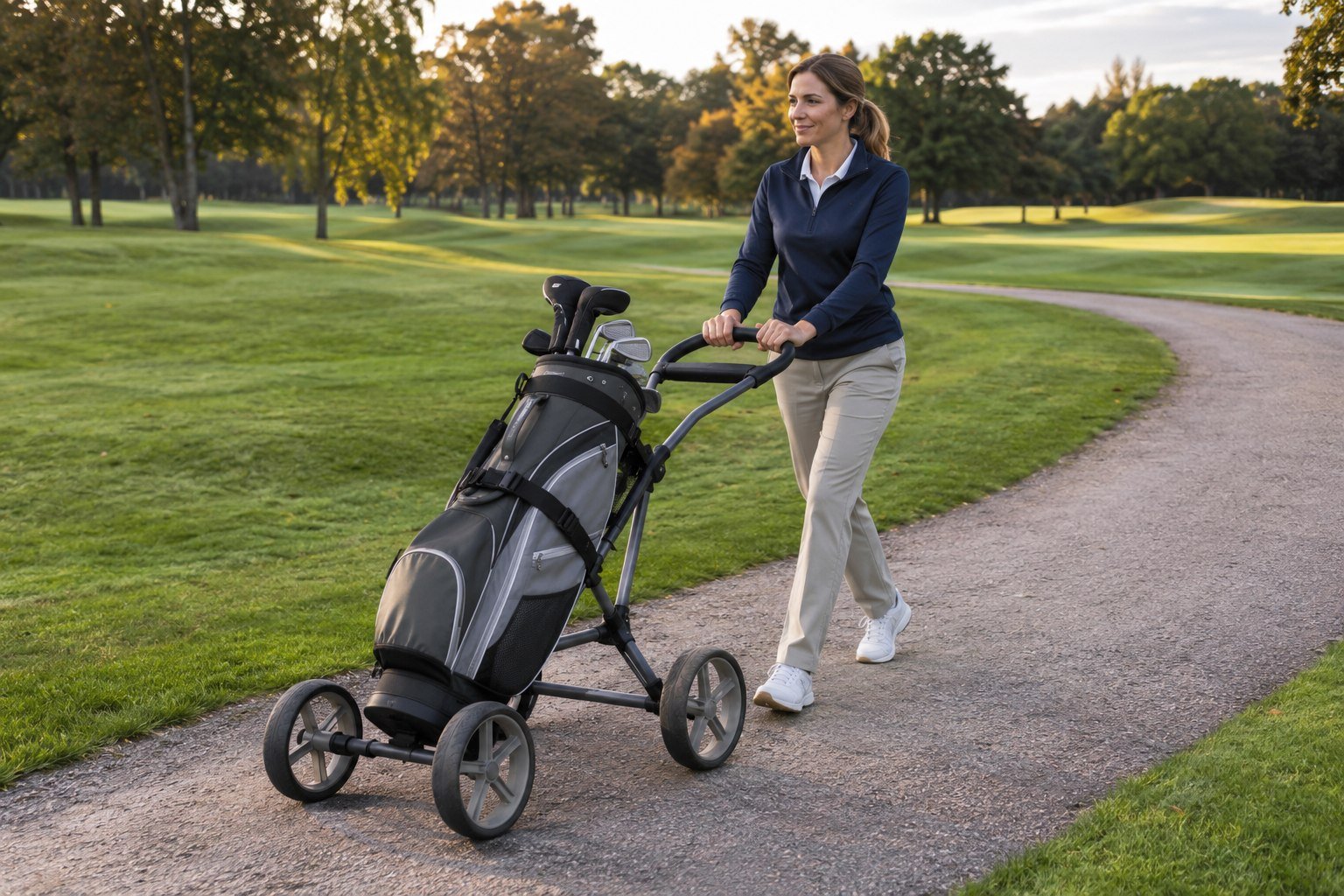
A wide, open fairway is only part of a golf round. Consider the clubhouse path, the corner at the first tee and the entrance to your storage area. Check the actual open width and what happens when you change direction; a four-wheel trolley is not automatically wider than every three-wheel rival.
Ask a demonstrator to show the maker’s intended turning method with a realistic, correctly secured bag. Use a flat permitted area and normal walking movements. Notice whether the trolley follows the turn willingly, whether the bag shifts and whether you have to wrench the handle sideways.
Fixed wheels and swivelling wheels deserve separate attention. Do not infer steering from the extra pair of front wheels. If a technique involves lifting part of the frame, have the retailer explain the manufacturer’s method and assess whether you can manage it with your load. Avoid improvised sharp pivots or using the handle to force a resistant wheel assembly.
Do not buy stability by assertion
Words such as “stable” and “all terrain” are not an independent result for your course. Follow the manufacturer’s limits, keep control of the trolley and choose suitable paths. Do not deliberately tip a loaded trolley or release it on a slope as a shop test.
Check the bag from its base to the pockets
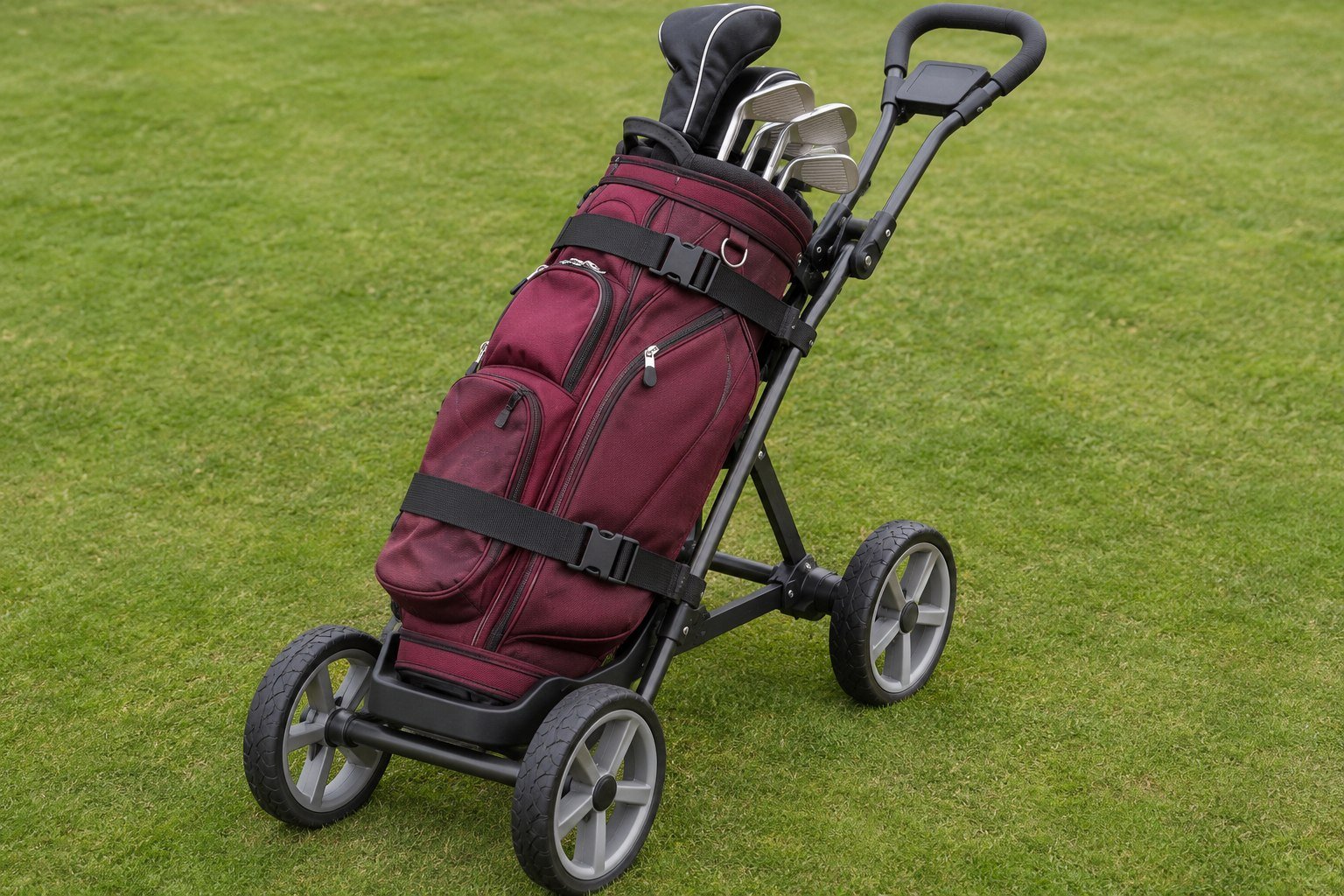
Use your normal bag, with the clubs and accessories you expect to carry. A demonstration with an empty small bag cannot settle how your own setup will behave.
- Seat the base in the lower support as instructed. It should not rely on a strap alone to keep it clear of a tyre.
- Secure the upper support without trapping a stand mechanism or compressing an access pocket.
- Check wheel clearance around the bag base and loose straps.
- Reach the putter, drinks pocket and rainwear without undoing the main supports.
- Make ordinary controlled turns and recheck that the bag has stayed seated.
If the fit fails, stop and check the maker’s approved solutions. Do not add homemade wedges, over-tighten straps or assume that an accessory from the same brand fits every frame.
Clicgear’s Model 8.0+ guidance specifically says that not all of its accessories are compatible with that model. Check the exact accessory’s compatibility rather than buying by logo alone. [1]
Carrying a full set does not mean every pocket must remain full. Remove duplicated items and unnecessary loose weight before deciding that the frame needs replacing. Keep useful equipment, but make the load intentional.
Back to guide contents ↑Make the folded trolley pass your storage test
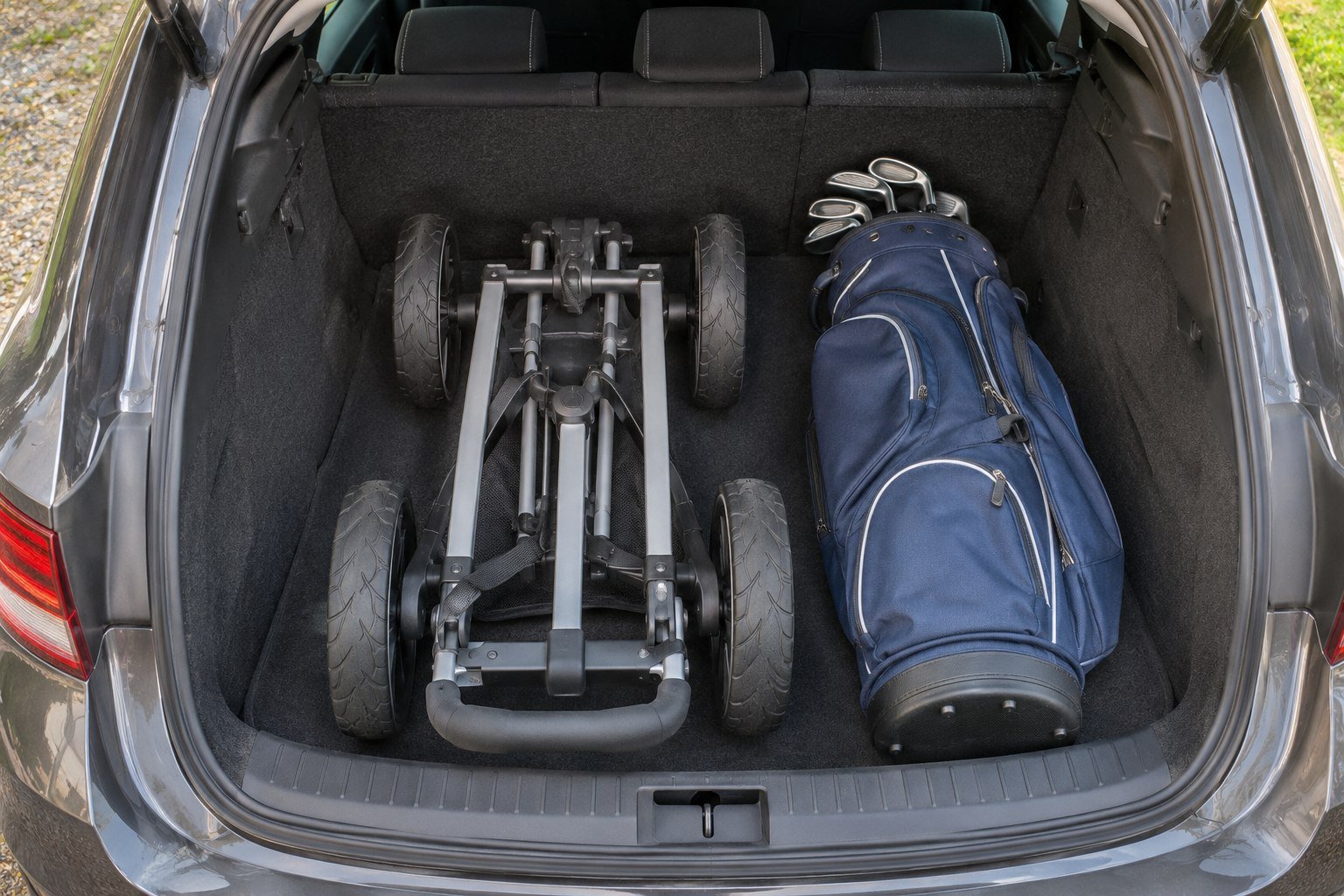
Measure the boot opening, usable floor and height under any shelf. Then check how the trolley will share the space with your bag. A fold that fits across an otherwise empty boot may be awkward once the clubs are beside it.
For a candidate around 69 cm along its longest folded dimension, a 70 cm opening does not establish a comfortable fit. Handles, wheel orientation and the angle of the lift can still interfere. Treat a close measurement as a reason for a real demonstration, not as a guarantee.
- Ask for the actual unboxed trolley weight and whether it includes every part you will lift.
- Check the fold and unfold sequence, locks and designated carrying points.
- Try the loading height you will use, rather than lifting only from a low shop display.
- Check whether holders or other accessories must come off before folding.
- Allow for the routine after wet golf: muddy wheels need cleaning and equipment needs to dry before enclosed storage.
If the storage test is the weak point, compare different folding mechanisms across both three- and four-wheel designs. Paying for an extra wheel does not resolve a shape that does not suit the space.
Back to guide contents ↑Compare the whole offer, including parts support
Obtain a quote for the exact model and the accessories you actually need. Ask what service support is available for wheels, brake parts, straps and the folding mechanism. A modest saving at purchase may be less attractive if the seller cannot identify a compatible replacement part.
For an older or used trolley, confirm the model designation before ordering parts. A similar-looking wheel or bag support is not enough evidence of compatibility. Inspect the frame, locks and brake operation with the seller; uncertain damage or safety-critical faults need appropriate professional advice.
Compare a suitable three-wheel alternative alongside the four-wheel model. If it fits your bag, handles well and solves the storage problem more neatly, it remains a valid choice.
The Clicgear 4.5 listing at Clubhouse Golf is one verified UK three-wheel alternative to investigate. It is included because the documented bag-fit difference may matter to this decision, not because this guide has tested it or established a preferred winner. [4]
Back to guide contents ↑When the extra wheel earns its place
A four-wheel trolley earns a place on your shortlist when it passes every essential check: your bag is approved and secure, the turning method is manageable, the parking arrangement works correctly, and the folded frame fits the places you use. Its extra support then becomes a useful part of a suitable whole.
Keep a well-matched three-wheel trolley if it already carries the load securely and is pleasant to use and store. First address a worn strap, an incorrectly fitted bag or a serviceable wheel problem through the manufacturer’s guidance. Those issues do not necessarily call for a different wheel layout.
If you are starting from scratch, take your loaded bag and your boot measurements to a retailer. Ask to compare one appropriate three-wheel and one appropriate four-wheel design. The better purchase is the one that passes the complete routine, even if the other looks more substantial in a photograph.
Our Trolleys & Course Accessories guides cover other decisions within the same equipment setup.
Back to guide contents ↑Sources
- Clicgear USA — Model 8.0+ Push Cart
Manufacturer’s US bag-fit restriction and accessory compatibility guidance. US price, shipping and warranty are not applied to UK purchases. Checked 23 November 2026. - Clicgear USA — Model 4.5 Push Cart
Individual model page: stand-bag accommodation, front-wheel hand brake and 13 × 15 × 24-inch fold. Regional specifications must be confirmed with the UK seller. Checked 23 November 2026. - JS Golf Brands — Clicgear 8.0+ Trolley, Silver
UK distributor’s model details, dual front brakes and 15 × 27 × 17-inch folded size. Carton measurements and packaged weight are kept separate. Checked 23 November 2026. - Clubhouse Golf — Clicgear 4.5 three-wheel trolley, Slate
Verified UK listing used as a relevant three-wheel comparison option; no current stock, lowest-price or tested-performance promise. Checked 23 November 2026.
Illustrations in this article were created for Taylor’s Trailblazing Golf. Third-party photographs, where used, are credited beside the image or in the source list.