

Golf Shoe Waterproof Claims: Membranes, Seams and Warranties
Check what keeps water out, what the promise covers and how to record a problem.
A waterproof claim needs more evidence than water beading on an upper. Generic AI illustration, not a water-resistance test.
Golf shoe waterproof claims can describe a material, a complete shoe or a promise to help if it leaks. Those are related, but they do not supply the same evidence. A photograph of water beading on an upper cannot tell you how its hidden seams are sealed or what a UK warranty excludes.
This research-led guide separates construction from cover. It gives you a way to compare product pages before buying and to describe a wet-foot problem accurately without turning a home experiment into supposed proof of failure.
Ad – includes affiliate links. If you buy through these links, Taylor’s Trailblazing Golf may earn a commission. Recommendations are based on the equipment decision and the available evidence.
Find out what the maker actually documents about the complete shoe.
Match the stated protection to the wet grass and rain you expect to encounter.
Record who handles a claim, what is excluded and when the promise starts.
Save the model details and purchase documents before a problem occurs.
Read golf shoe waterproof claims in three layers
Start with the exact wording rather than the photograph or a familiar technology badge. The same brand can offer shoes for different conditions, so a claim attached to one style does not transfer to another.
On a phone, swipe within the table to see all columns.
| What the page describes | What it helps establish | What remains to check |
|---|---|---|
| Water-repellent surface treatment | The outer surface is intended to shed water. | Whether the complete shoe has a waterproof construction and an explicit waterproof promise. |
| Named membrane or waterproof lining | A documented part of the water-protection system. | How that material is incorporated into the actual shoe, including its joins and openings. |
| Waterproof warranty | A commercial promise with particular terms. | Eligible model, country, start date, exclusions, evidence and the process for a claim. |
GORE-TEX describes its membrane as part of a laminate and explains that waterproof seam tape is used to seal stitching in the waterproof construction. The material name is therefore one part of a larger system. [1]
A maker can also offer a waterproof shoe without naming GORE-TEX. FootJoy’s UK HyperFlex page, for example, states waterproof protection in normal use for one year. Evaluate the actual promise and terms rather than assuming that the absence of a particular membrane brand makes the shoe unsuitable. [4]
If a listing says only water-resistant or describes a treatment, ask for clarification before relying on it for prolonged wet conditions. Do not silently upgrade that wording to waterproof.
Back to top ↑Look for evidence about the complete construction
A waterproof material still has to work within a shoe that bends, contains joins and has an opening for your foot. Visible upper stitching may sit outside a separate protective lining. Conversely, a neat-looking seam does not prove that the relevant water barrier is sealed.

Gore’s footwear testing description addresses the assembled system: it includes a walking simulator in water, leak testing and checks that upper components do not wick water over the lining. That explains why a statement about the complete shoe is more useful than a close-up of its fabric alone. These are the manufacturer’s tests, not tests performed for this guide. [2]
Ask the retailer or maker three focused questions when the specification is thin:
- Does the waterproof claim apply to this exact style and version as a complete shoe?
- Is the claimed barrier a named membrane, another lining or a construction the maker can describe?
- What limits or care conditions accompany that claim?
You do not need to cut a shoe open to answer those questions. Keep the response with the model details. An unexplained technical term is a reason to seek clearer evidence, rather than a reason to assume either excellent or poor performance.
Back to top ↑Distinguish possible entry routes from a diagnosis
A shoe’s collar remains an opening. Water arriving over it can bypass protection lower down, and the relationship between the shoe, sock and trouser cuff is worth observing. Gore also tests upper components specifically for water travelling over its lining, so the surrounding construction matters. [2]

On a phone, swipe within the table to see all columns.
| Observation | A useful follow-up | What it does not prove |
|---|---|---|
| Water beads on the outside | Record the product’s treatment and care instructions. | That every seam and internal layer is watertight. |
| The upper looks wet but the inside feels dry | Allow it to dry as instructed and inspect its condition. | That the hidden waterproof barrier has failed. |
| The sock is wet near the cuff | Note rain, cuff coverage and whether water could have entered from above. | That a toe or sole seam is leaking. |
| A repeated damp area develops inside | Record where and when it first appears, with photographs if useful. | The precise fault location or cause without further assessment. |
This is an observation guide, not a diagnostic test. Note whether the shoe and sock were dry at the start, which foot was affected, how long you were out and what conditions you encountered. Moisture inside should be described before its cause is assumed.
Avoid filling shoes with water, standing in a deep container or directing a hose at them to recreate a laboratory test. Ask the supplier what evidence it needs. An improvised test can introduce water through an unintended route and make the original problem harder to assess.
Back to top ↑Compare warranty scope before comparing duration
A longer-sounding promise is not necessarily broader cover. Read the geographical scope and the exact product wording, then distinguish a fixed period from a useful-life guarantee.
On a phone, swipe within the table to see all columns.
| Published example | What the source says | Practical implication |
|---|---|---|
| FootJoy UK limited waterproof warranty | For UK-bought shoes whose product page states one-year waterproof protection: one year from original purchase in normal use, subject to damage and misuse exclusions. [3] | Keep the eligible model description, purchase date and applicable UK terms together. |
| GORE-TEX commercial guarantee | Eligible new products carrying its promise are covered for their useful life for the original owner, subject to its terms. Normal wear, accident, misuse and inadequate care are excluded. [5] | Useful life is not an unlimited lifetime promise; Gore assesses the product and possible remedy. |
| Skechers GO GOLF Prestige SL, style 214126 | The UK product page states a one-year waterproof warranty. [7] | That page supplies a duration, but you should also obtain the claim procedure and detailed conditions for your purchase. |
For qualifying Gore claims, the possible outcome is repair, replacement or refund, with the decision made after assessment under its terms. Do not read the available remedies as a promise that every complaint automatically receives a new pair. [5]

Commercial warranties are also distinct from the seller’s obligations for faulty goods. GOV.UK explains that rights to repair or replacement can continue when a warranty or guarantee has expired. The appropriate outcome depends on the purchase and fault; an expiry date alone is not the whole question. [8]
Back to top ↑Make a small evidence record before buying
Use this checklist to turn a broad claim into something you can compare. Save the relevant pages or written replies with the receipt, rather than relying on the wording remaining unchanged.
On a phone, swipe within the table to see all columns.
| Record | What to capture | A reason to pause |
|---|---|---|
| Exact product | Full name, style code, version and UK seller. | The evidence refers to another model, generation or market. |
| Protection statement | The complete wording and any stated use conditions. | Only a surface treatment is described when you need a whole-shoe waterproof claim. |
| Construction information | Named membrane or other documented waterproof construction. | A badge or retailer phrase cannot be matched to the maker’s exact product. |
| Warranty clock | Duration, start event and eligibility. | A headline period is given without the relevant terms. |
| Claim route | Seller or manufacturer contact, required evidence and shipping instructions. | You cannot establish who handles a problem. |
| Care record | Model-specific cleaning, drying and treatment instructions. | The proposed care product or method conflicts with those instructions. |
A worked product-page check
FootJoy’s current UK HyperFlex page identifies style 55489 and a one-year normal-use waterproof promise. The HyperFlex White/Navy/Green listing at Clubhouse Golf also identifies 55489 and a one-year warranty. That is a useful identity match; it still needs to be read with the UK warranty conditions and your purchase documents. [4] [9]
The record separates what is documented from what remains unanswered. It does not certify the shoe’s construction or predict how long your own pair will remain serviceable.
Back to top ↑Treat care as part of the protection system
Use the instructions for the exact combination of upper and waterproof technology. Avoid borrowing advice for a different shoe simply because both uppers look like leather or fabric.
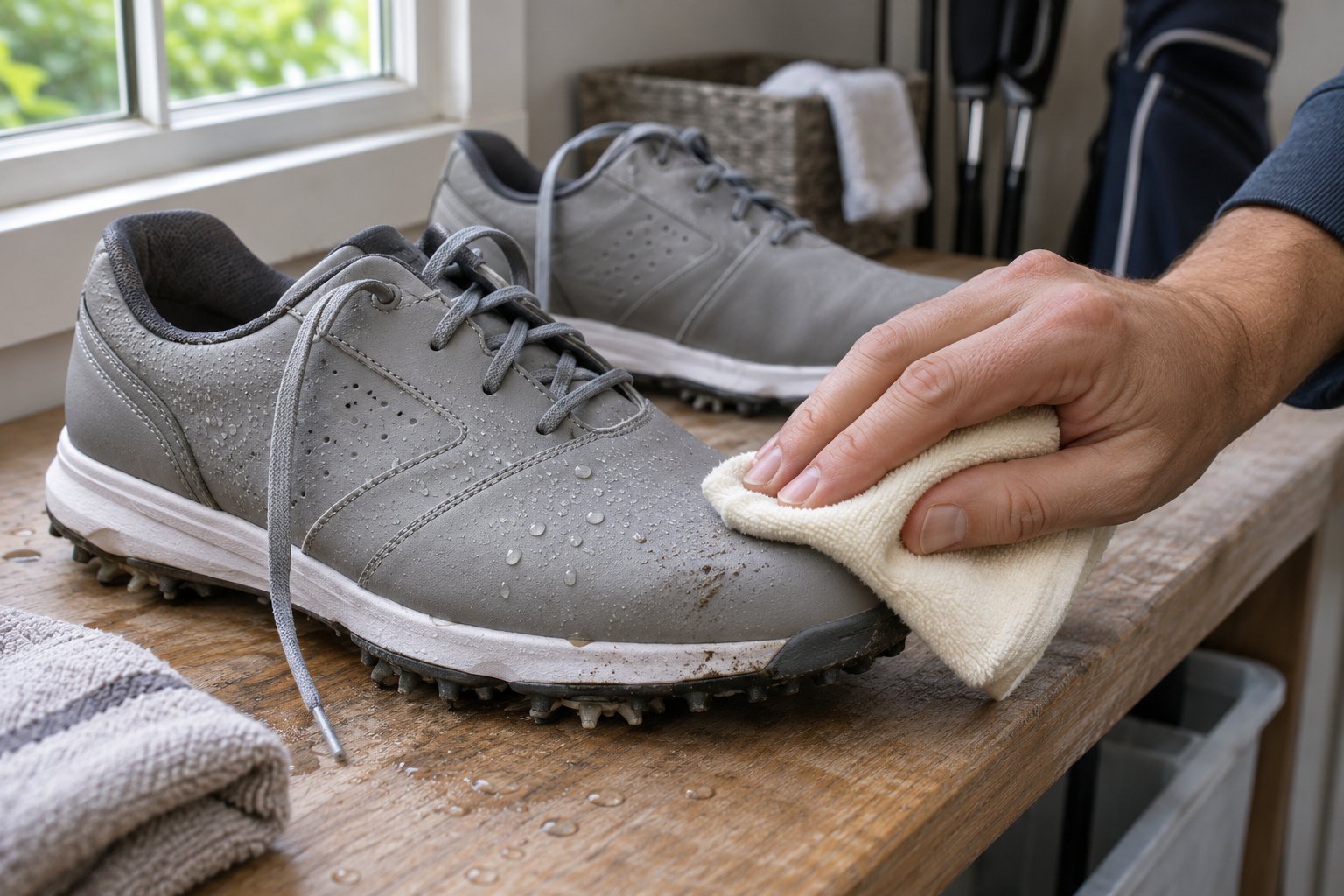
Gore’s footwear guidance calls for gentle cleaning, natural drying at moderate temperatures and avoiding direct heat. When surface beading is lost, it recommends an appropriate water-based repellent treatment and warns against waterproofing waxes or greases that can affect breathability. The footwear maker’s instructions must also be followed. [6]
A treatment step is not proof that an internal leak has been repaired. If you suspect a fault, contact the supplier before applying an unfamiliar product, adding adhesive or altering a seam. Keep a note of the products and drying methods already used so the advice can be specific.
You do not need a new bottle of treatment every time an upper looks damp. First identify the material, the documented care requirement and whether you are dealing with surface wetting or a problem inside the shoe.
Back to top ↑Report a suspected leak with useful facts
Set the shoes aside, clean and dry them only as their instructions permit, and gather the purchase record. A concise description helps more than a conclusion such as “the membrane has gone”.
- Identify the model, style code, seller and purchase date.
- Describe the conditions and approximate time before dampness was noticed.
- Say whether one or both shoes were affected and where moisture first appeared.
- Include clear pictures of the whole shoe and any visible damage.
- Explain the care products, drying methods and any alterations used.
FootJoy directs warranty queries for purchases through authorised retailers to the place of purchase. Its direct-order instructions request the original packing list and a description of the claimed defect. Follow the route for your transaction rather than posting shoes to an address copied from another country’s site. [3]
Wait for the supplier’s assessment instructions before attempting a repair or arranging a return. If the cause is uncertain, leave it uncertain in the record; neither a visual check nor a wet sock alone can establish a hidden manufacturing defect.
Back to top ↑Buy for the conditions you expect to play in
For regular wet-grass or rainy rounds, favour a clearly documented whole-shoe waterproof claim, understandable UK terms and a care routine you can follow. A branded membrane may make the construction easier to research, but it does not replace checking the exact shoe.
For mainly dry-weather use, waterproofing need not outrank every other requirement. Consider fit, traction and how the shoe will be used, without assuming that a longer warranty will improve those separate qualities. The guide to comparing golf shoe sizes between brands can help with the fit decision.
Keep a suitable existing pair when its condition and documented protection still meet your needs. If the evidence is unclear, ask a precise question before paying for a promise you cannot yet interpret.
Back to top ↑Sources and checks
Research and specifications checked on 23 November 2026. Manufacturer descriptions are identified in the text; practical checklists and worked examples are editorial guidance, not product testing.
- GORE-TEX — Membrane, laminate and seam construction — checked 23 November 2026
- GORE-TEX — Testing footwear — checked 23 November 2026
- FootJoy UK — Warranties information — checked 23 November 2026
- FootJoy UK — HyperFlex, style 55489 — checked 23 November 2026
- GORE-TEX — Guarantee and returns, UK page — checked 23 November 2026
- GORE-TEX — Footwear care instructions — checked 23 November 2026
- Skechers UK — GO GOLF Prestige SL, style 214126 — checked 23 November 2026
- GOV.UK — Accepting returns and giving refunds — checked 23 November 2026
- Clubhouse Golf — HyperFlex White/Navy/Green, style 55489 — checked 23 November 2026
Illustrations in this article were created for Taylor’s Trailblazing Golf. Third-party photographs, where used, are credited beside the image or in the source list.


