Golf Bags for Electric Trolleys: Weight Distribution and Access
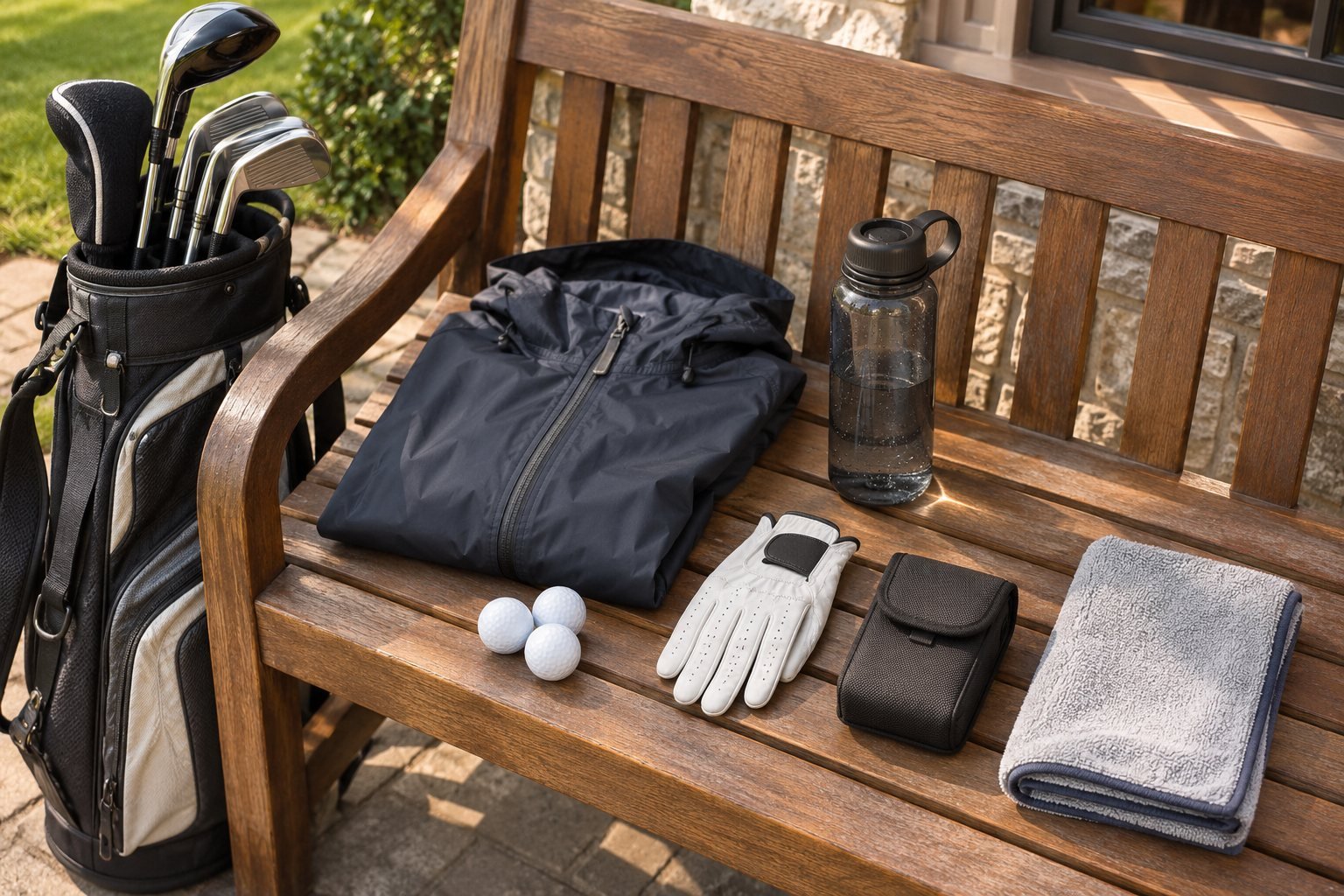
The useful comparison is the bag you take onto the course, with clubs, water and waterproofs inside. Start there before paying for more pockets or a lighter empty shell.
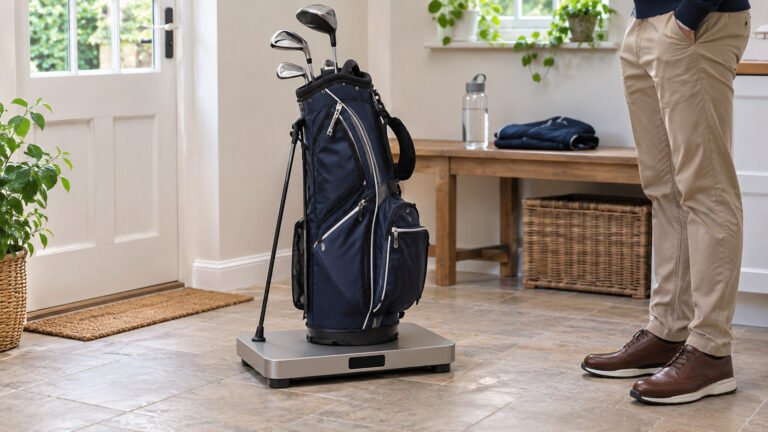
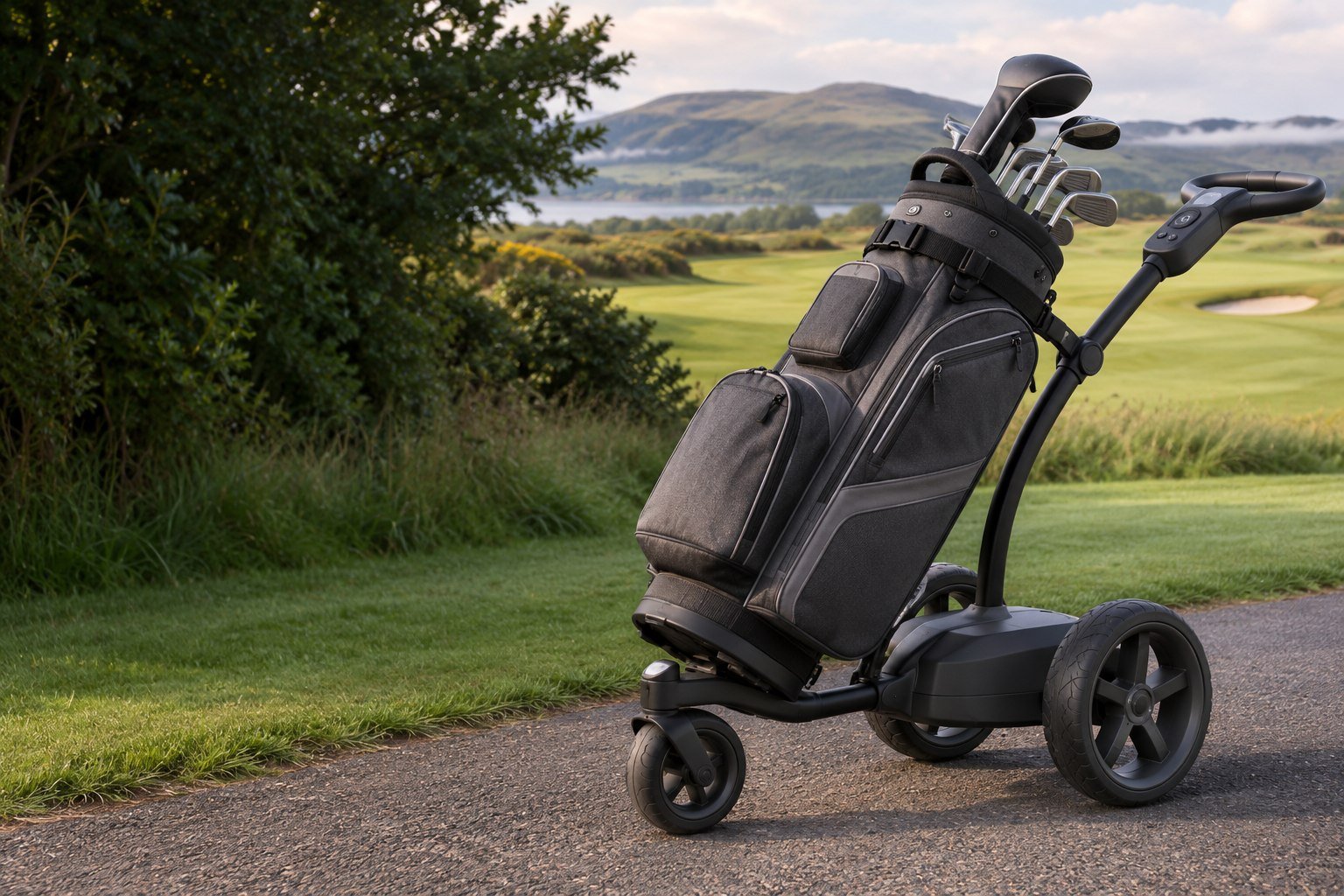
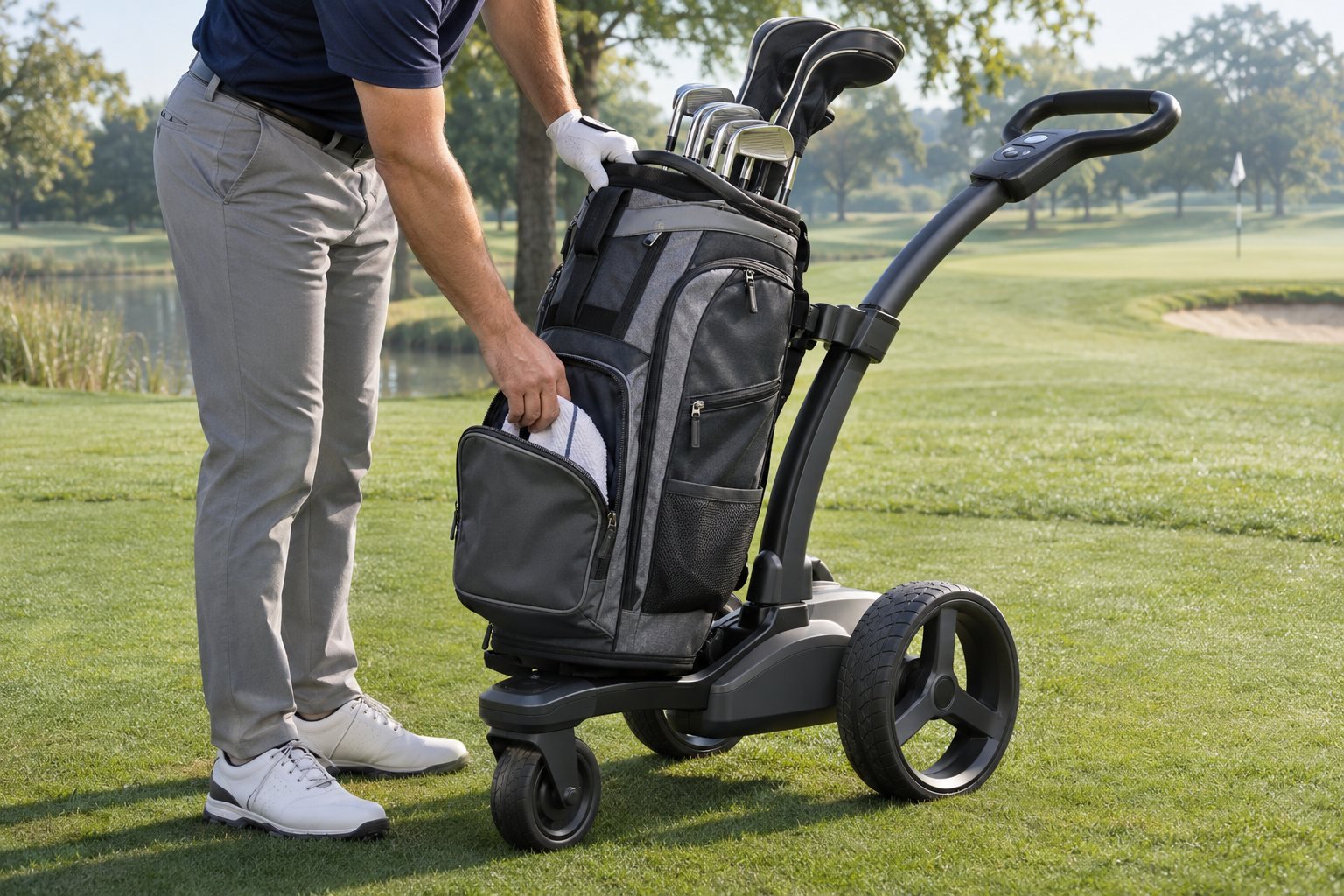
AI illustration of generic equipment. The bag, normal contents and exact trolley form one working setup. No named product or physical test is pictured.
Golf bags for electric trolleys need to work as part of the loaded system. The motor moves the kit, but the golfer still has to pack it sensibly, reach the essentials and lift the bag at either end of the round.
Research-led guidance for UK golfers. Read how we assess golf equipment for the distinction between documented features and hands-on testing.
This guide contains affiliate links. If you buy through them, Taylor’s Trailblazing Golf may receive a commission at no extra cost to you.
Include the clubs, drinks and clothing you really carry.
An optimised bag weight and a maximum rated load are different statements.
Pocket access should work with all required restraints fastened.
Use the trolley’s prescribed mounting and charging arrangements.
Golf bags for electric trolleys: compare the whole load
When comparing golf bags for electric trolleys, the packed weight matters more than the empty-bag figure alone. The empty weight still helps you compare what you will lift into the car. On the course, the trolley carries a larger and more variable load. Your clubs, drinks, spare clothing, balls and accessories all join the calculation. Start by packing a normal round rather than building a shortlist around the lightest published bag figure.
Read the manual for your exact trolley and version before setting a target. The 2026 Motocaddy M1/M1 DHC manual gives a maximum rated load of 20 kg. The 2026 PowaKaddy FX1 manual says its trolley is optimised for a bag weight up to 14 kg and warns that an excessively light or heavy bag affects performance. Those are different statements about different products, not interchangeable limits.[1][2]
On a small screen, swipe inside the table to read every column.
| Exact manual | Published wording, paraphrased | Practical interpretation |
|---|---|---|
| Motocaddy M1/M1 DHC, 2026 | Maximum rated load: 20 kg. | A ceiling for that trolley, not a desirable packing target. |
| PowaKaddy FX1, 2026 REV2 | Optimised for a bag weight up to 14 kg; both extremes affect performance. | Follow that model’s guidance rather than borrowing another maker’s figure. |
These examples were checked on 23 November 2026. For another model, an older generation or a revised manual, find its own instructions. Where the definition of load is unclear, ask the manufacturer what is included; do not silently deduct accessories or assume the published figure refers only to clubs.
A simple weighing method is to use a suitable scale that can safely support the packed bag. Record the result and the contents. Avoid awkward lifts just to obtain a number: a retailer can help if your scale or lifting setup is unsuitable.
Back to the start ↑Build a loading grid around what you actually use
The following grid is an editorial planning aid. It helps identify where your usual items go and whether you can retrieve them. It does not calculate a certified centre of gravity or prove that the trolley is safe on a slope.
On a small screen, swipe inside the table to read every column.
| Contents | Packing question | Access check with bag secured |
|---|---|---|
| Clubs and putter | Does your normal set fit without forcing grips or headcovers together? | Remove and replace the clubs you use most without pulling against the trolley support. |
| Drink and food | Is the bottle secure in its intended compartment, without a conspicuous one-sided bulge? | Can you take it out without reaching through a strap or opening the bag restraint? |
| Waterproofs and warm layer | Is the clothing pocket big enough for the real garments, loosely packed? | Can the jacket be removed and put back while the bag stays properly attached? |
| Balls and small kit | Are you carrying a useful amount rather than every spare you own? | Can you retrieve a ball and repair tool with normal ease? |
| Rangefinder or other valuables | Is each item in a suitable closed pocket, with its own protection where needed? | Can you access it with the trolley stopped, without stretching across controls? |
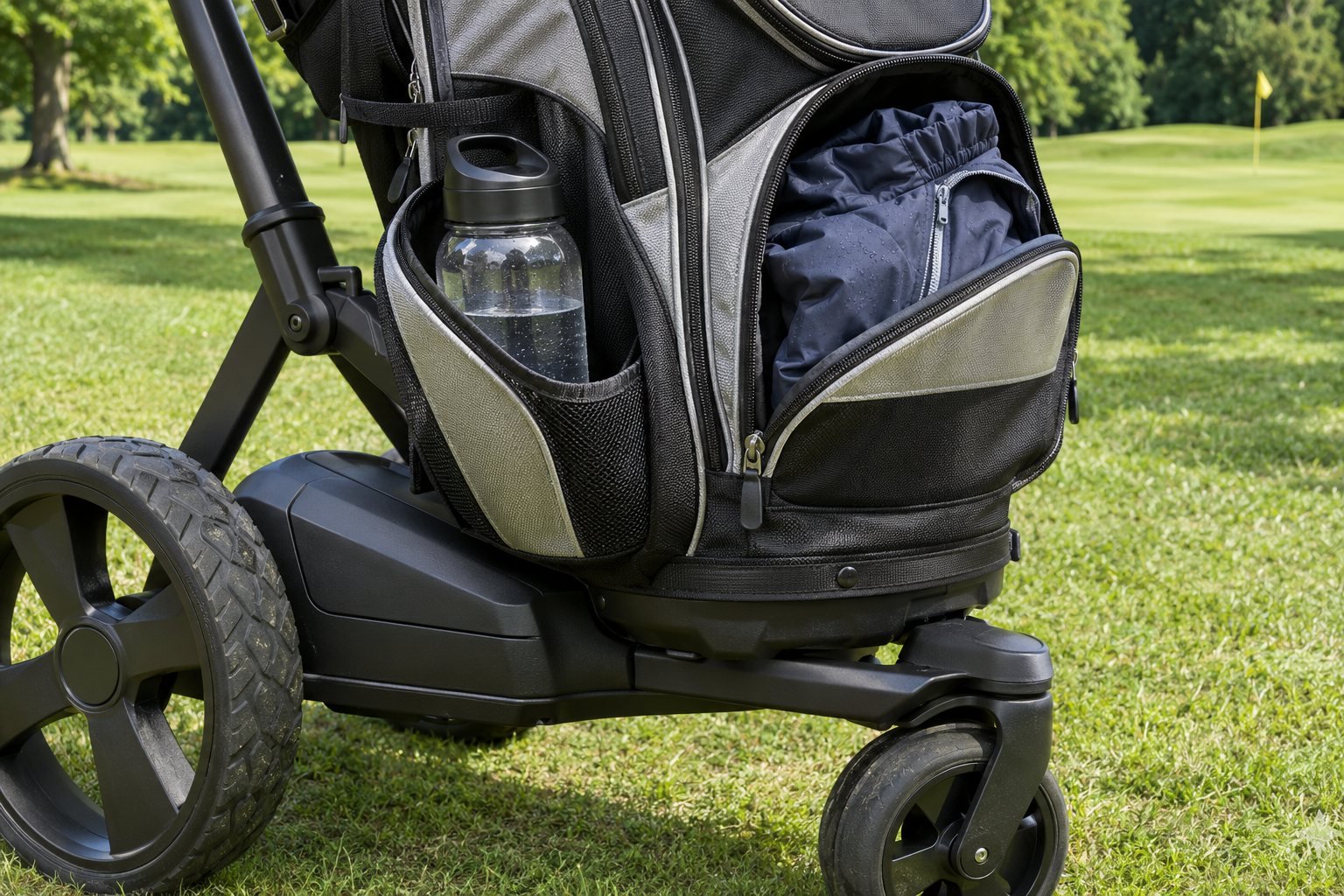
As a practical packing principle, avoid concentrating unnecessary heavy items high up or entirely on one side. Use the compartments as intended, keep the load compact and remove surplus kit before looking for more capacity. This is a sensible starting arrangement, not permission to override a model-specific instruction.
Do not add ballast merely to imitate another player’s bag weight or make the trolley look more settled. If normal, permitted contents leave the equipment behaving oddly, the next step is manufacturer support or a different compatible bag, not extra weight chosen by guesswork.
Back to the start ↑A powered trolley adds a separate handling question
Secure attachment and balanced packing are necessary checks, but they do not settle how a powered trolley behaves. Starting, stopping, steering and travelling over changing ground involve the whole machine. A bag that sits neatly while stationary may still be an inconvenient partner in use.
Motocaddy’s 2026 M7 REMOTE manual specifically notes that bag weight affects speed and steering and that the surface changes turning behaviour. It also identifies the rear anti-tip wheel as required. Those instructions belong to that model; they are not evidence that a heavier bag or any generic accessory will improve another trolley.[3]
Make the first movement check modest
After the static fitting and packing checks, use only the operating method in the manual and a clear, level area. Check normal starts and stops at an appropriate low setting. Stay close enough to operate the prescribed controls. Do not deliberately drive across a slope, over an obstacle or towards a drop to see whether the bag stays put.
For the M7 REMOTE, the manufacturer advises an open grass area for first use and warns against manually steering while the trolley is in remote-control mode. Select the correct manual-control mode before any handle-controlled check.[3]
Watch for a change in how the bag sits, a repeatedly obstructed pocket or an item that migrates towards a moving part. Stop and correct a simple packing issue with the trolley safely switched off as instructed. If the attachment or handling remains uncertain, ask the manufacturer or service agent to inspect it. Passing a short check is useful feedback; it is not proof of stability in every course condition.
Back to the start ↑Choose pockets by frequency and direction of access
Count the pockets only after deciding which ones you need to reach most often. A large rear compartment may be excellent for carrying the bag to the car but inaccessible when it rests against the trolley. A smaller outward-facing pocket can be more useful during the round.
With the bag mounted in its prescribed orientation, try the drink, ball, rangefinder and clothing pockets. Open each normally, take the item out, replace it and close the pocket. The useful question is whether this works with the required restraints still fastened, not whether the zip is visible.
Give the putter and longest clubs their own check
Use your actual clubs if possible. A different grip size or headcover can change the available space. Stand where you would normally retrieve the club, and make sure neither the trolley handle nor a nearby accessory forces an awkward extraction. Do not put your face over the bag top while another person pulls clubs out.
The full-length divider guide deals with the internal channel question in more detail. Here, the priority is access once the bag is inclined and attached to the trolley.
Try the rain hood with the clubs loaded and the straps fastened. A setup that is easy in dry conditions can become awkward if the hood opening faces the frame or catches on an accessory. Check the intended towel and umbrella storage too; nothing loose should trail towards wheels or moving components.
If the trolley has its own suitable holder for a frequently used item, that may solve an access problem without replacing the bag. Use a holder approved for that trolley, and account for it when assessing the overall setup.
Back to the start ↑Protect the prescribed battery space
Inspect the lower bag area with the trolley stationary and switched off as instructed. Confirm that the bag, its pockets and loose straps leave the battery installation and release points usable. Follow the manufacturer’s sequence for fitting or removing the battery and bag; do not force one past the other.
A useful example is Callaway’s 2026 ORG 14 HD: the UK listing includes an electric battery pouch as well as LOWRIDER trolley compatibility. A pouch is a bag feature, not approval to relocate every trolley battery. Cable-free or fixed-tray systems still need their prescribed mounting arrangements.[4]
Do not run extension leads around the bag, adapt battery connectors or move a battery into a pocket simply because it fits. The M1/M1 DHC instructions identify the compatible battery types and limit battery or charger opening and maintenance to authorised personnel.[1]
Keep this decision separate from range. A larger pocket does not extend battery life, and a bag change does not establish a particular number of holes. For a longer day, the published guide to 36-hole trolley battery claims explains the conditions to check.
When comparing bags in a shop, ask to see the battery area with the normal load fitted. You want to know whether routine access works as intended. There is no need to perform electrical work or test charging as part of a bag purchase.
Back to the start ↑Choose between capacity, weather protection and daily lifting
A useful bag choice should solve a named shortcoming. If your present bag fits and the only difficulty is a cluttered pocket, reorganising the contents may be enough. If the support presses against the wrong part of the bag or the main storage remains inaccessible, replacement has a clearer purpose.
The 2026 Motocaddy Club-Series illustrates a relatively light empty cart bag: the manufacturer states 2.6 kg, with upper and lower carry handles and EASILOCK compatibility. Its waterproof rain hood should not be confused with a waterproof bag body; the matched Clubhouse Golf listing identifies the body as non-waterproof.[5][6]
If those characteristics suit your priorities, view the Club-Series Black/Lime at Clubhouse Golf and confirm the exact version and your trolley fit before ordering. It is an example to inspect, not a tested winner.
Where documented wet-weather construction matters more, Callaway lists seam-sealed 10K waterproof fabric for the 2026 ORG 14 HD. Treat that as the maker’s construction claim and check the full product instructions and limitations. View the ORG 14 HD at Callaway UK.[4]
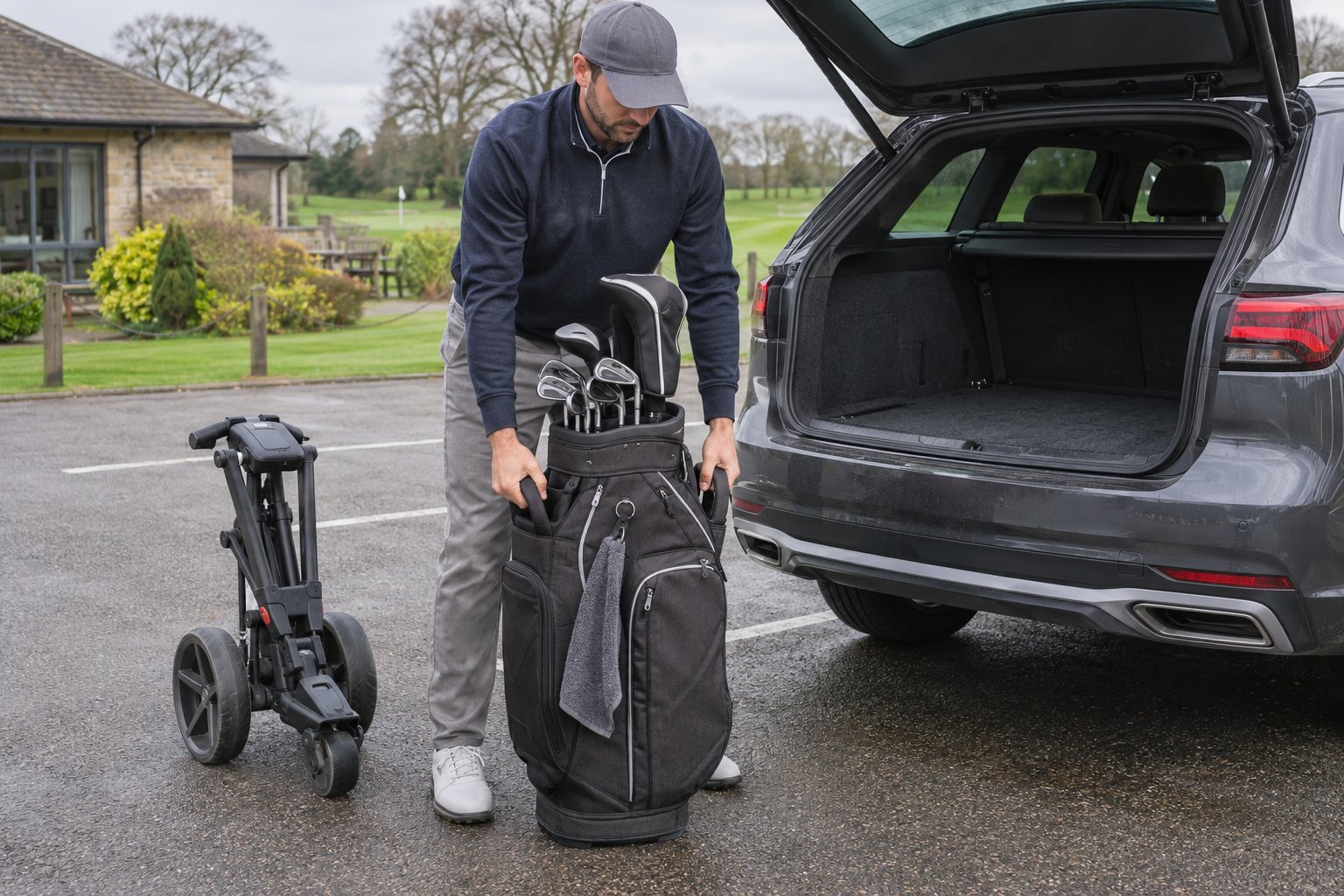
No current price, stock status or cross-brand fit is assumed for either option. Compare the packed bag you will lift, the weather protection you need and the pockets that remain useful on your own trolley. More capacity is worthwhile only if you need the contents and the resulting load remains appropriate.
Before buying a new bag to cure drifting or poor handling, check that the present bag is secured and packed correctly, then follow the trolley’s diagnostic guidance. A worn support or trolley fault may need service; a new bag is not a reliable repair for it.
Back to the start ↑Treat parking and descent features separately from bag choice
The bag does not turn downhill assistance into a parking brake. In the 2026 FX1 manual, PowaKaddy describes optional EBS as assisted braking for descent and explicitly distinguishes it from a full parking brake. Motocaddy’s 2026 M1 manual describes an electronic parking brake for the DHC model only. Check the version you own.[2][1]
Stop in a suitable location before reaching into pockets, secure the trolley by its approved method and keep control as the manual directs. Do not rely on switching the motor off as a universal parking procedure. If conditions make stopping or accessing the bag unsafe, choose a better place rather than reaching while it moves.
Make the final bag decision from four observations: it fits the supports; the actual packed load follows the manual; essential items are accessible; and the battery area and operating controls remain clear. Record any compromise honestly. A slightly less spacious bag that works well in all four respects can be more useful than a larger one that demands repeated adjustments.
Keep the bag you have when it meets those needs. Buy a replacement when it resolves a specific failing that packing or an approved accessory cannot fix. The wider Golf Bags collection can help compare layouts, while the exact trolley manual remains the authority for how the system is used.
Back to the start ↑Questions before you decide
Will a lighter bag give me a predictable number of extra holes?
No. Empty-bag weight alone does not establish battery range. The actual loaded system, trolley and battery specification, terrain and conditions matter. Use the exact manufacturer’s range guidance rather than calculating extra holes from a small weight saving.
Can a stand bag work on an electric trolley?
It can be worth checking if both manufacturers allow the pairing. Confirm that the base and upper support fit, the retracted legs and mechanism do not interfere, and the intended restraints work. The presence of stand legs does not itself establish or rule out compatibility.
Should I choose a bag with a battery pocket?
Only if that compartment suits an explicitly permitted arrangement for your equipment. Many trolleys use a prescribed battery tray or connection. Choose a bag around that system rather than treating a pocket as permission to move or modify it.
Sources and editorial checks
Manufacturer specifications and instructions inform this guide. The comparison and checklists are editorial decision aids, not results of hands-on product testing.
- Motocaddy — 2026 M1/M1 DHC instruction manualPages 4, 6–7 and 23: exact rated load, battery restrictions and DHC-only parking-brake description. Checked 23 November 2026.
- PowaKaddy — 2026 FX1 owners manual, REV2Pages 3 and 7: model-specific loading guidance and EBS distinction from a parking brake. Checked 23 November 2026.
- Motocaddy — 2026 M7 REMOTE instruction manualPages 3–4: required anti-tip wheel, bag-weight and surface effects, operating-mode cautions. Checked 23 November 2026.
- Callaway UK — 2026 ORG 14 HD Cart BagLOWRIDER, electric battery pouch and stated weather-protection construction. No universal fit or battery relocation permission inferred. Checked 23 November 2026.
- Motocaddy UK — 2026 Club-Series bagPublished empty weight, handles, EASILOCK and rain-hood features. Checked 23 November 2026.
- Clubhouse Golf — Club-Series Black/LimeVerified exact UK listing and non-waterproof body classification; no current stock or price claim. Checked 23 November 2026.
Illustrations in this article were created for Taylor’s Trailblazing Golf. Third-party photographs, where used, are credited beside the image or in the source list.