Sunday Golf Bags: What Fits in a Half-Set?
Build a reduced club selection, give the essentials a place and check the complete load before choosing the bag.
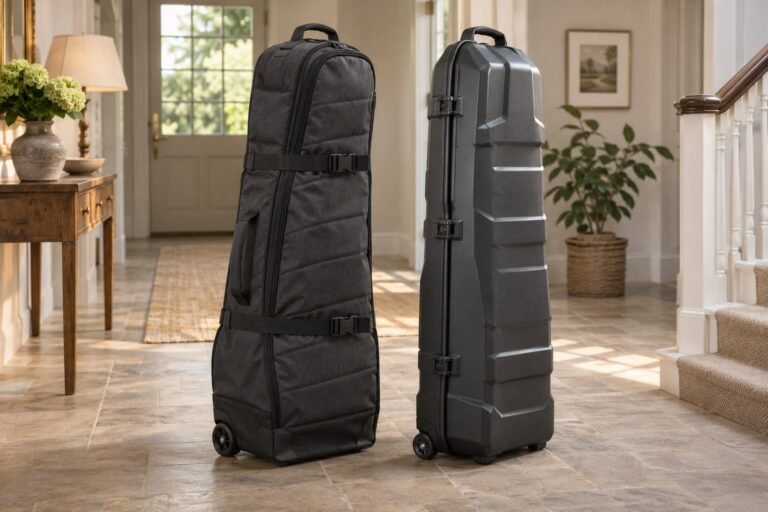
AI illustration of a reduced load. It does not establish a named bag’s club capacity.
Sunday golf bags make most sense when you can name the load you want to carry. “Seven clubs and a few bits” leaves important questions unanswered: which seven clubs, how large are their grips, which headcovers stay on, and where will your drink and jacket go?
Start with the clubs and essentials, then choose a bag that accepts them. This guide uses one seven-club example that you can adapt to your own equipment and course. It does not prescribe a set for your swing or claim that the named bags have been packed or carried by the author.
Here, “half-set” means a deliberate reduced selection. The aim is a complete, usable load for your chosen outing, rather than achieving a particular number at the expense of something you need.
This guide contains affiliate links. If you buy through them, Taylor’s Trailblazing Golf may receive a commission at no extra cost to you.
Use clubs that cover the shots you expect; seven is an example, not a compulsory definition.
Record the largest grip and bulkiest headcover before judging a small bag’s opening.
Allow for your drink, personal essentials and the clothing the outing requires.
If required equipment has no practical home, change the bag or the outing plan.
Build a half-set around useful club roles
Rule 4.1b allows fewer than 14 clubs and sets 14 as the maximum. [1] There is no need to fill a bag simply because it has space. Equally, a smaller bag is a poor reason to leave out a club you know you will need for the planned course.
The following is an illustrative seven-club starting point. The iron numbers are examples, not a recommendation about your distances or loft gaps.
Scroll within the table to see every column.
| Role | Example selection | Question before keeping it |
|---|---|---|
| Tee club — one club | Driver or a fairway wood; choose one. | Which is useful from the tees you intend to play? |
| Long approach — one club | A hybrid or another suitable long club. | Does it provide a distinct role from the tee club? |
| Middle distances — two clubs | For example, a 6-iron and an 8-iron. | Do your own clubs leave gaps you are willing to manage? |
| Short approaches and greenside play — two clubs | For example, pitching wedge and sand wedge. | Do these cover the situations you expect, including bunkers where relevant? |
| Putting — one club | Your usual putter. | Will its actual grip and headcover fit the chosen bag? |
The count is 1 + 1 + 2 + 2 + 1 = 7. Replace the examples with clubs you already know, using your own typical distances and the course layout. Alternating iron numbers is a convenient illustration; it does not prove that the gaps are even.
For a shorter course, you might need fewer long clubs. For another round, an additional approach club may justify an eighth place. Decide that from the outing rather than treating the example as a target. If a six-club version works, write down the role you merged; if it leaves a problem you do not want, retain the club and reconsider the bag.
You can try the proposed selection in your existing bag first. That helps you decide whether the reduced set suits the purpose before paying for smaller storage. It does not test a new bag’s fit or carrying behaviour.

Read top dimensions as a starting point
Record the exact bag and version, its published top measurement and your awkward items. A top-cuff width is a measurement of the cuff as described by the maker; it should not be silently treated as the clear internal opening available to your grips.
For example, Titleist lists a 17.8 cm top-cuff width and 1.2 kg weight for the Premium Carry Bag, model TB23CY1-400. It also specifies mini deployable legs and a double strap. Those details identify the design; they do not establish how many of your clubs will fit. [2]
Use that kind of specification to ask a better question: “Can I check this exact putter grip and these six other clubs in the bag, with their headcovers?” Do not calculate a club allowance by dividing the cuff width by a shaft diameter. Grips, compartment shapes and the route into the bag matter too.
- List the largest grip by model, or measure its widest dimensions if the seller requests them.
- Note headcovers that occupy a large amount of space above the top.
- Include unusual club lengths or a putter shape that affects how the group rests.
- Ask whether the published measurement is an outer dimension or a usable opening, and whether any capacity claim has qualifications.
Keep this focused on your reduced set. If you need to establish what the internal partitions actually do, use the separate guide to checking full-length divider claims. A top count and a club count are different pieces of information.
Add an essentials list before filling pockets
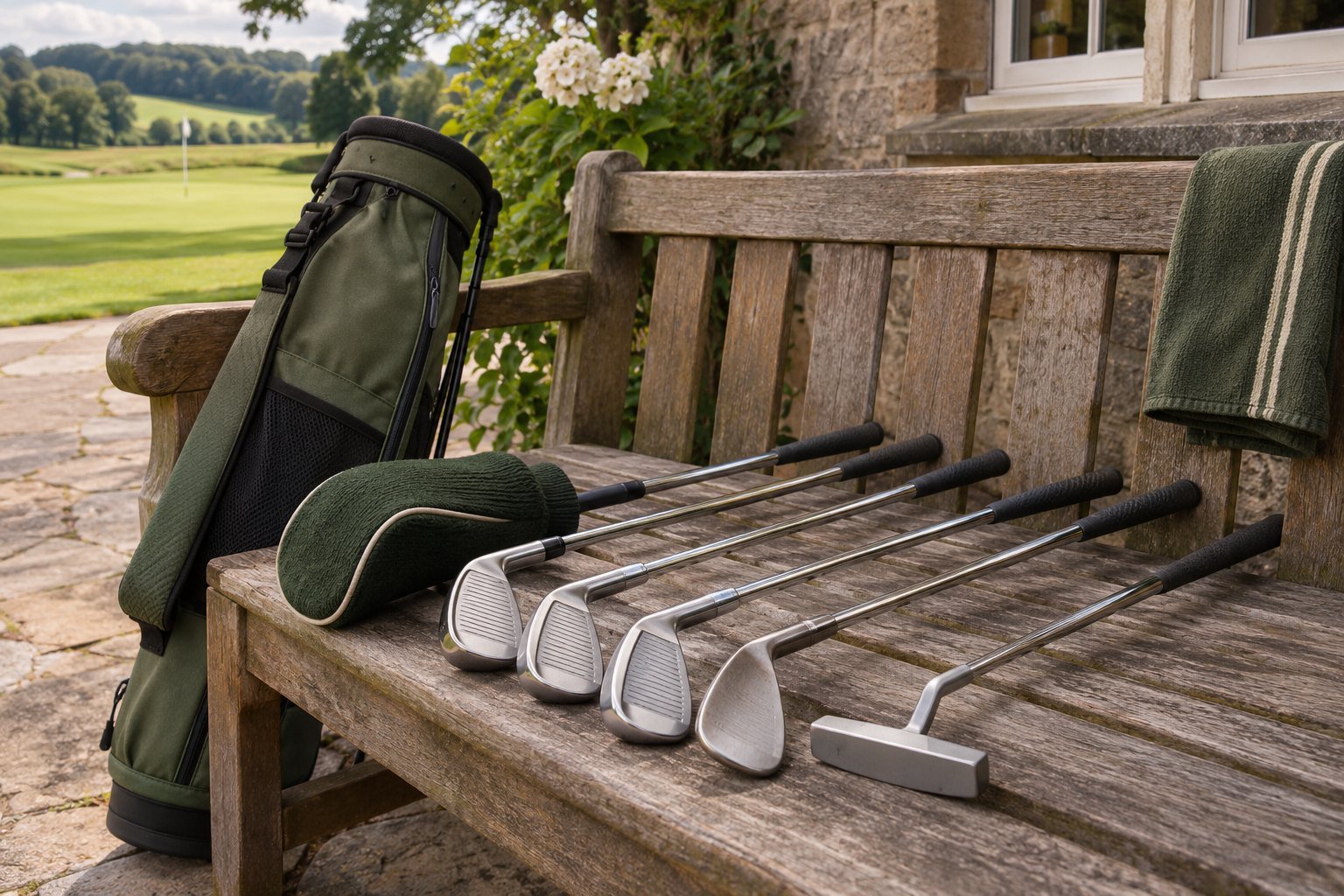
The club selection is only half the packing plan. Build an inventory for the intended duration, forecast, course facilities and your personal requirements. Start with what must accompany you, then see whether the bag accommodates it.
This example is a planning sheet for a short round. Its ball and tee quantities are assumptions to replace, not a universal minimum. The bottle’s contents and any extra drink provision must suit your actual outing.
Scroll within the table to see every column.
| Item or group | Example starting entry | Adapt it for your round |
|---|---|---|
| Clubs and headcovers | Seven selected clubs, plus their usual protective covers. | Write the exact club names beside the role template. |
| Balls | Three balls total, including the one you start with. | Increase the allowance if your course and likely losses call for it. |
| Tees and small tools | Six tees, one ball marker and one pitch-mark repair tool. | Use the sizes and quantities you need; remove accidental duplicates. |
| Glove and towel | One glove and one compact towel. | Add replacements if conditions require them. |
| Drink and food | Your chosen filled bottle; food if needed. | Check the bottle fits with the other pockets occupied. |
| Clothing and rain protection | The layer, protection and any bag hood you need. | Account for both what you wear initially and what may come off. |
| Personal essentials | Keys, phone and anything else you must take. | Keep these in the plan even if the bag is marketed as minimal. |
Count the carried balls correctly. If one is ready for the first tee and two are in the pocket, that is three total, not three spares. Put the intended quantities beside the bag so the exercise includes their actual bulk.
A layer worn at the start may need a home later. Conversely, an empty pocket in warm conditions may be occupied by gloves or clothing on another day. Record those changes instead of assuming one successful dry-day pack covers every round.
Do not make the bag pass by removing required drink, clothing or personal items. If the essentials list is already deliberate, more usable bag space is the appropriate change.
Back to the top ↑Give this exact load a repeatable arrangement
Lay out the chosen seven clubs and their normal covers. For a bag with three usable compartments, an initial planning sketch might put the two longest clubs together, the two irons together, and the two wedges with the putter. Label those groups A, B and C on your own sketch; their physical positions depend on the actual top.
The putter group is the first question to resolve if its grip is large. Move a club between groups only where the bag’s construction allows it. Do not force a grip into a narrowing gap or assume a two/two/three allocation must work. If the putter needs more room, let that determine the arrangement.
Add the essentials from the sheet with the clubs still in place. Give the filled bottle, folded layer and personal items their intended homes; then add the small accessories. The object is to establish whether your complete load fits simultaneously, not to demonstrate that each item can fit on its own.
Record a short acceptance note: “All seven fit; putter returns freely; jacket fits with bottle installed; all closures close normally.” Change any part that is untrue into a precise unresolved question. If taking a wedge requires unloading two neighbours, decide whether that inconvenience is acceptable before buying.
Finish by counting seven clubs again. A simple grouping helps you remember the reduced selection and notice an empty place. Photograph your own packed arrangement if useful, but keep a written inventory too: a picture of clubheads does not show which small essentials are missing.

Choose the support and strap the packing plan needs
Short legs, a full stand or no stand change how you set down a small bag. Look at the exact configuration rather than assuming that a Sunday bag must have one particular arrangement. Check how low the body rests and how accessible your packed clubs and belongings remain.
One candidate with short support legs is the Callaway Par 3 HD Stand Bag ’25, product code ceu246370. Callaway lists a three-way top, micro stand legs and its Anamatic strap system. Its UK page does not give a numerical club capacity or usable top-opening dimensions, so it leaves a real fit question for your set. [3]
If that arrangement suits your shortlist, view the Callaway Par 3 HD Stand Bag ’25 at Callaway UK. Confirm the exact configuration, hood provision and fit of your putter grip before ordering. The product name is not evidence that your seven-club example has been checked in it.
Assess the supplied strap with the intended load. Do not assume a replacement double strap can be added simply because two clips look compatible. For model routing, adjustment and a careful walking assessment, follow the loaded carry-harness guide. This packing plan cannot establish comfort over a round.
Back to the top ↑Adapt the pack when the outing changes
Keep the club-and-essentials list as a baseline, then change only the items affected by the next outing. This makes a useful packing record more durable than a fixed “seven clubs, three balls” shopping rule.
A short-course visit
Replace an unnecessary long club with a useful approach option, or leave that place empty if the reduced selection covers the outing. Recount the set and revise the grouping. Removing the driver may change the headcover crowding, but it does not prove that a larger putter grip will pass through a restricted opening.
A round needing extra weather kit
Add the actual folded clothing and required gloves before deciding whether the bag is suitable. Include where a layer will go after you take it off. If the pack now depends on leaving needed equipment behind, use a larger bag for that day. Check the chosen model’s rain protection separately from its capacity.
A longer outing or an unfamiliar course
Reconsider drink provision, ball allowance and any club role the original selection lacks. Do not assume access to a refill or shop without checking. An eighth club or more supplies may be entirely reasonable, but both change the load that the bag must accept.
These are reasons to revise the plan, not to buy several bags automatically. Your existing larger bag may remain the easiest option for the more demanding outing, while the reduced bag has a clear, narrower purpose.

Use a packing acceptance record before buying
Complete this record for one exact bag and one exact outing. An unanswered question remains unresolved; it should not quietly become a tick.
Scroll within the table to see every column.
| Record | What to write | Decision consequence |
|---|---|---|
| Bag identity | Make, full model, version, product code and supplied strap/support. | Do not transfer a result to another generation or top option. |
| Selected clubs | Exact club list, total count and normal covers. | A change of grip or cover calls for a fresh fit check. |
| Difficult item | Largest grip, bulkiest cover or necessary folded layer. | Resolve that restriction before relying on the headline capacity. |
| Essential inventory | Required quantities, clothing and drink provision. | Missing essentials mean the load has not passed. |
| Packed access | Every selected club and required item has a workable place. | Repeated forced handling or strained closures means revise the pack or bag. |
| Weight and handling | Your actual loaded weight, where available, and outstanding carry-fit questions. | Packing success alone does not establish that carrying suits you. |
| Buying conditions | Seller answers, included accessories and inspection/returns terms. | Clarify these before paying, particularly for an online order. |
The successful choice is the bag that takes your deliberate reduced set and the rest of the day’s kit with a usable arrangement. It need not hold every club you own. It does need to hold everything you have decided this outing requires.
If the selection is still uncertain, keep using your present bag while you refine it. If the selection is settled but the smaller bag is crowded, choose more space. A half-set is a useful packing decision only when the complete load remains practical.
Back to the top ↑Sources and research
Research reviewed on 23 November 2026. Manufacturer descriptions, official guidance and retailer information are distinguished from the original planning worksheets and editorial recommendations in this guide.
- The R&A — Rule 4.1b, club-number limit14-club maximum; checked 23 November 2026.
- Titleist UK — Premium Carry Bag, TB23CY1-400Published cuff width, weight, mini legs and double strap. Checked 23 November 2026.
- Callaway UK — Par 3 HD Stand Bag ’25, ceu246370Three-way top, micro stand legs and named strap system; numerical capacity and usable opening dimensions are not supplied. Checked 23 November 2026.
Find more equipment guidance in Golf Bags.
Illustrations in this article were created for Taylor’s Trailblazing Golf. Third-party photographs, where used, are credited beside the image or in the source list.